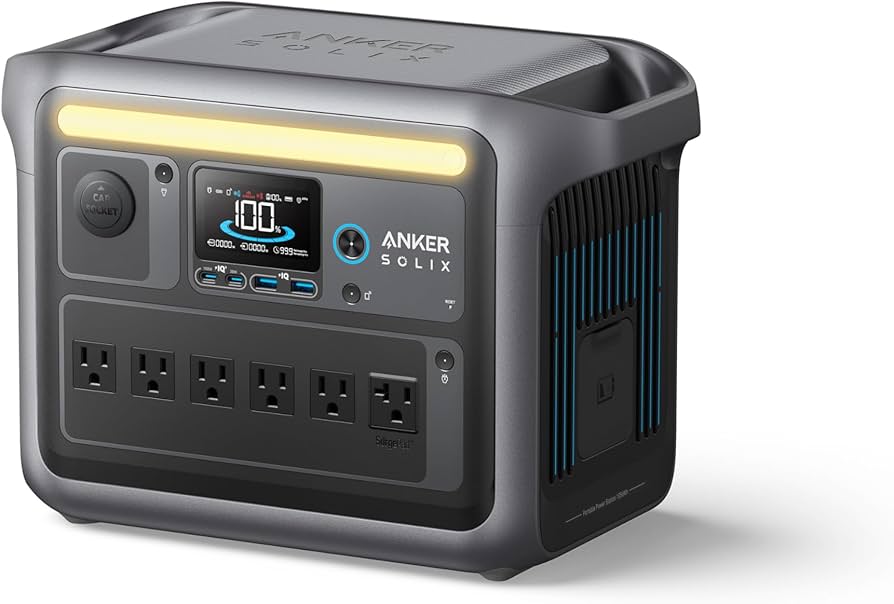
The Anker SOLIX is a high-performance portable power station and LiFePO4 home backup solution designed for users who need a perfect balance of capacity and recharge speed, delivering 768Wh of LiFePO4 capacity and 1200W continuous output. Whether you're looking for a reliable off-grid power source or emergency home backup, the SOLIX stands out for its industrial-grade durability and rapid charging. Combining rapid recharge speeds with industrial-grade durability, it is a premier choice for weekend campers, RV users, and homeowners seeking a reliable short-term backup for critical electronics during power outages.
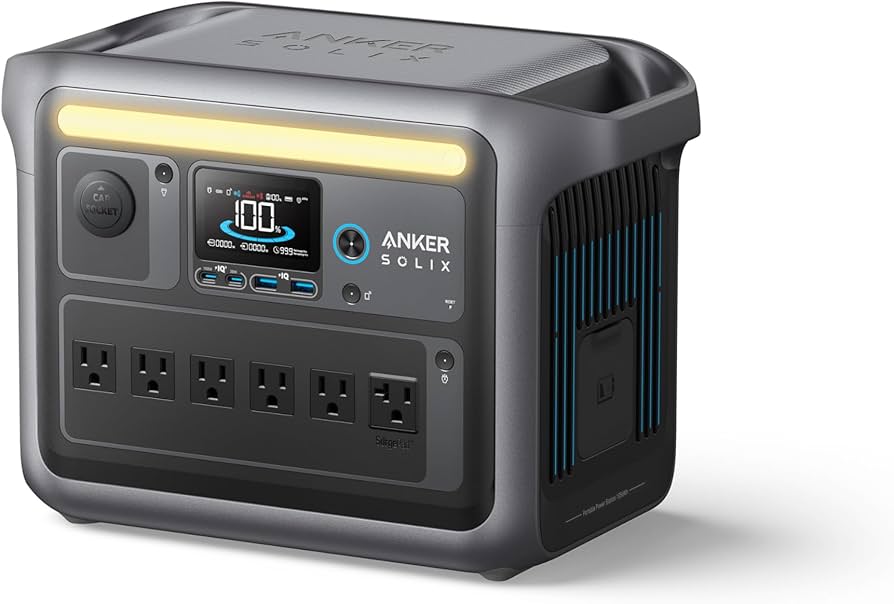
Top Pick: Best Mid-Sized Portable Power
Anker SOLIX - 9.2/10. Exceptional charging speed and LFP longevity make this the gold standard for 800Wh-class power stations.
Anker SOLIX
The Anker SOLIX represents a strategic balance between portability and power.
Check out the Anker SOLIX for high-speed portable power.
Unlike massive home-backup batteries that require permanent installation, the SOLIX is designed for mobility. It utilizes an advanced Lithium Iron Phosphate (LiFePO4) battery chemistry, which is significantly safer and more durable than the Nickel Manganese Cobalt (NMC) batteries found in older or cheaper portable units. For the average user, this means the device can be charged and discharged thousands of times before seeing a meaningful drop in capacity.At the heart of the SOLIX is a high-efficiency inverter capable of producing 1200W of continuous AC power. This is sufficient for the vast majority of small household appliances, including coffee makers, electric kettles, and power tools. The unit is particularly impressive in its recharge capabilities; utilizing a high-wattage AC wall input, it can reach a full charge in under an hour, removing the "charging anxiety" often associated with larger capacity batteries.
For those integrating the SOLIX into a home emergency plan (which often includes a comprehensive home security setup) or smart monitoring like the Arlo Pro 4), the UPS (Uninterruptible Power Supply) mode is a standout feature. By keeping the unit plugged into a wall outlet and your critical devices plugged into the SOLIX, the unit acts as a bridge. If the grid fails, the SOLIX switches to battery power in roughly 20 milliseconds, ensuring that routers, desktop PCs, and medical equipment like CPAP machines do not reboot. For those building a full-scale backup system, combining this with a Wayne ESP25 battery backup (see our guide on the best submersible utility pumps for overall drainage) and a professional security system ensures total home resilience. For those securing their basements, pairing this with a reliable battery backup sump pump or reviewing our buying guide for wet basements ensures critical drainage remains active during the same outage.
| Specification | Details (Model A1753111) |
|---|---|
| Capacity | 768Wh LiFePO4 |
| AC Output | 1200W Continuous / 1600W Surge |
| Charging Time (AC) | ~58 Minutes |
| Solar Input | Up to 300W (XT-60) |
| Cycle Life | 3,000 cycles to 80% capacity |
| Weight | ~24.7 lbs (11.2 kg) |
| Connectivity | Wi-Fi / Bluetooth App Control |
Strengths
- Industry-leading AC recharge speed
- Safe, long-lasting LiFePO4 battery cells
- Compact form factor for easy transport
- Integrated multi-mode LED light bar
- Fast 20ms UPS switchover time
Trade-offs
- Fixed capacity (no expansion ports
- Solar input capped at 300W
- Fans become audible under heavy AC loads
- Lacks integrated wireless charging
Note: Pricing and availability for the Anker SOLIX may vary by retailer. We may earn a commission from qualifying purchases made through links in this guide.
Deep Dive: How the Anker SOLIX Works
To understand why the Anker SOLIX performs differently than a standard power bank, one must look at the internal power conversion process. The SOLIX doesn't just store electricity; it manages the transformation of DC (Direct Current) energy into AC (Alternating Current) via a pure sine wave inverter. A pure sine wave is critical because it mimics the power coming out of a wall outlet, preventing "electronic noise" that can damage sensitive equipment like laptops, CPAP machines, or high-end audio gear. Cheaper units often use "modified sine waves," which can cause motors to run hot or screens to flicker.
The Battery Management System (BMS) is the "brain" of the SOLIX. It constantly monitors the voltage of individual cells to prevent overcharging or deep discharging. This is why the unit is rated for 3,000 cycles. While a standard lithium battery might fail after 500 cycles, the LFP chemistry used here allows for nearly a decade of daily use. The BMS also regulates the temperature, ramping up the internal fans only when the cells or the inverter reach a specific thermal threshold, which helps preserve the chemical integrity of the battery.
When charging via solar, the SOLIX uses an MPPT (Maximum Power Point Tracking) controller. This technology optimizes the voltage coming from the solar panels to ensure the battery receives the maximum amount of energy possible regardless of cloud cover or panel angle. While the 300W cap is a limitation for some, for most users, a 200W-300W array is the practical limit before the physical size of the panels becomes too cumbersome for portable use.
The internal wiring is designed for high thermal efficiency. Heat is the enemy of lithium batteries; thus, the SOLIX incorporates aluminum heat sinks and targeted airflow paths. When you run a high-wattage device like a hair dryer or coffee maker, the fans will kick in to move heat away from the inverter and the battery cells, preventing thermal throttling—a common issue in smaller, less robust power stations where the device shuts down simply because it cannot shed heat fast enough.
Comprehensive Buyer's Guide: Is This the Right Capacity?
One of the most common mistakes buyers make is choosing a power station based on the "Wattage" rather than the "Watt-hours (Wh)." Wattage is the speed of delivery (how much power it can push at once), while Watt-hours is the fuel tank (how long that power lasts). The Anker SOLIX has a 768Wh tank and can push 1200W.
Calculation Tip: To estimate runtime, divide the total capacity (768Wh) by the device wattage. For example: 768Wh / 60W (Mini Fridge) = 12.8 hours. (Note: Real-world efficiency is usually around 85%, so multiply your result by 0.85 to get a realistic estimate).
Comparing Use-Case Scenarios
The Weekend Camper: If you are running a 12V portable fridge, charging two smartphones, and powering a few LED camp lights, the SOLIX is ideal. It can typically sustain these loads for 48-72 hours, especially if supplemented with a 100W solar panel during the day. The weight is manageable enough to move from a vehicle to a picnic table without significant strain.
The Remote Professional: For those working from a van or a remote cabin (where maintaining air quality with a high-efficiency air filter is key), a laptop (60W), a mini-split heater for climate control, and a 24-inch monitor (30W) combined with a Wi-Fi router (10W) draw roughly 100W per hour. The SOLIX provides roughly 6-7 hours of focused work on a single charge, making it a perfect "day-trip" power source. For those building a high-end home office or studio, we also recommend checking out our GE Profile PHP9036DJBB review for the rest of your kitchen upgrade. Because of the pure sine wave output, there is no risk of damaging expensive professional hardware. If you are managing power for a larger home system, you might also find our guide to AFCI breakers for home circuit safety useful for ensuring overall circuit safety.
The Emergency Backup: In a blackout, the SOLIX can keep your internet active and a few lamps lit for several days if used sparingly. For those needing specialized backup for basement utilities, our Wayne ESP25 buying guide is a great companion, similar to the strategies found in our buying guide for wet basements to this power station. For those managing flood-prone basements (see our Ridgid SP-650C review or our guide to the best submersible utility pumps or the Basement Watchdog BW1033) ) (which may also require a high-capacity dehumidifier), pairing portable power with a reliable battery backup sump pump is a critical part of a complete home emergency strategy. For a broader look at water management, see our comprehensive guide on the best submersible utility pumps for draining water fast or explore our Ridgid SP-650C review for high-performance drainage. However, it cannot run high-heat appliances like space heaters, electric ovens, or heavy-duty appliances (which is why we recommend our guide to the best submersible utility pumps for high-draw emergency drainage), which often exceed 1500W and would trip the internal circuit breaker (for more on home electrical safety, see our guide on how to replace a circuit breaker safely or compare Square D vs Eaton circuit breakers.).
Understanding the LFP Advantage
Many users are tempted by cheaper units that offer higher Wh for lower prices. These typically use NMC (Nickel Manganese Cobalt) cells. While NMC is denser (lighter for the same capacity), it is chemically less stable. LFP (Lithium Iron Phosphate) cells, like those in the SOLIX or the Anker PowerHouse 757 Portable Power Station, are virtually immune to "thermal runaway" (fire risk) and can be cycled 3,000+ times compared to the 500-800 cycles of NMC. If you plan on using this device weekly for the next five years, LFP is the only viable choice.
Step-by-Step Setup and Optimization
Setting up the Anker SOLIX is straightforward, but a few optimization steps can either double your battery life or significantly improve your experience during an emergency.
- Initial Charge: Always charge the unit to 100% before the first use. This calibrates the BMS and ensures the percentage display is accurate. If you start with a partial charge, the "time remaining" estimate may be erratic for the first few cycles.
- App Integration: Download the Anker app and pair the unit via Bluetooth/Wi-Fi. From the app, you can set "Charging Speed" limits. If you aren't in a rush, lowering the AC charge speed reduces heat and can technically extend the battery's chemical lifespan further.
- UPS Configuration: If using as a backup, plug the SOLIX into the wall, then plug your surge protector or devices into the AC outlets of the SOLIX. Ensure the "UPS Mode" is toggled on in the settings. This creates a seamless power bridge that protects your hardware from power spikes.
- Solar Array Placement: When using solar panels, place them facing South (in the Northern Hemisphere) at a 45-degree angle. Use the XT-60 port for the most efficient energy transfer. Avoid placing panels on grass if possible, as the ground can act as a heat sink, lowering the panel efficiency.
Long-Term Maintenance and Battery Health
While LiFePO4 batteries are rugged, they are not maintenance-free. To ensure your SOLIX lasts the promised 10+ years, follow these storage and care guidelines:
The 50% Rule: If you are storing the unit for more than three months, do not store it at 0% or 100%. The ideal storage voltage for lithium batteries is between 40% and 60%. Storing a battery at 100% for months can cause "voltage stress," while 0% can lead to "deep discharge," where the battery becomes unable to take a charge again.
Temperature Management
Avoid using the unit in extreme heat (above 113°F / 45°C) or extreme cold (below 14°F / -10°C). While the unit has internal protections, charging in freezing temperatures can cause permanent cell damage because lithium ions cannot move effectively through the electrolyte when frozen. If the unit has been in a cold car, let it warm up to room temperature for 2 hours before plugging it into a charger.
Physical Care and Port Cleaning
Because this is often used outdoors, dust, sand, and grit can enter the USB-C and AC ports. Periodically use a can of compressed air to clear these ports. Grit in a USB-C port can cause poor contact, leading to slower charging speeds or intermittent connectivity. Never use a metal needle to clean ports, as this can short out the pins; use a soft plastic toothpick or air.
Anker SOLIX vs. The Competition
| Feature | Anker SOLIX (A1753111) | Generic 700Wh Units | High-End Expandable Units |
|---|---|---|---|
| Battery Type | LiFePO4 (LFP) | Often NMC/Lithium-Ion | LiFePO4 (LFP) |
| Cycle Life | 3,000+ Cycles | 500 - 800 Cycles | 3,000+ Cycles |
| Charge Time | < 1 Hour | 3 - 6 Hours | 1 - 2 Hours |
| Expandability | None | None | High (Extra Batteries) |
| Weight | Moderate (~24 lbs) | Heavy/Bulky | Very Heavy |
When compared to the broader market, the SOLIX wins on speed and reliability. Many competitors, such as the EcoFlow Delta 2 Portable Power Station (or the higher-capacity Delta 2 Max) or Jackery Explorer 1000 Portable Power Station models in the 700-800Wh range, still use older NMC chemistry, which degrades significantly after just two years of heavy use. The SOLIX's use of LFP is a major value-add for anyone looking for a long-term investment.
The only area where it loses to "Pro" level stations is the lack of an expansion port. If you realize you nee