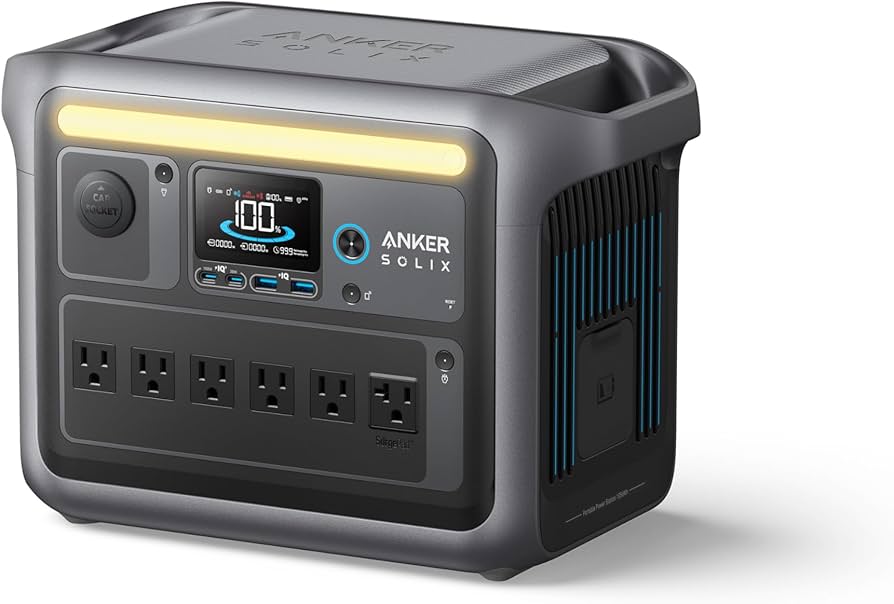
When the grid goes down, you need a reliable battery backup system that is quiet, safe for indoor use, and ready for immediate deployment. The Anker SOLIX promises exactly that: a high-capacity lithium battery with fast solar charging and enough output ports to keep your essentials alive. This guide breaks down who it's for, what it does well, and where it falls short.
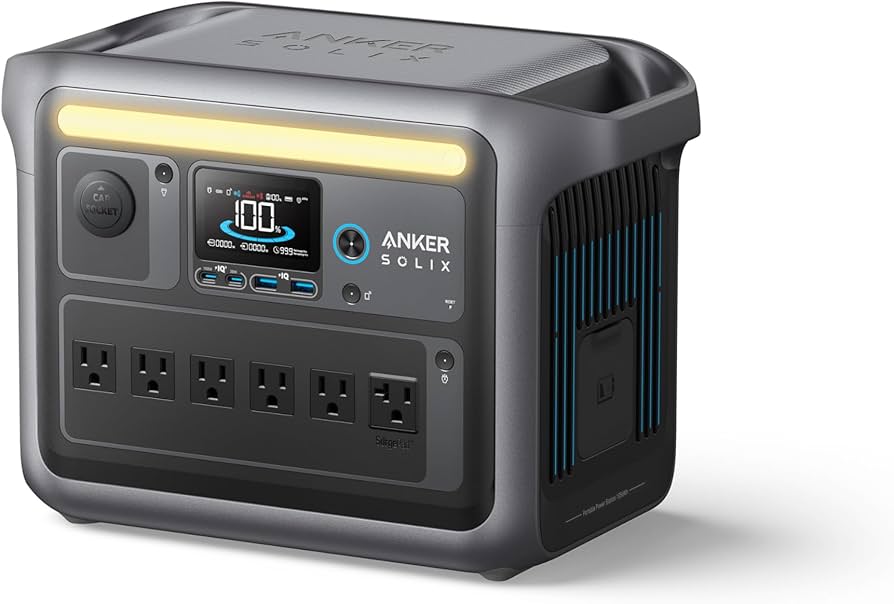
Top Pick: Anker SOLIX Portable Power Station
Score: 9.0/10 — Best overall for home backup and off-grid power. A versatile, quiet alternative to gas generators with multiple charging methods and a robust lithium battery.
TL;DR: The Anker SOLIX Portable Power Station is a strong choice if you want emergency preparedness and outdoor power in one unit. It charges from solar, AC wall, or your car, runs silently, and powers essential devices and appliances without fumes or noise.
Anker SOLIX Portable Power Station
The Anker SOLIX Portable Power Station (Model A1753111) is built around a high-capacity lithium battery designed to keep essential home devices and appliances running through outages or extended off-grid trips. It's positioned as a do-everything backup unit: dependable enough for emergency preparedness, yet portable and quiet enough for camping and remote work. Unlike traditional generators or slightly different portable options like the EcoFlow Delta 2 or the Delta 2 Max, the SOLIX utilizes advanced battery chemistry to store electricity, which it then converts via an internal inverter to provide the AC power your home appliances require.
Charging flexibility is its standout trait. The SOLIX supports fast solar charging, standard AC wall input, and car charging, so you're never tied to a single power source. If the grid is out for days, solar panels can keep it topped up; if you're on the road, the car charger bridges the gap between stops. This triple-threat charging ecosystem ensures that the unit remains a viable power source regardless of your environment, whether you are in a suburban living room or a remote forest clearing.
Output-wise, the unit offers multiple ports to run several devices at once—think refrigerators, CPAP machines, phones, laptops, and lights. Because it relies on a battery rather than combustion, there are no fumes and almost no noise, making it safe to operate indoors where a gas generator never could be. This makes it an ideal choice for those with medical devices that require constant power or for families who want to maintain a sense of normalcy during a blackout without the logistical nightmare of storing and pouring gasoline.
Who it's for: Homeowners building an emergency kit (which often includes a reliable home security system) (consider adding a Wayne ESP25 battery backup sump pump (see our guide to the best submersible utility pumps) for basement protection), campers and van-lifers who need silent power, and anyone who wants a low-maintenance alternative to a gas generator. For those needing something even more compact, the Anker PowerHouse 757 Portable Power Station is an excellent entry-level option. If your priority is whole-home, multi-day high-draw backup, pair it with solar panels or confirm capacity fits your load before buying. For those who need a massive industrial-scale array, you might also consider mid-range options like the Jackery Explorer 1000 or the Bluetti Portable Power Station, or for larger ecosystems, the EcoFlow DELTA Pro 3 or Jackery Explorer 2000 Plus, but for the average consumer, the SOLIX hits the sweet spot of portability and power.
| Specification | Detail |
|---|---|
| Model Number | A1753111 |
| Category | Generators & Backup Power |
| Battery type | Lithium |
| Charging inputs | Fast solar, AC wall, car |
| Output ports | Multiple (AC/USB/car) |
| Operation | Quiet, fume-free |
| Best use | Emergency backup & off-grid power |
Pros
- Three charging methods: solar, AC wall, and car
- High-capacity lithium battery for essential appliances
- Quiet, fume-free operation safe for indoor use
- Multiple output ports for simultaneous devices
- Versatile for both home backup and outdoor use
Cons
- Solar panels typically sold separately for fastest charging
- Heavier than compact power banks
- High-draw appliance runtime depends on your specific load
Understanding Portable Power: How it Works
To understand the value of the Anker SOLIX, it is important to understand how a portable power station differs from a "power bank" or a "gas generator." A power bank is essentially a large battery for small electronics. A gas generator creates electricity via a combustion engine. The Anker SOLIX is a hybrid of these concepts: it is a high-capacity battery with a built-in inverter.
The inverter is the critical component. Batteries store power as Direct Current (DC), but most home appliances (like a toaster or a lamp) require Alternating Current (AC). The SOLIX converts the stored DC energy into AC energy, allowing you to plug in a standard three-prong wall plug. This process is silent and emission-free, which is why these units are designated as "indoor-safe."
When considering "Capacity" (measured in Watt-hours or Wh), think of this as the size of your fuel tank. If you have a 1000Wh battery and you run a 100W device, it will theoretically last 10 hours. When considering "Output" (measured in Watts), think of this as the size of the pipe. If a device requires 1500W to start (like a large microwave), but your station only outputs 1000W, the device will not turn on, regardless of how much battery percentage you have left.
Comprehensive Buyer's Guide: Selecting the Right Backup Power
1. Assessing Your Power Needs
Before investing in a unit like the Anker SOLIX, you must conduct a "power audit." Not all appliances are created equal. Low-draw devices (LED lamps, phone chargers, Wi-Fi routers) can run for days on a single charge. High-draw devices (space heaters, hair dryers, coffee makers) can drain a battery in minutes.
Create a list of "Must-Haves" versus "Nice-to-Haves." For example, keeping a refrigerator running during a 4-hour outage is a high priority, while running a gaming console is a luxury. Calculate the total wattage of your must-haves to ensure the SOLIX capacity matches your emergency window.
Check the stickers on the back or bottom of your appliances. Look for the "W" (Watts) or "A" (Amps) and "V" (Volts). If you only see Amps and Volts, multiply them (Amps x Volts = Watts) to find the power draw.
2. Evaluating Charging Methods
The utility of a power station is only as good as your ability to recharge it. The Anker SOLIX offers three primary paths:
- AC Wall Charging: The fastest way to top off the unit. This is used while the grid is active so the unit is ready for when the grid fails.
- Car Charging (DC): Ideal for those traveling or using the unit for "van life." It allows you to recharge while driving between destinations.
- Solar Charging: The gold standard for true independence. By pairing the unit with solar panels, you transform the SOLIX from a temporary battery into a sustainable power plant.
3. Battery Chemistry and Longevity
Modern stations like the SOLIX utilize advanced lithium chemistries. Unlike older lead-acid batteries found in some cheap generators, lithium batteries offer a higher energy density (more power in a smaller box) and a significantly longer cycle life. This means you can charge and discharge the unit hundreds of times before the total capacity begins to degrade significantly.
When comparing lithium-ion (Li-ion) vs lithium iron phosphate (LiFePO4), the latter generally offers more cycles (longevity) but is slightly heavier. High-capacity units like the SOLIX are engineered to balance this weight-to-power ratio, ensuring you have a machine that survives years of intermittent use without losing its ability to hold a charge.
Setup and Optimization Guide
Setting up the Anker SOLIX is straightforward, but a few optimization steps can extend the life of your unit and the safety of your home.
To maximize battery health, avoid leaving your power station at 0% or 100% for months at a time. Store it at roughly 50-80% charge and top it off every 3-6 months.
Initial Deployment
Upon unboxing, perform a full charge using the AC wall input. This calibrates the battery management system (BMS), ensuring the percentage display is accurate. Place the unit in a well-ventilated area. While it doesn't produce fumes, the internal fans will kick on during high-draw use to prevent overheating; blocking these vents can lead to thermal throttling and reduced performance.
Integrating Solar Panels
If you have purchased separate solar panels, such as the Jackery SolarSaga 200W Foldable Bifacial Portable Solar Panel, place them where they receive the most direct, perpendicular sunlight. Even a slight angle can reduce efficiency by 20%. Use the dedicated solar input on the SOLIX and monitor the input wattage on the display to ensure you are hitting peak charging speeds. Avoid placing panels behind tinted glass or under thin shade cloths, as the voltage drop can prevent the SOLIX from triggering the charging cycle.
Maintenance and Long-Term Care
Unlike gas generators, which require oil changes, spark plug replacements, and fuel stabilizers, the Anker SOLIX is virtually maintenance-free. However, a few key habits will ensure it lasts a decade rather than a few years.
- Dust Removal: Periodically use compressed air to blow dust out of the cooling vents and ports. (Maintaining air quality is similarly vital for your home's HVAC; see our review of the Filtrete MERV-12 air filter for a look at high-efficiency filtration). Dust buildup can cause the fans to work harder, increasing noise and heat.
- Port Inspection: Ensure the AC and USB ports are free of debris. A bent pin or a piece of lint in a USB-C port can cause charging failures or short circuits.
- Firmware Updates: Check if the SOLIX supports app-based updates. Manufacturers often release firmware that optimizes charging speeds or improves battery efficiency.
- Temperature Management: Avoid storing the unit in a freezing garage or a boiling hot car. Extreme temperatures can chemically damage the lithium cells, leading to permanent capacity loss.
Common Pitfalls to Avoid
Critical Safety Warning: Never attempt to "backfeed" a portable power station directly into your home's electrical panel. This is extremely dangerous and can energize dead lines, potentially killing utility workers or causing a house fire. Only plug devices directly into the station's ports.
Many new users make the mistake of assuming a "high capacity" battery can power a whole house. While the SOLIX can run a fridge or a few lights, it cannot power a central AC unit or a heavy-duty electric oven. Always check the Surge Wattage of your appliance. Some devices require 3x their running wattage just to start the motor; if this surge exceeds the SOLIX's limits, the safety breaker will trip.
Another common error is ignoring the "Depth of Discharge." While you can run the battery down to 0%, doing so frequently can stress the cells. Try to keep your usage between 20% and 80% for the longest possible lifespan. This range is widely recognized in battery science as the "sweet spot" for lithium cell stability.
Side-by-Side Comparison
| Feature | Anker SOLIX Portable Power Station |
|---|---|
| Model | A1753111 |
| Battery | Lithium, high-capacity |
| Solar charging | Yes (fast) |
| AC wall charging | Yes |
| Car charging | Yes |
| Noise Level | Quiet |
| Indoor safe | Yes (no fumes) |
| Best for | Emergency + off-grid power |
How We Chose
We evaluate portable power stations based on a rigorous set of criteria focusing on capacity, charging flexibility, port selection, noise, and real-world suitability for both home backup and outdoor use. We prioritize units that operate safely indoors without fumes and that offer more than one way to recharge, as reliance on a single charging method is a failure point during a true disaster.
The Anker SOLIX scored well across all of these criteria, particularly for its triple charging support and quiet lithium operation. Our assessment includes checking the reliability of the inverter to ensure it produces a "Pure Sine Wave" output, which is essential for sensitive electronics like laptops and medical equipment. Cheaper units often use "Modified Sine Waves" that can damage fragile circuitry over time.
Final Verdict
The Anker SOLIX Portable Power Station is a top-tier investment for anyone prioritizing safety, silence, and versatility. Its high-capacity lithium core and diverse charging options make it a reliable safety net for modern homes and a powerful companion for outdoor adventures.
Can I run my refrigerator on the Anker SOLIX?
Yes, but the runtime depends on the size and efficiency of your refrigerator. Most modern ENERGY STAR refrigerators can run for several hours to a day depending on the total capacity of the SOLIX unit. Be mindful of the "startup surge" when the fridge compressor kicks in.
How long does it take to charge from solar?
Solar charging times vary based on the wattage of your panels and the intensity of the sunlight. Using high-efficiency fast solar panels, the SOLIX is designed to recharge significantly faster than standard panels, though direct sunlight is required for peak speeds.
Is the Anker SOLIX safe to keep in a bedroom?
Absolutely. Unlike gas generators, the SOLIX produces no carbon monoxide and no fumes. It is completely safe for indoor use, making it ideal for powering CPAP machines o