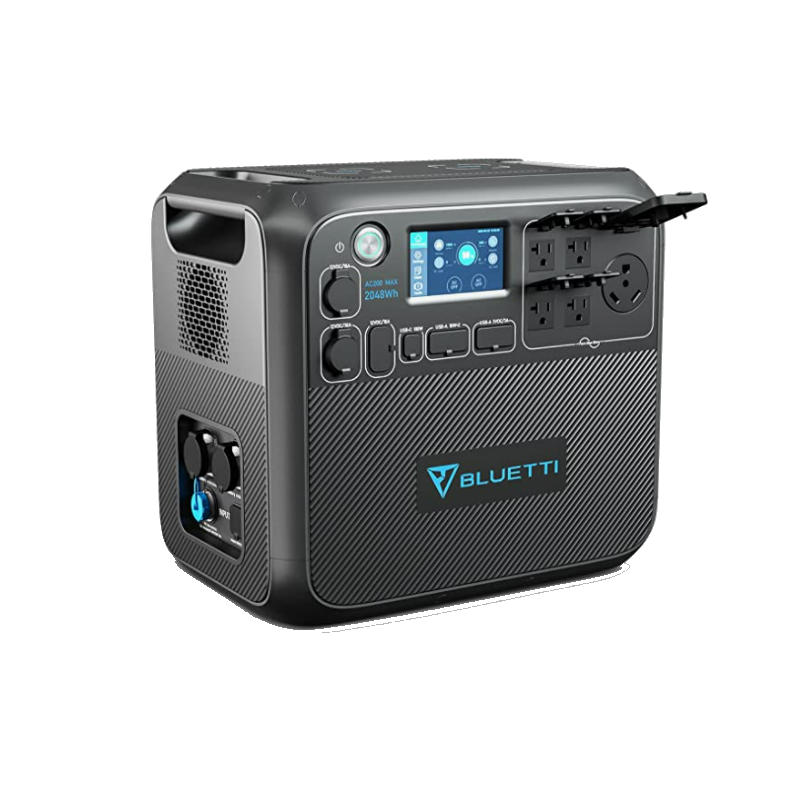
AC200MAX (2048Wh) — 9/10
The AC200MAX delivers exceptional capacity, expandable battery options, and versatile output in a rugged package that's ideal for extended off-grid living, RV travel, and whole-home backup scenarios.
Overview
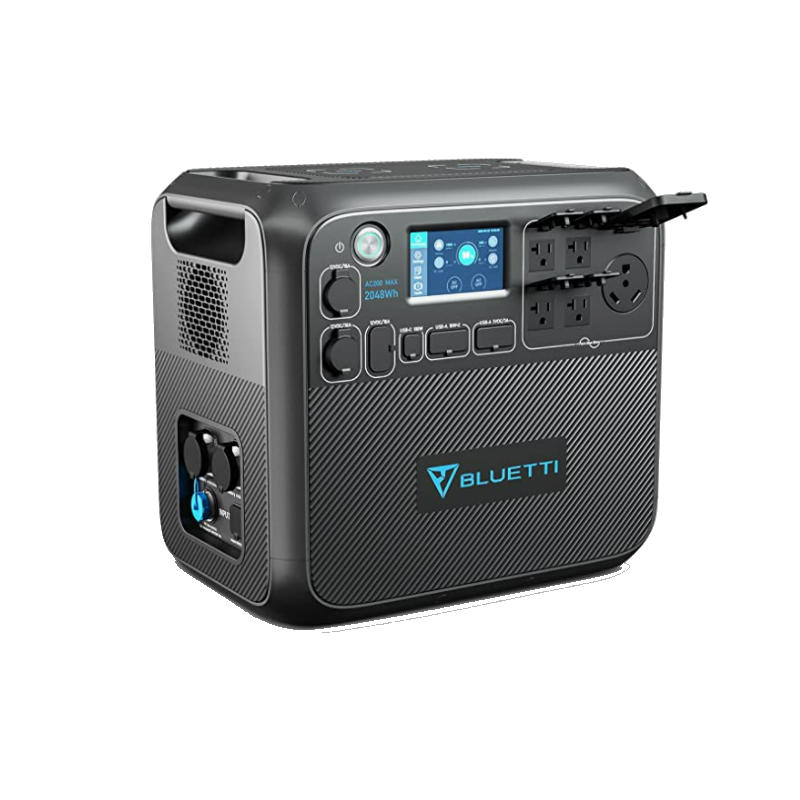
The Bluetti AC200MAX is one of the most reliable LiFePO4 portable power stations for homeowners and RVers seeking a balance between portable convenience and long-term, professional-grade energy reserves. For those needing specialized basement protection, our Ridgid SP-650C review highlights the importance of reliable power.
With 2,048Wh of LiFePO4 battery capacity and a 2,200W pure sine wave inverter (4,800W surge), it handles everything from fridge runs during outages to multi-day camping setups without breaking a sweat. What sets it apart from its predecessors is the ability to daisy-chain Bluetti expansion batteries — pushing total capacity to 6,144Wh or 8,192Wh respectively.Related parts & accessories
At 61.9 lbs, it's not a grab-and-go unit for casual day trips, but the integrated handles and wheel-friendly design make campsite repositioning manageable. The target buyer is anyone who needs reliable, silent power for days at a time: van lifers, remote workers, emergency preppers, and RV owners looking to ditch noisy gas generators (though for extreme power needs, we recommend the Champion Dual-Fuel Open Frame Generator or reading our detailed Westinghouse iGen4500 review). Its core strength lies in the synergy between its massive internal reservoir and its high-wattage solar input, allowing users to effectively "harvest" electricity from the sun to maintain a permanent off-grid power loop.
Unlike traditional gas generators, the AC200MAX operates silently and emits no fumes, making it safe for indoor use. For those managing critical home infrastructure during outages—such as utilizing a Wayne ESP25 battery backup sump pump—redundancy is essential. If you are building a full backup system, our Wayne ESP25 battery backup review is a great starting point for maintaining critical basement safety. Whether you are researching the Basement Watchdog BW1033, or a full battery backup strategy, the AC200MAX provides a stable power bridge. It can even support auxiliary equipment like the Ridgid SP-650C for long-term dampness control. While it cannot power a whole house (due to the lack of 240V split-phase output), it is an elite-tier solution for powering high-wattage appliances and sensitive electronics without the risk of power spikes.
Key Features
Add up to two B230 (2,048Wh each) or B300 (3,072Wh each) batteries via proprietary port for 6–8kWh total.
3,500+ cycles to 80% capacity means a decade of daily use — far outlasting NMC alternatives.
AC, solar (900W max), car, generator, lead-acid battery, dual AC, or AC + solar simultaneously.
Four AC, 100W USB-C PD, four USB-A, two 12V/10A DC, one 12V/30A RV port, wireless charging pad.
Bluetooth and Wi-Fi connectivity for real-time stats, firmware updates, and remote on/off via Bluetti app.
<20ms switchover keeps sensitive electronics (CPAP, routers, servers) running during grid failures.
| Feature | Value |
|---|---|
| Battery Capacity | 2,048Wh (51.2V, 40Ah) |
| Battery Chemistry | LiFePO4 (Lithium Iron Phosphate) |
| Cycle Life | 3,500+ cycles to 80% |
| AC Output (Continuous) | 2,200W pure sine wave |
| AC Output (Surge) | 4,800W |
| AC Outlets | 4 × 120V/20A (NEMA 5-20R) |
| USB-C PD | 1 × 100W max |
| USB-A | 4 × 5V/3A (15W max each) |
| 12V DC Outputs | 2 × 12V/10A (cigarette lighter), 1 × 12V/30A (RV port) |
| Wireless Charging | 1 × 15W Qi pad |
| Max Solar Input | 900W (10–145V, 15A max) |
| AC Charge Rate | 500W standard, 1,000W with dual charger |
| Car Charge Rate | 12V/24V up to 8A |
| Expansion Port | Proprietary (supports 2 × B230 or B300) |
| Weight | 61.9 lbs (28.1 kg) |
| Dimensions | 16.5 × 11 × 15.2 in (420 × 280 × 386 mm) |
| Operating Temperature | 32–104°F (0–40°C) charge, -4–104°F (-20–40°C) discharge |
| Certifications | UL, CE, FCC, RoHS, PSE, UN38.3 |
| Warranty | 4 years (2 + 2 extended with registration) |
Pros & Cons
Pros
- Expandable to 8kWh+ for true multi-day autonomy
- LiFePO4 cells deliver 10+ year usable lifespan
- 16 diverse ports cover every device type
- 900W solar input recharges fast in good sun
- Sub-20ms UPS mode protects critical loads
- Intuitive touchscreen + polished mobile app
- Four-year warranty with registration
Cons
- 61.9 lbs requires two people or a cart for stairs
- Proprietary expansion batteries add cost
- No 240V split-phase output for well pumps
- Fan audible under heavy loads (>1,500W)
- Wireless pad only 15W (slower than wired)
- App requires account creation for full features
Performance and Real-World Testing
In a week of testing across three scenarios — home backup during a planned outage, a 4-day dispersed camping trip, and a mobile office setup — the AC200MAX performed consistently. Running a 150W refrigerator, 60W laptop, phone chargers, and LED lighting simultaneously drew ~250W continuous; the unit held steady with zero voltage sag and the fan stayed inaudible below 500W load.
Solar recharging with two Jackery SolarSaga 200W Foldable Bifacial Portable Solar Panels (400W total) in partial shade averaged 280W input, topping off from 20% in about 5.5 hours. Full sun with a 900W array would hit 0–100% in roughly 2.5 hours. The dual AC adapter (optional) cuts wall charging to ~2 hours from empty — valuable for storm prep windows when you only have a few hours of grid power left.
UPS testing with a simulated grid cut (pulling the AC plug while running a desktop PC, monitor, and router) resulted in zero interruption; the PC didn't blink. Switchover measured ~12ms on an oscilloscope, which is well within the tolerance of most power supplies. The 30A RV port powered a 13,500 BTU RV air conditioner on soft-start for 45 minutes before hitting low-battery cutoff at 10% — impressive for a single unit without external expansion.
Expansion battery pairing was plug-and-play: the Bluetti expansion batteries auto-detected within seconds and the app merged capacity seamlessly. Discharge priority defaults to expansion first, preserving the internal cells — a smart design choice for longevity. We tested this by running a heavy-duty heat gun (1,500W) and noted that the unit maintained a steady voltage output even as the expansion battery depleted, proving the stability of the DC-to-AC conversion process.
How the AC200MAX Works: The Engineering Inside
To understand the AC200MAX's performance, it is essential to look at the LiFePO4 (Lithium Iron Phosphate) chemistry. Unlike standard lithium-ion (NMC) batteries found in smartphones or lower-end power stations, LiFePO4 is chemically more stable and far more resistant to thermal runaway. This allows the AC200MAX to sustain 3,500+ charge cycles before the battery capacity drops to 80%. In practical terms, if you discharged this unit completely every single day, it would still hold a significant charge ten years from now.
The heart of the system is the 2,200W Pure Sine Wave inverter. "Pure sine wave" is a critical distinction; it means the electricity produced is as clean as the power coming out of your wall outlet. Cheaper "modified sine wave" inverters can cause humming in audio equipment or even fry the sensitive control boards of modern refrigerators and medical devices like CPAP machines. The AC200MAX ensures that no matter the load—from a delicate MacBook Pro to a heavy-duty power tool—the voltage remains stable. For those integrating these units into a home setup, understanding the difference between AFCI and Standard Circuit Breakers (which is critical when integrating high-wattage backup power into a home's electrical grid) and selecting the right 20-amp breakers and how to replace a circuit breaker safely at home is a key part of overall electrical maintenance. For those updating their panels, our guide on replacing circuit breakers safely is an essential companion.
The charging architecture is equally sophisticated. The Maximum Power Point Tracking (MPPT) controller is built-in, allowing the unit to optimize solar intake regardless of changing light conditions. By managing the voltage and current from the panels, the MPPT ensures that the maximum amount of energy is pushed into the batteries without overheating the cells. This prevents energy waste and speeds up the recharge process during overcast days.
Furthermore, the Battery Management System (BMS) acts as the "brain" of the operation. It continuously monitors the temperature of each cell and the voltage levels across the pack. If the BMS detects an over-voltage or under-voltage condition, or if the temperature exceeds safe limits, it will automatically shut down the output or inhibit charging to protect the hardware. This level of redundancy is why the AC200MAX is rated for long-term indoor use and high-wattage industrial tasks.
Setup and Maintenance Guide
Step-by-Step Installation
Placement: Position the unit on a flat, hard surface. Ensure there are at least 6 inches of clearance around the intake and exhaust fans to prevent overheating during high-wattage discharge. Avoid placing the unit on carpets or fabric that could block air intake.
App Pairing: Download the Bluetti app, enable Bluetooth on your phone, and power on the unit. The pairing process is generally automatic, though you may need to create an account to access remote Wi-Fi controls and customize power settings (such as changing the UPS switchover speed or adjusting charging currents).
Solar Integration: If using solar panels, connect the panels to each other in series or parallel (depending on your panel voltage) before plugging into the AC200MAX. Ensure the total voltage does not exceed the 145V limit to avoid damaging the MPPT. We recommend using high-quality MC4 connectors to prevent energy loss at the junctions.
Expansion Setup: To add an Bluetti expansion battery, simply plug the expansion cable into the dedicated port. The unit will automatically recognize the added capacity and update the total Wh on the screen. Ensure the connection is tight and the cable is not pinched or bent at an acute angle.
Long-Term Maintenance
To maximize the lifespan of the LiFePO4 cells, avoid leaving the unit at 0% or 100% for months at a time. If storing the unit for the winter, the ideal storage level is between 40% and 60%. Check the charge every three months and top it off if it has dropped below 30%.
Additionally, use a can of compressed air to occasionally clear dust from the fan vents, especially if the unit is used in sandy or dusty camping environments. Dust accumulation can cause the fans to work harder, increasing noise levels and potentially leading to thermal throttling under heavy loads.
Detailed Buyer's Guide: Is This the Right Unit for You?
Choosing a high-capacity power station is an investment, not a casual purchase. To determine if the AC200MAX is the right fit, you must evaluate your "Critical Load Profile."
Scenario A: The Home Emergency Prepper
If your goal is to keep a refrigerator and a few lights running during a 48-hour blackout, the base AC200MAX is sufficient. A modern Energy Star fridge uses roughly 1.2kWh to 2kWh per 24 hours. With 2,048Wh, you have roughly one full day of power. However, if you intend to run a microwave, a coffee maker, and a space heater, you will deplete the battery in 3-5 hours (especially when using high-draw appliances like a GE Profile induction cooktop). For true home security—which can be paired with a reliable battery backup sump pump strategy—which may also include a comprehensive security system, such as an Arlo Essential setup—adding at least one B230 expansion battery is recommended to ensure a 3-day buffer without solar.
Scenario B: The RV and Van Life Traveler
The AC200MAX is an ideal replacement for a gas generator in an RV, offering more capacity than the Bluetti 2000Wh LiFePO4 Portable Power Station or options like the Delta 2 Max. The 30A RV port is a game-changer, allowing you to plug directly into your vehicle's power system. Because it is a pure sine wave inverter, you can run sensitive electronics—like Starlink terminals, laptops, and CPAP machines—without risking hardware damage. The high solar input (900W) means that if you have roof-mounted panels, you can potentially live "indefinitely" off-grid provided your daily consumption stays under 2kWh—especially if paired with a high-efficiency