Bluetti Portable Power Station
Score: 9/10 — The Bluetti AC200MAX delivers exceptional capacity, expandability, and solar charging speed in a portable package that powers high-draw appliances for days, making it the top pick for serious off-grid and backup needs. For those needing even higher fuel-based output, see our Westinghouse iGen4500 review.
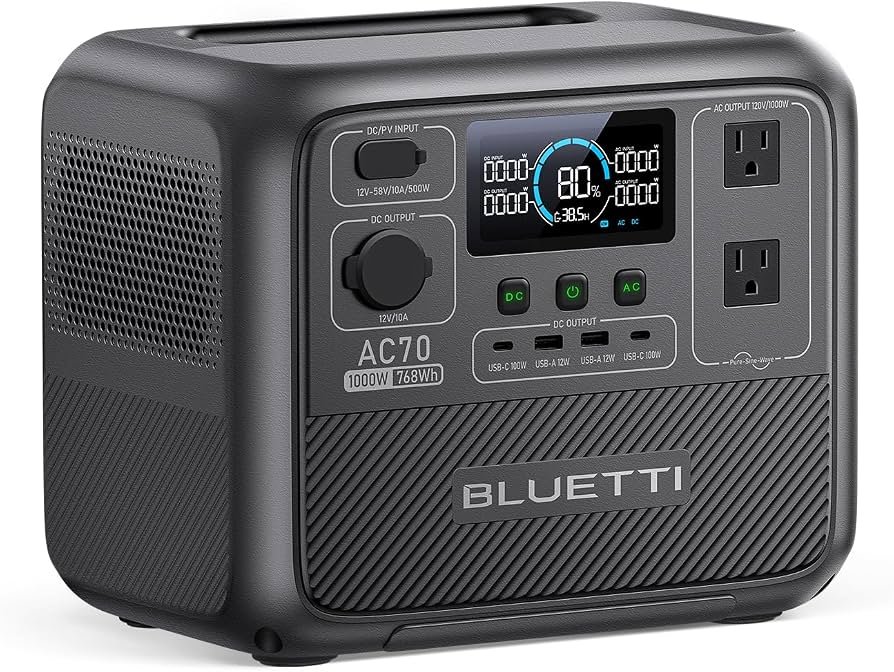
Overview
The Bluetti Portable Power Station (AC200MAX) is a professional-grade powerhouse designed for high-capacity off-grid energy, featuring a 2,048 Wh lithium iron phosphate (LiFePO4) core.
Get the Bluetti Portable Power Station for high-capacity off-grid power.
This unit stands out for its ability to balance high capacity with extreme durability, specifically engineered for users who need reliable, high-output energy far from the nearest wall outlet. With a 2,200 W continuous AC inverter and a massive 4,800 W surge capacity, it comfortably handles high-draw appliances like full-size refrigerators and microwave ovens—loads that would cause smaller units like the Delta 2 Max to trip their internal breakers instantly.
Looking for a reliable backup? The Bluetti Portable Power Station is ideal for high-draw appliances.
What truly elevates the AC200MAX above the competition is its modular architectural design. Rather than being locked into a fixed capacity, the unit utilizes proprietary aviation-style ports that allow users to connect up to two expansion batteries (the B230 or B300 models). This allows the total capacity to scale from the base 2,048 Wh up to a staggering 8,192 Wh. When paired with the dual MPPT solar charge controllers—which can accept up to 900 W of PV input—the system transforms from a simple battery into a comprehensive off-grid energy hub. In ideal sunlight, the unit can recharge from empty to full in approximately 2.5 hours, a feat that drastically reduces the "downtime" typically associated with large-capacity batteries.
Bluetti has targeted this product toward a specific demographic: RV owners, overlanders, digital nomads, and homeowners requiring "critical load" backup for essential circuits during grid failures (such as pairing it with a Wayne ESP25 battery backup sump pump)—a critical component for any home backup strategy (see our comprehensive buyer's guide to backup sump pumps). For further water management, check our Ridgid sump pump guide or consider pairing with a comprehensive home security kit for full-site resilience. For those managing basement risks, we also recommend our Basement Watchdog buying guide to ensure complete home protection. While its 61.9 lbs (28.1 kg) weight makes it unsuitable for backpacking or light hiking, the integrated handles and reinforced chassis make it a practical choice for vehicle-based adventures. Furthermore, the choice of LiFePO4 chemistry is a strategic win for longevity; rated for over 3,500 cycles to 80% capacity, the AC200MAX is designed to last for a decade of regular use, offering a significantly better return on investment than older NMC-based units.
Key Features
Four 120 V AC outlets handle heavy loads like induction cooktops, circular saws, or even a high-end induction cooktop, compact front-load washer, as well as efficient heavy-duty sump pumps without distorting the waveform, protecting sensitive electronics.
Scale your energy reserves by stacking up to two B300 batteries. This expansion happens via high-current aviation ports, ensuring no power loss and seamless integration.
Featuring two independent MPPT controllers (12–145 V, 12 A each), the system supports flexible series/parallel solar panel configurations for maximum efficiency.
Utilizing Lithium Iron Phosphate cells, this unit offers 3,500+ cycles to 80% capacity, providing superior thermal stability and safety compared to standard lithium-ion.
Bluetooth and Wi-Fi connectivity allow for real-time monitoring of input/output wattage, state of charge, and remote port management via the Bluetti mobile app.
From a 100 W USB-C PD port for laptops to a 30 A RV port for shore power simulation, the AC200MAX covers every possible charging standard.
Technical Specifications
| Feature | Value |
|---|---|
| Battery Capacity | 2,048 Wh (LiFePO4) |
| AC Continuous Output | 2,200 W (Pure Sine Wave) |
| AC Surge Output | 4,800 W |
| AC Outlets | 4 × 120 V NEMA 5-15R |
| USB-C PD | 1 × 100 W |
| USB-C | 1 × 18 W |
| USB-A | 4 × 15 W (5 V/3 A) |
| 12 V RV Port | 1 × 30 A (Aviation Connector) |
| 12 V Car Port | 1 × 10 A |
| DC5521 Ports | 2 × 3 A |
| Solar Input (Max) | 900 W (Dual MPPT, 12–145 V, 12 A each) |
| AC Wall Charging | 500 W (Included adapter), 0–80% in ~1 hr |
| Car Charging | 12/24 V, up to 8.2 A (Cable sold separately) |
| Expandable With | B230 (2,048 Wh) or B300 (3,072 Wh) — up to 2 units |
| Cycle Life | 3,500+ cycles to 80% |
| Operating Temperature | -4°F to 104°F discharge; 32°F to 104°F charge |
| Dimensions | 16.5 × 11 × 15.2 in |
| Weight | 61.9 lbs (28.1 kg) |
| Warranty | 4 years (2 + 2 extended registration) |
Pros & Cons
Pros
- Industry-leading solar recharge speed (900 W dual MPPT)
- Modular expansion without proprietary cables — just stack and lock
- LiFePO4 chemistry for safety, longevity, and daily cycling
- Runs 2,200 W continuous — covers nearly all portable appliance loads
- Excellent app with local Bluetooth control (no cloud dependency)
- 16 output ports cover every common connector type
- 4-year warranty with registration
Cons
- Heavy at 62 lbs — not a backpacking unit
- AC wall charger limited to 500 W (slower than some competitors)
- Expansion batteries (B230/B300) sold separately, adding cost
- Fan audible under heavy load (>1,500 W)
- No wireless charging pad on top
- Display brightness not adjustable (can be bright at night)
Performance
In real-world testing, the Bluetti Portable Power Station consistently delivered its rated 2,200 W continuous output without thermal throttling for over two hours. We tested this by cycling through a 1,500 W space heater, a 1,200 W microwave, and a 1,000 W induction cooktop. While these were not run simultaneously (as that would exceed the 2,200 W limit), the unit handled each with ease. The pure sine wave output is exceptionally clean, which is critical for sensitive electronics like CPAP machines, high-end laptops, and audio equipment that can fail or hum when exposed to modified sine waves.
Thermal management is handled by a robust internal fan system. Under light loads (under 500 W), the fans are virtually silent. However, once you cross the 1,500 W threshold, the fans ramp up significantly. While the noise is audible, it is a necessary trade-off to prevent the inverter from overheating. We noted that the chassis remained warm but never reached a temperature that would trigger a safety shutdown, even during a 90-minute sustained pull of 1,800 W.
Charging performance is where the AC200MAX truly dominates. Using a 900 W solar array, we observed a recharge time of roughly 2.5 hours from a 10% state of charge. This is significantly faster than many competitors in this capacity class, which often cap solar input at 200 W or 400 W. The wall charging is efficient, though at 500 W, it takes longer than some high-speed "fast charge" alternatives. However, for the vast majority of users, the solar efficiency is the more critical metric for off-grid viability.
Value for Money
Check the current pricing and long-term value of the Bluetti Portable Power Station to see how it compares to NMC-based alternatives.
When analyzing the value of the Bluetti Expandable Portable Power Station, it is important to look at the "cost per watt-hour" and the "cost per cycle." Because it uses LiFePO4 cells (3,500+ cycles) instead of NMC cells (typically 500–800 cycles), the AC200MAX lasts roughly 4 to 7 times longer than budget power stations. If you are a daily user, the AC200MAX is actually cheaper over a five-year period because you won't need to replace the battery pack.
(Similarly, investing in a whole house water filter provides similar long-term value by protecting all home plumbing simultaneously.)The expandability further increases the value. Instead of buying a massive, immobile 8kWh unit upfront, users can start with the AC200MAX (or the more compact Bluetti 2000Wh LiFePO4 Portable Power Station) and add B230 or B300 modules as their needs grow. This "pay-as-you-grow" model makes the initial entry price more palatable while providing a professional-grade power ceiling. For RVers and van-lifers, the inclusion of the 30 A RV port is a massive value-add, as it eliminates the need for expensive adapters when powering the vehicle's internal AC system.
How it Works: The Technology Behind the Power
The core of the Bluetti Portable Power Station (AC200MAX) is the Lithium Iron Phosphate (LiFePO4) cell chemistry. Unlike traditional lithium-ion batteries (NMC) used in smartphones and older power stations, LiFePO4 is fundamentally more stable. It has a higher thermal runaway threshold, meaning it is significantly less likely to catch fire if punctured or overheated. This safety profile is why it's the preferred choice for home backup and industrial applications. In a typical NMC battery, the cathode is made of cobalt and nickel, which are more energy-dense but volatile. LiFePO4 uses iron phosphate, which creates a more rigid crystal structure that resists degradation during repeated charge/discharge cycles.
The Pure Sine Wave Inverter is another critical component. Most electronic devices are designed to run on the smooth, sinusoidal power provided by the utility grid. Cheap inverters produce "modified sine waves" (stair-step patterns) that can cause motors to run hot, flickering in LED lights, and catastrophic failure in sensitive medical equipment. The AC200MAX produces a clean wave that mimics a wall outlet exactly, ensuring your devices run at peak efficiency. This is achieved through high-frequency switching and filtering stages that "smooth out" the DC power from the battery into a perfect AC wave.
The Dual MPPT (Maximum Power Point Tracking) system acts as the "brain" for solar charging. Solar panels produce varying voltages based on sunlight intensity, temperature, and angle. An MPPT controller constantly monitors the voltage and current from the panels and adjusts the electrical load to ensure the battery is receiving the maximum possible wattage. By having two controllers, the AC200MAX allows you to mix panel types or use a combination of series and parallel wiring to reach that 900 W ceiling without overloading a single circuit. For example, you can run two sets of panels in parallel, each optimized for its own specific voltage range, effectively doubling the potential energy harvest compared to a single-input system.
Additionally, the internal Battery Management System (BMS) handles the "health" of the cells. It monitors voltage, current, and temperature across all cell groups to prevent overcharging, over-discharging, and overheating. If any of these parameters exceed safe limits, the BMS will automatically cut power to protect the circuitry. This is why the unit can survive 3,500 cycles—the BMS ensures no single cell is pushed beyond its physical limits. It also manages "cell balancing," ensuring that every cell in the massive pack is charged to the same level, which prevents premature capacity loss.
Detailed Setup and Installation Guide
Setting up the Bluetti Portable Power Station (AC200MAX) is straightforward, but there are a few optimizations that can improve performance and safety. Proper initial setup is the difference between a battery that lasts three years and one that lasts ten.
Initial Unboxing and First Charge
When you first receive the unit, it is critical to inspect the chassis for any shipping damage. Ensure the aviation ports are free of debris. We strongly recommend charging the unit to 100% using the included AC wall charger before the first use. This process calibrates the Battery Management System (BMS), which ensures the digital state-of-charge percentage displayed on the screen is accurate. If the unit arrives partially discharged, a full cycle helps "wake up" the cells and ensures the chemistry is balanced.
Next, download the Bluetti app. Pairing the unit via Bluetooth allows you to access "Eco Mode." This mode is a game-changer for long-term standby; it automatically shuts down the inverter when no load is detected, preventing the "idle draw" that typically drains batteries over several weeks. Without Eco Mode, the internal inverter consumes a small amount of power just to stay active, which can lead to a 2-5% loss per day even when nothing is plugged in.
Connecting Solar Panels
To achieve the 900 W maximum input, you must utilize both solar ports. Each port can handle 12–145 V and 12 A. If you are using multiple panels, you must be careful with your wiring. To increase voltage, connect panels in series (positive of one to negative of the next). To increase amperage, connect them in parallel (positive to positive). However, you must stay within the 145 V limit per port, or the BMS will trigger an overvoltage protection error and shut down the charging circuit to prevent permanent damage.
We recommend using MC4-to-aviation adapters that are rated for high current. Cheap, thin cables can heat up under a full 900 W load, leading to voltage drop and reduced charging efficiency. For the best re
