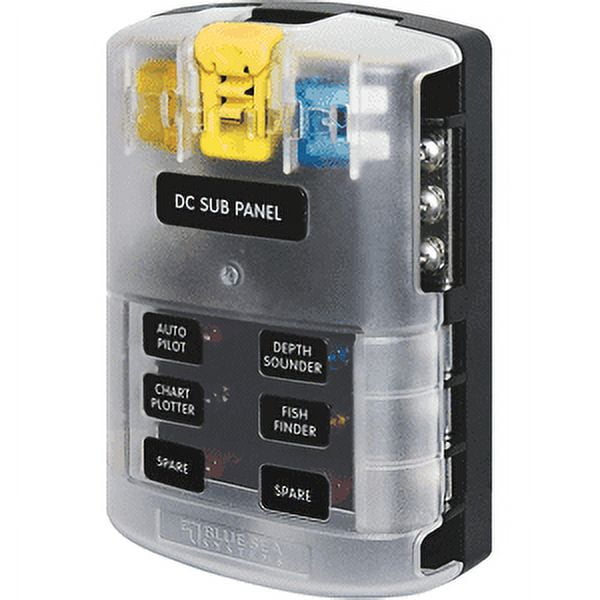
Blue Sea Systems 6-Circuit ST Blade Fuse Block with Cover — 9.0/10
A compact, durable, and well-organized fuse block that is worth it for clean 12V DC circuit protection in RV, marine, van, solar, and backup power setups.
Overview
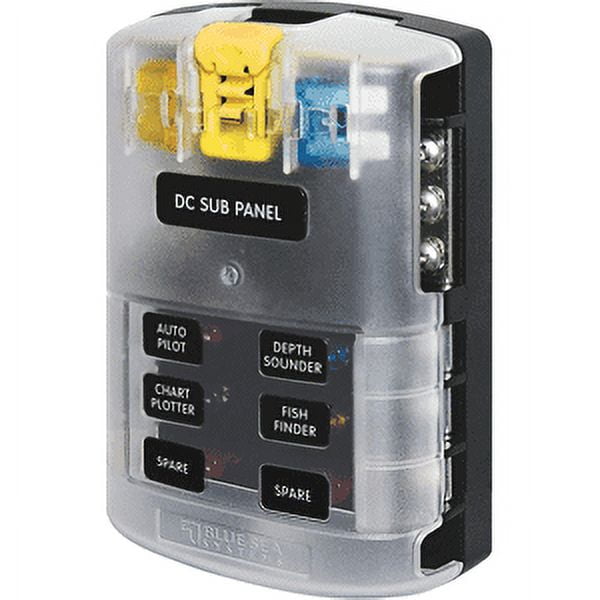
If you need a professional way to organize 12V DC wiring for an RV, boat, or solar build, the Blue Sea Systems 6-Circuit ST Blade Fuse Block with Cover (5025) is a top-tier choice for reliable circuit protection in marine, van, and off-grid power systems.
Related parts & accessories
The Blue Sea Systems 6-Circuit ST Blade Fuse Block with Cover is designed to give low-voltage DC systems a safer, cleaner way to distribute power across multiple branch circuits.
Related parts & accessories
It is especially useful for automotive, marine, RV, camper van, off-grid, and backup power installations—such as those utilizing a Wayne ESP25 battery backup sump pump for flood-prone basements (see our detailed Wayne ESP25 review and battery backup sump pump guide)—where accessories such as LED lights, ventilation fans, water pumps, and monitoring displays need individual fuse protection.
Pro Tip: To keep your system running, we recommend pairing this block with a Littelfuse ATO 5-30 Amp Blade Fuse Assortment Pack (see our detailed Littelfuse review) for quick replacements.
The included transparent cover helps shield the fuse block from accidental contact and prevents dust or debris from settling on the terminals, giving the installation a more finished, serviceable, and professional layout.
The Blue Sea Systems 6-Circuit ST Blade Fuse Block with Cover is best for builders who prioritize reliability and neat wiring. If your build requires a Blue Sea Systems Marine Thermal Circuit Breaker instead of individual blade fuses (see our guide on AFCI vs Standard Circuit Breakers), refer to our Blue Sea Systems 5025 Review for a detailed breakdown of marine DC protection. It is important to note that this is not a smart panel, a high-amperage breaker panel, or a high-voltage AC component (like those discussed in our Eaton BRCAF115 review or our AFCI vs Standard guide); it is a straightforward, high-quality DC blade fuse block built for dependable circuit protection in demanding environments.
Key Features
Each output circuit has its own dedicated blade fuse position, making it easier to protect and troubleshoot accessories independently without affecting the rest of the system.
The Blue Sea Systems 6-Circuit ST Blade Fuse Block with Cover pairs perfectly with a Littelfuse ATO 5-30 Amp Blade Fuse Assortment Pack, ensuring you have every necessary rating on hand for a quick replacement.
The transparent, snap-on cover reduces the risk of accidental short circuits from dropped tools or loose wires while keeping the fuse status visible for quick inspection.
Its small form factor works perfectly in tight electrical compartments, under vehicle seats, inside RV cabinets, or near battery and solar charge controllers.
By consolidating accessory circuits into one central block, it removes the need for messy battery-terminal stacking and simplifies future maintenance or system upgrades.
Blue Sea Systems components are engineered for demanding mobile and marine environments where vibration, moisture, and temperature fluctuations are constant factors.
Technical Specifications
| Feature | Value |
|---|---|
| Product Name | Blue Sea Systems 6-Circuit ST Blade Fuse Block with Cover |
| Model Number | 5025 |
| Category | Circuit Breakers & Fuses |
| Circuit Count | 6 fused branch circuits |
| Fuse Type | ATO/ATC blade fuses |
| Typical System Type | Low-voltage DC electrical systems |
| Common Applications | Automotive, marine, RV, camper van, off-grid solar, backup power |
| Cover Included | Yes, transparent protective cover |
| Primary Purpose | Centralized distribution and fuse protection for multiple DC loads |
| Best For | Organized 12V accessory wiring and serviceable installations |
| Not Intended For | High-voltage AC or main system-level overcurrent disconnects |
Pros & Cons
Pros
- Excellent way to organize multiple 12V accessory circuits in one spot.
- Uses common ATO/ATC blade fuses available at any auto parts store.
- Protective cover improves safety and prevents accidental shorts.
- Compact enough for tight spaces in vans, boats, and solar enclosures.
- Strong fit for DIY builders seeking a professional alternative to inline clutter.
- Simplified troubleshooting due to separate circuit fusing.
Cons
- Limited to six circuits; larger builds may require multiple blocks or a transition to high-amperage protection (see the Blue Sea Systems Marine Thermal Circuit Breaker for DC Applications or compare high-voltage brands in our best 20-Amp circuit breakers guide or explore AFCI vs Standard Circuit Breakers).
- Fuses are not included;
For a complete set of replacements, we recommend the Littelfuse ATO 5-30 Amp Blade Fuse Assortment Pack.
- Requires proper crimping and wire sizing for a safe installation (similar to the safety principles in our guide on how to replace a circuit breaker safely at home).
- Not a replacement for main battery fuses or master disconnects.
- Higher price point than generic, non-branded fuse holders.
Performance
In real-world use, the Blue Sea Systems 6-Circuit ST Blade Fuse Block with Cover performs exactly as a high-grade fuse block should: quietly, reliably, and without adding unnecessary complexity to the power path. Its primary advantage is not a "feature" in the digital sense, but rather the way it improves the mechanical and electrical architecture of a low-voltage system. A clean fuse block makes it significantly easier to identify which circuit is which, replace a blown fuse without hunting through the chassis, and inspect connections for corrosion or looseness.
For RV, van, and marine installations, vibration resistance and secure terminations are critical. The Blue Sea Systems 6-Circuit ST Blade Fuse Block with Cover feels substantially more confidence-inspiring than cheap, no-name blocks found on discount marketplaces. In mobile systems, constant bumps and chassis flex can loosen poorly made terminals; the build quality here ensures a tight fit that minimizes heat buildup and prevents intermittent power loss. The transparent cover is particularly useful in cramped compartments—such as under a sink or behind a dashboard—where tools, loose screws, or other wires could otherwise make accidental contact with live terminals.
The six-circuit capacity is a "sweet spot" for many small-to-medium accessory systems. For example, a typical van build might use the following distribution: one circuit for interior LED strip lighting, one for a MaxxAir vent fan, one for a 12V water pump, one for a pair of USB-C charging ports, one for a voltmeter/battery monitor, and one for a small 12V fridge or cooling fan. This individual protection is vital because a fault in the water pump—such as a jam causing an amperage spike—should only blow the pump's fuse, leaving the lights and monitoring system operational for the user to diagnose the problem.
The main limitation is scalability. If you are building a complex "luxury" electrical system with dozens of loads (complex lighting zones, multiple pumps, heating pads, etc.), the Blue Sea Systems 6-Circuit ST Blade Fuse Block with Cover may run out of available circuits quickly. In such cases, it still functions excellently as a "sub-panel" for a specific area of the vehicle, but you will need a more robust primary distribution system to feed multiple blocks like this one. For those planning larger builds, the Blue Sea Systems Marine Thermal Circuit Breaker for DC Applications guide explains how to handle higher loads.
How it Works: The Mechanics of DC Distribution
To understand the value of the Blue Sea Systems 6-Circuit ST Blade Fuse Block with Cover, one must understand how it differs from standard wiring. In a basic, unorganized system, wires are often "daisy-chained" or piled onto a single battery terminal. This creates two major problems: a "nest" of wires that is impossible to troubleshoot, and a lack of localized protection. If a wire shorts out in a daisy-chained system, you may not know where the short is, and you might lose power to every device on that chain.
The Blue Sea Systems 6-Circuit ST Blade Fuse Block with Cover acts as a Bus Bar with Integrated Protection. If you are designing a larger home-scale power backup, you might also consider how components like a battery backup sump pump system integrates into your 12V strategy. Inside the unit, there is a primary positive bus—a conductive strip that carries the main power supply from your battery or solar controller. When you connect your main power wire to the input terminal, that power is distributed across all six fuse slots. When you insert an ATO/ATC fuse and connect a load to the output terminal, you create a dedicated branch. The fuse acts as the "weak point" in the circuit; if the current exceeds the fuse's rating, the internal element melts, breaking the connection instantly and preventing the wire from overheating.
The use of ATO/ATC (Automotive Time Out/Standard) fuses is a strategic choice. These fuses are the industry standard for 12V systems because they are inexpensive, reliable, and available in a wide array of ratings (from 1A to 30A). By using a standard format, Blue Sea Systems ensures that users aren't locked into proprietary, expensive replacement parts, making the system maintainable over decades of use.
Comprehensive Buyer's Guide: Is This the Right Block for You?
Choosing the right fuse block requires balancing your current needs with your future growth. When deciding if the Blue Sea Systems 6-Circuit ST Blade Fuse Block with Cover (5025) is the right choice, consider the following factors:
1. Total Load Count
Count every single 12V accessory you plan to install. If you have 4 or fewer devices, this block is a great way to centralize them. If you have 6, you are at maximum capacity. If you have 10 or more, you have two choices: buy two of these blocks or move up to a larger 12-circuit or 24-circuit distribution panel. Many professional builders prefer using multiple 6-circuit blocks (e.g., one for "Living Area," one for "Kitchen/Utility") to keep wiring runs shorter and more organized.
2. Environmental Exposure
Where will this be mounted? If it is going inside a sealed cabinet, the basic block is fine. However, if it is located in an area where moisture, dust, or accidental impact is likely (like near a battery box or under a chassis), the included transparent cover on the 5025 model is an essential safety feature. It prevents a stray wrench or a spilled drink from bridging the gap between the positive terminal and the chassis (ground), which would cause a massive spark and a blown main fuse.
3. Amperage Requirements
This block is designed for low-to-medium amperage branch circuits. It is perfect for LEDs, fans, and small pumps. It is NOT designed for high-current loads like a 2000W inverter, a large microwave, or a heavy-duty winch. Those devices require their own heavy-gauge wiring and high-amperage fuses or a Blue Sea Systems Marine Thermal Circuit Breaker for DC Applications located as close to the power source as possible. For a deeper dive into these high-current options, see the Blue Sea Systems Marine Thermal Circuit Breaker for specialized DC circuit protection.
4. Ease of Maintenance
If you are a "tinkerer" who frequently adds new gadgets to your rig, the blade fuse system is ideal. Replacing a fuse takes three seconds. The organized layout allows you to label each circuit with a label maker, meaning you don't have to guess which fuse controls the reading light and which one controls the water pump.
Installation and Setup Guide
Installing the Blue Sea Systems 6-Circuit ST Blade Fuse Block with Cover is straightforward, but doing it correctly is the difference between a safe system and a fire hazard. While this is a DC system, the same cor