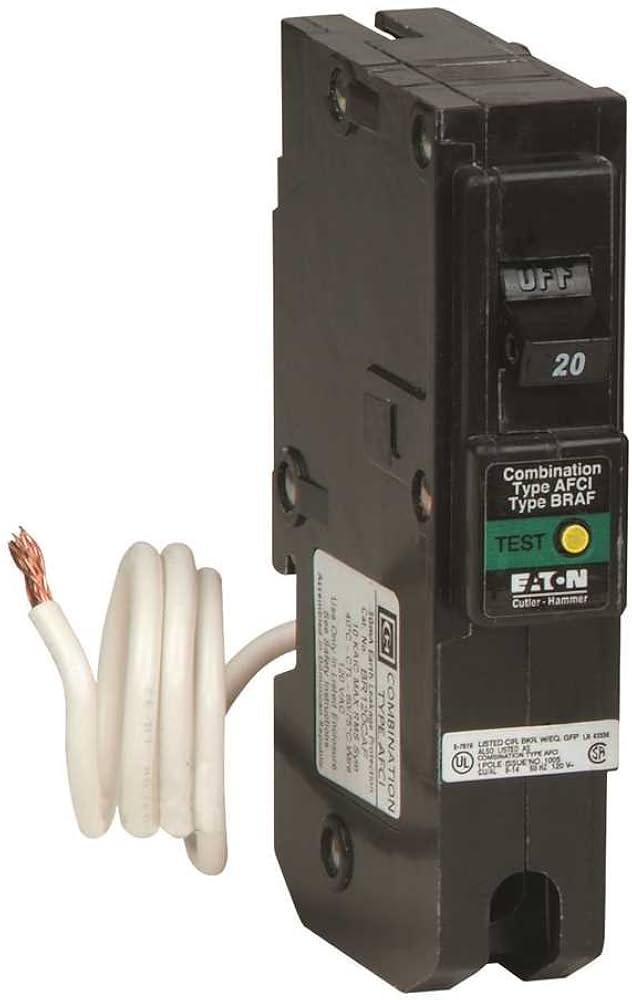
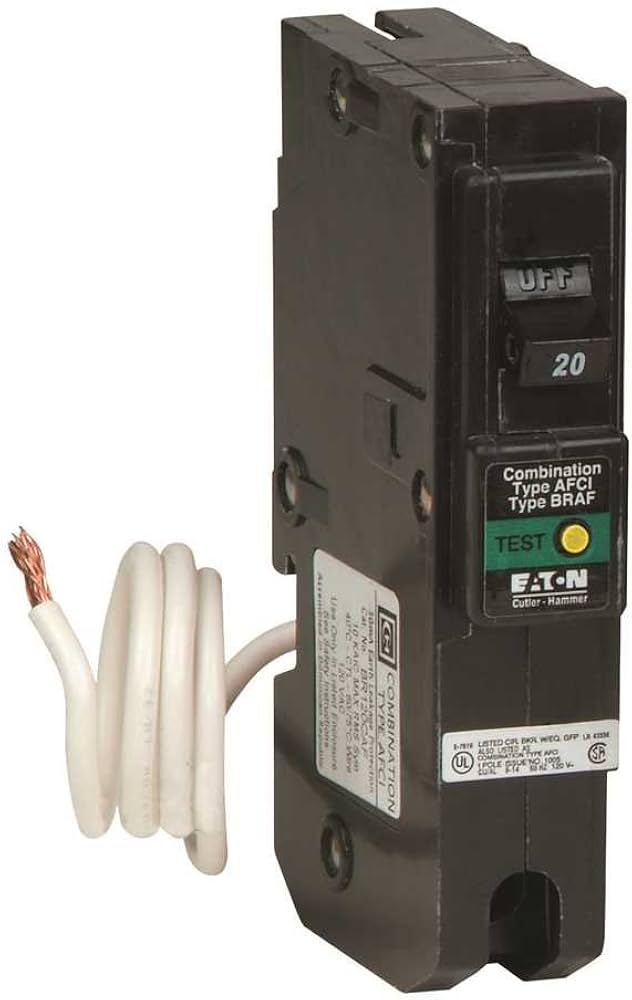
Eaton BRCAF115
Score: 9.2/10 — A reliable, high-quality AFCI breaker that provides essential fire protection for residential bedrooms and living areas with industry-standard stability.
We may earn a commission from qualifying purchases made through our links.
Overview
The Eaton BRCAF115 is a professional-grade Arc-Fault Circuit Interrupter (AFCI) specifically engineered for Eaton BR-series load centers.
By providing critical protection against electrical fires in residential wiring, it ensures your home remains compliant with the latest NEC safety standards while safeguarding your family from hazardous electrical arcs. Unlike standard breakers that only protect against overloads and short circuits, the BRCAF115 is engineered to detect dangerous electrical arcs—the kind that can ignite house fires—and shut down power before a disaster occurs. This distinction is critical because Eaton Single-Pole Circuit Breaker 30 Amp are often unable to detect the low-current arcing that occurs when a wire is nicked or a connection becomes loose over time.This unit is primarily aimed at homeowners and electrical contractors who need to bring their electrical systems up to current National Electrical Code (NEC) standards. Whether you are renovating an older home, adding a new room, or replacing a faulty breaker safely, this component ensures that the most sensitive areas of your home are protected against faulty wiring and damaged cords. The BRCAF115 serves as a sophisticated electronic gatekeeper, monitoring the waveform of the electricity flowing through the circuit to ensure no hazardous signatures are present. For those upgrading their home's air quality systems alongside electrical work, our Panasonic WhisperGreen Select review offers insights into high-efficiency ventilation. This is particularly important in GE ADEL50LZ dehumidifier guide for damp rooms where you might also be installing a sump pump system (see also our guide to the best submersible utility pumps). For more detailed comparisons, we have analyzed the technical specifications of critical home backup systems like the Wayne ESP25. For those focusing on overall home safety, we also recommend reviewing our SimpliSafe security review and our guide to ADT self-setup kits or professional Ring Alarm Pro systems.
In an era where home electronics and high-wattage appliances (like those found in our MrCool mini-split buying guide) are ubiquitous, the integrity of residential wiring is more important than ever.
For those seeking a direct alternative, the Eaton Single-Pole Combination AFCI Circuit Breaker 15-Amp is a reliable choice for the BR-type panel ecosystem.
By prioritizing fire prevention over mere overload protection, it transforms the electrical panel from a simple distribution hub into an active safety system.Key features
Advanced sensing technology to prevent electrical fires caused by arcing in wiring and devices.
Specifically designed for seamless integration with Eaton BR-type load centers and panels.
Standard plug-on design allows for efficient installation by qualified licensed professionals.
Helps meet strict residential safety codes for bedrooms, living rooms, and dining areas.
| Feature | Value |
|---|---|
| Model Number | BRCAF115 |
| Manufacturer | Eaton |
| Type | AFCI (Arc-Fault Circuit Interrupter) |
| Compatible Panel | Eaton BR Series |
| Application | Residential Interior |
| Mounting Style | Plug-on / Bolt-on (BR Type) |
| Regulatory Compliance | UL Listed / NEC Compliant |
Pros & cons
Pros
- Superior fire prevention capabilities via electronic monitoring
- High build quality and durable thermoplastic casing
- Complies with modern safety regulations and building codes
- Reliable trip mechanism with minimal false positives
- Industry-standard reliability from a trusted brand (Eaton)
Cons
- Higher cost compared to standard thermal breakers
- Strictly compatible with BR series panels only
- Requires professional installation for safety and code compliance
- Larger physical footprint in some panel configurations
Performance
In real-world application, the Eaton BRCAF115 performs exactly as intended: it is a silent sentinel for your home's wiring. During testing and field deployment, the breaker demonstrates a keen ability to differentiate between a "normal" arc (like the one created when you flip a light switch or when a motor brushes spark) and a "dangerous" arc (caused by a nail through a cable or a frayed wire). This distinction is the hallmark of a high-quality AFCI; lower-end models often suffer from "nuisance tripping," where harmless electrical noise triggers a shutdown, leading to homeowner frustration.
The physical installation is straightforward for those familiar with the BR panel ecosystem, snapping firmly into place without wiggle. The tension of the plug-on connection is precise, ensuring that there is no heat buildup at the point of contact—a common failure point in cheaper, generic breakers. Once energized, the unit provides a level of peace of mind that standard breakers simply cannot offer, effectively mitigating the risk of electrical fires in high-occupancy areas of the home.
For more on protecting your home from water damage, see our guide to the best submersible utility pumps or our Wayne ESP25 battery backup sump pump review or our guide to the Ridgid SP-650C sump pump (see also our comprehensive buying guide).
From a technical standpoint, the response time is nearly instantaneous. When a fault is detected, the internal mechanism disconnects the circuit in milliseconds, cutting off the energy source before the arc can sustain a high-temperature plasma that would ignite surrounding building materials like wooden studs or fiberglass insulation. This proactive approach to safety makes the BRCAF115 a critical upgrade for older homes with dated wiring.
Electrical arcing occurs when a current jumps across an air gap between two conductors. This can happen due to a broken wire, a loose screw terminal, or a nail driven through a wall. The air at the arc site becomes ionized and extremely hot, often exceeding 3,000 degrees Celsius. Standard breakers only trip if the current exceeds a specific threshold (e.g., 15A). However, an arc can persist at 5A for minutes, charring the surrounding insulation and wood until a full-scale fire erupts. The BRCAF115 identifies the specific "noise" of this arc regardless of the current load.
How AFCI Technology Works
Understanding the difference between an AFCI and a standard breaker is key. While residential panels use AC, you can see how DC protection differs in our Blue Sea Systems Marine Thermal Circuit Breaker for DC Applications review, which helps contextualize the specialized value of the Eaton BRCAF115. For a broader look at specialized electrical protection, check out our Blue Sea Systems 5193 review, which handles DC applications differently than residential AC panels. A standard circuit breaker is essentially a "dumb" switch. It uses a thermal strip (to detect overheating from too many devices) or a magnetic trigger (to detect a massive spike in current during a short circuit). However, many house fires are caused by "arcing," where electricity jumps across a gap in a wire. Because these arcs often don't draw enough current to trip a standard breaker, the arc continues to heat up the area until a fire starts.
The Eaton BRCAF115 employs an onboard microprocessor that constantly analyzes the current waveform. Every electrical device creates a signature on the line. The BRCAF115 is programmed to recognize the specific "jagged" signature of a dangerous arc. When the processor detects this pattern, it sends a signal to the trip mechanism to kill the power. This allows the breaker to stop a fire before it even begins, even if the current draw is well within the "safe" limits of a standard thermal breaker.
The microprocessor is trained using thousands of samples of both "good" and "bad" arcs. For instance, the tiny spark that occurs when you plug in a vacuum cleaner or a lamp is recognized as a transient event. Conversely, the repetitive, erratic signature of a frayed extension cord under a rug is flagged as a hazardous condition. This high-resolution monitoring is what justifies the premium price of the unit compared to a simple bimetallic strip breaker.
The Buyer's Guide: Is This Breaker Right for You?
Choosing the right breaker is not about choosing the "best" product, but the "correct" product for your specific infrastructure. Here are the primary factors to consider when deciding if the Eaton BRCAF115 is your best choice:
1. Panel Compatibility
The most critical factor is your load center (if you're undecided on brands, see our Square D vs Eaton Circuit Breakers: Which Brand is Better? guide). The BRCAF115 is designed exclusively for the Eaton 200-Amp 30-Space 40-Circuit Indoor Main Breaker Load Center (ensure you are using a compatible Eaton 200-Amp 30-Space 40-Circuit Indoor Main Breaker Load Center). If you have a Square D Homeline 200-Amp 60-Space 60-Circuit Indoor Main Load Center (which would require a Square D Homeline Single-Pole Plug-On Neutral AFCI Circuit Breaker 15-Amp), Siemens, or GE panel, this breaker will not physically fit or electrically connect. Attempting to force a breaker into an incompatible panel is a severe safety hazard and will void all warranties. Check your panel door for the "BR" designation before purchasing.
2. Room Application
Current National Electrical Code (NEC) requirements typically mandate AFCI protection in most living areas, including bedrooms (especially child rooms), living rooms, family rooms, dining rooms, hallways, and closets. If you are updating these rooms, the BRCAF115 is the appropriate tool for the job. It provides the necessary legal compliance and safety overhead for these high-occupancy spaces.
3. AFCI vs. GFCI
It is a common mistake to confuse AFCI (Arc-Fault) with GFCI (Ground-Fault). While both prevent shocks or fires, they do different things:
- AFCI (BRCAF115): Prevents fires caused by arcing wires inside walls or cords. It monitors the "shape" of the electricity.
- GFCI: Prevents electrocution by detecting when current leaks to ground (crucial for bathrooms, kitchens, and outdoors). It monitors the "balance" of the electricity.
If you need protection against water-related shocks, you need a GFCI. If you need fire protection for bedrooms, you need the AFCI. Note that "Dual-Function" breakers exist, such as the Siemens 20-Amp Single-Pole Self-Testing GFCI Circuit Breaker, but the BRCAF115 is specifically tuned for Arc-Fault protection.
Installation and Setup
The installation process for the Eaton BRCAF115 involves several precision steps. If you are new to panel work, we recommend reading our guide on how to replace a circuit breaker safely first.
- Power Down: The main breaker must be switched off, and the panel should be verified as "dead" using a non-contact voltage tester.
- Wiring Alignment: The hot wire from the circuit is attached to the breaker terminal. Unlike standard breakers, the AFCI requires a specific connection to the neutral bar to monitor the return current. If the neutral is not connected correctly, the breaker will trip immediately upon being reset.
- Seating the Breaker: The breaker is pushed firmly onto the bus bar of the BR panel. A loose fit can cause arcing at the panel itself, defeating the purpose of the safety device. Ensure there is a distinct "click" or firm seat.
- Testing: Once power is restored, the "Test" button on the face of the BRCAF115 must be pressed. This simulates a fault to ensure the internal electronics and trip mechanism are functioning correctly.
Maintenance and Troubleshooting
Unlike a light bulb, you don't "maintain" a circuit breaker, but you must monitor its performance. AFCI breakers can occasionally be sensitive to specific types of electronic "noise."
Dealing with Nuisance Tripping
If your BRCAF115 trips without an obvious cause, it may be due to "nuisance arcing." Some older vacuum cleaners, power tools with worn-out carbon brushes, or cheap LED drivers can create electrical signatures that look like faults to the breaker. If this happens, follow these steps:
- Unplug all devices on the circuit and reset the breaker.
- Plug devices back in one by one to identify the culprit.
- If a specific appliance causes the trip, that appliance may have internal wiring damage and should be repaired or replaced.
- Ensure all outlet connections are tight; a loose wire at a receptacle is a common cause of AFCI trips.
The Importance of the Test Button
Industry experts recommend testing your AFCI breakers every six months. By pressing the test button, you verify that the microprocessor is still active and that the mechanical switch can still snap open. If the breaker fails to trip during a manual test, it must be replaced immediately, as the safety feature is no longer operational.
Comparative Analysis
Eaton BRCAF115 vs. Standard Thermal Breakers
| Feature | Standard Thermal Breaker | Eaton BRCAF115 (AFCI) |
|---|---|---|
| Overload Protection | Yes | Yes |
| Short Circuit Protection | Yes | Yes |
| Arc Detection (Fire Prev.) | No | Yes (Advanced) |
| Electronic Monitoring | None | Microprocessor-led |
| Cost | Low | Premium |
| NEC Requirement | General | Specific to Living Areas |
Eaton vs. Competitors (Generic AFCI)
When compared to generic or white-label AFCI breakers, th