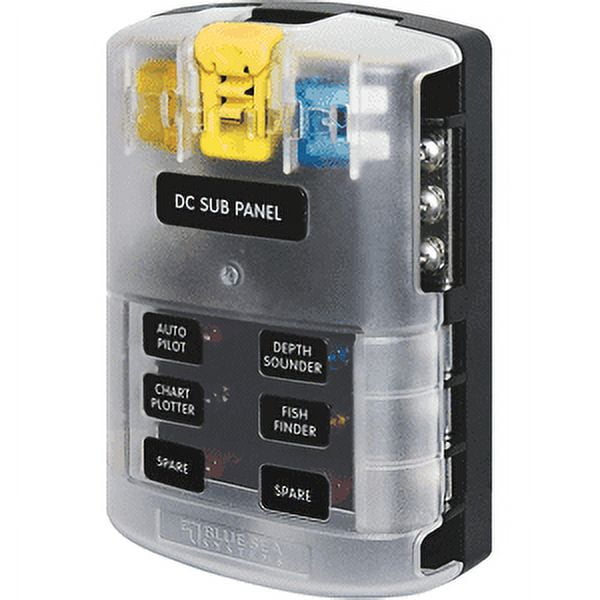
Adding small DC loads is easy until every accessory gets its own inline fuse and the wiring turns into a troubleshooting headache. For those seeking a reliable solution for marine, RV, van, or solar off-grid DC wiring, the Blue Sea Systems 6-Circuit ST Blade Fuse Block with Cover (Model 5025) from Blue Sea Systems is designed to centralize fused circuits and simplify power distribution. While this guide focuses on DC distribution for mobile and off-grid setups, those managing home-wide AC power should consult our Eaton Single-Pole Combination AFCI Circuit Breaker review to understand the differences between low-voltage DC and high-voltage AC safety standards. If you're building out a utility room, you might also consider a Wayne ESP25 battery backup sump pump guide or a Ridgid SP-650C guide for critical home protection.
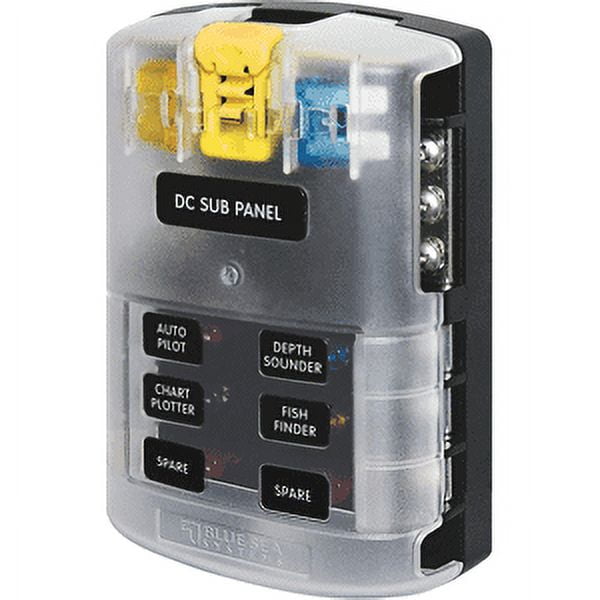
Best Compact DC Fuse Block: Blue Sea Systems 6-Circuit ST Blade Fuse Block with Cover
Score: 9.2/10. A well-built, easy-to-service fuse block for organizing up to six standard ATO/ATC blade-fuse circuits in marine, RV, automotive, solar, and off-grid DC systems.
Related parts & accessories
Blue Sea Systems 6-Circuit ST Blade Fuse Block with Cover
The Blue Sea Systems 6-Circuit ST Blade Fuse Block with Cover is designed to bring order to small DC electrical systems (see our Blue Sea Systems (5025) Review for a performance deep-dive).
Related parts & accessories
Instead of running a separate inline fuse holder for every light, pump, fan, radio, USB charger, refrigerator control line, or monitoring device, this block lets you distribute power through up to six individually fused branch circuits. This makes the installation cleaner and simplifies future troubleshooting.
For comprehensive circuit protection, we suggest the Littelfuse ATO 5-30 Amp Blade Fuse Assortment Pack (see our Littelfuse (00940400Z) review) to ensure you have all necessary ratings on hand.
Its use of standard ATO/ATC blade fuses is one of its biggest practical advantages. These fuses are widely available, easy to carry as spares, and simple to inspect and replace. For RV, van, boat, and off-grid home energy setups (often paired with portable power like the Westinghouse iGen4500), that matters: if a circuit opens while you are away from a workshop, you do not want to hunt for a rare fuse format.
Avoid downtime during trips by pairing this block with a Littelfuse ATO 5-30 Amp Blade Fuse Assortment Pack to maintain a stock of essential spares.
The included transparent cover helps protect the terminals from accidental contact and gives the installation a more finished appearance. It also makes the block easier to label and visually inspect, which is useful in compact electrical compartments where multiple DC loads may be added over time. For marine and mobile environments, the covered layout is a major upgrade over loose fuse holders or exposed terminal strips.
This fuse block is best for builders who are already working with a 12V or 24V-style DC accessory system and want a reliable distribution point for moderate branch loads. It is critical to remember that this is a distribution tool, not a primary safety disconnect. It is not a substitute for correct wire sizing, a main battery fuse, overcurrent protection close to the power source, or dedicated Blue Sea Systems Marine Thermal Circuit Breaker for DC Applications (see our Blue Sea Systems (5025) Review) for high-current equipment like inverters and large chargers.
Pros
- Organizes up to six individually fused DC branch circuits
- Uses widely available ATO/ATC blade fuses
- Transparent cover reduces accidental contact and keeps installation tidy
- Excellent fit for RVs, boats, vans, and solar accessory panels
- Cleaner and easier to troubleshoot than multiple scattered inline fuse holders
- Strong reputation for build quality and durability
Cons
- Only six circuits; larger systems may outgrow it quickly
- Fuses are typically purchased separately
- Not intended to replace main battery or high-current protection
- Requires proper crimping and labeling for professional results
Disclaimer: We may earn a commission from qualifying purchases made through links in this guide.
| Specification | Blue Sea Systems 6-Circuit ST Blade Fuse Block |
|---|---|
| Product Category | Circuit Breakers & Fuses |
| Model Number | 5025 |
| Fuse Type | Standard ATO/ATC blade fuses |
| Number of Fused Circuits | 6 branch circuits |
| Cover | Included transparent protective cover |
| Typical Applications | Marine, RV, automotive, van, solar, backup power |
| Best Use | Centralized low-voltage branch-circuit distribution |
Comprehensive Guide: How DC Fuse Blocks Work
To understand why the Blue Sea Systems 5025 is a critical component for any off-grid or mobile build, it is important to understand the role of "Branch Circuit Protection." In a basic electrical setup, power flows from a battery to a device. If a short circuit occurs—such as a wire rubbing against a metal frame and stripping its insulation—the battery will dump massive amounts of current into that wire. Without a fuse, the wire becomes a heating element, melting the insulation and potentially starting a fire.
The 5025 acts as a central hub. If you are designing a wider home automation or utility system, managing critical backup power is essential (similar to how using the best submersible utility pumps for draining water fast or the Ridgid SP-650C sump pump ensures basement safety); for example, our Wayne ESP25 battery backup sump pump review highlights the importance of redundant power systems for critical home safety.
Instead of one giant fuse for the whole system (which would mean one failure kills every light and pump) or twenty tiny inline fuses (which are hard to find and manage), you have a managed distribution point. The "Bus Bar" inside the block connects to your main power source, and the individual fuse slots branch off to your specific devices. While this handles DC loads, home AC panels use different logic; for a deeper look at residential safety, including our AFCI vs Standard Circuit Breakers guide, including our Square D vs Eaton circuit breaker comparison and our comprehensive guide to Eaton AFCI breakers for home AC safety. This allows you to isolate a single failing device without powering down your entire electrical system.
For those transitioning from basic automotive wiring to a professional off-grid or marine setup, the shift to a centralized block like this represents a transition from "hobbyist" wiring to "engineered" wiring. It allows for a logical layout where all "hot" connections are in one place, making the system easier to document and maintain over years of use.
The Physics of Overcurrent Protection
At its core, a fuse is a deliberately weak point in a circuit. An ATO/ATC fuse contains a small strip of metal designed to melt when current exceeds a specific threshold. When the metal melts, the circuit is broken, and the flow of electricity stops instantly. This prevents the heat from transferring to the insulation of your wiring, which is usually the point of ignition in electrical fires.
In a system using the Blue Sea Systems 5025, you are implementing a "tiered" protection strategy. You have the primary fuse at the battery (such as the Blue Sea Systems Marine Thermal Circuit Breaker for DC Applications), and then you have the branch fuses in the block. This ensures that if a single LED strip fails, only a 5A fuse blows, even if your main feed wire is 10AWG and capable of handling 50A. Without the branch fuse, the 10AWG wire would likely not melt, but the tiny 22AWG wire going to the LED strip would ignite almost instantly.
Many DIYers make the mistake of over-fusing. They assume that a 30A fuse is "safer" because it won't blow as often. In reality, a fuse is not there to protect the device—it is there to protect the wire. If you use a 30A fuse on a wire rated for only 10A, the wire will melt long before the fuse blows. Similar to how we prioritize power redundancy in our review of the Wayne ESP25 battery backup sump pump, the Blue Sea Systems 5025 encourages a disciplined approach to wiring by forcing you to select a specific fuse for every single branch.
Maintain a professional safety map of your electrical system by keeping a Littelfuse ATO 5-30 Amp Blade Fuse Assortment Pack on hand for quick replacements.
Related parts & accessories
Buyer's Guide: What to Consider When Choosing a Fuse Block
When selecting a distribution block for your DC system, several technical factors must be weighed. While the Blue Sea Systems 5025 is a gold standard for compact builds, you should evaluate your needs against the following criteria:
1. Circuit Count and Scalability
The 5025 provides six circuits. Before purchasing, list every device you plan to power. Do you have a water pump, four LED light strips, a USB hub, and a ventilation fan? That is six circuits. If you plan to add a 12V refrigerator or a diesel heater later, you will have already reached capacity. If your list exceeds six, you may need to either buy two 5025 blocks or move up to a larger 12-circuit panel.
However, the 6-circuit model is often preferred for "sub-panels." For example, in a large camper van, a builder might install one block specifically for "cabin" loads (lights, fans) and another block in the "engine bay" or "utility area" (pumps, heaters). This distributes the wiring load and prevents a single massive bundle of wires from having to run across the entire length of the vehicle, which reduces voltage drop and improves organization.
2. Fuse Standard (ATO/ATC vs. Mini)
The 5025 uses standard ATO/ATC blade fuses. These are the larger, traditional automotive fuses. Some newer vehicles use "Mini" or "Micro" fuses. While Mini fuses save space, ATO/ATC fuses are generally more robust and more widely available in every hardware store and gas station across the country. If you are building a system for remote travel (overlanding or sailing), the ubiquity of the ATO/ATC standard is a significant safety advantage.
Standard blade fuses also typically have a higher current capacity range, making them more versatile for a wider variety of accessories. When you choose a block like the 5025 and pair it with a Littelfuse ATO 5-30 Amp Blade Fuse Assortment Pack, you are choosing a standard that has remained virtually unchanged for decades, ensuring that you will be able to find replacements long after the current vehicle model is obsolete.
3. Environmental Protection and Safety
In a marine or RV environment, moisture, dust, and vibration are constant. An open terminal strip is a liability; a dropped wrench or a stray piece of metal can cause a catastrophic short. The 5025's transparent cover serves two purposes: it prevents accidental contact and it protects the fuse contacts from corrosion. When comparing blocks, always prioritize those with covers, especially if the block is located in a place where you might store tools or gear.
Corrosion is the silent killer of DC systems. In saltwater environments, "green crust" (copper oxidation) can develop on terminals, increasing resistance and causing heat buildup. A cover significantly slows this process by reducing the amount of salt-laden air that reaches the connection points. While the 5025 is not waterproof (it is not intended for submersion), the cover provides the essential "splash and dust" protection required for most installation sites.
4. Voltage Compatibility and Load
The Blue Sea Systems 5025 is designed for low-voltage DC systems. Whether you are running a 12V lead-acid system, a 12.8V LiFePO4 battery, or a 24V solar array, the block can handle the distribution. However, the fuse you choose must be rated for the current, and the wire must be rated for the voltage and distance to prevent voltage drop.
It is important to understand the total load. If you have six circuits each pulling 10 amps, your main feed wire must be capable of handling 60 amps. The 5025 is a robust piece of hardware, but it cannot magically increase the capacity of your wiring. Always match your main input wire gauge to the sum of your potential maximum loads to avoid overheating the main terminal.
Step-by-Step Installation and Setup
Installing a fuse block like the 5025 is straightforward, but doing it "correctly" requires attention to detail regarding safety and wire management.
Phase 1: Planning and Positioning
Mount the fuse block as close to the battery as is practical, but in a location that remains accessible. You do not want to have to dismantle your entire dashboard or cabinetry just to change a 5-amp fuse. Use the provided mounting holes to secure the block to a non-conductive surface or a dedicated electrical panel. Ensure the block is mounted firmly to prevent vibration from loosening the connections over time.
Avoid mounting the block directly under a water source or in a place where condensation naturally collects. While the cover helps, the terminals are still open to the air. A vertical mount is generally preferred to prevent dust from settling on top of the unit.
Phase 2: The Main Feed (The "Hot" Wire)
The most critical connection is the main positive feed. This wire runs from your battery (or battery switch) to the main input terminal of the fuse block. Crucial Safety Step: You must install a "Master Fuse"—such as the