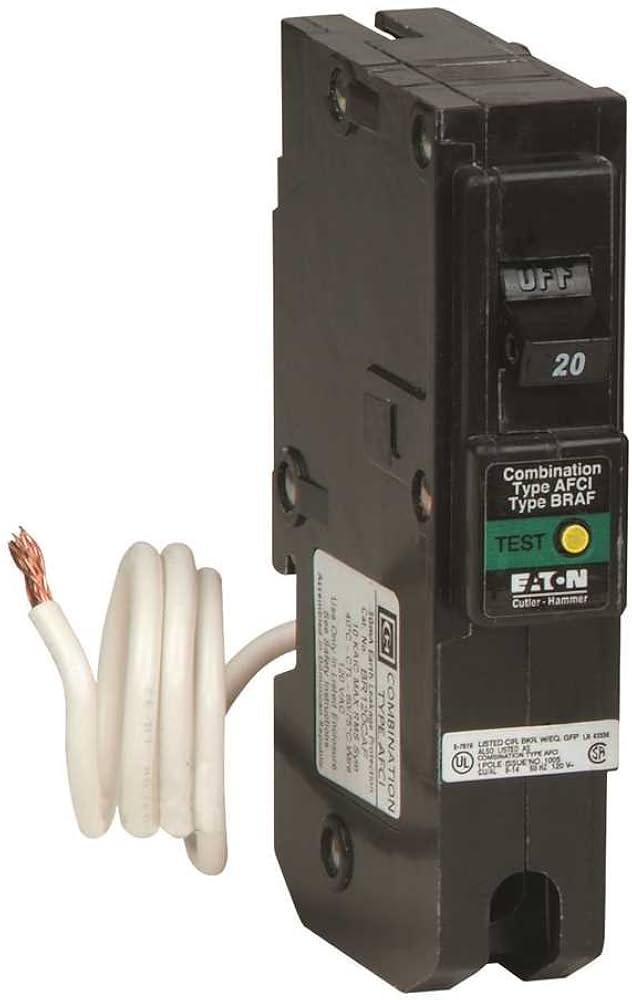
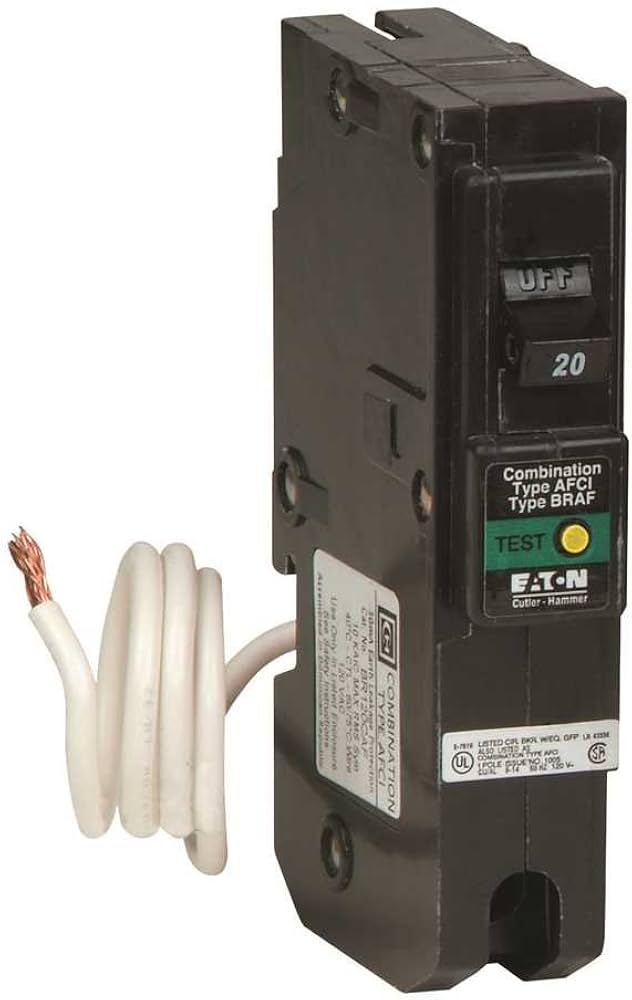
Eaton Single-Pole Combination AFCI Circuit Breaker 15-Amp
Score: 8.6/10 — The Eaton Single-Pole Combination AFCI Circuit Breaker 15-Amp (BRCAF115) is a dependable solution for home electrical safety in Eaton BR panels. This guide examines how it provides essential fire protection and NEC compliance for residential branch-circuit upgrades and panel modernizations.
This review contains affiliate links. We may receive a commission for purchases made through these links at no additional cost to you.
Overview
The Eaton Single-Pole Combination AFCI Circuit Breaker 15-Amp (BRCAF115) is a specialized safety device engineered specifically for the Eaton 200-Amp 30-Space 40-Circuit Indoor Main Breaker Load Center and related BR series panels.
In the realm of residential electrical safety, the shift toward Arc Fault Circuit Interrupter (AFCI) technology (see our full AFCI vs Standard Circuit Breakers guide) represents one of the most significant updates to the National Electrical Code (NEC) in recent decades. Unlike standard thermal-magnetic breakers, which primarily protect against overloads and short circuits, the BRCAF115 is designed to detect the dangerous "arcing"—a process explained in our AFCI vs Standard Circuit Breakers guide—that occurs when electricity jumps across a gap in a damaged wire.This specific model provides 15-amp protection on a single-pole configuration, making it the ideal replacement or upgrade for the most common residential circuits, including bedroom lighting, living room receptacles, and hallway outlets. By utilizing "combination" detection, the BRCAF115 monitors for both series and parallel arc faults—two different types of electrical failures that can lead to residential fires. For homeowners and contractors, this breaker provides a path to compliance with NEC 2014 and subsequent standards, ensuring that the electrical system is guarded against faults that traditional breakers simply cannot "see."
The critical factor for any potential buyer is panel compatibility. The BRCAF115 is built exclusively for the Eaton 200-Amp 30-Space 40-Circuit Indoor Main Breaker Load Center (BR series). Installing a breaker into a panel it was not designed for is not only a violation of the manufacturer's warranty but a significant safety risk that could lead to poor contact, overheating, or failure to trip during a fault. For those with the correct hardware, the BRCAF115 offers a seamless integration that balances high-tech sensing with the rugged reliability expected from the Eaton brand.
How Combination AFCI Technology Works
To understand the value of the Eaton Single-Pole Combination AFCI Circuit Breaker 15-Amp (BRCAF115), it is necessary to understand what it is actually protecting against. Traditional breakers (see our AFCI vs Standard comparison) trip when they detect too much current (overload) or a direct short to ground. However, an arc fault is different; it is a localized discharge of electricity between two conductors. This can happen if a nail is driven through a wire in a wall, if a vacuum cleaner cord is frayed, or if a wire nut becomes loose over time. These arcs can reach temperatures high enough to ignite surrounding building materials long before a standard breaker would ever detect a surge in current.
Looking for different amperage options? Check out the Eaton Single-Pole Combination AFCI Circuit Breaker range to find the right fit for your circuit load.
The "Combination" aspect of the BRCAF115 refers to its ability to detect two distinct types of arcs:
1. Parallel Arc Faults: These occur when electricity jumps between two different conductors (such as hot to neutral or hot to ground). This often happens due to insulation failure or when a conductor is pinched. The BRCAF115 identifies the unique electrical signature of these sparks and trips the circuit instantly.
2. Series Arc Faults: These are more insidious. A series arc occurs along a single conductor, often caused by a break in the wire or a poor connection (like a loose screw on a receptacle). Because the total current flowing through the circuit might remain normal, a standard breaker will not trip. The BRCAF115 uses sophisticated digital signal processing (DSP) to analyze the waveform of the current and identify the specific "noise" patterns created by a series arc.
By combining these two detection methods, the BRCAF115 provides a comprehensive safety net. It effectively monitors the "health" of the wiring throughout the entire branch circuit, from the panel to the last outlet in the room. This level of protection is why AFCI breakers have become mandatory in almost every "dry" area of the modern home.
Furthermore, the electronic brain of the BRCAF115 is constantly sampling the current. While a standard breaker is a passive device relying on a bimetallic strip that heats up, the AFCI is an active monitor. It distinguishes between "normal" arcs—such as those created by the brushes in a universal motor of a vacuum cleaner—and "dangerous" arcs caused by damaged wiring. This discrimination is the result of extensive waveform analysis and is why "Combination" units are preferred over older, single-detection AFCI models which were notorious for tripping on almost any electronic device.
Key Features
Detects both series and parallel arc faults to meet NEC 2014+ requirements, providing superior fire prevention.
Optimized for standard 15A residential branch circuits used in bedrooms, living areas, and hallways.
Precision-engineered for a secure fit within Eaton BR load centers, ensuring maximum contact and reliability.
Allows users to manually simulate a fault to verify the electronic tripping mechanism is operational.
Provides an immediate visual cue to identify which breaker has tripped, speeding up troubleshooting.
Specifically designed to satisfy residential electrical inspections for newer building codes.
Technical Specifications
| Product Name | Eaton Single-Pole Combination AFCI Circuit Breaker 15-Amp |
| Model Number | BRCAF115 |
| Category | Circuit Breakers & Fuses |
| Breaker Type | Combination AFCI (Arc Fault Circuit Interrupter) |
| Poles | Single-pole |
| Amperage | 15 Amps |
| Voltage Rating | 120 Volts AC |
| Protection Scope | Series and Parallel Arc Faults |
| Panel Compatibility | Eaton BR Load Centers |
| Testing Method | Integrated push-button test |
| Indicators | Mechanical trip indicator |
| Code Relevance | NEC 2014 and later |
| Mounting | Plug-in/Snap-in for BR panels |
Pros & Cons
Pros
- Comprehensive protection against both series and parallel arc faults.
- Perfect mechanical fit for Eaton BR panels, eliminating installation gaps.
- Easily verifiable operation via the built-in test button.
- Trip indicators significantly reduce the time spent diagnosing dead circuits.
- Essential for passing modern residential electrical inspections.
- High availability through major electrical wholesalers and retail stores.
Cons
- Strictly limited to Eaton BR panels; not a universal fit.
- Significantly higher unit cost than standard non-AFCI breakers.
- Prone to "nuisance tripping" if existing house wiring is old or degraded.
- Requires a neutral connection, which may complicate some very old panel retrofits.
- Not a replacement for GFCI protection in wet areas (kitchens, baths).
Performance Analysis
In real-world residential applications, the Eaton Single-Pole Combination AFCI Circuit Breaker 15-Amp (BRCAF115) functions as a high-precision safety gate. When installed in a properly wired Eaton BR panel, the breaker is virtually invisible until a fault occurs. Its primary performance metric is the speed and accuracy of its trip mechanism. In testing scenarios involving simulated arc faults, the BRCAF115 responds within milliseconds, cutting power before a spark can evolve into a sustained fire.
One of the standout performance aspects is the integration of the trip indicator. In a crowded electrical panel, identifying which breaker has flipped can be a guessing game, especially if several switches are in similar positions. The BRCAF115 removes this ambiguity, allowing a homeowner or electrician to see exactly where the fault occurred. This is particularly helpful during the "commissioning" phase of a remodel, where an electrician may be testing multiple circuits for the first time.
However, users should be aware of the "learning curve" associated with AFCI performance. Because the BRCAF115 is so sensitive to electrical noise, it may trip when connected to certain types of electronic equipment, such as older vacuum cleaners or poorly shielded power supplies. This is not necessarily a failure of the breaker, but rather a reflection of the "noisy" electrical environment of the device. In many cases, the BRCAF115 is actually doing its job by highlighting a piece of equipment that is creating dangerous arcs inside its own chassis.
Detailed Installation and Setup Guide
Installing the Eaton Single-Pole Combination AFCI Circuit Breaker 15-Amp (BRCAF115) is a process that requires precision. We highly recommend reviewing our guide on how to replace a circuit breaker safely at home before beginning, as safe installation and strict adherence to safety protocols are paramount. Because this involves working inside a live electrical panel, it is strongly recommended that this task be performed by a licensed electrician. However, for those qualified to do so, the process follows these critical steps:
1. Power Down and Safety Verification: The most critical step is the total isolation of the panel. The main breaker must be switched off, and the panel voltage must be verified with a calibrated multimeter to ensure the bus bars are not energized. Many panels have "main lugs" or specific configurations where some parts of the bus remain hot even with the main breaker off; therefore, voltage testing at the point of installation is non-negotiable.2. Neutral Connection Strategy: Unlike a standard breaker, the BRCAF115 requires a connection to the neutral bar. This is because the breaker needs to compare the current leaving the panel (on the hot wire) with the current returning (on the neutral wire). If there is a discrepancy, it indicates a fault. Depending on the specific BR panel model, this may involve a "plug-on neutral" system or a dedicated pigtail wire that must be landed on the neutral bus. Failure to connect the neutral correctly will result in the breaker tripping immediately upon being energized.
3. Physical Mounting and Seating: The breaker is snapped onto the bus bar of the Eaton BR load center. A secure, flush fit is essential. If the breaker does not snap in firmly, it may indicate an incompatible panel or a misalignment that could lead to arcing at the bus bar connection. Check for any debris or oxidation on the bus bar before installation, as a poor connection can cause overheating and premature failure of the electronic components.
4. Wiring the Load: The hot wire from the branch circuit is connected to the breaker terminal. Ensure the connection is torqued to the manufacturer's specifications. Loose connections are exactly the kind of faults the AFCI is designed to detect; ironically, a loose screw at the breaker itself can cause the BRCAF115 to trip repeatedly, leading the user to believe there is a fault in the walls when the problem is at the panel.
5. Commissioning and Testing: Once power is restored to the panel, the "Test" button on the face of the BRCAF115 should be pressed. This simulates a fault and should cause the breaker to trip immediately. This verifies that the internal electronic trip unit and the mechanical latch are functioning. If it does not trip, the installation is faulty or the unit is defective.
Maintenance and Long-Term Care
While circuit breakers are generally "install and forget" devices, the BRCAF115 contains electronic components that benefit from periodic verification. We recommend the following maintenance schedule to ensure the safety of your residential electrical system:
Quarterly Testing: Use the integrated test button once every three months. This ensures that the internal electronics have not failed and that the mechanical trip mechanism has not seized due to inactivity. If the breaker fails to trip during a manual test, it should be replaced immediately (refer to our guide on how to replace a circuit breaker safely).
Panel Inspection: Every year, visually inspect the area around the BRCAF115. Look for signs of overheating, such as discoloration of the plastic casing or a "burnt" smell. While rare in professionally installed panels, loose connections at the bus bar can cause localized heating that may degrade the AFCI's sensitive electronic components over time.
Load Audit: As you add new electronics to your home, be mindful of the total load on the 15-amp circuit. While the BRCAF115 handles overloads like a standard breaker, the addition of high-noise devices (like old power tools or cheap LED dimmers) can occasionally introduce enough electrical noise to cause nuisance trips. If you notice an increase in trips after adding a new appliance, try plugging that appliance into a different circuit to determine if it is the source of the noise.
Comprehensive Buyer's Guide: Is the BRCAF115 Right for You?
Choosing the right circuit breaker is not just about amperage; it is about matching the technology to your specific electrical environment and legal requirements. Here is a deep dive into the decision-making process for the Eaton Single-Pole Combination AFCI Circuit Breaker 15-Amp (BRCAF115).
1. The Compatibility Mandate
The most important question is: Do you have an Eaton 200-Amp 30-Space 40-Circuit Indoor Main Breaker Load Center? The "BR" in BRCAF115 denotes the series. Eaton produces multiple lines of panels (such as the CH series), and breakers are not interchangeable between these lines. A BR breaker will not fit securely in a CH panel, and vice versa. Using a non-compatible breaker can lead to "arcing" at the connection point—the very thing this breaker is designed to prevent.
2. AFCI vs. GFCI vs. Standard Breakers
Many homeowners confuse AFCI (Arc Fault) with GFCI (Ground Fault). It is critical to understand the difference:
- Standard Breaker: Protects the wires from overheating due to too much current (overload) or a direct short.
- GFCI (Ground Fault): Protects people from electric shock by detecting current leaking to ground. Mandatory in bathrooms, kitchens, and outdoors. When planning high-moisture installations, such as those described in our Ridgid SP-650C sump pump guide, proper ground-fault protection is non-negotiable. For detailed safety requirements for high-draw basement equipment, refer to our