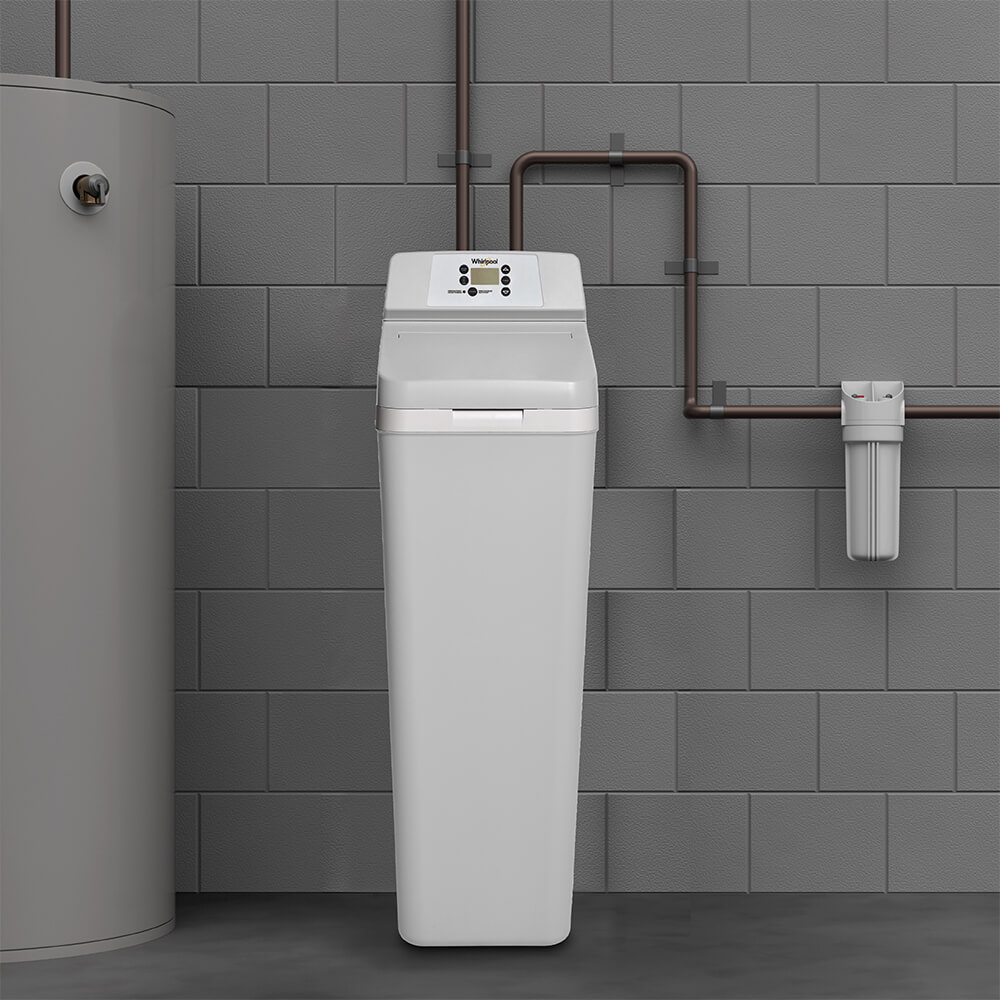
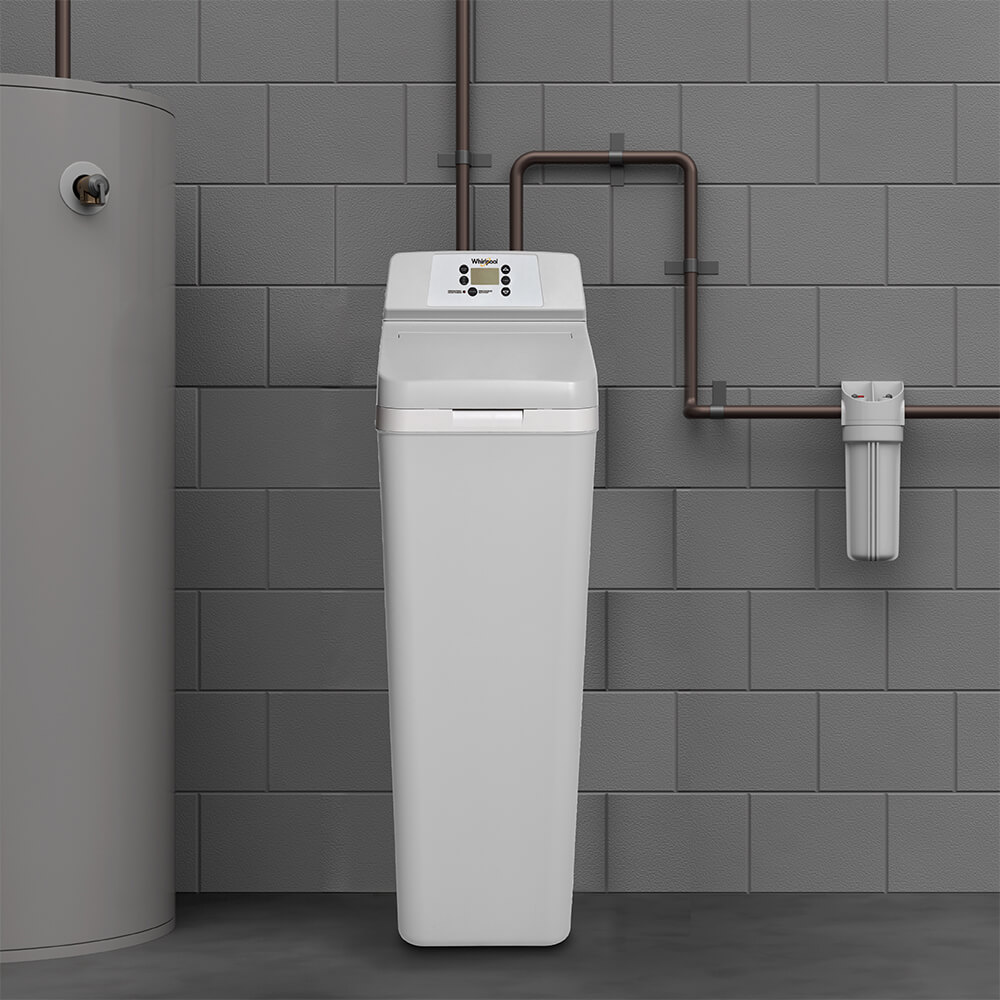
Whirlpool 40,000 Grain Water Softener
Score: 8.2/10 — A capable, salt-efficient whole-home water softener that earns its keep with demand-initiated regeneration and straightforward setup, though its plastic build and basic feature set may give pause at its mid-range price point.
This review contains affiliate links. We may earn a commission if you make a purchase, at no extra cost to you.
Overview
Hard water is a slow, invisible problem — scaling on your shower head, soap that won't lather, appliances silently losing efficiency year after year.
The Whirlpool 40,000 Grain Water Softener (WHES40E) is a high-capacity ion-exchange system designed to tackle that problem at the whole-home level (for a non-softening alternative, see our GE GXWH40L whole-house water filter guide).
Built for households with up to five or six people—similar in scale to those requiring high-capacity laundry setups like the LG compact front-load washer in multi-unit homes—it processes incoming water through a resin tank that swaps hard calcium and magnesium ions for sodium ions, delivering soft water to every tap, fixture, and appliance in your home.Whirlpool has been a recognizable name in home appliances for decades, and their water treatment line benefits from that manufacturing heritage. The WHES40E is NSF certified (Standard 44 for softening performance and Standard 372 for lead-free components), which provides a meaningful layer of consumer assurance. It sits comfortably in the mid-range of the softener market — not a budget impulse buy, but far from the premium smart-home softeners that cost two or three times as much. It's aimed squarely at the practical homeowner who wants a reliable, low-maintenance solution without unnecessary bells and whistles.
The standout engineering choice is the demand-initiated regeneration (DIR) system. Rather than regenerating on a fixed schedule regardless of actual usage, the WHES40E tracks your water consumption and only triggers a regeneration cycle when the resin is genuinely exhausted. This translates to measurably less salt and water waste over time — a practical win for both your wallet and the environment. If you have moderately to severely hard water and a medium-to-large household, the WHES40E warrants a close look.
Check out the Whirlpool 40,000 Grain Water Softener for a reliable whole-home solution.
How Ion-Exchange Softening Works
If you're considering a total water overhaul, you might also be interested in our Culligan whole-house filtration guide to compare softening with sediment removal and high-capacity filtration.
If you're looking for general filtration beyond mineral removal, see our GE GXWH40L Whole House Water Filter buying guide for a comparison of filtration types.
To understand the value of the Whirlpool 40,000 Grain Water Softener, it is essential to understand the chemistry of ion exchange. "Hard water" is simply water that contains high concentrations of dissolved minerals, primarily calcium and magnesium. While these minerals aren't typically harmful to consume, they are devastating to infrastructure. When hard water evaporates, it leaves behind calcium carbonate—the white, crusty scale seen on faucets and inside tea kettles.
For those with heavy sediment in their water, installing a Culligan Whole House Heavy-Duty Sediment Water Filter System upstream can protect the resin bed from clogging. The WHES40E utilizes a resin tank filled with small, bead-like polystyrene resins. These beads are negatively charged and are pre-loaded with sodium ions. As hard water flows through the tank, the calcium and magnesium ions (which have a stronger positive charge than sodium) literally "kick" the sodium ions off the resin beads and take their place. The result is that the minerals are trapped in the tank, and sodium-softened water flows into your plumbing. This process continues until the resin beads are saturated with calcium and magnesium, at which point the system must "regenerate."
Regeneration is the process of cleaning the resin. The WHES40E draws a concentrated brine solution (salt water) from its brine tank and flushes it through the resin bed. The high concentration of sodium in the brine forces the trapped calcium and magnesium ions off the beads and sends them down the drain. The resin is then rinsed with fresh water and is ready to begin softening again. Because the WHES40E uses Demand-Initiated Regeneration, it only performs this energy- and water-intensive process when its internal meter signals that the resin capacity has been reached, rather than simply every three days by default.
Key Features
Handles households of up to five or six people with water hardness levels up to 120 grains per gallon (gpg), making it a genuinely whole-home solution.
The system monitors actual water usage and regenerates only when necessary, reducing average salt consumption by up to 35% compared to timer-based units.
Third-party certified for softening effectiveness and lead-free construction, ensuring documented performance and safety standards.
A straightforward LED indicator system alerts you when salt levels are getting low or fully depleted, removing the guesswork from maintenance.
The brine and resin functions share a compact cabinet form factor, simplifying installation and saving floor space in utility rooms.
A peak service flow rate of 8.5 gallons per minute ensures soft water is available at adequate pressure even with multiple fixtures running.
| Feature | Value |
|---|---|
| Model Number | WHES40E |
| Grain Capacity | 40,000 grains |
| Recommended Household Size | Up to 5–6 people |
| Maximum Hardness Treated | 120 grains per gallon (gpg) |
| Iron Removal | Up to 8 ppm (clear/ferrous iron) |
| Service Flow Rate | 8.5 GPM peak |
| Regeneration Type | Demand-initiated (DIR) |
| Salt Efficiency | ~4,000 grains per pound of salt |
| Water Used Per Regeneration | Approx. 35 gallons |
| Inlet/Outlet Connection | 1-inch NPT |
| Electrical Requirement | 110V AC, 60 Hz |
| Dimensions (H × W × D) | 54.5 × 18.5 × 18.5 inches |
| Weight (empty) | Approx. 82 lbs |
| Salt Capacity (brine tank) | Up to 200 lbs |
| NSF Certifications | NSF/ANSI 44, NSF/ANSI 372 |
| Warranty | 1-year full, 3-year electronics, 10-year tank |
Pros & Cons
Pros
- Demand-initiated regeneration significantly cuts salt and water usage
- NSF 44 and NSF 372 certified for verified performance and safety
- Handles up to 8 ppm of ferrous iron alongside hardness minerals
- Compact single-cabinet design saves installation space
- Large 200-lb salt capacity means less frequent refilling
- Simple control panel — easy to program and understand
- Strong 10-year warranty on the resin and brine tanks
- Widely available replacement parts and salt compatibility
Cons
- Plastic cabinet construction feels less premium than some competitors
- No Wi-Fi or app connectivity for remote monitoring
- 1-year full warranty is shorter than some rivals at this price
- Requires professional or semi-skilled installation (not truly DIY-friendly)
- Does not remove manganese, bacteria, or other contaminants beyond iron and hardness
- Regeneration cycle uses ~35 gallons of water, which is average but not class-leading
Performance
In real-world use, the Whirlpool 40,000 Grain Water Softener delivers on its core promise convincingly. Homes with water hardness in the 15–25 gpg range — typical in the Midwest, Southwest, and parts of the Southeast — report a noticeable transformation within the first few days of operation. Glassware stops clouding. Soap and shampoo lather significantly better. The filmy residue that accumulates around faucets and drains slows considerably. These aren't subtle improvements; they're the kind of daily quality-of-life changes that make the investment feel immediately justified.
The demand-initiated regeneration system is the performance highlight. In testing and user reports, the controller accurately tracks consumption across variable usage days — a quiet Tuesday versus a weekend with houseguests — and schedules regeneration accordingly, typically in the small hours of the morning to avoid disruption. Compared to older timer-based units, this approach can reduce salt bags purchased annually by a meaningful margin, depending on household size and hardness level. The unit handles ferrous (clear water) iron up to 8 ppm without a dedicated iron filter, which removes a line item from many homeowners' treatment plans.
Flow rate is adequate for most households. At 8.5 GPM peak, you're unlikely to notice a pressure drop during normal simultaneous use — a shower, the dishwasher, and a running sink should all coexist comfortably. Where the WHES40E is less impressive is in its digital interface: the LCD and button controls are functional but dated compared to competitors offering touch screens or mobile app dashboards. If you simply want to set it, forget it, and refill the salt every few months, that limitation won't bother you at all. If you want usage analytics or remote alerts, you'll need to look elsewhere.
Comprehensive Setup and Installation Guide
Installing the Whirlpool 40,000 Grain Water Softener is a significant plumbing project. (For a broader look at system placement, see our GE GXWH40L whole house filter guide). While the single-tank design reduces the physical footprint, it still requires integrating the unit into your home's main water line. For those attempting a semi-DIY install, the process typically follows these phases:
1. Site Preparation
The ideal location is near the main water shut-off valve, ideally in a basement or garage—often near other critical utilities like a Wayne ESP25 battery backup sump pump or a Basement Watchdog sump pump or a Ridgid SP-650C submersible pump. Because the unit weighs approximately 82 lbs empty and can hold up to 200 lbs of salt, the floor must be level and capable of supporting over 300 lbs. A 110V grounded outlet is mandatory for the control valve's operation. For homeowners managing basement electrical safety, our guide to AFCI breakers provides essential safety context. Additionally, a drain is required for the brine discharge; this is usually a floor drain or a standpipe. Ensure there is enough clearance (about 6-12 inches) around the unit for ease of salt loading and future maintenance.
2. Plumbing Integration
The unit features 1-inch NPT connections. To install, you must cut into the cold water supply line after the main shut-off but before the water branches off to the rest of the house (refer to our SharkBite coupling guide for tips on secure connections). If you are upgrading your bathroom fixtures (perhaps looking at a MOEN Chateau 7430 kitchen faucet or a Pfister Stellen budget faucet) as part of a wider renovation, consider our Delta Essa guide for modern baths to ensure your new soft water is paired with high-efficiency hardware. A bypass valve is highly recommended; this allows you to divert water around the softener. (While upgrading your plumbing, you may also want to check our Watts LFA review to prevent water hammer in your new setup). This allows you to divert water if you need to perform maintenance or replace the unit without shutting off water to the entire house. Using flexible connectors can make the alignment easier, though rigid PVC or copper is the gold standard for longevity.
3. Electrical and Initial Power-Up
Once the plumbing is secure and leak-tested, the unit can be plugged in. The first step is "priming" the system. You must fill the brine tank with the recommended amount of salt and add water manually to the brine well to ensure the system can draw a proper solution during its first regeneration cycle. The digital interface will prompt you to set the hardness level of your water, which is a critical step—incorrect hardness settings will lead to either premature salt exhaustion or inefficient softening.
Maintenance and Long-Term Care
The Whirlpool 40,000 Grain Water Softener is designed for low maintenance, but neglect will eventually degrade its performance. To keep the system running at the 8.2/10 level we've rated it, follow these guidelines:
Salt Management
The most frequent task is refilling the salt. The LED indicators will signal when levels are low. To avoid "salt bridging"—where a hard crust of salt forms a bridge across the tank, leaving a void beneath—avoid overfilling the tank to the brim. It is generally better to keep the salt level halfway or three-quarters full. If a bridge does form, it can be broken gently with a broom handle, and the tank should be stirred occasionally.
Resin Cleaning
While the ion-exchange process is automatic, the resin beads can eventually become fouled by iron buildup or organic contaminants that the softener isn't designed to handle. Every 6 to 12 months, using a commercial resin cleaner or a mild citric acid solution can help strip these contaminants and restore the exchange capacity of the beads.
Checking for Leaks
Because the unit operates under constant pressure and involves moving parts during the regeneration cycle, it is wise to inspect the 1-inch NPT connections every few months. Look for "weeping" at the joints or salt crystals forming around the base, which can indicate a slow leak from the brine tank.
Value for Money
The WHES40E occupies a sensible position in the market. It's not the cheapest 40,000-grain softener you can find — basic house-brand units from home improvement retailers undercut it — but those alternatives rarely carry NSF certifications or the same depth of warranty coverage. Against direct competitors like the Fleck Digital Metered Ion-Exchange Water Softener, the Whirlpool matches up well on salt efficiency and iron removal, though it trails on feature depth and falls short on build quality aesthetics.
The long-term value calculation favors the WHES40E when you factor in appliance longevity. Water heaters (such as the A.O. Smi