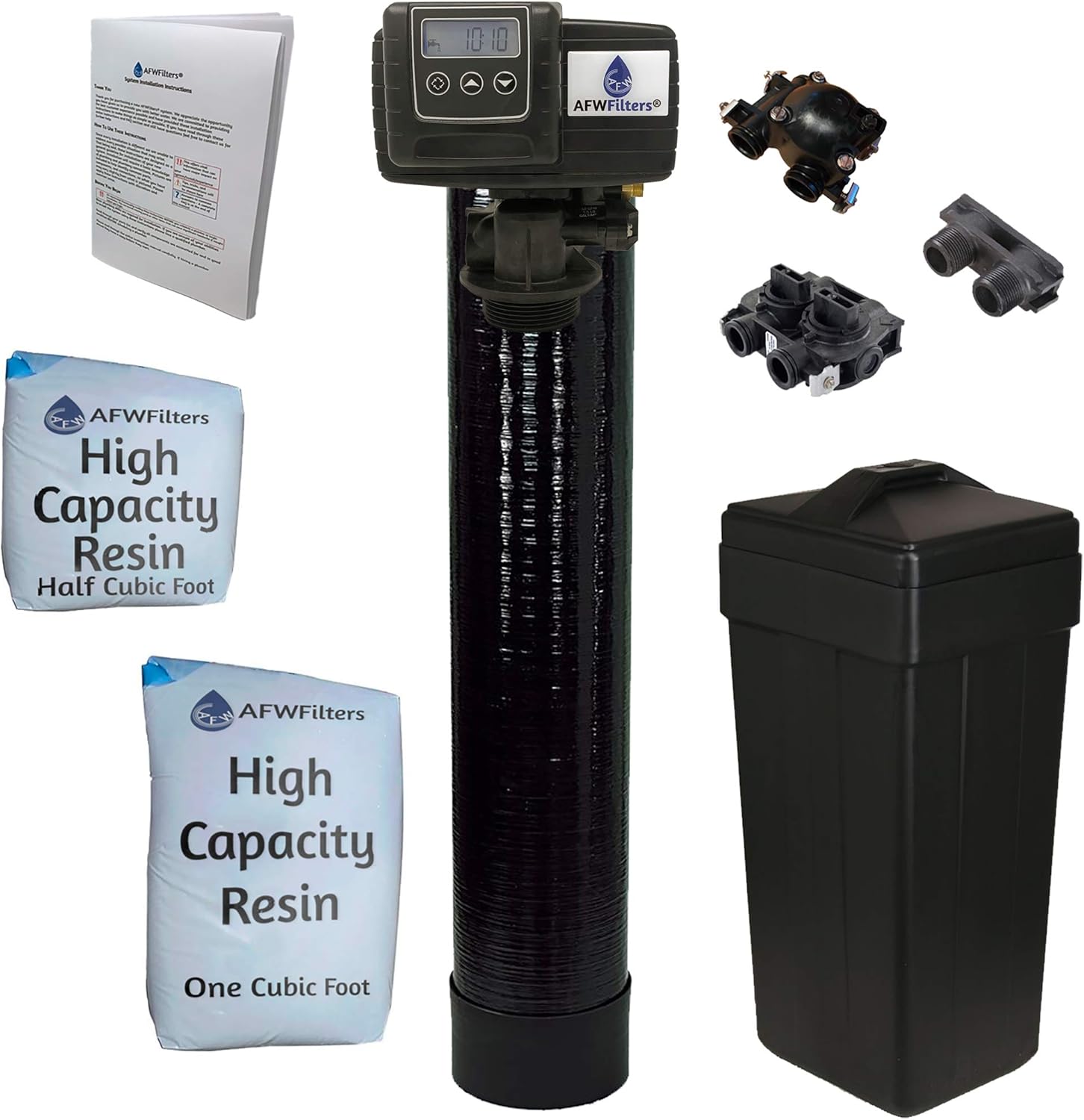
Hard water can leave scale on bathroom and kitchen fixtures (which can be seen in our budget faucet reviews), shorten appliance life, and make soap feel less effective. The Fleck Digital Metered Ion-Exchange Water Softener 48000 Grain is a long-running favorite because it pairs a proven ion-exchange tank with a digital metered control valve that regenerates based on actual water use, making it an ideal choice for medium to large households.
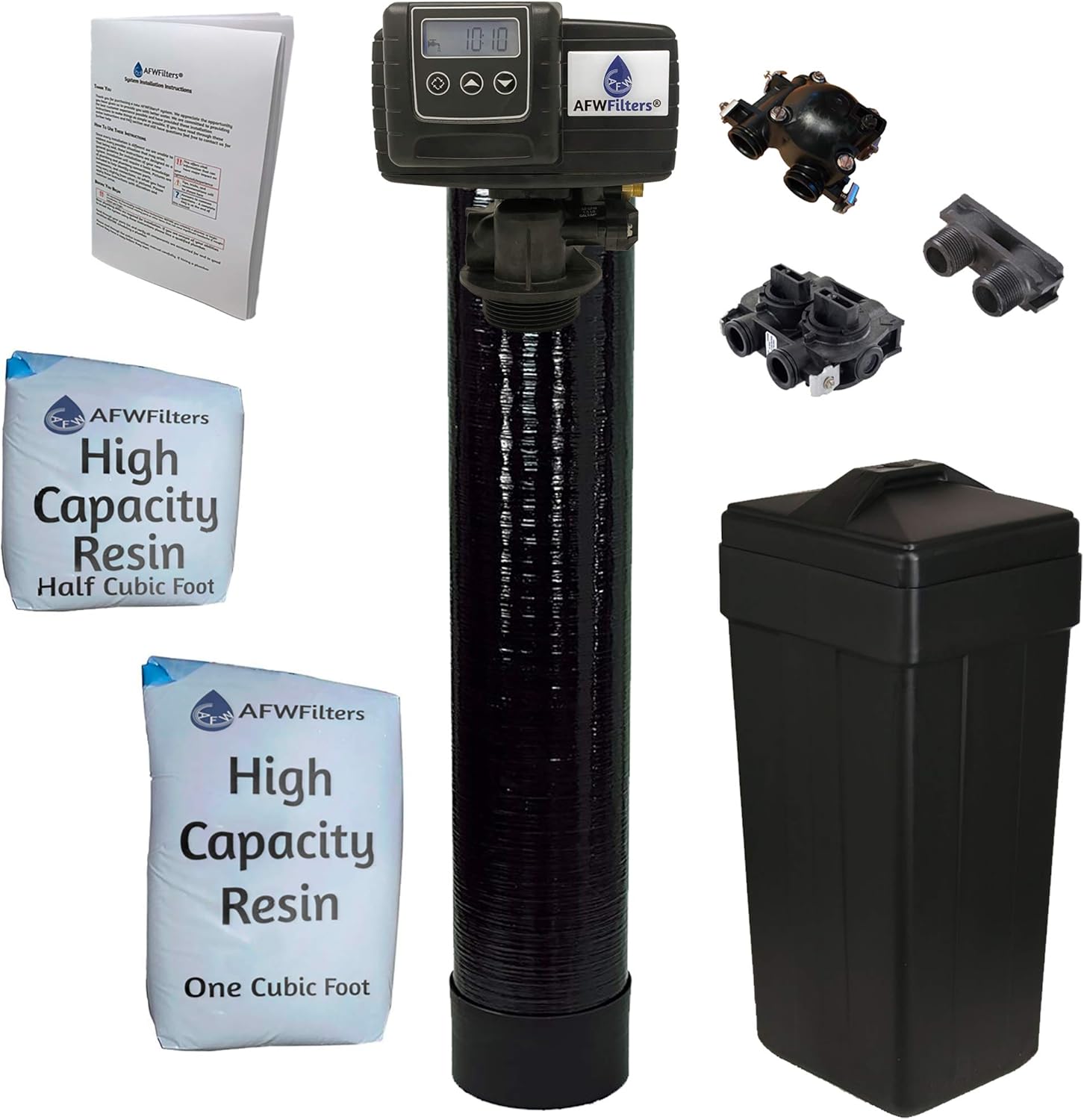
Best Overall: Fleck Digital Metered Ion-Exchange Water Softener 48000 Grain
Score: 9.2/10. A reliable, programmable 48,000 grain softener built around the respected Fleck digital metered valve, making it a strong fit for many 4–6 person homes with moderately to severely hard water.
Fleck Digital Metered Ion-Exchange Water Softener 48000 Grain
The Fleck Digital Metered Ion-Exchange Water Softener 48000 Grain is a classic salt-based water softening system designed to reduce calcium and magnesium hardness through ion exchange. Its headline feature is the Fleck 5600SXT digital metered valve, a widely used control head known for straightforward programming, dependable operation, and broad familiarity among professional plumbers and DIY installers alike.
The 48,000 grain capacity places this system in a practical middle-to-large residential range. For most homes, this means it can efficiently serve a household of around 4–6 people. The actual performance is dynamic; if your water is only moderately hard, the system may regenerate less frequently, saving you money on salt. Conversely, if your water is severely hard or your household has exceptionally high water demands, the digital meter ensures the system cycles exactly when needed to prevent hard water breakthrough.
The digital metered design is a major advantage over basic timer-based softeners. Instead of regenerating on a fixed schedule (e.g., every three days) regardless of whether you were away on vacation or hosting a crowd, the Fleck 5600SXT valve tracks every gallon of water consumption. It triggers regeneration only when the programmed capacity is reached, significantly reducing unnecessary salt and water waste.
This model is best for homeowners who want a proven, serviceable water softener rather than a sealed, proprietary "black box" appliance. It is especially appealing to those who value replaceable parts and a control valve that is recognized by service technicians nationwide. Because it is a full-size installation, buyers should confirm available space for both the resin tank and the brine tank, as well as access to a proper floor drain and electrical outlet.
Pros
- Uses the well-regarded Fleck 5600SXT digital metered control valve.
- Regenerates based on actual water consumption instead of a simple timer.
- 48,000 grain capacity suits many family-size households.
- Good fit for moderately to severely hard water when properly sized.
- Programmable settings allow high precision over salt use.
- Widely recognized design with strong long-term serviceability.
Cons
- Requires manual salt refills and routine brine tank maintenance.
- Installation requires plumbing knowledge or professional assistance.
- Not suitable for homes without an approved wastewater discharge drain.
- Does not remove chlorine, odors, or heavy sediment without whole-house pre-filtration (see our GE GXWH40L whole house water filter guide for detailed options).
- Requires correct initial programming to achieve maximum efficiency.
We may earn a commission from qualifying purchases made through our links.
Technical Specifications
| Specification | Fleck Digital Metered Ion-Exchange Water Softener 48000 Grain |
|---|---|
| Model Number | 5600SXT |
| System Type | Salt-based ion-exchange water softener |
| Rated Capacity | Up to 48,000 grains |
| Control Valve | Fleck 5600SXT digital metered valve |
| Regeneration Style | Metered, programmable based on consumption |
| Best-fit Household | 4–6 people (depending on hardness) |
| Target Water Type | Moderately to severely hard residential water |
| Category | Water Softeners & Filters |
Capacity Note: "48,000 grain" is a system capacity rating. Your actual days between regenerations will vary based on your specific grains per gallon (GPG) hardness and daily water usage.
How Ion-Exchange Water Softening Works
To understand why the Fleck 5600SXT is so effective, it is important to understand the chemistry of ion exchange. Hard water contains high concentrations of dissolved minerals, primarily calcium and magnesium. These minerals are positively charged ions that cling to surfaces, creating "scale" in pipes and preventing soap from lathering correctly. This build-up can restrict water flow in pipes, damage the heating elements of A.O. Smith residential water heaters (learn more about high-efficiency heating in our detailed review) (which benefit greatly from the pre-filtration discussed in our GE whole house water filter guide), and leave stubborn spots on glassware and shower doors.
Inside the resin tank of the Fleck 48,000 grain system are millions of tiny polymer beads called ion-exchange resin. These beads are coated with negatively charged sites that hold sodium ions. As hard water flows through the tank, the calcium and magnesium ions—which have a stronger positive charge than sodium—"kick" the sodium ions off the resin beads and take their place. This process effectively strips the hardness from the water and replaces it with a small amount of sodium, resulting in "soft" water. This happens instantaneously as water passes through the media bed.
Over time, the resin beads become saturated with calcium and magnesium, and the system can no longer soften the water. This is where the regeneration cycle comes in. The Fleck 5600SXT valve directs a concentrated brine solution (salt and water) from the brine tank into the resin tank. The high concentration of sodium in the brine forces the calcium and magnesium ions off the resin and back into the water, which is then flushed down the drain. This "recharges" the resin beads, preparing them to soften the next several thousand gallons of water.
The efficiency of this cycle is what differentiates a high-quality system like the Fleck from budget alternatives. By precisely controlling the volume of brine used and the duration of the backwash and rinse cycles, the 5600SXT minimizes water waste while ensuring the resin is completely stripped of minerals. This ensures that the water entering your home remains consistently soft without unnecessary salt consumption.
Deep Dive: The Fleck 5600SXT Control Valve
The heart of this system is the 5600SXT valve. In the water treatment industry, "metered" valves are considered the gold standard over "timer" valves. A timer valve might regenerate every 72 hours, even if you weren't home for the weekend, wasting salt and water. The 5600SXT, however, uses a flow meter to track every drop. This ensures that regeneration occurs only when the resin capacity is actually exhausted.
Programmability is another key strength. The digital interface allows users to adjust the hardness setting, which tells the valve how many grains of hardness are in each gallon of water. By matching the programming to your local water report, you can optimize the system for the lowest possible operating cost. The valve also supports different regeneration types and timing offsets, allowing you to schedule the brine flush for the middle of the night when water usage is lowest, ensuring no drop in water pressure is felt during peak hours.
From a maintenance perspective, the 5600SXT is designed for longevity. Many proprietary "cabinet-style" softeners use integrated valves that are impossible to repair; when the valve fails, you throw away the whole machine. The Fleck design is modular. If a gasket wears out or a gear slips after a decade of use, those specific parts can be ordered and replaced without replacing the entire tank or control head. This modularity significantly lowers the total cost of ownership over 15 to 20 years.
Additionally, the 5600SXT valve is built with high-grade materials that resist corrosion from the salt brine. The internal seals are designed to withstand thousands of cycles, and the digital display provides clear error codes if the system detects an issue, such as a failure to draw brine. This level of transparency makes troubleshooting much simpler for the homeowner compared to "dumb" systems that simply stop working without any indication of why.
Sizing Guide: Is 48,000 Grains Right for You?
Choosing the wrong capacity can lead to either excessive salt waste or frequent "hard water breakthroughs" where you notice scale returning before the system regenerates. To calculate if the 48,000 grain Fleck system is correct for your home, you need two pieces of information: your water hardness (in grains per gallon) and your average daily water use.
The Calculation Formula
A common way to determine capacity is: (People in household) x (Gallons per person per day) x (Grains of hardness per gallon) x (Desired days between regeneration).
For example, in a 5-person home using 75 gallons per person per day with 15 GPG hardness, and a desire to regenerate every 6 days: 5 x 75 x 15 x 6 = 33,750 grains. In this scenario, a 48,000 grain system is perfect because it provides a comfortable buffer, meaning the system won't have to work at its absolute limit to keep the water soft. This buffer allows for "peak usage" days, such as when you do several loads of laundry or fill a bathtub, without triggering a premature regeneration.
When to Go Smaller
For 1-2 person households with moderate hardness, the Aquasana SimplySoft Salt-Free Whole-House Water Conditioner is often a more efficient, salt-free alternative.
Choosing a system that is too large for your needs can lead to longer periods where the resin sits unused, which can occasionally lead to resin compaction or "channeling," where water carves a path through the resin without actually being treated.
When to Go Larger
If you have an 8+ person household, an Olympic-sized swimming pool that needs filling, or extreme hardness (30+ GPG), you may require a higher capacity system (such as the Whirlpool 40,000 Grain Water Softener as a starting point or a larger 64,000 grain unit) to avoid regenerating every single day. Daily regeneration increases salt costs and wear on the valve.
Installation and Setup Pitfalls
While the Fleck 5600SXT is a robust piece of machinery, its performance is entirely dependent on the quality of the installation. Many homeowners encounter "hidden" challenges during the setup phase that can lead to poor water quality or system failure.
Drainage and Backpressure
The regeneration process flushes a significant amount of salty water. This must go to a proper drain. A common mistake is using a "standpipe" that is too short or not properly vented, which can create a vacuum or backpressure. This can cause the valve to struggle to push water out or, worse, pull sewage back into the softener. Always follow local plumbing codes regarding "air gaps" to prevent cross-contamination. (For broader basement drainage tips, see our Ridgid SP-650C sump pump review or our comprehensive sump pump buying guide). For those with high-sediment water, pairing this with a Culligan Whole House Heavy-Duty Sediment Water Filter System (detailed in our Culligan filtration guide) or a GE whole-house water filter is highly recommended to protect the valve. Ensure the drain line is securely fastened to prevent it from whipping during the high-pressure backwash cycle. To prevent potential leaks in your main lines, consider a Watts LFA-3/4 leak arrestor.
The Brine Tank Level
The brine tank (the separate tank where you add salt) must be perfectly level. If the tank leans, the salt may not dissolve evenly, or the water level may not trigger the float valve correctly. Furthermore, ensuring the brine line (the small tube connecting the valve to the salt tank) is securely fastened and not kinked is critical; a kinked line will prevent the brine from reaching the resin, leading to a "salt-free" regeneration that doesn't actually soften the water.
Warning: Do not install a water softener after a whole-house carbon filter if the filter is prone to leaking or if the water contains high levels of iron, as iron can "foul" the resin beads and reduce the efficiency of the Fleck 5600SXT.
Long-Term Maintenance Strategy
A water softener is not a "set it and forget it" appliance. To ensure the Fleck 5600SXT lasts for 20 years instead of five, a consistent maintenance routine is required. The primary points of failure in most systems are not the valve electronics, but rather the chemical environment inside the brine tank and the health of the resin bed.
Managing Salt Bridges
A "salt bridge" occurs when a hard crust of salt forms across the top of the brine tank, creating a gap between the salt and the water below. This means that even if the tank looks full of salt, the system cannot draw the brine solution needed for regeneration. To prevent this, avoid overfilling the tank beyond the recommended level and occasionally "stir" the salt with a clean plastic broom handle. If you see a hollow cavity beneath a layer of salt, you have a bridge that needs to be broken manually.
Dealing with Salt Mush
Conversely, "salt mush" is a thick, slushy layer of undissolved salt that settles at the bottom of the tank. This is often caused by using low-quality salt with high impurity levels. Salt mush can block the brine intake and prevent the system from drawing the correct amount of salt. The only real cure for severe salt mush is to completely empty the brine tank, clean it out, and refill it with high-purity pellet salt.
Resin Cleaning
Over time, resin beads can accumulate iron, manganese, or chlorine, which "coats" the beads and prevents them from exchanging ions efficiently. While the 5600SXT is highly efficient, adding a commercial resin cleaner (such as a citric acid-based solution) to the brine well every six months can strip these contaminants and restore the system's full capacity.
Comparative Analysis: Metered vs. Timer Systems
Many homeowners are tempted by cheaper "timer-based" softeners. To understand the value of the Fleck 5600SXT, it is helpful to compare the operational logic of these two designs.
| Feature | Timer-Based Systems | Fleck 5600SXT ( |
|---|