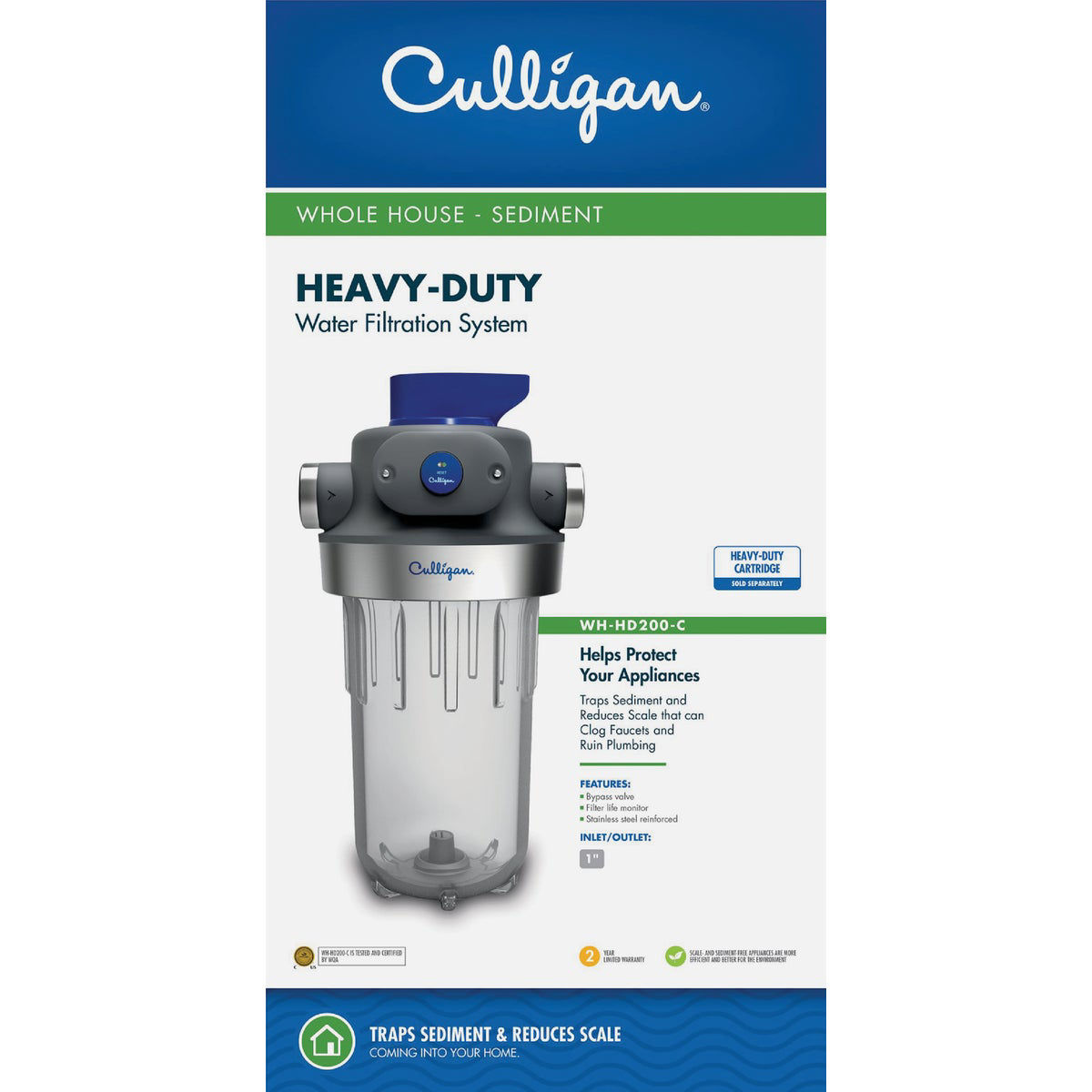
Whole-house sediment filtration is one of the most effective ways to protect your plumbing from grit, rust flakes, and cloudy water. In this buying guide, we examine how the Culligan WH-HD200-C point-of-entry system can extend the life of your fixtures by eliminating harmful particulates. The Culligan Whole House Heavy-Duty Sediment Water Filter System is engineered as a high-flow point-of-entry shield, scrubbing rust, sand, and dirt particulates before they reach your plumbing fixtures. For those comparing options, see our detailed Culligan (WH-HD200-C) review for a deeper dive into its real-world performance.
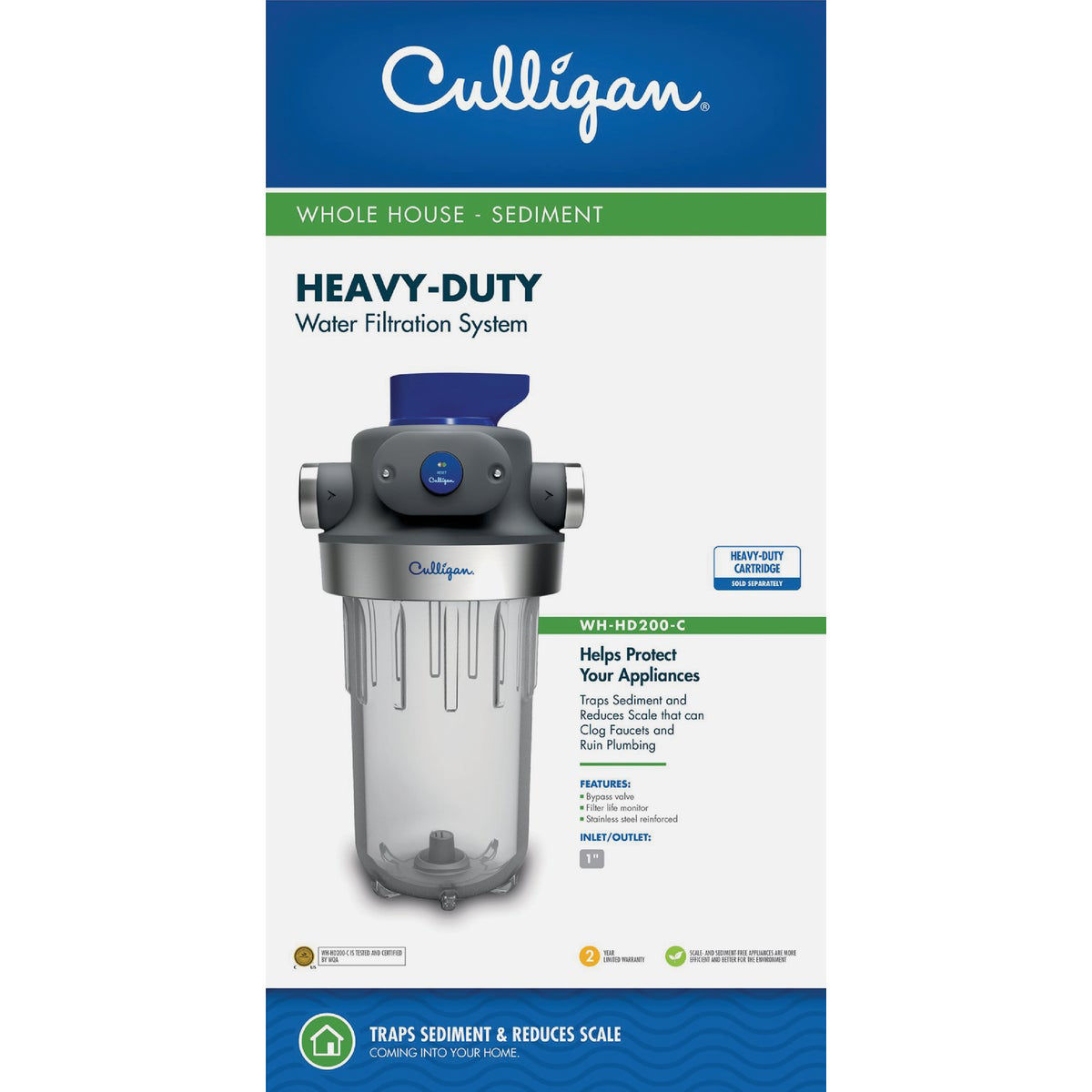
The Culligan Whole House Heavy-Duty Sediment Water Filter System is a heavy-duty sediment filter housing with 1-inch inlet/outlet connections, designed for those who need a durable first line of defense against rust, sand, and dirt. By using standard 10-inch filter cartridges, it offers homeowners a flexible, scalable way to protect their entire plumbing infrastructure from abrasive particles.
Best Overall: Culligan Whole House Heavy-Duty Sediment Water Filter System with 1-Inch Inlet/Outlet
Score: 9.0/10
A strong point-of-entry sediment filter housing for homes that want broad protection against rust, sand, dirt, and other particulates before they travel through plumbing and appliances.
Culligan Whole House Heavy-Duty Sediment Water Filter System
The Culligan Whole House Heavy-Duty Sediment Water Filter System is designed to be installed on the main water line, filtering water as it enters the home. Unlike point-of-use filters that only clean the water at a single kitchen tap, this system provides a comprehensive shield for the entire plumbing network.
By stopping sediment at the source, it prevents the "clogging" effect that often ruins expensive shower valves, dishwasher solenoids, and water heater elements (see our Pelican (PC600) review for more on heater maintenance).
One of the standout features of the WH-HD200-C is its heavy-duty housing. Because point-of-entry filters are subject to the full pressure of the municipal main or a home well pump, the housing must be incredibly robust to prevent leaks or bursts. The 1-inch inlet and outlet ports are sized to maximize flow rates, ensuring that adding filtration doesn't result in a noticeable drop in water pressure throughout the house, provided the correct cartridge is selected.
Flexibility is key with this system, as it utilizes standard 10-inch filter cartridges. This means you aren't locked into a proprietary, expensive replacement cycle. Depending on your specific water quality, you can swap between pleated filters for high-flow capacity, spun-polypropylene filters for deep-dirt trapping, or string-wound filters for heavy sediment loads. This adaptability makes it an ideal choice for various environments, from rural properties with sandy well water to urban homes with aging, rusting galvanized pipes.
It is important to understand that this system is a mechanical filter. It removes physical particles—things you can see or feel—rather than dissolving chemicals. While it is an essential first step, it does not remove dissolved minerals (hardness), bacteria, or chemicals like chlorine. If you are looking for a non-salt option to manage mineral buildup, an Aquasana SimplySoft Salt-Free Whole-House Water Conditioner is a strong alternative, whereas for traditional softening, options like the Fleck Digital Metered Ion-Exchange Water Softener or the Whirlpool 40,000 Grain Water Softener is a reliable industry standard. For homeowners with complex water issues, the WH-HD200-C serves as the perfect "pre-filter" that protects more expensive downstream equipment, such as water softeners or the Express Water Under-Sink Reverse Osmosis System with Alkaline Remineralization and UV Sterilization, from being fouled by sediment.
Pros
- Filters water at the point of entry for whole-home coverage
- Heavy-duty housing is appropriate for main-line filtration
- 1-inch inlet and outlet suit many residential whole-house installations
- Compatible with standard 10-inch cartridges for easier replacement options
- Helps protect appliances, fixtures, and plumbing from sediment buildup
- Good fit for homes with well water or older pipes that shed rust or debris
Cons
- Primarily targets sediment, not hardness, bacteria, or dissolved contaminants
- Requires plumbing installation on the main water line
- Filter life depends heavily on water quality and cartridge selection
- May need more frequent cartridge changes in high-sediment homes
- Does not replace a dedicated water softener or reverse osmosis system
| Specification | Culligan WH-HD200-C |
|---|---|
| Model number | WH-HD200-C |
| Product type | Whole-house sediment water filter system |
| Installation point | Main water line / point of entry |
| Primary purpose | Reduces sediment, rust, sand, dirt, and other particulates |
| Inlet/outlet size | 1 inch |
| Filter cartridge compatibility | Standard 10-inch cartridges |
| Best for | Well water, older plumbing, municipal sediment issues, appliance protection |
Understanding Whole-House Sediment Filtration
To appreciate the value of the Culligan WH-HD200-C, it is helpful to understand what "sediment" actually is in the context of residential plumbing. Sediment isn't just mud; it is a broad category of suspended solids. This includes sand and silt from groundwater, rust scales (iron oxide) from aging iron pipes, calcium carbonate flakes from hard water buildup, and even organic debris that enters the municipal system during main breaks or heavy rain events.
When these particles travel through your pipes, they don't just disappear. They settle in low-flow areas, such as the bottom of your water heater or inside the delicate screens of your faucet aerators (see our MOEN Chateau 7430 Kitchen Faucet Review or our guide on choosing the best bathroom sink faucet for more on high-quality fixture installation). Over time, this leads to "scaling" or "fouling," which restricts water flow and forces your appliances to work harder. A sediment filter acts as a mechanical sieve, trapping these particles in a porous medium before they can enter the home's internal plumbing.
The Culligan WH-HD200-C uses a "depth filtration" approach when paired with the right cartridges. Rather than just filtering on the surface, the water permeates through the material of the 10-inch cartridge, trapping particles throughout the thickness of the filter. This allows the system to hold a significant amount of debris before the pressure drop becomes noticeable, reducing the frequency of maintenance.
For those utilizing municipal water, sediment often enters the home during city infrastructure repairs. When a water main is broken and then repaired, the sudden change in flow direction and pressure often scours the inside of the city pipes, releasing years of accumulated rust and mineral deposits. Without a point-of-entry filter like the WH-HD200-C (see our Express Water (ROALK10DCG) review for a high-performance point-of-use option for another professional option), this concentrated burst of debris travels directly into your home, potentially clogging your dishwasher's inlet valve or leaving brown streaks in your toilet bowls. This is why many homeowners prioritize high-grade filtration as their primary defense.
Deep Dive: How the WH-HD200-C Works
The mechanics of the Culligan WH-HD200-C are fundamentally rooted in physical separation. The system consists of a reinforced polymer housing that holds a replaceable filter element. As water enters through the 1-inch inlet, it is forced through the walls of the filter cartridge from the outside in. This process is known as radial flow.
Depending on the cartridge selected, the filtration happens in different ways. For example, a spun-polypropylene filter is made of melted plastic fibers that are spun into a dense, gradient-density cylinder. The outer layers are coarse, catching larger particles, while the inner layers are tighter, catching smaller ones. This prevents the filter from clogging instantly (surface blinding) and allows it to store more contaminants throughout its volume.
A pleated filter, on the other hand, uses a folded fabric or synthetic material to increase the total surface area exposed to the water. Because there is more "room" for the water to pass through, pleated filters typically have a higher flow rate and can often be cleaned and reused (via backwashing or rinsing) depending on the material, though most residential users prefer the simplicity of replacement.
The 1-inch plumbing ports are critical here. In many standard homes, 3/4-inch piping is common, but the 1-inch ports on the WH-HD200-C minimize the "bottleneck" effect. By maintaining a larger diameter at the filter stage, the system helps preserve the dynamic pressure of the water, ensuring that you don't experience a drop in shower pressure when someone else in the house turns on a faucet.
Installation and Setup Guide
Installing the Culligan WH-HD200-C is a permanent plumbing modification. Because it sits on the main line, it should be installed immediately after the water meter or the main shut-off valve, but before any branching lines go to the rest of the house. This ensures that every single drop of water entering the home is filtered.
1. Plumbing Connections
The 1-inch NPT (National Pipe Thread) connections are designed for standard residential piping. Depending on your home, you may need adapters (such as using a Uponor AquaPEX piping guide for transitions) to transition from copper, PEX, or CPVC to the threaded housing. We strongly recommend using a plumber for this stage to ensure leak-proof seals and proper support for the housing (for more on protecting your basement, see our Basement Watchdog review). For other critical basement protections, see our Ridgid SP-650C Sump Pump Review or explore our Ridgid SP-650C Sump Pump Buying Guide to protect your home against flooding. Ensure that you use high-quality Teflon tape or pipe dope on the threads to prevent weeping leaks, which can lead to slow water damage in basements or crawlspaces. Since basement renovations often involve electrical updates, remember to replace circuit breakers safely if updating your utility area.
2. Housing Mounting
The housing should be secured to a wall or floor using heavy-duty brackets. A full 10-inch filter housing filled with water is significantly heavier than an empty one; without proper support, the weight can put undue stress on the plumbing joints, potentially leading to cracks or leaks over time. If you are managing water pressure via a pump, check our Ridgid SP-650C Sump Pump Buying Guide for more on system integration. Avoid letting the plumbing pipes "hold up" the filter; the brackets should bear the weight of the unit and the water inside.
3. Pressure Management
While the WH-HD200-C is built for high pressure, it is always wise to check your home's incoming water pressure. If you have an extremely high-pressure system (above 80-100 PSI), installing a pressure-reducing valve (PRV) before the filter housing can prolong the life of the seals and prevent catastrophic housing failure. High pressure can force sediment through the filter medium or, in extreme cases, cause the housing to fatigue.
4. The Bypass Loop
A professional installation tip is to include a "bypass loop." This consists of a set of three valves that allow you to divert water around the filter system if you need to perform maintenance or replace a cartridge without shutting off water to the entire house. This is especially useful in large families where a total water blackout for 30 minutes is impractical. By simply turning three levers, you can keep the water flowing while you unscrew the housing and swap the filter.
Comprehensive Maintenance Schedule
The longevity of the Culligan WH-HD200-C is dependent on the maintenance of the internal cartridge. Because this is a non-electric, mechanical system, there are no sensors to tell you when the filter is full. You must rely on a combination of observation and scheduling.
Monitoring Pressure Drop
The clearest sign that a filter needs changing is a drop in water pressure. If you notice that the shower flow has decreased or the laundry machine is taking longer to fill, the sediment filter is likely "loaded." The trapped particles are creating a physical barrier that restricts the flow of water. This is an indicator that the "dirt holding capacity" of the current cartridge has been reached.
Visual Inspection
If you use a transparent housing or can see the cartridge during a change, the color is a primary indicator. A clean white polypropylene filter will turn brown, orange, or grey as it captures rust and dirt. Once the cartridge is heavily discolored and the pleats (if using a pleated filter) are filled with sludge, it is time for a replacement. Do not wait until the water flow stops completely, as this can put excessive stress on your home's plumbing system.
The Replacement Process
- Shut off the main water supply: Close the intake valve leading into the filter.
- Bleed the pressure: Open the pressure relief valve (usually a small red button on top of the housing) or open a downstream faucet to release the trapped pressure. Attempting to unscrew a pressurized housing can be dangerous.
- Remove the canister: Use the provided housing wrench to unscrew the canister. Turn it counter-clockwise.
- Clean the housing: Remove the old cartridge and clean the interior of the housing with a mild soap and water to remove any trapped silt or slime.
- Install a new cartridge: Insert a new 10-inch cartridge. Ensure the O-ring is properly seated and lubricated using food-grade silicone grease to prevent leaks and make the next removal easier.
- Tighten the housing: Screw the canister back on. Tighten firmly with the wrench, but avoid over-tightening, which can crack the plastic threads or distort the O-ring.
- Flush the system: Slowly open the water supply and allow the system to fill. Run a nearby faucet for a few minutes to flush out any air pockets and loose particles from the installation.
Comparing Sediment Filtration to Other Systems
It is common for homeowners to confuse sediment filters with other types of water treatment. To ensure you are buying the right product, it is important to see where the Culligan WH-HD200-C fits into the overall water treatment hierarchy.