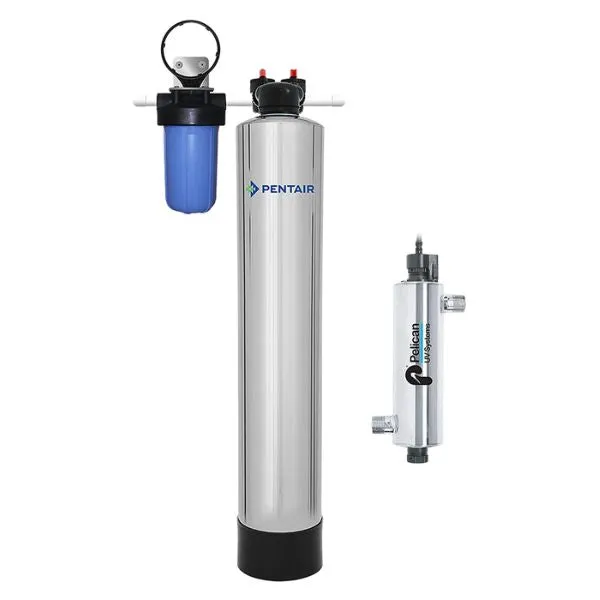
The Pelican Whole House Salt-Free Water Softener and Carbon Filter (PC600) is a high-capacity point-of-entry system designed to eliminate chlorine and prevent limescale buildup without the need for salt, electricity, or complex drainage.
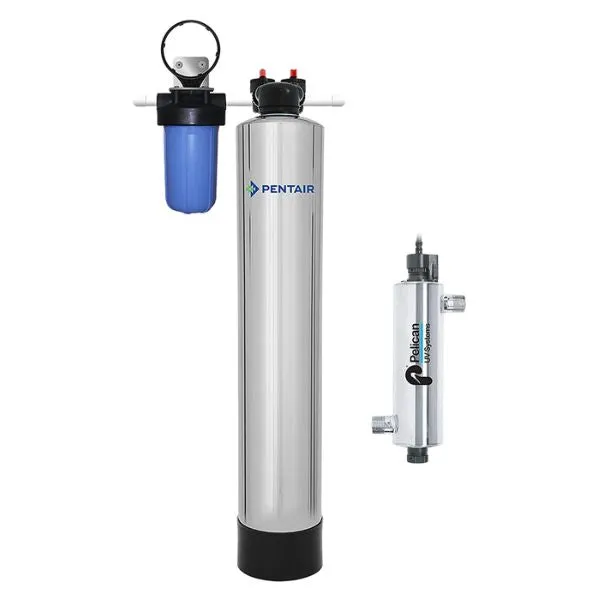
Best Low-Maintenance Whole-House Filter and Conditioner
Pelican Whole House Salt-Free Water Softener and Carbon Filter (PC600) — 8.7/10: A strong pick for homes up to 4 bathrooms that want carbon filtration and salt-free scale reduction in one system, with no electricity, no backwashing, and minimal ongoing maintenance.
Pelican Whole House Salt-Free Water Softener and Carbon Filter (PC600)
The Pelican Whole House Salt-Free Water Softener and Carbon Filter (PC600) is a dual-stage treatment system engineered to address two of the most common issues in municipal water supplies: chemical contaminants (like chlorine) and mineral scale.
Unlike traditional water softeners that rely on a brine tank and ion exchange, the PC600 uses a salt-free conditioning process. This means you get the benefits of scale protection without the "salty" taste or the environmental impact of discharging brine into your local groundwater.
At its core, the system begins with a 5-micron sediment pre-filter. This critical first stage acts as a shield, trapping sand, silt, and rust particles before they can clog the main filtration bed. Once the water passes the sediment stage, it enters the activated carbon and conditioning chamber. The carbon removes chlorine, volatile organic compounds (VOCs), and unpleasant odors (though for maximum purity, many users add an iSpring 6-Stage Under-Sink Reverse Osmosis Water Filter with Alkaline Remineralization at the kitchen sink), while the salt-free conditioning media alters the crystalline structure of calcium and magnesium. This process prevents minerals from sticking to your pipes and fixtures, effectively reducing scale buildup without removing the minerals entirely.
This system is specifically designed for homeowners who prioritize a "set it and forget it" experience. Because it requires no electricity and no backwashing, there are no motorized valves to fail and no power outlets needed in the basement or garage. It is an ideal choice for eco-conscious buyers who want to avoid the chemical additives associated with traditional softening and those who simply lack the space or desire to lug heavy bags of salt into their homes every few weeks.
Pros
- Combines whole-house carbon filtration with salt-free scale reduction
- No salt bags, electricity, drain line, or regeneration cycle required
- Includes a 5-micron sediment pre-filter to protect the main system
- Ideal capacity for homes up to 4 bathrooms
- Environmentally friendly: no wastewater discharge from regeneration
- Significantly lower long-term maintenance than ion-exchange systems
Cons
- Does not remove calcium and magnesium (does not "soften" in the chemical sense)
- Will not provide the "slippery" skin feel associated with salt softeners
- Effectiveness varies based on specific incoming water chemistry
- Sediment pre-filter requires manual replacement over time
- Not recommended for extreme hardness where total mineral removal is required
Detailed Technical Specifications
| Specification | Pelican PC600 Details |
|---|---|
| Model Number | PC600 |
| Product Type | Whole-house carbon filter and salt-free water conditioner |
| Filtration Stages | 5-micron sediment pre-filter → Activated Carbon → Salt-Free Conditioning |
| Recommended Home Size | Up to 4 bathrooms |
| Salt Required | No |
| Electricity Required | No |
| Backwashing Required | No |
| Primary Benefits | Chlorine taste/odor reduction, sediment protection, reduced scale buildup |
| Installation Type | Point-of-Entry (POE) |
Understanding Salt-Free Conditioning vs. Traditional Softening
One of the most common points of confusion for buyers is the difference between a "softener" and a "conditioner." To make an informed decision on the Pelican PC600, it is essential to understand the chemistry at play. Traditional softeners, such as the Whirlpool 40,000 Grain Water Softener, use ion exchange. They replace calcium and magnesium ions with sodium ions. This physically removes the minerals from the water, which is why the water feels "slippery" and soap lathers much more easily. However, this requires a constant supply of salt and creates a salty waste stream during the regeneration cycle.
The Pelican PC600 uses Template Assisted Crystallization (TAC) or similar salt-free conditioning. Instead of removing the minerals, it encourages them to form microscopic crystals that do not stick to the walls of your pipes or the surfaces of your faucets. The minerals remain in the water, but they stay in a suspended state. This means you still get the health benefits of minerals like calcium and magnesium, but you don't get the white, crusty scale buildup on your showerheads—a common issue we address in our Pfister Stellen faucet guide.
If you are looking for a different brand of salt-free technology, the Aquasana SimplySoft Salt-Free Whole-House Water Conditioner is a highly rated alternative.
In-Depth: How the Three-Stage Filtration Works
To appreciate the value of the Pelican PC600, one must look at the specific sequence of water treatment. Each stage is designed to protect the next, ensuring the longevity of the system and the purity of the output.
Stage 1: The 5-Micron Sediment Shield
Water from the municipal main often contains microscopic debris. While invisible to the naked eye, particles like rust from old city pipes, sand, and silt can act as abrasives. If these particles reached the carbon bed, they would coat the active sites of the carbon, effectively "blinding" the filter and reducing its efficiency. The 5-micron pre-filter acts as a mechanical sieve, ensuring only dissolved chemicals and minerals proceed to the second stage.
Stage 2: High-Capacity Activated Carbon
Activated carbon is the industry gold standard for removing chlorine and organic compounds. Through a process called adsorption, the carbon's vast surface area attracts and traps chlorine molecules. This is vital not just for the taste and smell of your drinking water, but for your skin and hair. Chlorine strips natural oils from the skin; by removing it at the point of entry, the PC600 provides a "spa-like" quality to every tap in the house. For those seeking laboratory-grade purity for drinking water, pairing this with an Express Water Under-Sink Reverse Osmosis System is a common upgrade for laboratory-grade drinking water.
Stage 3: The Salt-Free Conditioning Matrix
The final stage is where the "softening" effect occurs. The conditioning media interacts with calcium and magnesium ions. Rather than stripping them out—which can leave water feeling "hungry" or overly aggressive—it changes their physical structure. By transforming these ions into crystals, the system prevents them from bonding to metal surfaces. This protects your A.O. Smith EES-40 water heater (where scale is most damaging), dishwasher, and washing machine (such as the LG WM1455HWA compact washer) from the cumulative damage caused by limescale.
Installation and Setup Requirements
Looking to upgrade your home's water? The Pelican Whole House Salt-Free Water Softener and Carbon Filter offers a streamlined installation process without the need for salt bags.
The installation of the Pelican PC600 is significantly simpler than a traditional softener, but because it is a point-of-entry system, it requires plumbing modifications. If you are weighing different filtration strategies, our GE GXWH40L whole house water filter guide (useful for comparing carbon-only vs conditioning systems) provides a detailed look at alternative point-of-entry (POE) setups, while our Culligan WH-HD200-C filtration system explores heavy-duty sediment options like the Culligan Whole House Heavy-Duty Sediment Water Filter System with 1-Inch Inlet/Outlet.
Depending on your source water, you might also consider a dedicated Culligan Whole House Heavy-Duty Sediment Water Filter System with 1-Inch Inlet/Outlet for superior debris removal. It should be installed at the main water line entering the home, typically after the main shut-off valve but before the water branches off to the rest of the house.Plumbing Considerations
Since the PC600 does not require a drain line for backwashing, you don't have to worry about finding a floor drain or drilling through your foundation to reach an exterior exit (unlike some setups where submersible utility pumps are needed for drainage, as detailed in our Ridgid SP-650C sump pump review). This eliminates one of the biggest hurdles in water treatment installation. The system uses standard plumbing fittings (refer to our SharkBite 1/2-inch coupling for DIY fitting tips), though we recommend using a licensed plumber to ensure leak-proof seals and proper pressure regulation. Once your main filtration is set, ensure your fixtures are up to the task; we've reviewed high-quality options like the MOEN Chateau 7430 kitchen faucet (see also our detailed review) for the kitchen.
The Importance of a Bypass Valve
It is highly recommended to install a three-valve bypass system around the Pelican PC600. A bypass allows you to divert water around the filter entirely. This is crucial for two reasons: first, it allows you to change the sediment pre-filter without shutting off water to the entire house; second, if the system ever requires professional servicing or media replacement, your family still has access to water. Without a bypass, a simple filter change becomes a whole-home plumbing outage.
Long-Term Maintenance Guide
The "low-maintenance" claim of the PC600 is its strongest selling point. However, "low" does not mean "zero." To keep the system performing at peak efficiency, homeowners should follow a basic maintenance schedule.
Managing the Sediment Pre-Filter
The 5-micron sediment filter is the first line of defense. Depending on the turbidity of your incoming water, this filter will eventually become saturated. When the pressure in your home begins to drop slightly, or when the filter cartridge looks visibly dark or clogged, it is time for a replacement. For most municipal homes, this happens every 6 to 12 months. Neglecting this stage can lead to pressure drops and reduced flow in your showers.
Conditioning Media Lifespan
The activated carbon and conditioning media inside the main tank have a much longer lifespan than the pre-filter. While they don't require "regeneration" with salt, the media eventually loses its effectiveness. Depending on the hardness of your water and the volume of use, the media may need to be refreshed every few years. This is a significantly lighter burden than the weekly or monthly salt refills required by traditional systems.
Performance Pitfalls and Limitations
While the Pelican PC600 is a high-performing unit, it is not a "one size fits all" solution. There are specific scenarios where this system may not meet a homeowner's expectations.
Extreme Hardness Scenarios
In areas with "extreme" hard water (where calcium levels are exceptionally high), salt-free conditioners can sometimes be overwhelmed. While they will still reduce scale, the amount of mineral residue may be more noticeable than it would be with a salt-based system. If you are dealing with water that feels like liquid chalk, a traditional softener, such as the Fleck Digital Metered Ion-Exchange Water Softener 48000 Grain or the Whirlpool 40,000 Grain Water Softener, is the more robust choice for total mineral removal.
The "Slippery" Expectation
Many people buy water softeners because they want that specific "silky" feel on their skin and hair. Because the PC600 does not remove the minerals, you will not experience that change in water texture. If that sensory experience is your primary goal, you will be disappointed by any salt-free system, regardless of the brand.
Comparison with Other Whole-House Solutions
| Feature | Pelican PC600 | Traditional Salt Softener | Simple Sediment Filter |
|---|---|---|---|
| Scale Reduction | High (Conditioning) | Maximum (Removal) | None |
| Chlorine Removal | Yes (Carbon) | No | No |
| Ongoing Costs | Low (Filters only) | Medium (Salt) | Low (Filters) |
| Waste Water | None | High (Brine Discharge) | None |
| Electricity | Not Required | Required | Not Required |
| Complexity | Low | High | Very Low |
How We Chose the Pelican PC600
Our methodology for evaluating the Pelican PC600 centered on the balance between performance and ownership friction. We analyzed the system across four primary dimensions: Filtration Efficacy, Installation Complexity, Environmental Impact, and Maintenance Burden.
For Filtration Efficacy, we looked at the multi-stage approach. A system that only conditions water without removing chlorine is incomplete for municipal users. The inclusion of the 5-micron sediment filter and the activated carbon bed makes the PC600 a comprehensive "water quality" system rather than just a "scale" system. We verified that the capacity is appropriate for a medium-to-large household (up to 4 bathrooms), ensuring that flow rates remain acceptable even during peak usage times (e.g., morning showers and dishwasher cycles running simultaneously).
Regar