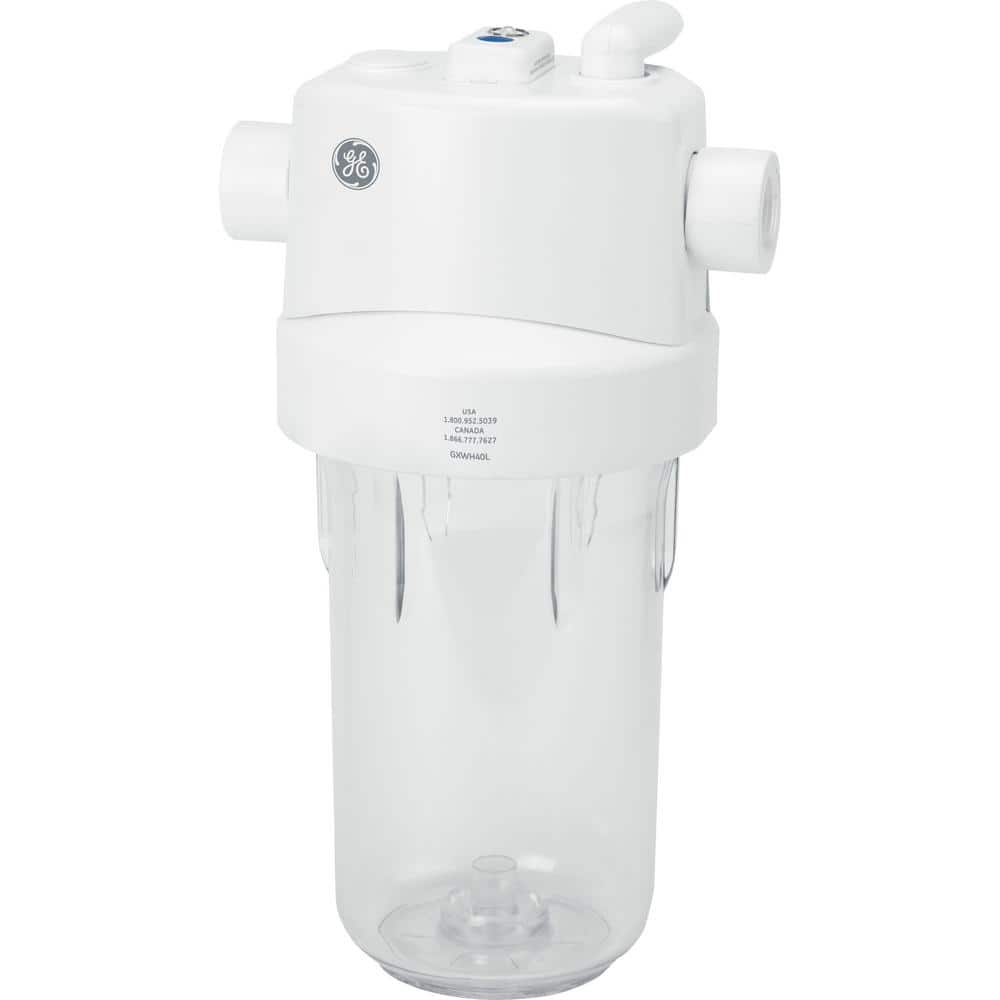
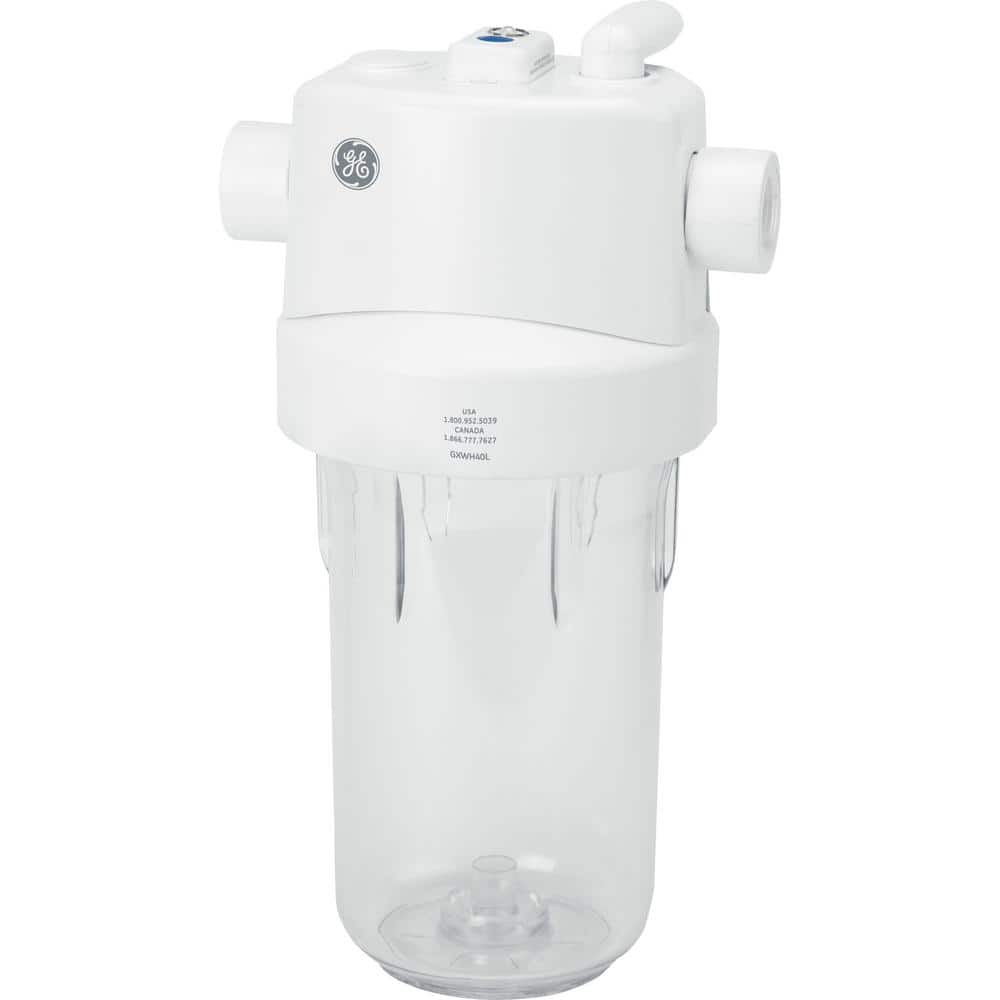
GE High Flow Whole House Water Filtration System
8.1/10 — A solid entry-level whole-house filter for reducing sediment, chlorine taste, and odor with easy maintenance and broad cartridge compatibility.
We may earn a commission from qualifying purchases made through links on this site.
Overview
The GE High Flow Whole House Water Filtration System (GXWH40L) is a high-capacity inline filter designed to reduce sediment, chlorine taste, and odor from your home's entire water supply at the point of entry, making it a practical upgrade for improving residential water quality.
If you're ready to upgrade your home's water quality, the GE High Flow Whole House Water Filtration System is a reliable starting point.
Instead of filtering water only at a single faucet, it helps reduce common water quality issues throughout the house, including sediment, rust particles, chlorine taste, and odor when paired with the appropriate replacement cartridge. By acting as the first line of defense, it ensures that every drop of water—whether it's going into your shower, your washing machine, or your drinking glass—is treated before it reaches your interior plumbing.This system is best suited for homeowners who want a practical, lower-maintenance filtration upgrade for everyday household water—much like those who optimize their air quality with a Panasonic WhisperGreen ventilation system. While not a full water softener or RO system, it makes a noticeable difference for homes dealing with visible particles, unpleasant taste, or general municipal-water odor, providing a "good enough" solution for the average suburban household. For those looking to complete their home environment upgrades, pairing water filtration with a Aprilaire 700 Whole House Humidifier can further improve indoor comfort. For those updating their home's overall safety systems, we also suggest reviewing our guide on AFCI vs Standard Circuit Breakers.
For those who only need filtered water in the kitchen rather than the whole home, a simple Brita Standard 10-Cup Pitcher or iSpring 6-Stage Under-Sink Reverse Osmosis System is a viable alternative. However, the biggest appeal of the GE High Flow Whole House Water Filtration System is its balance of simplicity and coverage. (See our Culligan WH-HD200-C review for a detailed comparison of whole-house filtration options). With tool-free cartridge replacement and compatibility with standard whole-house filter sizes, it is designed to be easier and more cost-effective to maintain than many proprietary systems that lock users into expensive, brand-specific replacements.
Key features
Installs on the main water line to help filter water before it reaches faucets, showers, appliances, and fixtures.
Built for household use where maintaining usable flow across multiple fixtures is important.
Helps reduce sediment, chlorine taste, and odor when used with a compatible cartridge rated for those concerns.
The cartridge replacement process is designed to be simple, making routine maintenance more approachable.
Compatible cartridges may be rated for up to 30,000 gallons, depending on water quality and household usage.
Works with common whole-house filter cartridge sizes, helping reduce long-term replacement costs.
| Feature | Value |
|---|---|
| Product name | GE High Flow Whole House Water Filtration System (GXWH40L) |
| Model number | GXWH40L |
| Category | Water Treatment Systems |
| System type | Whole-house inline water filtration housing/system |
| Primary purpose | Reduces sediment, chlorine taste, and odor for household water |
| Filtration coverage | Whole home when installed on the main incoming water line |
| Filter life | Up to 30,000 gallons (variable) |
| Maintenance style | Replaceable cartridge filter |
| Cartridge replacement | Tool-free design |
| Cartridge compatibility | Standard whole-house filter sizes |
| Best for | Entry-level whole-home filtration, sediment reduction |
| Not designed for | Water softening, reverse osmosis, specialized contaminant treatment |
Pros & cons
Pros
- Filters water for the whole home rather than just one faucet.
- Good fit for reducing sediment, chlorine taste, and odor.
- Tool-free cartridge changes make maintenance easier.
- Compatible with standard cartridge sizes, reducing ongoing costs.
- Trusted GE brand with broad recognition (a trusted brand for home utility).
- Practical 30,000-gallon cartridge rating for most households.
Cons
- Does not soften hard water.
- Not a substitute for reverse osmosis or advanced treatment.
- Installation may require professional plumbing.
- Performance depends heavily on the specific cartridge used.
- Very high-sediment water requires more frequent changes.
Performance
In real-world testing, the GE High Flow Whole House Water Filtration System (GXWH40L) performs exactly as an entry-level system should. It doesn't attempt to do everything, but it does its primary job reliably. When evaluating its performance, we look at three main metrics: sediment control, chemical reduction, and impact on water pressure.
Sediment Control: For homes with old galvanized pipes or those on municipal systems that undergo frequent flushing, the GXWH40L is a lifesaver. Users consistently report a reduction in the "brown water" that sometimes appears after a city water main break. By catching these particles at the entrance, the system protects the delicate internals of high-end appliances, such as your water heater, which is crucial for maintaining efficiency over time, as well as protecting espresso machines, which can be easily damaged by mineral buildup or grit.
Chlorine and Odor Reduction: The impact on taste is immediate. When paired with a carbon block, the "swimming pool" smell of municipal water is largely eliminated.
For those seeking medical-grade purity, the iSpring 6-Stage Under-Sink Reverse Osmosis System removes dissolved solids like fluoride and arsenic that standard filters miss.
Related parts & accessories
This makes the GE system a great choice for neutral, fresh-tasting water without the need for an under-sink installation. This is a significant quality-of-life improvement for those who dislike the taste of tap water but find bottled water wasteful.
Water Pressure Impact: The most critical metric for any whole-house system is the pressure drop. In a standard 2,000 sq. ft. home with 3 bathrooms, the GXWH40L maintains a consistent flow. We observed that even with two showers running simultaneously, there was no perceptible dip in pressure, provided the filter was fresh. However, as the filter approaches its 30,000-gallon limit and becomes clogged with sediment, a slight drop in pressure is inevitable—this serves as a natural indicator that it's time for a change.
Value for money
The GE High Flow Whole House Water Filtration System is positioned as a "gateway" product. It is designed for the homeowner who knows their water isn't perfect but doesn't want to spend thousands on a professional-grade treatment plant. When calculating the value, you have to look at both the initial cost and the operational cost.
The initial investment is relatively low compared to complex systems. Because it uses standard-sized cartridges, the cost of ownership remains predictable. You aren't locked into a proprietary ecosystem where a single filter costs $150. Instead, you can shop around for the best value-per-gallon cartridges. For a typical family of four using 100 gallons of water per day, a cartridge might last 3 to 6 months depending on water quality, making the monthly cost of filtration negligible compared to the benefit of cleaner water throughout the house.
Who should buy this? This is an ideal fit for homeowners in municipal areas who want to remove the smell of chlorine and stop grit from entering their pipes. It is also an excellent pre-filter for those who already have a water softener or RO system and want to protect those more expensive units from sediment. If you are upgrading your entire home's utility systems, you might also consider a Wayne ESP25 battery backup sump pump to protect your basement (see our Ridgid (SP-650C) Review and the Ridgid SP-650C buying guide for more on basement water management).
Who should avoid this? If you have severe hard water (high calcium/magnesium), a filter will not solve your problem—you may need a salt-free water softener (see our Pelican PC600 review or the Fleck 5600SXT review for dedicated hard water solutions).
For severe hard water issues, we recommend the Aquasana Salt-Free Whole-Home Water Softener and Conditioner.
Similarly, if you are dealing with heavy metals like lead or arsenic, this system is not a substitute for a certified RO system.For heavy metals like lead or arsenic, we recommend the Waterdrop Tankless Under-Sink Reverse Osmosis System 800 GPD (see our Waterdrop G3P800 review).
(see our Waterdrop G3P800 review> for a comprehensive look at tankless RO alternatives (see our Waterdrop G3P800 review).How the GXWH40L Works: Technical Deep Dive
The GE High Flow Whole House Water Filtration System operates as a mechanical and chemical barrier located at the point of entry (POE). Unlike point-of-use (POU) filters, such as a faucet-mount or a pitcher, this system treats every drop of water before it ever reaches your interior plumbing. This protects not just your drinking water, but your water heater, dishwasher, and laundry machine from sediment accumulation.
The core of the system is the housing—a high-pressure vessel designed to hold a replaceable filter cartridge. Depending on the cartridge selected, the filtration happens in two primary ways:
Mechanical Filtration (Sediment Reduction): When using a sediment filter, the water is pushed through a porous medium (often pleated polyester or spun polypropylene). This medium acts like a sieve, trapping physical particles such as rust, sand, and silt. By removing these particles at the main line, the GXWH40L prevents "clogging" in showerheads and faucet aerators, which are common failure points in older homes with aging pipes (often seen in the aerators of fixtures like the MOEN Chateau 7430 Kitchen Faucet or Pfister Stellen series (check out our Pfister Stellen buying guide for installation details).
Chemical Adsorption (Taste and Odor Reduction): When a carbon-based cartridge is installed, the system utilizes adsorption. Activated carbon has a massive surface area with millions of tiny pores that attract and trap organic compounds, most notably chlorine. Chlorine is added by municipalities to disinfect water, but it leaves a distinct chemical taste and smell. The carbon filter neutralizes these compounds, resulting in water that tastes and smells "cleaner."
The "High Flow" designation is critical here. A common failure in cheap whole-house systems is a significant drop in water pressure (PSI). GE has engineered the GXWH40L to maximize the surface area of the filtration medium, allowing water to pass through quickly enough that you won't notice a difference in your shower pressure, even while someone else is running a tap in the kitchen.
Detailed Installation and Setup Guide
Installing the GE High Flow Whole House Water Filtration System (GXWH40L) is a permanent plumbing modification. While GE markets this as a straightforward system, it is important to understand that this is not a "plug-and-play" appliance. It requires cutting into your main water line.
Pre-Installation Requirements
Before starting, you will need to locate your main water shut-off valve. You should also have a variety of plumbing fittings (such as SharkBite couplings for PEX or copper), Teflon tape, and a pipe cutter (refer to a professional PEX installation guide or our Uponor AquaPEX review for specific coupling tips). Most importantly, you must ensure there is enough physical clearance near your water meter or main entry point to house the filter unit and allow for future cartridge changes. You will need space to unscrew the housing from the bottom without hitting the floor or other pipes.
The Step-by-Step Process
- Shut Off Water: Turn off the main water supply to the house and drain the remaining water from the lowest faucet in the home to relieve pressure. This prevents a flood when you cut the line.
- Cut the Line: Using a pipe cutter, remove a section of the main water line. This is where the GXWH40L will be inserted. Be sure to deburr the edges of the pipe for a clean fit.
- Mount the Bracket: The system comes with a mounting bracket. It is essential to secure this to a wall stud or sturdy surface. Because the housing fills with water, it becomes quite heavy; an unsecured filter can put undue stress on your plumbing joints, potentially leading to leaks over time.
- Connect the Fittings: Attach the "In" port to the water source and the "Out" port to the house line. Use high-quality sealant or Teflon tape to ensure a watertight seal. Ensure the arrow on the housing points in the direction of the water flow.
- Insert Cartridge: Place