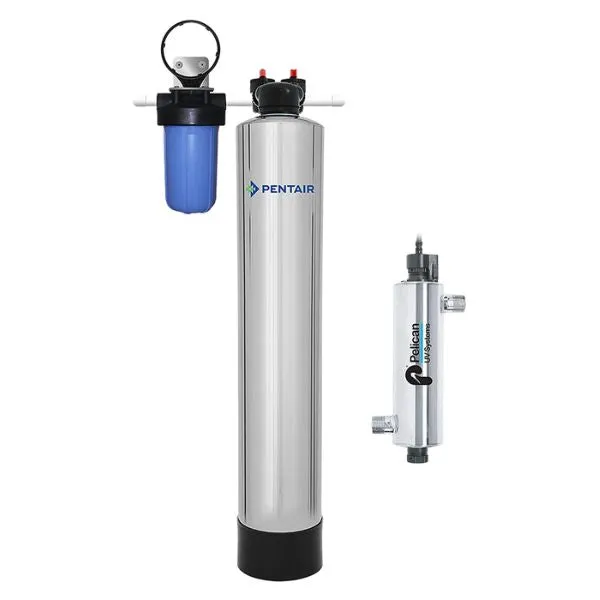
Pelican Whole House Salt-Free Water Softener and Carbon Filter (PC600)
Score: 8.4/10 — A strong low-maintenance whole-house option for reducing chlorine taste and odor while controlling scale without salt, electricity, or backwashing.
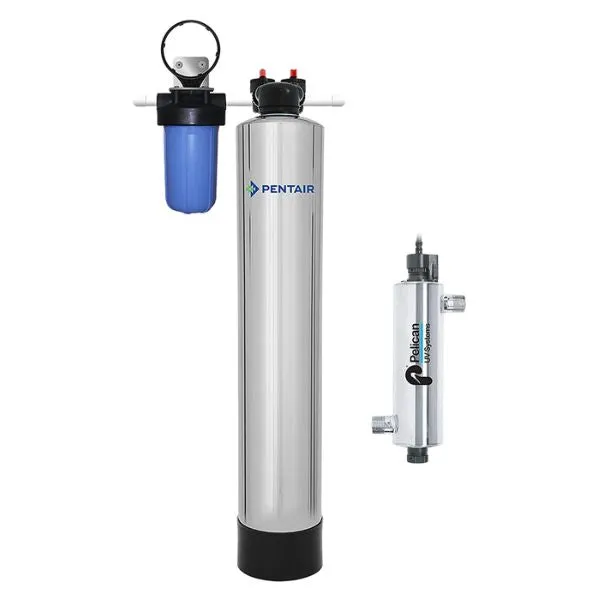
Overview
The Pelican Whole House Salt-Free Water Softener and Carbon Filter is a comprehensive two-in-one water treatment system (see our GE GXWH40L whole house water filter buying guide for more options) designed for homeowners who want a "set-and-forget" approach to water quality. By combining a 5-micron sediment pre-filter, a robust activated carbon stage, and a salt-free conditioning medium, the PC600 addresses three of the most common residential water issues: physical debris, chemical taste/odor, and mineral scale buildup.
Unlike traditional water softeners that use ion-exchange resin and brine tanks to physically remove calcium and magnesium ions, the PC600 is a water conditioner. It uses a specialized medium to alter the way minerals behave in the water, preventing them from crystallizing and clinging to your pipes, faucets (such as the MOEN Chateau 7430) (like the Kohler Artifacts), and heating elements. This makes it an ideal choice for eco-conscious buyers who want to avoid the environmental impact of salt discharge and the labor of hauling heavy salt bags into a basement.
Rated for households with up to 4 bathrooms, the system is engineered for high flow and minimal pressure drop. Because it requires no electricity and no backwashing, it is significantly simpler to install and maintain than industrial-grade softening systems. It is best suited for those living in municipal areas with high chlorine levels or those with moderately hard water who are more concerned with appliance longevity than the "slippery" feel of distilled-quality soft water.
Key Features
Filters water at the main point of entry, ensuring every tap in the house provides conditioned, filtered water.
Blocks sand, silt, and rust particles to protect the internal carbon and conditioning media from clogging.
High-grade carbon reduces chlorine, chloramines, and volatile organic compounds (VOCs) for better taste.
Prevents scale buildup on fixtures and appliances using a chemical-free, salt-free process.
Operates entirely on water pressure; no electrical wiring or outlet is needed for operation.
No regeneration cycles or backwashing means zero water waste during the maintenance process.
| Feature | Value |
|---|---|
| Product Name | Pelican Whole House Salt-Free Water Softener and Carbon Filter (PC600) |
| Model Number | PC600 |
| System Type | Combined Filtration & Conditioning |
| Household Capacity | Up to 4 Bathrooms |
| Sediment Filtration | 5 Micron |
| Media Type | Activated Carbon + Salt-Free Resin |
| Salt Usage | None |
| Electricity | Not Required |
| Backwash Requirement | None |
| Maintenance | Periodic sediment filter replacement |
Pros & Cons
Pros
- Unified system handles both filtration and scale control in one footprint.
- Zero ongoing cost for salt or electricity.
- Eliminates "chlorine smell" in showers and taste in drinking water.
- Eco-friendly: no brine discharge into the sewage system.
- Simple installation compared to traditional softener setups.
- Protects appliances and plumbing from mineral crystallization.
Cons
- Does not physically remove hardness minerals (calcium/magnesium).
- Does not provide the "slick" feel characteristic of salt-based softening.
- Requires a professional plumber for initial installation to ensure leak-free seals.
- Not suitable for extremely high TDS (Total Dissolved Solids) levels.
- Sediment filters need periodic manual replacement.
Performance Analysis
In real-world application, the Pelican Whole House Salt-Free Water Softener and Carbon Filter (PC600) excels in "invisible" performance. For the average homeowner, the most immediate improvement is the olfactory and gustatory change in the water. The activated carbon stage is highly efficient at scrubbing chlorine, which not only makes drinking water taste cleaner but significantly reduces the dryness of skin and hair after showering.
The sediment pre-filter acts as the first line of defense. In homes with older galvanized piping or municipal lines prone to "brown water" events (rust or silt spikes), this 5-micron barrier is essential. It prevents the finer carbon pores from becoming blinded by mud or rust, which extends the life of the more expensive internal media.
Regarding scale control, the PC600 performs well in preventing the "crust" that forms around showerheads and inside coffee makers. While you may still see some white powder (calcium) on a glass after it dries, this powder is non-adherent and wipes away easily, unlike the hard, bonded scale created by untreated hard water.
From a mechanical standpoint, the absence of a control valve or electronic timer is a major reliability win. There are no circuit boards to fry during a power surge and no motorized valves to fail. The water simply flows through the media, making it a highly dependable piece of home infrastructure.
Detailed Engineering: How It Works
To understand the value of the Pelican Whole House Salt-Free Water Softener and Carbon Filter (PC600), one must understand the three-stage process occurring inside the housing. This is not a simple screen; it is a chemical and physical transformation sequence.
Stage 1: Mechanical Filtration (The Guard)
Water first enters the 5-micron sediment filter. This is a physical barrier that stops any particle larger than 5 microns from entering the system. This includes sand, grit, and flakes of rust. By removing these first, the system prevents "channeling" in the carbon bed. Channeling occurs when water creates a path of least resistance through the media, bypassing the filtration process and leaving most of the expensive carbon unused. By ensuring a uniform flow through a clean pre-filter, the PC600 maximizes the efficiency of every single granule of carbon.
Stage 2: Chemical Adsorption (The Purifier)
The water then passes through high-surface-area activated carbon (for those needing even higher purity, see our GE GXWH40L whole-house water filter guide). Carbon works through adsorption—a process where molecules of chlorine and other organic chemicals stick to the surface of the carbon granules. This is fundamentally different from absorption (like a sponge). Adsorption is a surface-level bond. The high porosity of the activated carbon provides millions of tiny "traps" for chlorine and chloramines. This is why users report an immediate disappearance of the "swimming pool" smell in their tap water.
Stage 3: Template Conditioning (The Protector)
Finally, the water hits the salt-free conditioning media. This technology uses a process often referred to as "template" conditioning. In a traditional softener, calcium and magnesium are swapped for sodium ions. In the PC600, the minerals remain in the water, but they are forced into a specific crystalline structure. These crystals are microscopic and stable; they do not bond to metal surfaces. Instead of forming a hard scale layer (limescale) on your water heater's heating element, the minerals simply flow through and out of the tap. This protects the efficiency of your water heater and prevents the clogging of narrow pipes. If you are upgrading your heating system, check out our A.O. Smith EES-40 review to see how efficiency is maintained.
Comprehensive Installation Guide
Installing the Pelican Whole House Salt-Free Water Softener and Carbon Filter (PC600) is a straightforward process for those with plumbing experience, but professional installation is highly recommended to ensure the system is properly braced and leak-free (check out our SharkBite coupling guide for common plumbing connection tips) .
Pre-Installation Requirements
- Location: The system should be installed at the main water entry point, after the main shut-off valve but before any branching lines to the rest of the house. Installing it here ensures that everything from the kitchen sink to the garden hose is treated.
- Space: Ensure there is enough vertical and horizontal clearance for the filter housings and for future filter replacements. Do not tuck it into a space where you cannot easily unscrew the sediment housing. (If your installation area is prone to dampness or flooding, check out our Ridgid SP-650C sump pump review or see our Basement Watchdog BW1033 buying guide for more protection options).
- Bypass Valve: It is strongly advised to install a three-valve bypass (similar to the flow control principles discussed in our Watts LFA-3/4 review). This allows you to route water around the system if you need to perform maintenance or replace the sediment filter without shutting off water to the entire home. This is a standard "best practice" for any whole-home filtration system, as detailed in our Culligan WH-HD200-C buying guide for the Culligan Whole House Heavy-Duty Sediment Water Filter System with 1-Inch Inlet/Outlet.
Step-by-Step Setup Logic
- Shut-off: Turn off the main water supply and drain the lines to prevent flooding. Open the lowest faucet in the house to release pressure.
- Cutting: Cut the main copper or PEX line and install the necessary unions and adapters. Use high-quality solder or press-fit connectors to avoid leaks.
- Mounting: Secure the PC600 housing to the wall or floor using the provided brackets. This is critical; if the system is not braced, the weight of the water-filled unit can put undue stress on the plumbing joints, leading to leaks over time.
- Connection: Connect the inlet (incoming city water) and the outlet (outgoing to home) using high-quality plumbing fittings. Ensure the flow direction arrow on the unit is pointing toward the home.
- Flushing: Once the water is turned back on, run several faucets for 5-10 minutes. You may see some "carbon fines" (black dust) initially; this is normal. These are tiny particles of carbon that were loosened during shipping and will clear quickly.
Maintenance and Long-Term Care
One of the primary selling points of the Pelican Whole House Salt-Free Water Softener and Carbon Filter (PC600) is its low maintenance. However, "low maintenance" does not mean "zero maintenance." To keep the system performing at peak efficiency, follow this schedule.
How often should I change the sediment filter?
Depending on the turbidity of your incoming water, the 5-micron sediment filter should be replaced every 3 to 6 months. If you notice a drop in water pressure throughout the house, it is usually a sign that the sediment filter is clogged and needs replacement. If you live in an area with high silt or old city pipes, you may need to do this more frequently.
Does the carbon media ever expire?
Yes. While activated carbon is durable, it has a finite number of "binding sites." Once all sites are occupied by chlorine or VOCs, the filtration efficiency drops. Depending on usage and water quality, the main media should be evaluated every few years. If you notice the chlorine smell returning, it is time to replace the media.
How do I know if the scale control is working?
Since the minerals are still in the water, a hardness test will not show a change. Instead, observe your fixtures. If the white buildup on your showerheads is reduced or can be wiped away with a cloth rather than scrubbed with vinegar, the system is performing correctly.
The Buyer's Guide: Who is the PC600 For?
Not every home needs a salt-based softener, and not every home is suited for a salt-free conditioner. To determine if the Pelican PC600 is the right fit for your household, consider the following factors.
Water Hardness Levels
If your water is "moderately hard" (containing 10 to 20 grains of hardness per gallon), the PC600 is an excellent choice. It will prevent the destructive nature of the minerals without the hassle of salt.
If you are looking for a similar salt-free alternative, the Aquasana SimplySoft Salt-Free Whole-House Water Conditioner is a highly-rated option.
However, if you live in an area with "extremely hard" water (30+ grains per gallon), you may find that a salt-free conditioner isn't aggressive enough to stop all visible spotting. In extreme cases, you might consider a heavy-duty filter like the Culligan Whole House Heavy-Duty Sediment Water Filter System, or a traditional ion-exchange system such as the Fleck Digital Metered Ion-Exchange Water Softener or the Whirlpool Water Softener, as these are the most effective ways to completely remove minerals.
For high-purity drinking water, consider the iSpring 6-Stage Under-Sink Reverse Osmosis Water Filter.
Environmental Priorities
For those prioritizing a "green" home, the PC600 is the gold standard. Traditional softeners discharge a concentrated brine solution into the groundwater or sewage system during the regeneration cycle. This can contaminate local soil and strain municipal water treatment plants. The PC600 produces zero wastewater and uses no salt, making it an environmentally neutral choice.
Skin and Hair Sensitivity
Chlorine is a primary irritant for people with eczema or sensitive skin. Because the PC600 combines a carbon filter with the conditioner, it removes the chemicals that strip natural oils from your skin. Users often report that their skin feels less "tight" after a shower compared to using a standalone salt softener without carbon filtration.
Value for Money: The Long-Term Calculation
When analyzing the cost of the Pelican Whole House Salt-Free Water Softener and Carbon Filter (PC600), you must look beyond the initial purchase price. Traditional salt softeners have a significant "hidden" cost of ownership that accumulates over a decade.
- Salt Costs: A typical family may spend $100–$300 per year on salt bags. Over 10 years, that is $1,000 to $3,000 just in salt.
- Water Waste: Regeneration cycles can waste hundreds of gallons of water per month. Depending on your local water rates, this is a direct monthly expense.
- Energy Costs: Electric valves and timers add to the monthly utility bill. While small, it is a constant draw.
- Labor: The physical effort of hauling 40lb bags of salt into a basement is a recurring burden that many homeowners eventually grow to hate.
The PC600 eliminates all four of these c