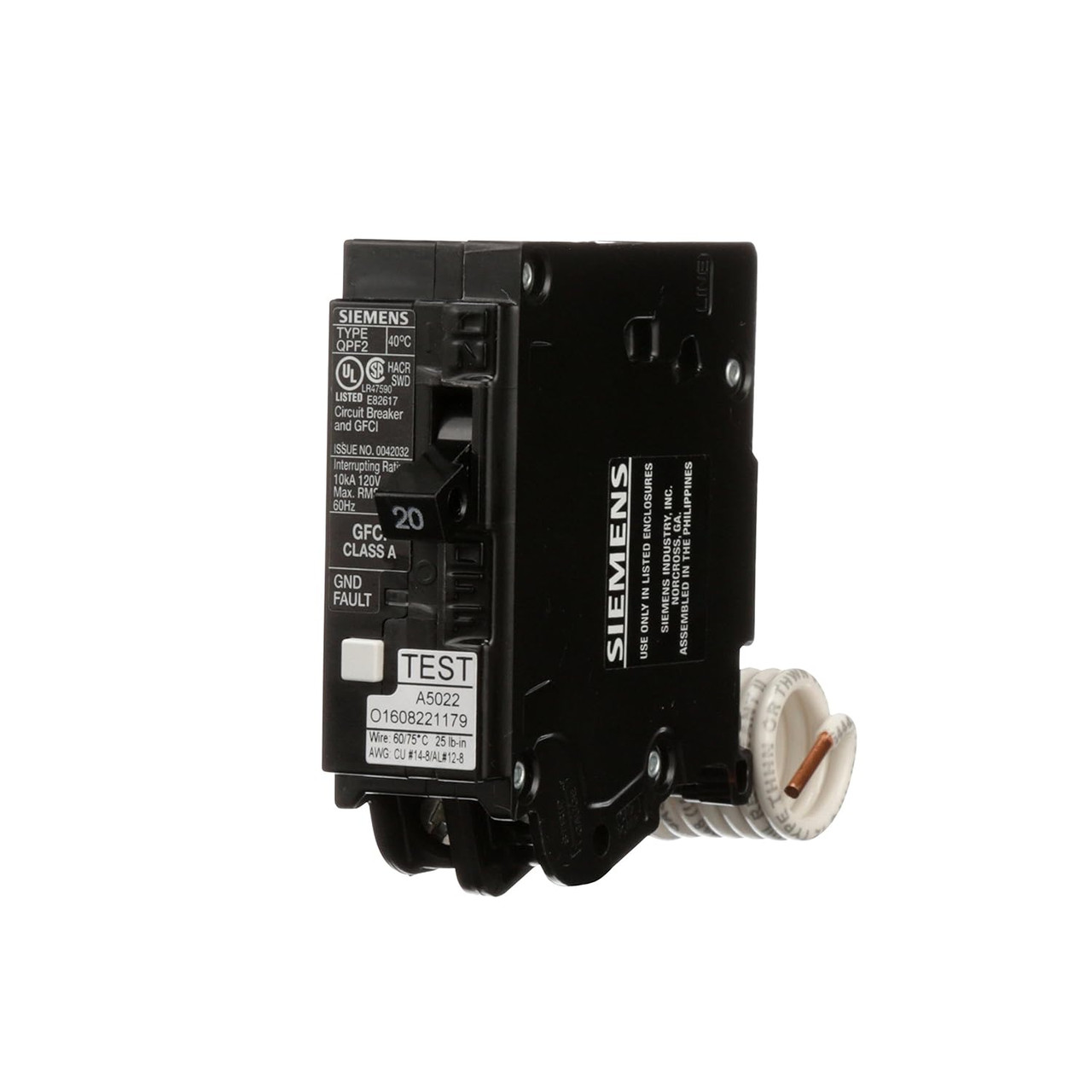
Siemens 20-Amp Single-Pole Self-Testing GFCI Circuit Breaker (QF120A)
Score: 9.0/10 — A reliable panel-level GFCI upgrade for compatible Siemens and Murray load centers, especially for protecting an entire 20-amp branch circuit in higher-risk areas.
Overview
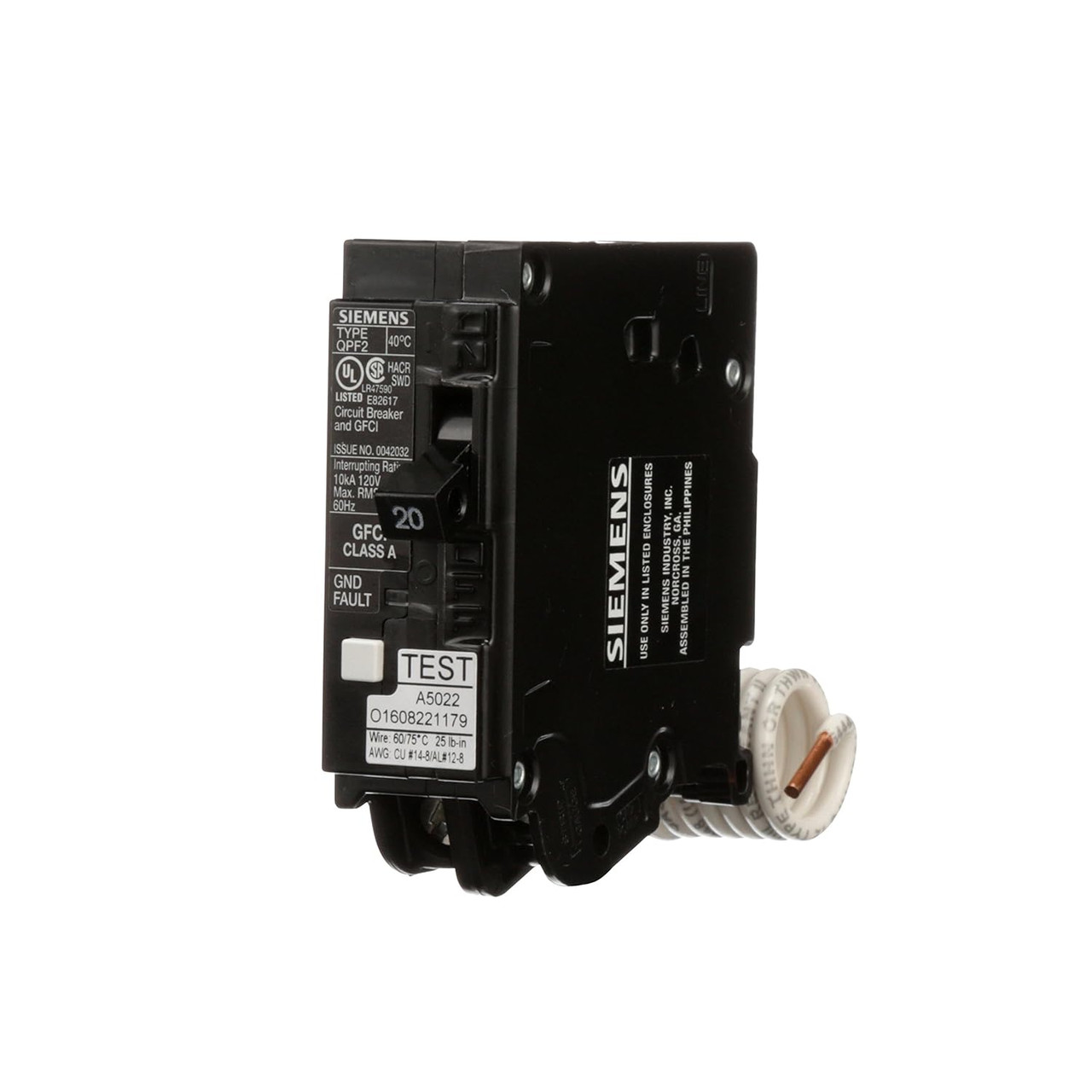
The Siemens 20-Amp Single-Pole Self-Testing GFCI Circuit Breaker is a professional-grade solution (see our guide to the best 20-amp circuit breakers for more options) for adding comprehensive ground fault circuit interrupter (GFCI) protection directly at the electrical load center. By securing the circuit from the source, this breaker ensures safer residential electrical systems—making it an essential upgrade for protecting compatible Siemens and Murray circuits. If you are upgrading your panel, be sure to follow our guide on how to replace a circuit breaker safely at home. While AFCI breakers protect against electrical fires (detailed in our Eaton BRCAF115 review for those using the Eaton Single-Pole Combination AFCI Circuit Breaker) are critical for preventing arc-fault fires, the Siemens GFCI breaker focuses on preventing lethal shocks via ground-fault interruption. Instead of protecting only one receptacle, it helps safeguard the entire connected branch circuit, which makes it especially useful for areas where GFCI protection is commonly required or recommended, such as bathrooms (see our guide on choosing the best bathroom sink faucet), kitchens, garages, and basements, laundry areas, and outdoor circuits.
As a 20-amp, single-pole breaker, the QF120A is aimed at standard 120-volt residential circuits that need both circuit interruption and ground-fault protection. Its self-testing function adds an important layer of confidence by automatically checking GFCI functionality over time, ensuring that the safety mechanism hasn't failed silently. This removes the reliance on the homeowner to remember monthly manual tests, providing a "set it and forget it" safety layer.
This product is best for homeowners, electricians, and serious DIYers who need a panel-mounted GFCI solution (or are considering an Eaton Single-Pole Combination AFCI Circuit Breaker to prevent electrical fires) and already have a Siemens 200-Amp Indoor Main Breaker Load Center or Murray panel.
As with any breaker installation, compatibility and safe installation are critical, so anyone who is not fully comfortable working inside a load center should hire a licensed electrician to ensure your home electrical and security infrastructure is safe.
Key Features
The Siemens 20-Amp GFCI Breaker protects the connected branch circuit from ground-fault conditions, not just a single outlet.
The Siemens 20-Amp Single-Pole Self-Testing GFCI Circuit Breaker is built for 120-volt, 20-amp branch circuits where single-pole protection is required.
The Siemens 20-Amp Single-Pole Self-Testing GFCI Circuit Breaker automatically checks its GFCI protection capability, helping support long-term reliability.
The Siemens 20-Amp Single-Pole Self-Testing GFCI Circuit Breaker is intended for compatible Siemens and Murray load centers.
The Siemens 20-Amp Single-Pole Self-Testing GFCI Circuit Breaker is a practical option when upgrading older circuits that need GFCI protection at the panel.
The Siemens 20-Amp Single-Pole Self-Testing GFCI Circuit Breaker is well-suited for bathrooms, kitchens, garages, and outdoor circuits.
| Feature | Value |
|---|---|
| Product name | Siemens 20-Amp Single-Pole Self-Testing GFCI Circuit Breaker |
| Model number | QF120A |
| Category | Circuit Breakers & Fuses |
| Breaker type | GFCI circuit breaker |
| Amperage | 20 amps |
| Poles | Single-pole |
| Primary protection | Ground fault circuit interrupter protection |
| Self-testing | Yes |
| Installation location | Electrical load center / breaker panel |
| Compatibility | Compatible Siemens and Murray load centers |
Pros & Cons
Pros
- Protects an entire branch circuit from ground-fault conditions.
- Self-testing design supports ongoing GFCI reliability.
- Good retrofit option for bringing eligible circuits up to modern standards.
- Cleaner than adding multiple GFCI receptacles across a circuit.
- Highly compatible with Siemens and Murray load centers.
Cons
- Strictly limited to compatible load centers.
- Higher cost than a standard 20-amp thermal breaker.
- Installation requires working inside the main electrical panel.
- Tripping requires a trip to the panel to reset rather than a local outlet.
Performance
In real-world use, the biggest advantage of the Siemens 20-Amp Single-Pole Self-Testing GFCI Circuit Breaker (QF120A) is that it centralizes GFCI protection at the panel.
Upgrade your panel safety with the Siemens 20-Amp GFCI Breaker, or explore our guide to the best 20-amp circuit breakers for your home.
For a properly wired compatible circuit, this can be more convenient than relying on a single downstream GFCI receptacle, especially when the goal is to protect every receptacle, device, or outlet point on the branch circuit.
This breaker is also appealing because it combines standard overcurrent protection with ground-fault protection in one panel-mounted device. When installed correctly, it should trip immediately when a qualifying ground-fault condition is detected, helping significantly reduce the risk of electric shock in vulnerable, damp areas. This precision is critical in environments like garages or outdoor patios where water ingress is common. If you are dealing with systemic water issues, our Ridgid SP-650C sump pump buying guide provides a roadmap for wet basement protection. For those managing utility areas, we recommend reviewing our Wayne ESP25 battery backup sump pump review or the Ridgid SP-650C sump pump review for comprehensive wet basement solutions (including the Basement Watchdog BW1033 review) (see our guide to submersible utility pumps or the Ridgid SP-650C sump pump buying guide). For those installing specialized DC power in garages or workshops, a Blue Sea Systems Marine Thermal Circuit Breaker for DC Applications (detailed in our Blue Sea Systems 5193 review) may also be necessary for workshops.
The self-testing feature is a major strength. GFCI devices are safety components, and their protective function needs to remain dependable over time. The Siemens 20-Amp Single-Pole Self-Testing GFCI Circuit Breaker (QF120A) helps address the "silent failure" problem by automatically checking its internal circuitry, making it a more modern and safer choice than older manual-test-only solutions.
Installation is generally straightforward for a qualified person familiar with Siemens and Murray load centers. However, the QF120A is sensitive to wiring quality. If there are existing wiring faults, shared neutrals, or moisture problems in the walls, the breaker may trip immediately upon installation. This is actually a performance benefit, as it reveals underlying electrical hazards that a standard breaker would ignore, essentially acting as a diagnostic tool for the integrity of the branch circuit.
How It Works: The Science of Ground Fault Protection
To understand the value of the Siemens 20-Amp Single-Pole Self-Testing GFCI Circuit Breaker (QF120A), it is important to understand what a "ground fault" actually is. In a standard electrical circuit, current flows out from the panel on the "hot" wire and returns on the "neutral" wire. Under normal conditions, the amount of current flowing out and the amount returning are identical. This balance is the baseline for electrical stability.
A ground fault occurs when the electricity finds an unintended path to the ground—such as through a person's body, a puddle of water, or a frayed wire touching a metal junction box. When this happens, some of the current bypasses the neutral wire. The Siemens QF120A constantly monitors the balance between the hot and neutral conductors using a differential current transformer. If it detects a discrepancy as small as 5 milliamperes (mA), it identifies a potential shock hazard and trips the circuit in a fraction of a second—far faster than a standard thermal breaker would respond.
The "Self-Testing" aspect of this breaker is what separates it from basic GFCI breakers. Conventional GFCI outlets and breakers require a human to press a "Test" button monthly to ensure the internal solenoid and sensing electronics are still operational. Over time, these mechanical parts can degrade. The QF120A performs this check electronically and automatically. If the self-test fails, the breaker will typically provide a visual indication (such as a LED light change or failure to reset), alerting the user that the device needs replacement before a real emergency occurs.
Detailed Setup and Installation Process
Installing the Siemens 20-Amp Single-Pole Self-Testing GFCI Circuit Breaker (QF120A) is a high-stakes task. Before you begin, we strongly recommend reviewing our guide on how to replace a circuit breaker safely at home. This process requires strict adherence to safety protocols before attempting panel work. Because this involves the main service panel, the risk of arc flash or electrocution is present. This section is for educational purposes and should not replace the guidance of a licensed professional.
Step 1: Power Down and Safety
Before opening the panel, the main breaker must be switched off to kill power to the bus bars. Even with the main breaker off, the lugs bringing power into the panel remain live; these must be avoided entirely. Use a non-contact voltage tester to confirm the bus bars are dead before touching any components. Wearing insulated gloves and using tools with insulated handles is strongly recommended during this phase of the process; for more safety tips, see our guide on replacing breakers safely.
Step 2: Identifying the Circuit
The user must identify the specific 20-amp circuit that requires GFCI protection. Ensure that the wiring for this circuit is 12-gauge (standard for 20-amp circuits) to prevent overheating. If 14-gauge wire is present, Siemens Single-Pole Plug-In Circuit Breaker 15 Amp (see our Siemens Single-Pole Plug-In Circuit Breaker review) must be used instead of the QF120A to avoid creating a fire hazard. Using a 20-amp breaker on 14-gauge wire is a severe code violation and a significant fire risk because the wire may melt before the breaker ever trips.
Step 3: Mounting the Breaker
The Siemens QF120A is designed to snap onto the hot bus bar of compatible Siemens or Murray panels. The breaker is pushed firmly onto the rail until it clicks into place. Proper seating is critical; a loose connection can cause arcing and heat buildup, which may lead to premature failure or panel damage. If the breaker does not seat fully, do not force it; check for debris on the bus bar or verify that the panel is indeed a compatible model.
Step 4: Connecting the Wiring
The hot wire is secured under the breaker's terminal screw. Unlike some older GFCI styles, the QF120A handles the neutral monitoring internally at the panel, though specific panel configurations may require the neutral wire to be connected to a specific GFCI neutral bar or the breaker itself depending on the load center model. Ensuring the neutral connection is tight is as important as the hot connection to ensure the differential sensing works correctly. Loose neutrals are a primary cause of "phantom trips" in GFCI installations.
Step 5: Testing and Verification
Once installed and the main power is restored, the breaker should be switched to the "On" position. The user should then use a GFCI plug-in tester at the outlets on the circuit to verify that the breaker trips as expected when a ground fault is simulated. This verifies the entire path from the panel to the end of the line. If the breaker trips immediately without any load, it suggests a ground fault already exists in the house wiring that needs to be addressed.
Maintenance and Common Pitfalls
While the Siemens 20-Amp Single-Pole Self-Testing GFCI Circuit Breaker (QF120A) is designed for "install and forget" convenience, there are several maintenance considerations and common installation errors to avoid to ensure the system remains safe and operational over its lifespan.
1. The "Nuisance Trip" Problem
One of the most common complaints with GFCI breakers is the "nuisance trip." This happens when a device with a slight current leak (like an old refrigerator, a damp outdoor extension cord, or some high-end power tools) triggers the breaker. Because the QF120A protects the entire circuit, one faulty appliance in the garage can kill power to every other outlet on that circuit. If this occurs, the solution is not to replace the breaker, but to isolate and identify the leaking applia