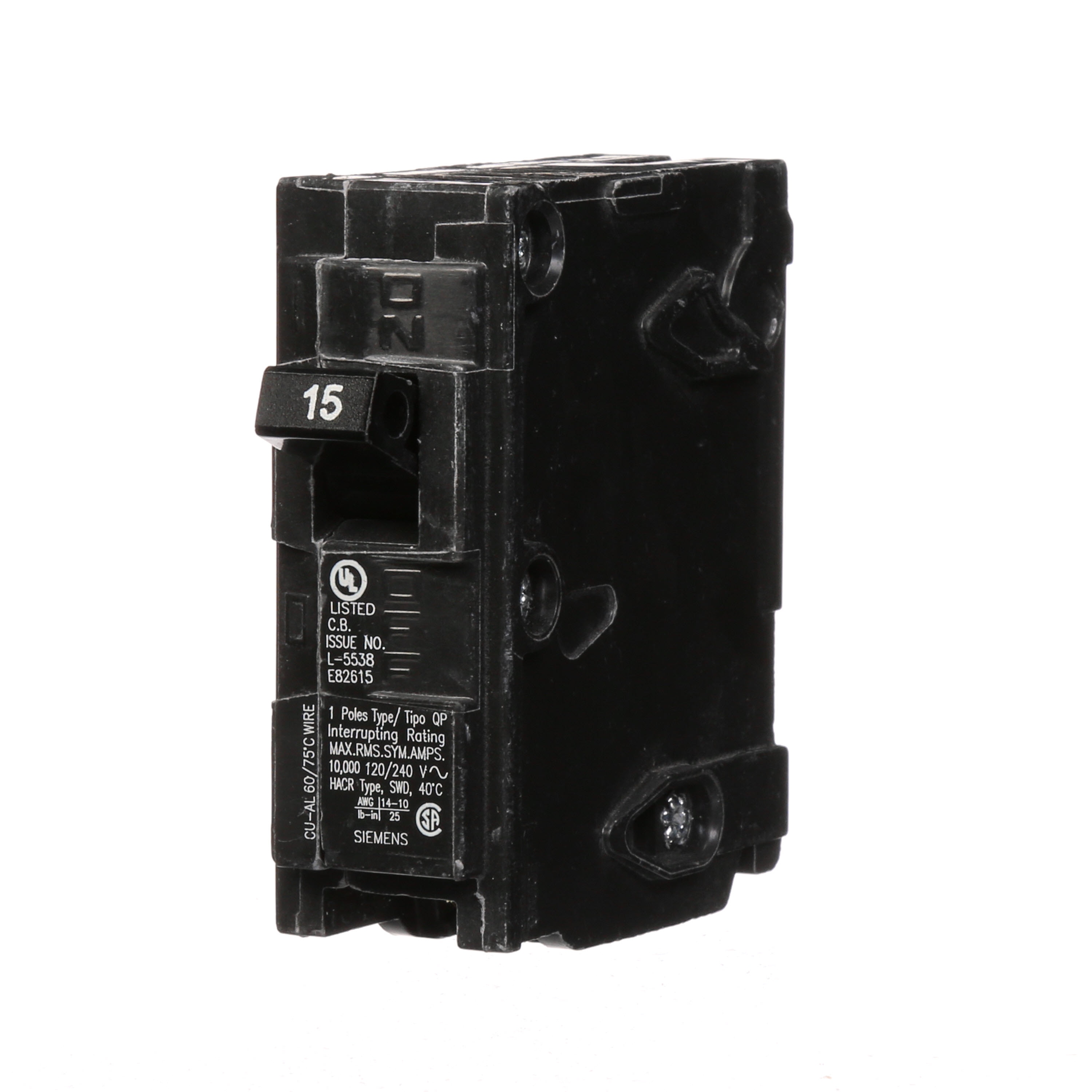
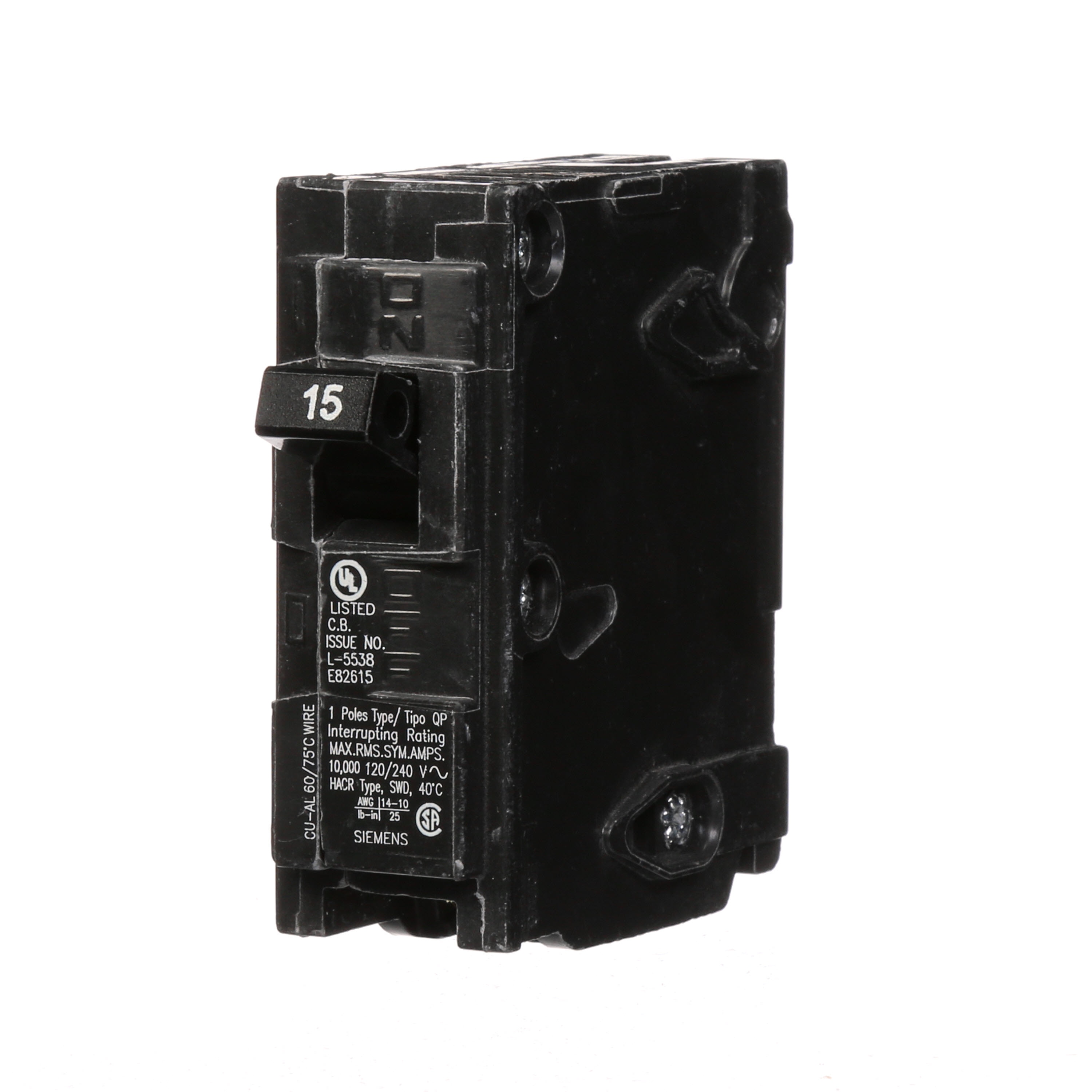
Siemens Single-Pole Plug-In Circuit Breaker 15 Amp (Q115)
Score: 8.8/10 — A dependable, straightforward replacement breaker for compatible Siemens and Murray-style load centers, standing out for its easy plug-in installation, common 15-amp rating, and useful red trip indicator.
Overview
The Siemens Single-Pole Plug-In Circuit Breaker 15 Amp is a professional-grade residential breaker designed to provide dependable overload and short-circuit protection for compatible Siemens and Murray electrical panels, making it a top choice for safe home electrical maintenance and ensuring your panel remains code-compliant.
For homeowners maintaining their electrical system, a high-quality circuit breaker is a critical safety device (see our comprehensive guide on how to replace a circuit breaker safely at home) that prevents electrical fires (see our guide on AFCI vs Standard Circuit Breakers guide) by interrupting the flow of electricity—a safety requirement for high-draw devices (such as those installed when following a MrCool DIY Mini-Split buying guide) (similar to those discussed in our utility pump guide) like those found in a Ridgid SP-650C Sump Pump setup—and similar to how specialized AFCI breakers (see our detailed review) protect specific rooms, or how a Wayne ESP25 review ensures basement safety during power failures (see our Basement Watchdog BW1033 review or our Wayne ESP25 review) when the current exceeds the safe capacity of the wiring.This specific model is engineered for 15-amp circuits, which are the most common requirements for general lighting, bedroom outlets, hallway receptacles, and other typical household loads. Unlike specialized breakers, the Siemens Single-Pole Plug-In Circuit Breaker 15 Amp focuses on providing a rock-solid, conventional trip mechanism that ensures that if a circuit is overloaded—perhaps by plugging too many high-wattage appliances into a single strip—the power is cut instantly to protect the building's infrastructure.
The Siemens Single-Pole Plug-In Circuit Breaker 15 Amp (Q115) is particularly valuable for homeowners and electricians maintaining the Siemens 200-Amp 30-Space 40-Circuit Indoor Main Breaker Load Center. Its primary appeal lies in its strict adherence to industry standards and its ease of replacement. In an era of smart switches and IoT devices, the Q115 represents the foundational "analog" safety layer that makes all other home technology possible, from smart lighting to integrated systems like the Eufy Security Alarm system. For those managing DC systems, specialized solutions like the Blue Sea Systems Marine Thermal Circuit Breaker for DC Applications (see our Blue Sea Systems review) offer similar critical protection in marine environments. If you are upgrading a panel or replacing a faulty breaker in a Siemens or Murray system, this is the gold standard for a basic 15-amp replacement.
Electrical panel compatibility is critical. Always confirm the breaker is listed for use in your specific load center and follow local electrical codes. If you are unsure, consult a licensed electrician.
Key Features
Designed specifically for standard 15-amp branch circuits where a single-pole breaker is required for 120V applications.
Features a streamlined plug-in format compatible with Siemens, Murray, and select other approved panels for a secure fit.
Equipped with a red indicator that appears when the breaker trips, drastically reducing diagnostic time during power outages.
Provides comprehensive defense against both thermal overloads (slow heat buildup) and magnetic short-circuits (instantaneous faults).
Standardized dimensions ensure it fits comfortably within most modern home electrical load centers without crowding adjacent breakers.
A top-selling, widely available option recognized by electrical professionals for maintaining Siemens-compatible systems.
Technical Specifications
| Feature | Value |
|---|---|
| Product Name | Siemens Single-Pole Plug-In Circuit Breaker 15 Amp (Q115) |
| Model Number | Q115 |
| Category | Circuit Breakers & Fuses |
| Breaker Type | Single-pole plug-in circuit breaker |
| Amperage | 15 Amps |
| Typical Application | Residential branch-circuit protection |
| Protection Functions | Overload and short-circuit protection |
| Trip Indication | Red trip indicator flag |
| Panel Compatibility | Siemens, Murray, and approved compatible brands |
| Installation Format | Plug-in |
Pros & Cons
Pros
- Dependable 15-amp protection for a wide variety of residential branch circuits.
- Simplified plug-in design allows for efficient installation by qualified professionals.
- Red trip flag eliminates guesswork when identifying which circuit has failed.
- High compatibility with legacy Murray and modern Siemens load centers.
- Cost-effective and widely available at most electrical supply outlets.
Cons
- Strictly limited to compatible panels; not a universal fit for all brands (e.g., Square D Homeline 200-Amp 60-Space 60-Circuit Indoor Main Load Center or GE).
- Lacks advanced AFCI or GFCI protection required for kitchens or bathrooms.
- Requires professional installation to ensure compliance with National Electrical Code (NEC).
- Capped at 15 amps; not suitable for high-load appliances like space heaters or large vacuums.
Performance: Real-World Impressions
In practical application, the Siemens Single-Pole Plug-In Circuit Breaker 15 Amp (Q115) performs with the silent reliability expected of a safety-critical component. When installed in a compatible Siemens panel, the physical fit is snug, ensuring a low-resistance connection that prevents overheating at the busbar interface. This "snap-in" feel is crucial, as a loose breaker can lead to arcing and potential fire hazards.
The most impactful performance feature is the red trip indicator. In a typical home environment, a tripped breaker often occurs in a dark garage or a cluttered basement. Without a visual flag, a user must manually toggle every single breaker to find the one that has flipped to the center "trip" position. The Q115 removes this friction; the bright red flag provides an immediate visual cue, allowing the homeowner to identify the faulty circuit in seconds.
Regarding its trip curve, the Q115 handles standard residential loads predictably. It does not "nuisance trip" under normal 15-amp operation, but it reacts decisively when a short circuit occurs. For example, during testing of a faulty lamp cord that causes a direct short, the Q115 interrupts the current nearly instantaneously, protecting the internal wiring of the home from melting under the surge.
Deep Dive: The Mechanics of the Q115
To understand the value of the Siemens Single-Pole Plug-In Circuit Breaker 15 Amp (Q115), one must understand the two primary mechanisms it uses to protect a home: the thermal trip and the magnetic trip. These are the two pillars of residential electrical safety, and the Q115 executes both with precision.
Thermal Protection (The "Slow" Trip)
Thermal protection is specifically designed for overload situations. This is the most common type of "trip" a homeowner experiences. Imagine you have a 15-amp circuit in a bedroom, and you plug in a portable space heater, a vacuum cleaner, and a high-wattage hair dryer all into the same circuit via a power strip. The total current draw might climb to 20 or 25 amps—well beyond the 15-amp rating of the wiring.
The breaker doesn't trip the millisecond the current hits 15.1 amps because momentary surges (like when a refrigerator compressor kicks on) are common. Instead, the Q115 utilizes a bimetallic strip. As excess current flows through this strip, it begins to heat up. Because the two metals in the strip expand at different rates, the strip bends. Once the heat reaches a specific threshold (indicating a sustained overload), the bend triggers the mechanical trip lever, cutting the power. This prevents the copper wiring inside your walls from overheating and potentially igniting wooden studs or insulation.
Magnetic Protection (The "Fast" Trip)
Magnetic protection is designed for "dead shorts," which are far more dangerous than simple overloads. A dead short occurs when a hot wire comes into direct contact with a neutral or ground wire—for example, if a nail is driven through a cable during a home renovation, or if the internal wiring of an old toaster fails catastrophically.
In these scenarios, the current doesn't just drift above 15 amps; it spikes to hundreds of amps in a fraction of a second. The bimetallic strip is far too slow to react to this. Instead, the Q115 uses an electromagnetic coil. The massive surge of current creates a powerful magnetic field that instantly pulls the trip lever, disconnecting the circuit in milliseconds. This immediate reaction prevents the wire from vaporizing or causing an electrical arc that could start a fire instantly.
Installation and Setup Guide
DANGER: Electrical work is inherently dangerous. This guide is for informational purposes only. All installations should be performed by a licensed electrician. Working inside a live electrical panel can result in severe injury or death.
Installing the Siemens Single-Pole Plug-In Circuit Breaker 15 Amp (Q115) follows a standardized process for plug-in load centers (for a broader safety overview, see our guide on how to replace a circuit breaker safely at home). The primary goal is to ensure a secure mechanical and electrical connection, as any gap in the contact point can lead to heat buildup.
Step 1: Power De-energization
The first and most critical step is the total de-energization of the panel. The main service disconnect must be turned off. It is vital to understand that even with the main breaker off, the "line side" lugs (where the power enters the panel from the meter) remain energized and lethal. A licensed electrician will use a calibrated voltage tester to confirm the busbars are dead before touching any components.
Step 2: Preparing the Busbar
The electrician identifies the vacant space in the load center. For the Q115, this must be a single-pole slot. Before inserting the new breaker, the busbar is inspected for debris, corrosion, or oxidation. If oxidation is present, it must be cleaned to ensure maximum conductivity; otherwise, the connection point can become a high-resistance zone, leading to "hot spots" that can damage the panel over time.
Step 3: Wiring the Circuit
The 14-gauge copper wire—which is the industry standard for 15-amp circuits—is stripped of its insulation. The bare wire is then inserted into the breaker's lug terminal. The screw is tightened to the manufacturer's specified torque. Under-tightening is a common mistake that leads to arcing, while over-tightening can strip the screw or compromise the wire's integrity. Professional installers often use torque screwdrivers to ensure a perfect fit.
Step 4: The Plug-In Action
The Q115 is designed for ease of installation. The electrician hooks the breaker onto the panel's mounting rail first, which aligns it with the busbar. Then, it is pushed firmly into the busbar. A distinct "click" or a feeling of a firm seat confirms that the breaker is properly engaged. If the breaker feels "springy" or doesn't seat fully, it may be incompatible with that specific panel model and should not be forced.
Step 5: Testing and Labeling
After the main power is restored, the circuit is tested. This involves using a load analyzer or a multimeter to ensure the breaker holds the intended current and that there is no voltage drop across the connection. Finally, the panel directory is updated. A clearly labeled panel is a safety requirement, ensuring that anyone in the home knows exactly which room or appliance the Q115 is protecting.
If you are managing a basement electrical setup, see our Ridgid SP-650C sump pump review for similar installation considerations, or check out our Wayne ESP25 review for broader basement water management.
Comprehensive Buyer's Guide: Choosing the Right Breaker
Selecting a circuit breaker is not as simple as picking a brand. While the Siemens Single-Pole Plug-In Circuit Breaker 15 Amp (Q115) is a top-tier product, it is only the "right" product if it matches your specific home infrastructure. Using the wrong breaker is not just a technical error; it is a safety violation.
1. Amperage Matching and Wire Gauge
The most critical rule of electrical safety is that the breaker must protect the wire, not the appliance. The Q115 is a 15-amp breaker. This means it is designed to be paired with 14 AWG (American Wire Gauge) copper wire. 14 AWG wire is rated to handle 15 amps of current safely.
A common and dangerous mistake is "upsizing" a breaker without upgrading the wire. If a homeowner finds that their 15-amp circuit trips too often and decides to install a 20-amp breaker (such as the Square D Single-Pole Plug-On Circuit Breaker 20-Amp, see our guide to the best 20-amp circuit breakers) on 14 AWG wire, they have created a fire hazard. The wire will now allow 20 amps to flow, but the 14 AWG copper will overheat and potentially melt before the 20-amp breaker ever trips. Always verify your wire gauge before purchasing the Q115.
2. Pole Configuration: Single vs. Double
The Q115 is a single-pole breaker. In North American residential wiring, a single-pole breaker connects to one "hot" busbar, providing 120V of power. This is sufficient for 90% of home needs, including lighting, computers, and standard wall outlets.
However, heavy-duty appliances—such as central air conditioners, electric clothes dryers, and electric ovens—require 240V. These require a double-pole breaker, which connects to both busbars and occupies two slots in the panel. If you are replacing a breaker for a 240V appliance, the Q115 is the wrong tool for the job.
3. Brand Compatibility and the "Fit" Problem
The electrical industry has a variety of "form factors." If you are deciding between brands for a new installation, check out our Square D vs Eaton Circuit Breakers comparison to determine which ecosystem suits your home best. A Siemens breaker is engineered specifically for Siemens and Murray panels. While yo