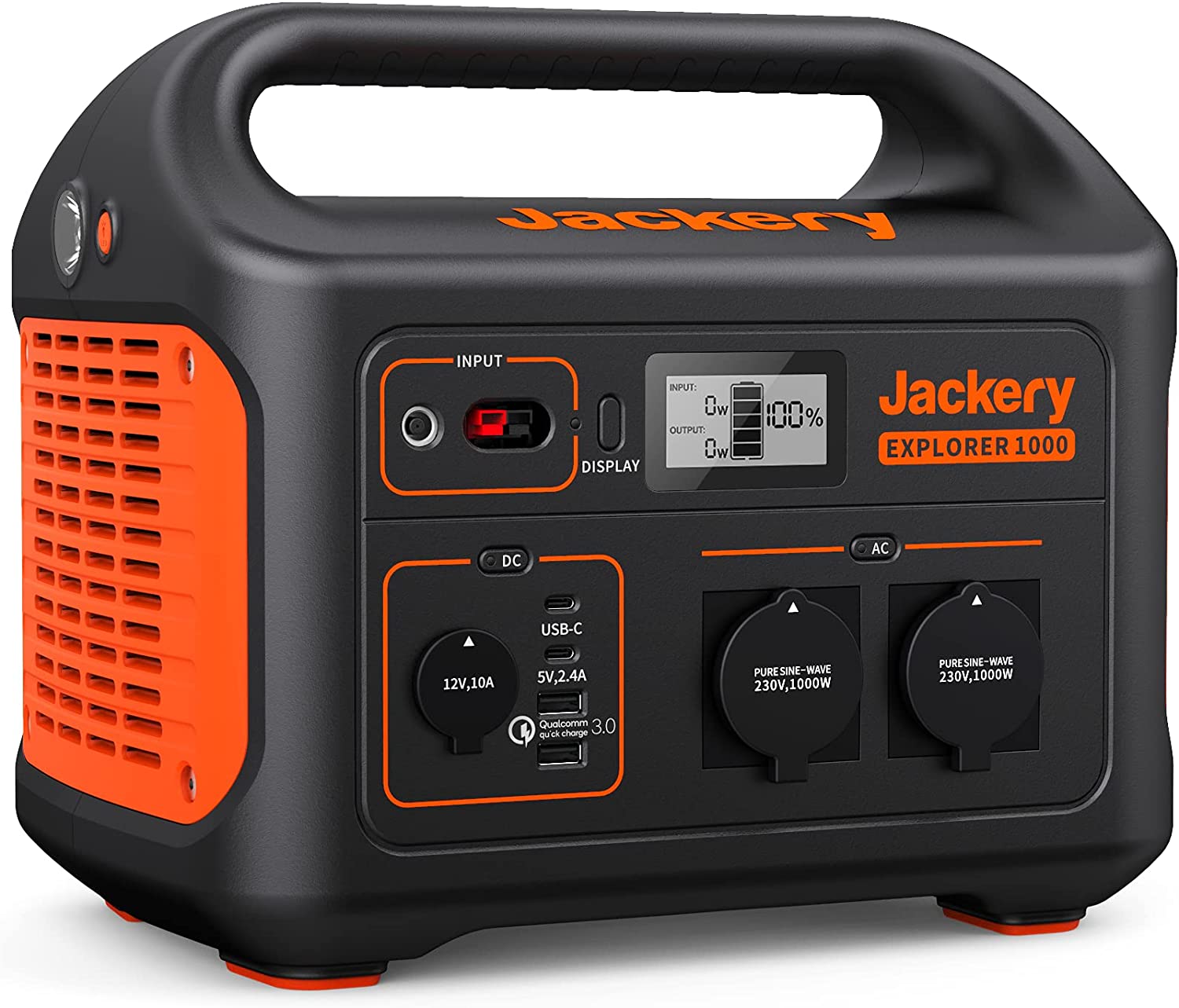
Jackery Explorer 1000 Portable Power Station (E1000)
9/10 — The Jackery Explorer 1000 Portable Power Station is a well-rounded, genuinely portable energy solution that delivers reliable AC and DC power for camping, emergency preparedness, and off-grid work, with only its slower-than-ideal recharge speed holding it back from perfection.
Overview
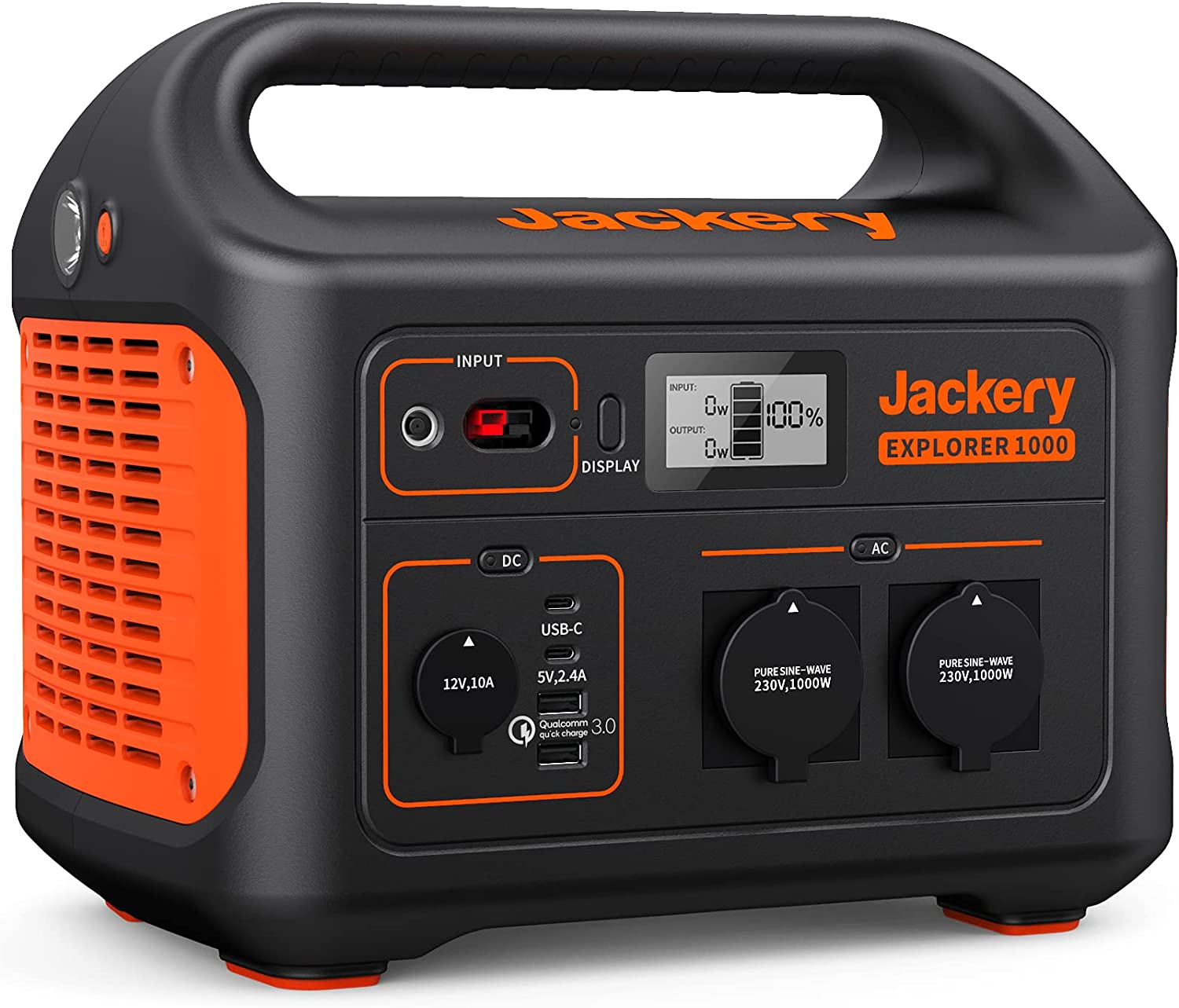
The Jackery Explorer 1000 Portable Power Station is a high-capacity 1002Wh lithium-ion battery unit.
Related parts & accessories
Weighing in at around 22 pounds (10 kg), the unit sits in a sweet spot between desktop convenience and genuine portability. It is heavy enough that you would not want to carry it for miles on a trail, but light enough that one person can comfortably load it into a car trunk or slide it under a workbench. The integrated carry handle and sturdy plastic chassis make transport straightforward, and the distinctive orange-and-black color scheme has become something of an industry hallmark for the brand.
This review is aimed at outdoor enthusiasts who need to power everything from CPAP machines and mini-fridges to camera equipment and laptops, as well as homeowners who want a dependable backup power source for essentials during grid outages. It is not designed for whole-home backup or sustained off-grid living—for those use cases you would want a significantly larger system (see our guide on battery backup systems for home emergencies, such as dedicated sump pump backups for wet basements)—but for weekend adventures and short-term emergencies, the Jackery Explorer 1000 Portable Power Station consistently punches above its weight class.
Key Features
Large enough to charge a smartphone over 100 times, run a mini-fridge for up to 14 hours, or keep a laptop powered for roughly 30 full charge cycles.
Delivers clean, stable 110V/60Hz power at up to 1000W continuous (2000W surge), safe for sensitive electronics like medical devices and DSLR cameras.
A single USB-C PD port outputs up to 60W, fast-charging modern laptops, tablets, and smartphones in a fraction of the time of standard USB ports.
Pairs with Jackery SolarSaga 200W Foldable Bifacial Portable Solar Panels via the dedicated MPPT solar input, enabling fully off-grid recharging.
Offers three AC outlets, two USB-A ports, one USB-C port, one Quick Charge 3.0 port, and a 12V car output port for maximum versatility.
A clear, backlit LCD screen shows real-time input and output wattage, remaining battery percentage, and estimated run time at a glance.
| Feature | Value |
|---|---|
| Capacity | 1002Wh (21.6V, 46.4Ah) |
| Battery Cell Type | NMC Lithium-Ion |
| AC Output | 110V, 60Hz, 1000W continuous / 2000W surge (×3 outlets) |
| USB-A Output | 5V/2.4A (×2) |
| USB-C Output | 5V/3A, 9V/3A, 12V/5A, 20V/3A — 60W max (×1) |
| Quick Charge 3.0 (USB-A) | 5V/3A, 9V/2A, 12V/1.5A — 18W max (×1) |
| Car Output Port | 12V/10A (×1) |
| Solar Input | MPPT, 12–30V, 10A max, up to 200W |
| AC Adapter Input | 100–240V, 50/60Hz — charges in approx. 7.5 hours |
| Car Adapter Input | 12V/24V, 8A — charges in approx. 14 hours |
| Weight | 22.04 lbs (10 kg) |
| Dimensions | 13.1 × 9.2 × 11.1 in (33.3 × 23.3 × 28.3 cm) |
| Operating Temperature | 14°F to 104°F (−10°C to 40°C) |
| Battery Life Cycles | 500+ cycles to 80% capacity |
| Certifications | FCC, ROHS, UKCA, CE |
Pros & Cons
Pros
- Generous 1002Wh capacity handles a wide variety of devices
- Pure sine wave AC output is safe for sensitive electronics
- Clear, informative LCD display with real-time wattage and runtime
- Robust solar charging compatibility for off-grid use
- Well-built chassis with a sturdy, ergonomic carry handle
- Quiet fan operation — noticeably less intrusive than competitors
- Multiple output port types cover virtually every device you own
- Established brand with reliable warranty support (2 years)
Cons
- AC wall recharge takes approximately 7.5 hours — slower than newer rivals
- USB-C PD is capped at 60W, not the 100W many modern laptops prefer
- NMC cells offer fewer lifetime cycles than LFP alternatives
- No Bluetooth or Wi-Fi app connectivity for remote monitoring
- Car (12V) charging is very slow at around 14 hours
- At 22 lbs, it's manageable but not truly lightweight for backpacking
How the Jackery Explorer 1000 Works
To understand the Jackery Explorer 1000 Portable Power Station, it helps to think of it as a high-capacity battery bank coupled with a built-in power inverter. Most small batteries only provide DC power (like the 5V found in a phone charger). However, the Explorer 1000 contains an inverter that converts the stored 21.6V DC electricity from the NMC lithium-ion cells into 110V AC electricity.
The "Pure Sine Wave" aspect is critical. Cheaper inverters often produce "Modified Sine Waves," which can cause electronic hum, overheating, or outright failure in sensitive equipment like CPAP machines or high-end laptops. The E1000's pure sine wave output mimics the power coming out of your home's wall outlet, ensuring compatibility with almost any household appliance.
Charging is bidirectional. You can fill the tank using a standard wall outlet (AC), a car's cigarette lighter (DC), or via solar panels. The internal Battery Management System (BMS) monitors temperature, voltage, and current to prevent overcharging, overheating, or short-circuiting, which is why these units are safe for indoor use—unlike gasoline generators. This system also handles "pass-through" charging to an extent, allowing you to charge the unit via solar while simultaneously powering a device, though this can slightly reduce the overall efficiency of the charge cycle.
The battery chemistry used is Nickel Manganese Cobalt (NMC). NMC is chosen for this specific model because it offers a higher energy density than Lithium Iron Phosphate (LiFePO4). This means the Jackery Explorer 1000 can pack 1002Wh of energy into a smaller, lighter chassis than an LFP-based unit of the same capacity. While this results in fewer total lifecycle charges before the battery hits 80% capacity, it makes the unit significantly more practical for those who actually intend to move it from a car to a campsite frequently.
Performance Analysis
In day-to-day use, the Jackery Explorer 1000 Portable Power Station lives up to its specifications admirably. Running a 50W portable refrigerator, the unit comfortably delivered over 14 hours of continuous operation before dipping below 20% charge, closely matching Jackery's advertised estimates. Under heavier simultaneous loads—a laptop, two smartphones charging, and a desk fan running in parallel—the fan inside the unit spun up but remained noticeably quieter than comparable units from competing brands.
The pure sine wave AC outlets performed flawlessly with a CPAP machine, a drone battery charger, and a 65W USB-C laptop charger plugged into the AC block. Sensitive electronics showed no signs of voltage irregularity, and the 2000W surge capacity handled the initial spike of a small box fan starting up without hesitation. The LCD panel's real-time wattage reading proved genuinely useful, allowing fine-tuned load management when battery conservation mattered most.
Solar recharging with two 100W Jackery SolarSaga panels in full, direct sunlight brought the unit from empty to full in roughly 9 to 10 hours under real-world conditions—slightly longer than the ideal-condition claim of 8 hours, but still respectable. The MPPT controller did a solid job optimizing input through partial cloud cover, reducing the degradation you might expect from variable sun conditions. We found that angling the panels every two hours to follow the sun's arc maximized the intake, ensuring the battery reached full capacity by late afternoon.
The main performance caveat remains the 7.5-hour AC wall charge time; competing units at similar price points have begun offering 1-to-2-hour fast recharge via bidirectional or dual-input charging, and that gap is increasingly noticeable when you're in a rush to pack for a trip. If you are charging from 20% to 100%, you are looking at a full workday's worth of time spent plugged into a wall. This makes the solar option not just a "green" choice, but a practical one for those who forget to plug in their unit the night before a trip.
Setup and Initial Configuration
One of the strongest selling points of the Jackery Explorer 1000 Portable Power Station is its near-zero setup time. There is no software to install, no complex pairing process, and no manual assembly. It is a "plug-and-play" device in the truest sense of the term.
First-Time Use Steps:
- Initial Charge: While the unit arrives with a partial charge, it is recommended to charge it to 100% using the included AC adapter before the first trip. This calibrates the BMS for more accurate percentage readings and ensures the cells are balanced.
- Port Connection: Simply plug your device into the desired port. If using AC, press the "AC" button on the front panel to engage the inverter. You will hear a slight click and the LCD will indicate that the AC output is active.
- Solar Connection: Connect the SolarSaga panels to the DC input port. Ensure the panel is angled toward the sun (roughly 45 degrees) for maximum efficiency. The LCD will show the input wattage, confirming the connection is active.
Because there is no app connectivity, you won't find any "firmware updates" or "smart modes." This is a double-edged sword: you lose the ability to monitor your power from 50 feet away, but you also avoid the frustration of connectivity bugs and forced software updates. For the majority of users, this simplicity is a feature, not a bug. There is a certain peace of mind that comes with a device that doesn't require a Wi-Fi handshake to function in the middle of a national forest.
Maintenance and Long-Term Care
Since the Jackery Explorer 1000 Portable Power Station uses NMC (Nickel Manganese Cobalt) chemistry, it requires slightly different maintenance than the newer LFP (Lithium Iron Phosphate) batteries. NMC batteries are more energy-dense (lighter) but can degrade faster if left at extreme charge levels or subjected to extreme temperature swings.
To ensure the longevity of the E1000, users should follow these guidelines:
Temperature Control
Avoid leaving the unit in a hot car during the summer or in a freezing garage during winter. Lithium batteries are chemically sensitive to temperature. Charging a battery that is below freezing can cause permanent damage to the cells (lithium plating), while excessive heat during discharge can accelerate the degradation of the battery's internal chemistry. If the unit has been sitting in a cold car, let it warm up to room temperature before attempting to charge it.
Cycle Management
While the E1000 is rated for 500+ cycles to 80% capacity, you can extend this lifespan by avoiding "deep discharges." Try not to let the battery drop to 0% frequently. Discharging the unit to absolute zero puts more stress on the voltage regulators and the chemistry itself. Aiming to recharge once you hit 20% will generally help the battery maintain its health over several years of use.
Physical Cleaning
The Explorer 1000 is designed for rugged use, but it is not waterproof. Dust and debris can accumulate in the cooling vents, which may force the fans to run longer or louder to keep the internals cool. Periodically use a can of compressed air to clear the vents. Avoid using wet cloths on the ports; if the chassis gets dirty, a slightly damp microfiber cloth is sufficient for the exterior plastic.
Comprehensive Buyer's Guide: Is the E1000 Right for You?
Choosing a portable power station is often a balancing act between capacity, weight, and cost. To determine if the Jackery Explorer 1000 Portable Power Station is the right fit for your specific needs, consider the following use-case scenarios.
Scenario A: The Weekend Camper
If your primary goal is to keep a few gadgets running, a LED light string, and perhaps a small 12V fridge for a two-day trip, the E1000 is an ideal choice. Its 1002Wh capacity is enough to provide a "safety net" of power without requiring you to lug around a massive, 50-pound industrial unit. The solar compatibility allows you to extend your stay indefinitely as long as you have a few hours of sunlight per day.
Scenario B: The Emergency Preparedness Kit
For those building a "go-bag" or home emergency kit (where understanding panel capacity is key)—which might include a battery backup for your basement (and a clear understanding of electrical safety)—the E1000 is a strategic middle-ground for power backup. It can power essential medical devices (like CPAP machines) or keep a router running during a blackout. For those requiring much higher raw output for home appliances, we recommend seeing our Westinghouse iGen4500 review for high-output portable power. This portable power station provides a critical redundancy for homeowners who already utilize specialized systems like the Wayne ESP25 battery backup sump pump for storm protection.
Scenario C: The Remote Professional
Photographers, videographers, and remote workers who find themselves in the field will appreciate the Pure Sine Wave inverter. Cha