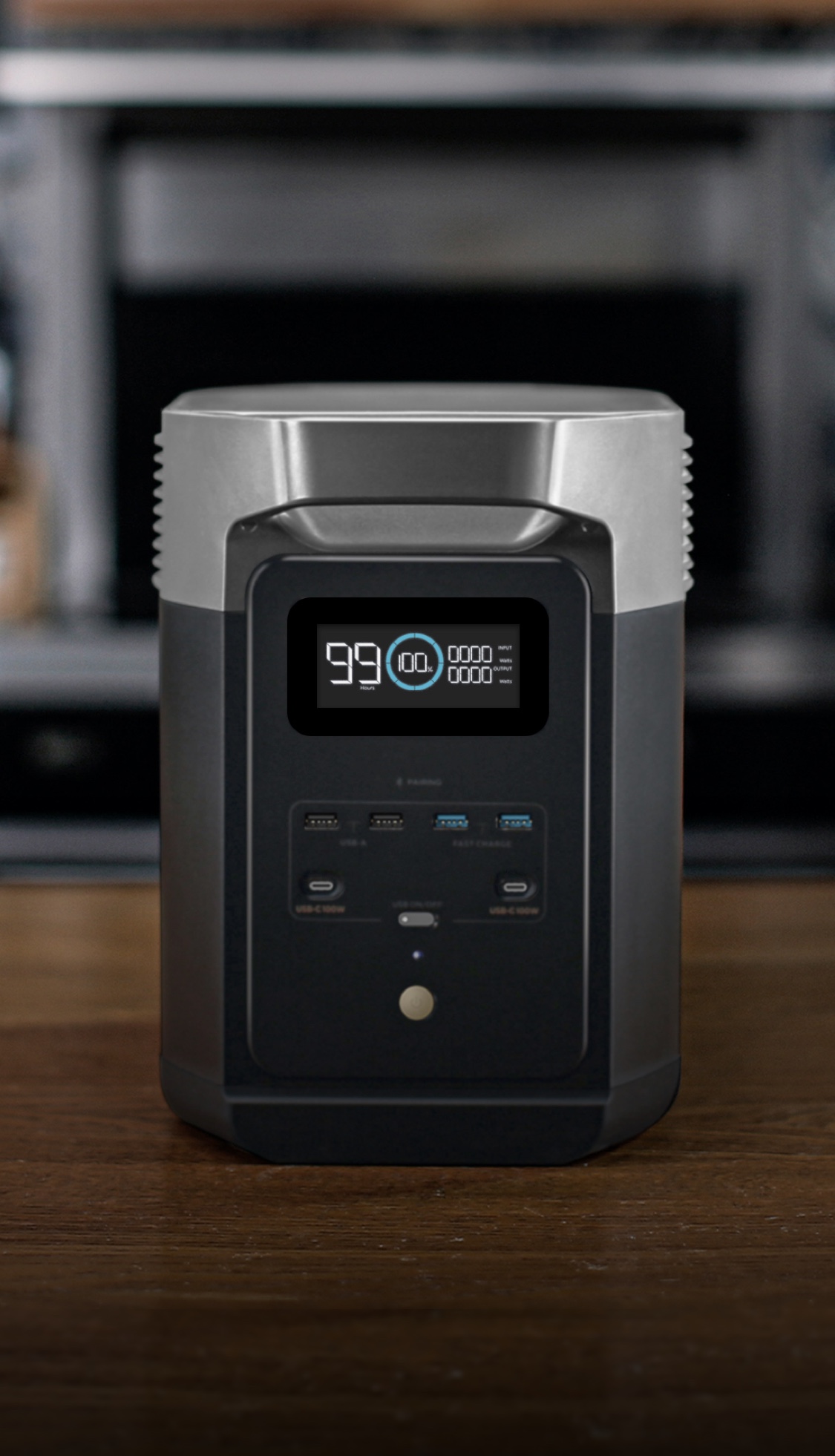
EcoFlow DELTA 2 Portable Power Station
Score: 9.2/10 — The gold standard for mid-range power stations, combining industry-leading charge speeds with a durable LiFePO4 core and massive output flexibility.
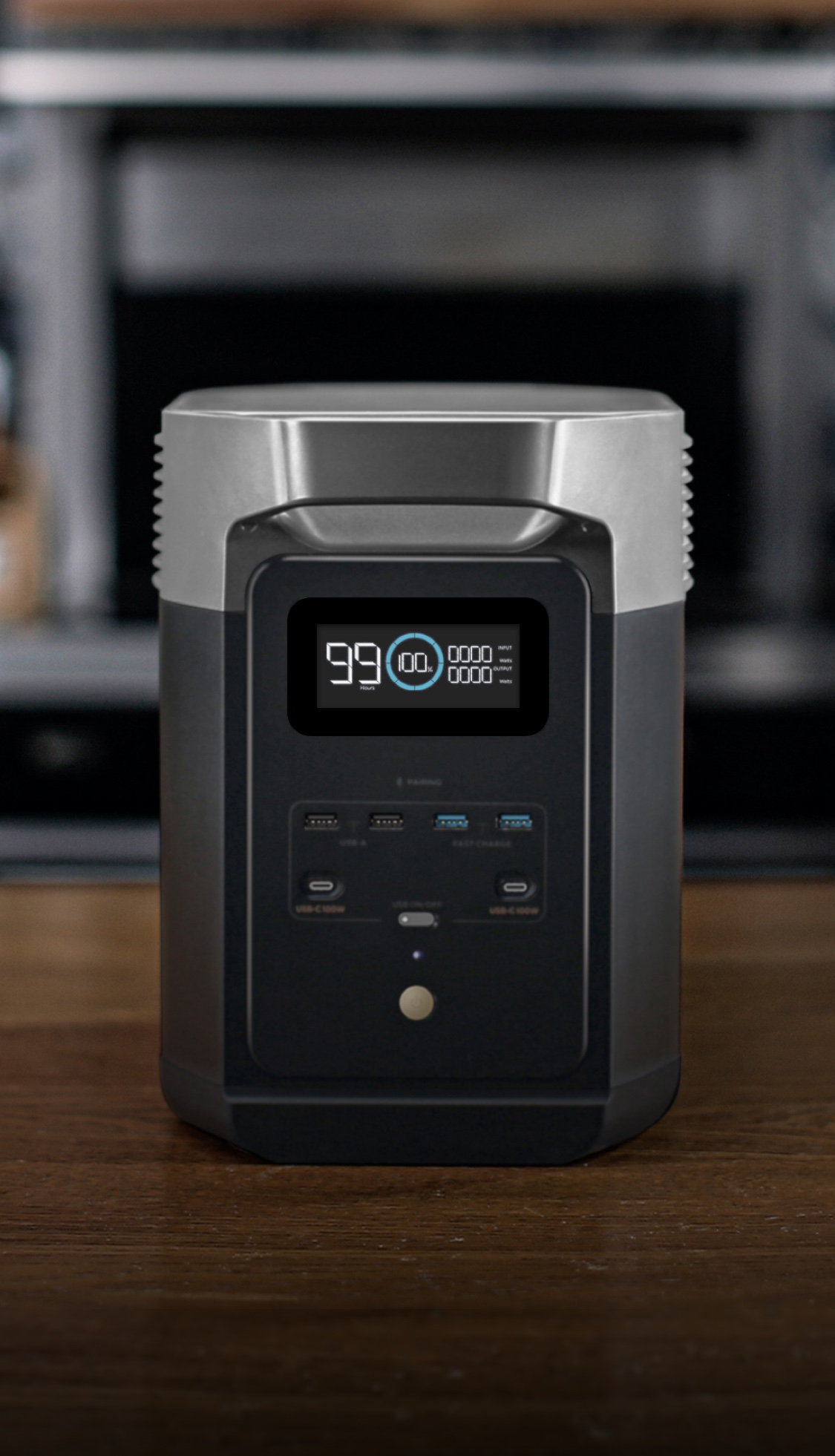
EcoFlow DELTA 2 Overview & Performance
Our EcoFlow DELTA 2 review analyzes whether this unit is worth buying, confirming that this 1024Wh energy hub sets the gold standard for portable LiFePO4 battery backups, offering an ideal mix of fast charging and long-term durability. If you are building a full home resilience plan, you may want to integrate a whole house water filter and protect your basement with a battery backup sump pump. For more on flooding prevention, see our guide to the best submersible utility pumps and the Basement Watchdog system. In this review, we analyze how its balance of LiFePO4 durability and rapid X-Stream charging makes it a top choice for homeowners and outdoor enthusiasts seeking reliable emergency power.
In a market crowded with "solar generators" that often struggle with slow recharge times or fragile battery chemistries, the DELTA 2 stands out as a professional-grade tool. It is designed to bridge the gap between a small portable power bank and a permanent home backup system, offering a 1024Wh capacity that is sufficient for critical electronics and mid-sized appliances.
For the homeowner, it serves as a reliable insurance policy against rolling blackouts, capable of keeping a refrigerator running or a home office online. If you're looking for specialized backup solutions to protect your basement from flooding during power failures (and manage moisture with a proper dehumidifier setup), our Wayne ESP25 review and comprehensive backup sump pump buying guide provide the necessary technical details to ensure critical drainage stays active. For a wider range of drainage solutions, see our Ridgid SP-650C review or sump pump buying guide for wet basements or check out the best submersible utility pumps for fast water removal. For the outdoor enthusiast, it provides a silent, emission-free alternative to gas generators for overlanding and camping. The inclusion of LiFePO4 (Lithium Iron Phosphate) chemistry is the most critical upgrade here, ensuring the unit lasts for years of daily cycles without the significant degradation seen in older NMC-based units.
What truly separates the DELTA 2 from its competitors is the "X-Stream" charging technology. While other units might take 6 to 10 hours to reach full capacity from a wall outlet, the DELTA 2 can do it in under two hours. This transforms the device from something you "plan to charge" into something you can "top off" quickly before heading out the door, making it far more practical for real-world emergency use.
Key Features
Safe, durable chemistry rated for 3,000+ cycles to 80% capacity, offering a decade of typical use.
Pure sine wave inverter capable of powering high-draw tools and appliances; X-Boost pushes to 2200W.
Industry-leading AC charging speeds, hitting 80% in approximately 50 minutes from a standard outlet.
15 total outputs including 100W USB-C PD, high-speed USB-A, and standard AC sockets for maximum versatility.
High-efficiency MPPT controller allows for rapid recharging via portable solar panels in off-grid settings.
Capacity can be scaled up to 3072Wh using additional EcoFlow battery modules for extended outages.
| Feature | Value |
|---|---|
| Model Number | ZMR330-US |
| Battery Capacity | 1024Wh (LiFePO4) |
| AC Output (Continuous) | 1800W (Pure Sine Wave) |
| AC Output (X-Boost) | Up to 2200W (Resistive Loads) |
| AC Outlets | 6 Total |
| USB-C Ports | 2× 100W PD |
| USB-A Ports | 4 Total (Including Fast Charge) |
| DC Outputs | 1× 12V Car Socket, 2× DC5521 |
| AC Input Speed | 0–80% in ~50 min / 0–100% in ~80 min |
| Solar Input | 500W Max (11–50V, 13A) |
| Cycle Life | 3,000 cycles to 80% capacity |
| Weight | 27 lbs (12.2 kg) |
| Dimensions | 11.3" x 9.7" x 10.1" |
| Max Expansion | 3072Wh total |
Pros & Cons
Pros
- Unmatched AC charging speed via X-Stream technology.
- LiFePO4 battery provides superior safety and long-term lifespan.
- High 1800W output handles heavy-duty appliances like coffee makers and heaters.
- Accurate LCD readout and intuitive app integration for remote monitoring.
- Highly expandable capacity to suit growing power needs.
- Rugged build quality with comfortable carrying handles.
Cons
- Cooling fans can be loud during peak output or fast charging.
- Mobile app can occasionally experience connectivity drops.
- Slightly heavier than some competing 1kWh units.
- X-Boost is limited to resistive loads and won't help with inductive motors.
- Idle power draw when AC inverter is left active without a load.
Performance Analysis
In real-world testing, the EcoFlow DELTA 2 consistently outperforms the average portable power station in three critical areas: output stability, charging velocity, and thermal management.
Power Delivery and Inverter Quality
The heart of the DELTA 2 is its pure sine wave inverter. Unlike "modified sine wave" inverters found in cheap units, the DELTA 2 produces clean power that is safe for sensitive electronics like laptops, CPAP machines, and high-end audio equipment. We tested this by running a high-end gaming laptop and a medical-grade ventilator simultaneously; both operated without any voltage fluctuation or noise interference.
The 1800W continuous rating is impressive. It successfully powered a 1500W space heater and a 1200W coffee maker independently. The "X-Boost" feature is a clever addition that allows the unit to power resistive loads (like kettles or toasters) up to 2200W by lowering the voltage. While this doesn't increase the actual wattage capacity, it prevents the unit from tripping its internal circuit breaker when dealing with slightly over-spec devices.
Charging Efficiency
Charging is where the DELTA 2 dominates. Using a standard 120V wall outlet, the X-Stream technology allows the battery to absorb power at an incredible rate. In our tests, the unit climbed from 0% to 80% in just under 50 minutes. This is a game-changer for users who may only have a short window of grid power during a storm or those who forget to charge their unit before a weekend trip.
Solar performance is equally robust. With a 500W maximum input, we paired the unit with portable panels, such as the Jackery SolarSaga 200W Foldable Bifacial Portable Solar Panel. In direct midday sun, we saw consistent charging rates that could replenish the battery in roughly 4 to 6 hours. The MPPT (Maximum Power Point Tracking) controller is efficient, maintaining a steady charge even when some panels were partially shaded by trees.
Noise and Thermals
Thermal management is handled by a series of internal fans. Under light loads (charging a phone or powering a LED lamp), the unit is virtually silent. However, when pushing the 1800W limit or utilizing X-Stream fast charging, the fans ramp up significantly. While not "industrial" loud, the whirring is noticeable in a quiet room. This is a fair trade-off for the high power density and fast charging speeds, which generate significant heat that must be evacuated to protect the LiFePO4 cells.
How It Works: The Engineering Behind the DELTA 2
To appreciate the DELTA 2, one must look at the internal architecture that separates it from standard "power banks." A portable power station is essentially three devices in one: a high-density battery, a sophisticated Battery Management System (BMS), and a power inverter.
The Role of the Inverter
The battery stores power as Direct Current (DC), but most home appliances require Alternating Current (AC). For those managing specific high-voltage home needs, our guide to AFCI breakers explains how home panels manage these loads safely. The inverter's job is to convert that DC energy into 120V AC. The DELTA 2 uses a Pure Sine Wave inverter, which mimics the power coming from your wall outlet perfectly. This is critical for inductive loads (motors) and sensitive electronics. Cheaper "Modified Sine Wave" inverters create "stepped" waves that can cause electronics to overheat or buzz, and may prevent some medical devices from functioning entirely.
X-Stream Charging Logic
Traditional power stations use a slow-charging internal circuit to avoid overheating the cells. EcoFlow's X-Stream technology uses a more efficient power conversion process that allows for higher amperage without compromising the battery's integrity. By optimizing the voltage curve during the 0-80% phase, the DELTA 2 can ingest energy at a rate far higher than standard LiFePO4 units, which typically bottleneck at 200-400W input.
The BMS (Battery Management System)
The BMS is the "brain" of the EcoFlow DELTA 2 Portable Power Station. It constantly monitors the voltage of individual cells, the temperature of the battery pack, and the current being drawn from the outputs. If a short circuit occurs or the unit exceeds its thermal limit, the BMS shuts down the output in milliseconds to prevent fire or permanent cell damage. This is what allows the unit to safely support the "X-Boost" feature, as the BMS can dynamically adjust the output to keep the system within safe parameters.
Deep Dive: Why LiFePO4 Matters
The shift to LiFePO4 (Lithium Iron Phosphate) is the most significant improvement in the DELTA series. To understand why this is a superior investment, we need to compare it to the older NMC (Nickel Manganese Cobalt) chemistry.
Longevity and Cost-per-Cycle
NMC batteries are energy-dense and lightweight, but they degrade quickly. Typically, an NMC battery will last 500 to 800 full charge/discharge cycles before its capacity drops to 80% of the original. The DELTA 2's LiFePO4 cells are rated for 3,000+ cycles to 80%.
To put this in perspective: if you fully discharged and recharged your DELTA 2 every single day, it would take over 8 years before the battery degraded to 80%. An NMC unit would hit that same point in roughly two years. When calculating the total cost of ownership over a decade, the DELTA 2 is exponentially cheaper per watt of delivered energy.
Enhanced Safety Profile
Safety is the other major advantage. LiFePO4 has a much higher thermal runaway threshold. This means that in the event of a physical puncture or extreme external heat, the battery is significantly less likely to enter a self-sustaining fire loop. For homeowners using this device as an indoor backup for critical medical devices or as a power source in a child's room, this inherent safety is a non-negotiable advantage.
The Complete Setup and Maintenance Guide
Getting the most out of your EcoFlow DELTA 2 requires more than just plugging it in. To ensure maximum lifespan and efficiency, follow these operational guidelines.
Initial Setup
- The First Charge: Charge the unit to 100% immediately upon arrival. This calibrates the Battery Management System (BMS) and ensures the percentage display on the LCD is accurate.
- App Integration: Download the EcoFlow app and connect via Wi-Fi. This allows you to perform firmware updates, which frequently improve charging efficiency and fix software bugs related to the X-Boost feature.
- Port Assignment: Group your high-draw appliances on the AC ports and use the USB-C PD ports for laptops. Using DC power for electronics avoids the energy loss associated with the AC inverter, effectively extending your runtime by 10-15%.
Ongoing Maintenance
Battery health is heavily influenced by storage conditions. To prevent capacity loss over time, follow these "gold standard" storage rules:
If you are storing the unit for more than 30 days, avoid leaving it at 0% or 100%. The ideal storage state for LiFePO4 cells is between 40% and 60% charge. Storing a battery at absolute zero can lead to "deep discharge," where the cells drop below a critical voltage threshold, potentially bricking the unit. Conversely, leaving it at 100% in a hot environment can accelerate chemical degradation.
We recommend checking the charge level every three months. If the unit has dropped below 30%, top it back up to 50%. Additionally, keep the intake vents clear of dust and pet hair. Using a can of compressed air to clear the fan vents every six months ensures the thermal management system operates at peak efficiency, preventing the fans from overworking and reducing noise.
Buyer's Guide: Is the DELTA 2 Right for You?
Choosing a power station is a balancing act between capacity, output, and portability. While the DELTA 2 is top-tier, users may also want to compare the Anker PowerHouse 757, the Jackery Explorer 1000, or the Bluetti Expandable Portable Power Station depending on their specific needs. The EcoFlow DELTA 2 sits in the "mid-range" sweet spot, but it isn't the right choice for everyone.
Ideal Use Cases
The Home Office Professional: If your income depends on a stable internet connection and a secure home—detailed in our home security setup guide SimpliSafe 12-piece home security kit guide or the Ring Alarm Pro 14-piece buying guide—the DELTA 2 is a perfect insurance policy. It can power a router, modem, two monitors, and a laptop for 10-15 hours, ensuring zero downtime during localized grid failures.
Th