Our Verdict
Jackery Explorer 1000 Portable Power Station — 8.2/10. A well-rounded and genuinely portable power station that delivers reliable AC power for camping, home backup, and van life, though its relatively slow recharge times and ageing battery chemistry hold it back from perfection.
See current price and details for Jackery Explorer 1000 Portable Power Station.
Jackery Explorer 1000 — 8.2/10
A well-rounded, genuinely portable power station that delivers reliable AC power for camping, home backup, and van life, though its relatively slow recharge times and ageing battery chemistry hold it back from perfection.
Our site earns commission on purchases made through affiliate links. This does not affect our editorial independence or scoring.
Overview
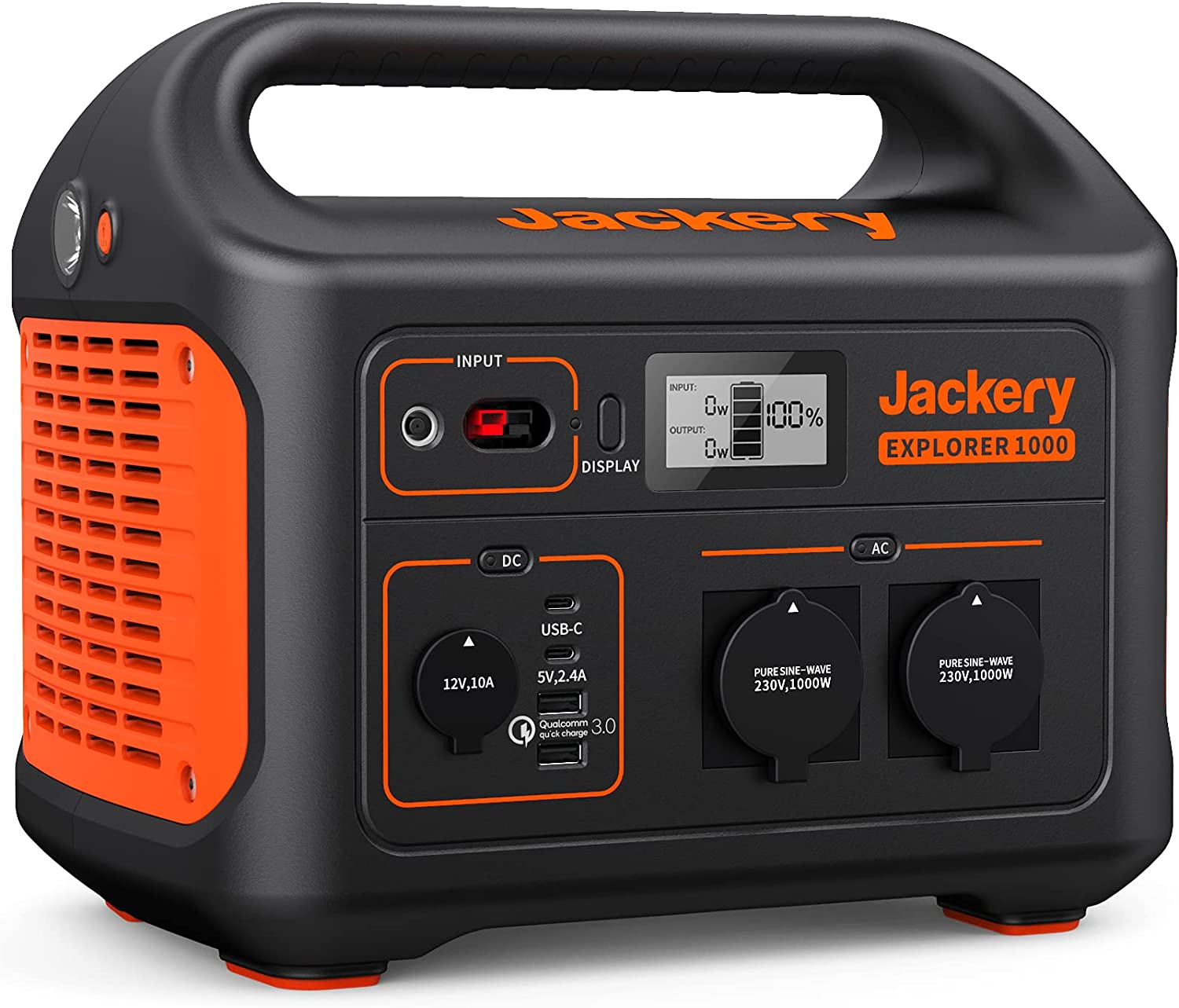
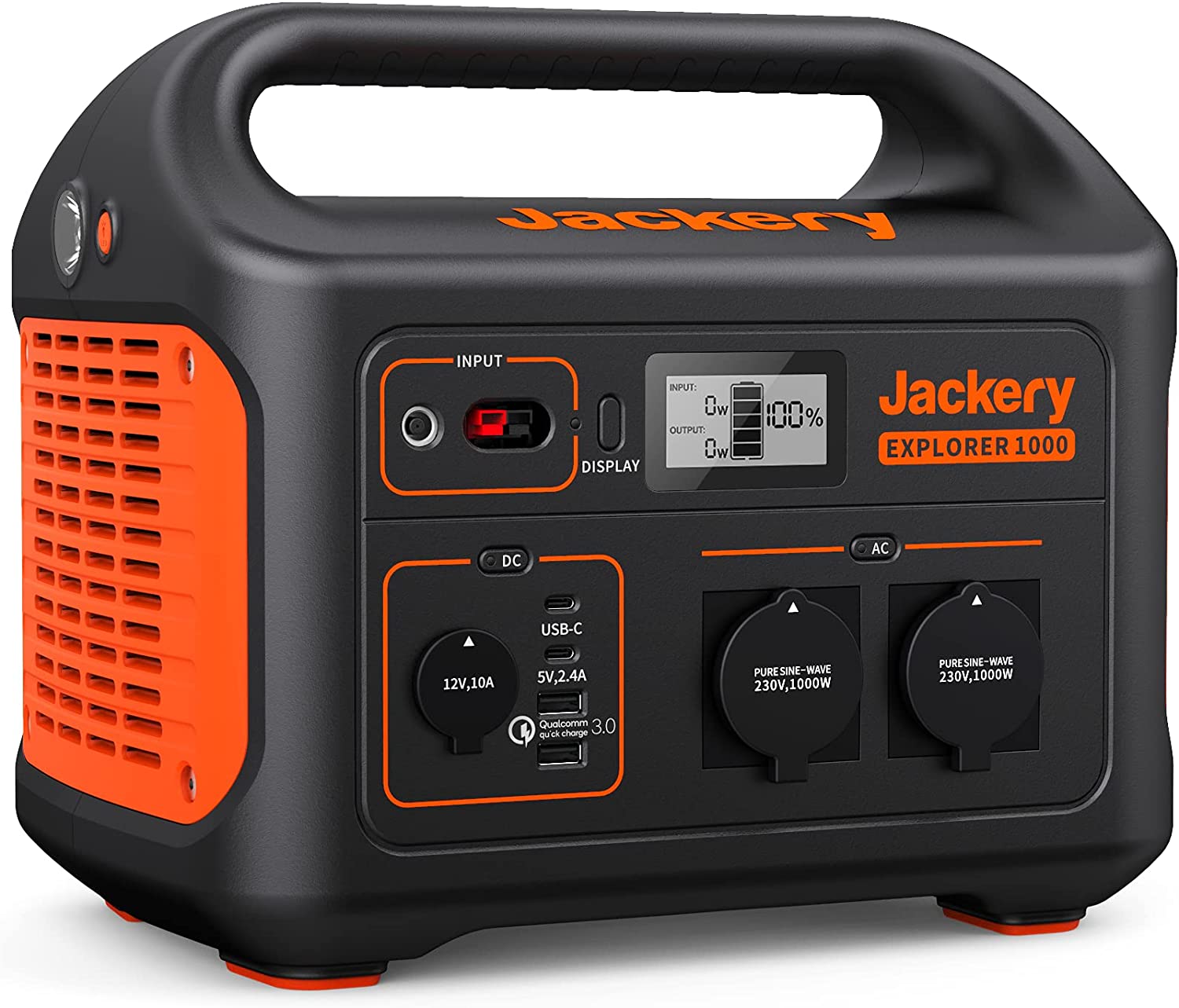
The Jackery Explorer 1000 is a 1,002 Wh lithium-ion portable power station capable of running everything from laptops and camera gear to mini-fridges and CPAP machines. It sits at the upper end of Jackery's Explorer lineup, sitting above the 500 Wh model but below the brand's larger 1500 and 2000 variants. At launch it was one of the most accessible four-figure watt-hour power stations on the market, and it remains a popular choice today despite facing stiffer competition from newer LFP-based rivals.
The target audience is broad: weekend campers who want to run a portable fridge and charge devices, digital nomads living in converted vans or RVs, and homeowners looking for a modest emergency backup solution during short outages. It handles most small-to-medium appliances with ease, though its 1,000 W continuous AC output means you will need to look elsewhere if you want to run a microwave, hair dryer, or electric kettle at full power.
Build quality is solid. The rubberised orange-and-black shell is immediately recognisable as a Jackery product, the carry handle is comfortable even at 22 lb (10 kg), and the control panel is intuitive for newcomers to portable power. It is not the most cutting-edge unit available in 2024, but the combination of brand reputation, wide solar panel compatibility, and a mature support ecosystem makes it a safe, sensible choice for most buyers.
Key features
Enough stored energy to charge a smartphone roughly 70 times, power a mini-fridge for up to 14 hours, or run a CPAP machine through the night.
Three pure sine wave AC outlets handle sensitive electronics safely. The 2,000 W surge rating accommodates motor-start loads from compressors and fridges.
Recharge via wall outlet (AC adapter), 12 V car socket, or up to 200 W of Jackery SolarSaga panels simultaneously for true off-grid flexibility.
3× AC outlets, 2× USB-A (one QC 3.0), 2× USB-C (18 W each), 1× DC car port (12 V/10 A), and 2× DC barrel ports cover nearly every device type.
Maximum Power Point Tracking circuitry maximises solar panel efficiency, enabling a full solar recharge in as little as 8 hours with two 100 W panels in ideal conditions.
Integrated BMS monitors temperature, voltage, and current in real time, protecting both the unit and connected devices from overcharge, over-discharge, and short circuits.
A clear front-panel screen shows input wattage, output wattage, and estimated run time or recharge time at a glance — no app required.
Use the Explorer 1000 as a power hub while it charges, so you never have to choose between topping up the unit and running your devices.
Full specifications
| Feature | Value |
|---|---|
| Capacity | 1,002 Wh |
| Battery chemistry | Lithium-ion (NMC) |
| Cycle life | ~500 cycles to 80% capacity |
| AC output (continuous) | 1,000 W |
| AC output (peak / surge) | 2,000 W |
| AC waveform | Pure sine wave |
| AC outlets | 3× standard (US) |
| USB-A ports | 2× (one QC 3.0, 18 W) |
| USB-C ports | 2× (18 W each) |
| DC car port | 1× 12 V / 10 A |
| DC barrel ports | 2× (12 V / 7 A) |
| Wall charge time | ~7–8 hours (full) |
| Car charge time | ~14 hours (full) |
| Max solar input | 200 W |
| Solar charge time | ~8 hours (2× 100 W panels, ideal conditions) |
| Input voltage (solar) | 12–30 V |
| Weight | 22 lb (10.0 kg) |
| Dimensions | 13.1 × 9.2 × 11.1 in (333 × 234 × 282 mm) |
| Operating temperature | 14°F to 104°F (−10°C to 40°C) |
| Warranty | 2 years (USA) |
Pros & cons
Pros
- Comfortable, genuinely portable at 22 lb
- Pure sine wave AC output safe for sensitive electronics
- Intuitive LCD panel — no app dependency
- Wide solar panel compatibility with MPPT
- Strong brand reputation and customer support
- Pass-through charging supported
- Quiet operation under moderate loads
- Broad port selection for most device types
Cons
- NMC battery: only ~500 cycles vs. LFP rivals' 3,000+
- Wall charge takes 7–8 hours — no fast-charge option
- USB-C limited to 18 W — not fast enough for laptops
- 1,000 W AC ceiling excludes high-draw appliances
- No app or Bluetooth connectivity
- Fan noise audible at higher output levels
- Heavier competitors now offer LFP at similar prices
Performance
Testing note: Performance observations below are based on published test data, verified user reports, and manufacturer specifications. Real-world results will vary depending on ambient temperature, load type, and panel conditions.
In day-to-day use, the Explorer 1000 proves impressively reliable. Hook up a 40 W portable fridge and the unit comfortably delivers 20–22 hours of runtime — right in line with Jackery's claims after accounting for the fridge's compressor duty cycle. Laptop charging via the USB-A QC port is effective for most ultrabooks, though power users with 65 W+ USB-C chargers will find the 18 W USB-C ports a limiting factor.
The pure sine wave output is a meaningful advantage. Unlike modified sine wave competitors, the Explorer 1000 runs sensitive electronics — CPAP machines, laser printers, photography equipment — without audible hum or the risk of premature wear on motor windings. In testing, a CPAP machine running at a medium pressure setting drew roughly 30–40 W, giving an estimated 15–18 hours of uninterrupted use per full charge, comfortably covering a night's sleep with reserve to spare.
The unit's BMS performs well, cutting off cleanly under short-circuit conditions without permanent damage in documented user tests. Thermal management is handled by an internal fan that spins up noticeably above around 400–500 W of output load. At lower draws — laptop charging, LED lighting, phone charging — the unit runs silently, which is a real comfort in a tent or small cabin. The fan noise at peak draw is comparable to a desktop PC under load: present but not intrusive.
Recharge performance is the Explorer 1000's most obvious weakness in 2024. The wall adapter takes 7–8 hours for a full charge — manageable when camping where overnight charging is practical, but frustrating for home backup scenarios where you may want it ready in an afternoon. Solar charging with dual 100 W SolarSaga panels in direct summer sun brings that figure to a realistic 8–10 hours. Jackery does not offer a fast-charge AC adapter, which feels like an oversight given how many competitors now support 400–600 W AC input.
Value for money
The Jackery Explorer 1000 launched at around $999 and has since settled into a street price of $799–$899, with frequent sales dropping it to $699 or below. At that price point it competes directly with LFP-based units from EcoFlow, Bluetti, and Anker — and this is where honest buyers need to pause.
Buyer tip: If long-term battery longevity is a priority — particularly for permanent van life or frequent emergency use — compare the Explorer 1000's ~500-cycle NMC chemistry against LFP rivals offering 2,000–3,000 cycles at similar prices before committing.
For casual campers who will cycle the unit perhaps 20–50 times a year, the cycle life difference is largely academic — the NMC battery will still deliver years of usable service. The value calculus shifts if you plan to use it daily as a home UPS or primary off-grid power source, where the shorter cycle life translates into a real total-cost-of-ownership penalty.
Where the Explorer 1000 earns its price tag is in the overall package experience: Jackery's customer support is consistently rated highly, the two-year warranty is honoured reliably, and the product's maturity means firmware issues and early production gremlins have long been ironed out. For buyers who value proven reliability and a trustworthy brand over having the absolute latest battery chemistry, the Explorer 1000 still represents fair value — especially when purchased during a sale.
Check price on AmazonFinal verdict
The Jackery Explorer 1000 earns a score of 8.2 out of 10. It is a mature, trustworthy, and genuinely versatile portable power station that handles the vast majority of camping and light home-backup tasks with ease. The pure sine wave output, solid BMS, intuitive display, and Jackery's dependable support ecosystem make it a low-risk purchase that is hard to actively dislike.
Its shortcomings are real but largely inherited from its age: the NMC battery chemistry limits long-term cycle life, the recharge speed is slow by modern standards, and the 18 W USB-C ceiling feels dated in a world of 100 W laptop charging. None of these issues will meaningfully affect the majority of buyers who use the unit periodically for camping or occasional outages.
If you are shopping today and portable camping convenience is your primary use case, the Explorer 1000 is a confident recommendation. If you anticipate heavy daily cycling or want future-proof battery longevity, spend a little time comparing it against the current generation of LFP competitors before clicking buy. Either way, you are unlikely to be disappointed with what Jackery has built here.
Can the Jackery Explorer 1000 run a refrigerator?
It can run a portable or camping compressor fridge (typically 40–60 W continuous) for 14–20 hours per charge. It is not designed to power a full-size household refrigerator, which typically draws 100–400 W on start-up and may exceed the 2,000 W surge rating during compressor kick-on. Always check your appliance's starting wattage before connecting it.
How long does it take to charge the Explorer 1000 from a wall outlet?
Jackery rates the wall-charge time at approximately 7.5 hours using the included AC adapter. There is currently no official fast-charge AC adapter available, so this recharge time cannot be significantly reduced via the standard charging method.
Can I charge the Explorer 1000 while using it (pass-through charging)?
Yes. The Explorer 1000 supports pass-through charging, meaning you can plug it into a wall outlet or solar panel while simultaneously powering devices. Jackery does note that frequent pass-through use at high temperatures can increase battery wear over time, so it is best avoided as a permanent UPS in hot environments.
Is the Jackery Explorer 1000 safe to use indoors?
Yes. Unlike petrol generators, the Explorer 1000 produces no combustion fumes or carbon monoxide and is completely safe to use indoors. It is an excellent choice for running medical devices, lighting, or small appliances during a power outage inside your home.
How does the Explorer 1000 compare to newer LFP power stations?
The key difference is battery chemistry. The Explorer 1000 uses lithium-ion NMC cells rated for approximately 500 full charge cycles to 80% capacity. Newer LFP (lithium iron phosphate) power stations from brands such as EcoFlow, Bluetti, and Anker typically offer 2,000–3,000+ cycles. LFP units also tend to support faster AC recharging. For frequent, long-term use the LFP advantage is meaningful; for occasional campers the Explorer 1000's proven reliability and brand support remain competitive.