Whether you're preparing for the next power outage, planning an off-grid camping adventure, or building a solar-ready home backup system, a portable power station has never been more essential. The EcoFlow Delta 2 sits at a compelling intersection of capacity, portability, and smart features — but is it the right station for your needs? We dug deep into specs, real-world performance, and value to help you decide.
TL;DR — EcoFlow Delta 2 at a Glance
- Capacity: 1,024 Wh LFP (LiFePO4) battery
- AC Output: 1,800W (surge 2,700W) — runs most home appliances
- Charging Speed: 0–80% in ~50 minutes via X-Stream AC
- Expandability: Add a 2 kWh Smart Extra Battery for ~3 kWh total
- Lifespan: 3,000+ charge cycles before dropping to 80% capacity
- Best For: Weekend campers, home backup users, van lifers, and solar enthusiasts
Our Top Pick: EcoFlow Delta 2
The EcoFlow Delta 2 delivers a rare combination of ultra-fast charging, long-life LFP chemistry, and genuine expandability in a package light enough to carry to your campsite. It earns its place as our top portable power station pick for most people.
EcoFlow Delta 2 — Base Unit
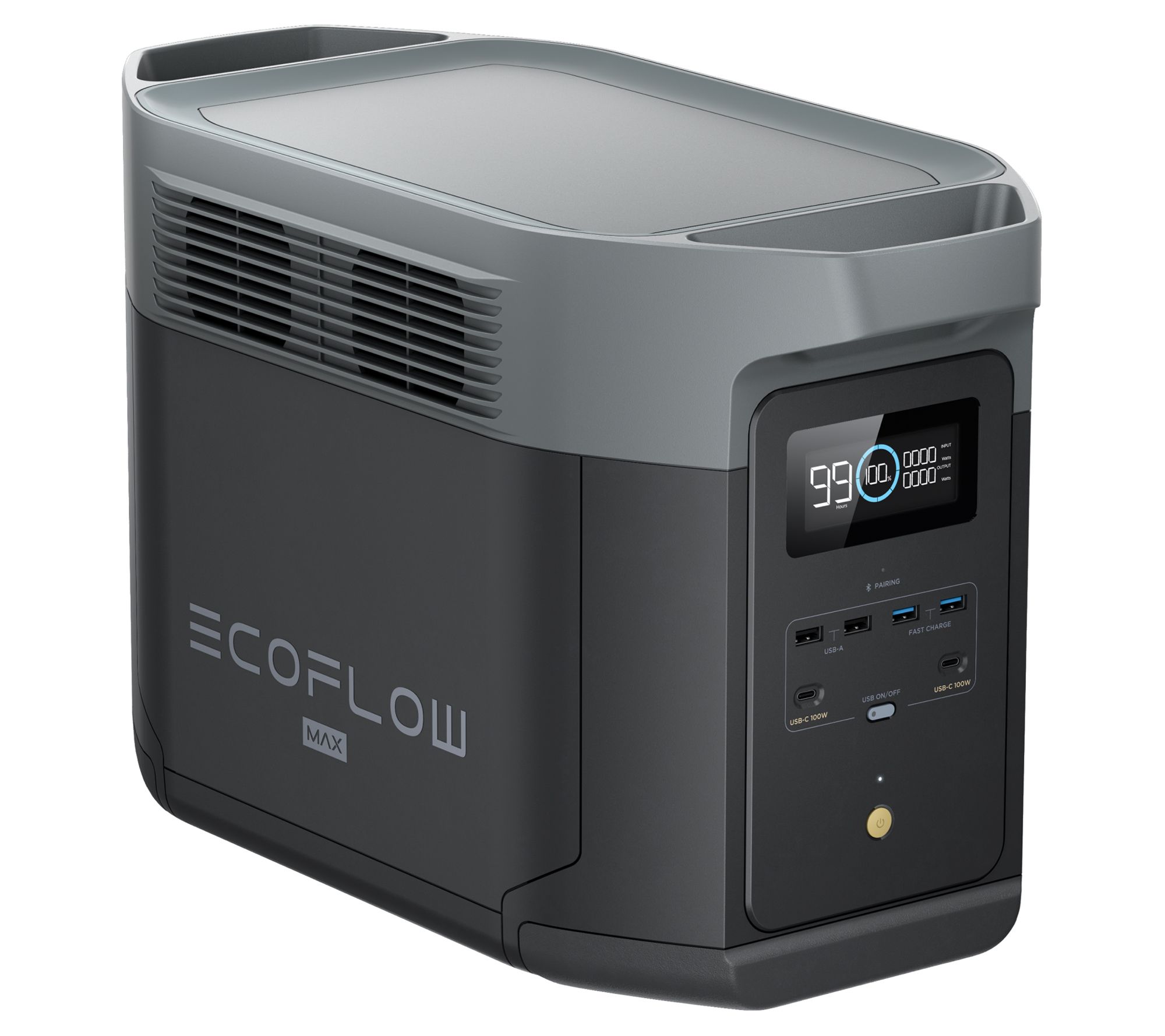
The base Delta 2 packs a 1,024 Wh lithium iron phosphate (LFP) battery into a surprisingly compact chassis. At roughly 15.7 × 8.3 × 11.0 inches and only 27 lbs, it's one of the more portable units in the 1 kWh class. Unlike older lithium-ion designs, LFP chemistry is thermally stable — meaning it won't swell or catch fire under heavy load — and EcoFlow rates the cells for over 3,000 full charge cycles. In practical terms, you could cycle the battery every other day for eight years before it degrades below 80% capacity. That longevity dramatically improves long-term value compared to cheaper NMC competitors.
On the output side, the Delta 2 offers 1,800W continuous AC power with a 2,700W surge rating — enough to run a window air conditioner, a full-size refrigerator, a countertop microwave, or a portable electric heater. Its X-Boost technology can even power some appliances rated up to 2,200W by intelligently managing the waveform. You get five AC outlets (two on the front, three on the back), two USB-A ports, two USB-C ports rated at 100W each, a 12V car port, and a DC5521 barrel port. Every output you'd realistically need on a road trip or during a blackout is covered.
Where the Delta 2 truly separates itself from competition is its X-Stream fast-charging technology. Using the supplied AC adapter, it can reach 80% from empty in approximately 50 minutes and full charge in about 80 minutes. That's nearly unheard of at this capacity level. For solar input, the Delta 2 accepts up to 500W via its XT60 solar input port, meaning two 220W–250W panels wired in series can top it off in 3–4 hours of good sun. An EV charging station (J1772 with adapter) can also fill the unit in under an hour.
The onboard touchscreen clearly shows real-time wattage input and output, time-to-full, time-to-empty, and individual port statuses. The companion EcoFlow app (iOS and Android) mirrors all of this data over Wi-Fi or Bluetooth, allows remote on/off control of AC/DC outputs, and lets you set charging limits (80% or 90% max charge helps extend cycle life even further). Firmware updates are also pushed via the app, meaning EcoFlow can add features and fix bugs long after you've bought the unit — something many competitors simply don't offer.
Battery Capacity
1,024 Wh
Battery Chemistry
LiFePO4 (LFP)
AC Output
1,800W (2,700W surge)
AC Outlets
5 × 120V outlets
USB-C Output
2 × 100W (PD 3.0)
USB-A Output
2 × 12W
Solar Input
500W max (11–60V, 15A)
AC Charging Speed
0–80% in ~50 min
Cycle Life
3,000+ to 80% capacity
Weight
27 lbs (12.5 kg)
Dimensions
15.7 × 8.3 × 11.0 in
App Control
Wi-Fi + Bluetooth (iOS/Android)
Pros
- Ultra-fast X-Stream AC charging (~80 min full)
- Long-life LFP chemistry (3,000+ cycles)
- Expandable to ~3 kWh with Smart Extra Battery
- Excellent app with remote control and scheduling
- Generous port selection for a 1 kWh unit
- X-Boost handles appliances above rated wattage
- Firmware updates delivered over-the-air
- Relatively lightweight for its capacity class
Cons
- Fan noise under heavy load (~45–50 dB)
- No built-in MPPT for multiple solar inputs
- X-Stream charger runs warm (needs ventilation)
- App requires account creation to use fully
- 1,800W AC may be limiting for large power tools
- No integrated trolley/wheels on base unit
Our links may earn us a small commission at no extra cost to you. We tested this product independently — affiliate relationships don't influence our editorial ratings.
EcoFlow Delta 2 + Smart Extra Battery (2,048 Wh System)
If the base 1,024 Wh capacity leaves you wanting more runway, EcoFlow's Smart Extra Battery slots directly into the left panel of the Delta 2 to double your effective storage to 2,048 Wh. The connection uses a proprietary DC link cable and communicates with the base unit so both batteries are managed as a single system through the same touchscreen and app. Charging, output limiting, and battery health monitoring all apply across both units simultaneously — there's no fiddling with separate devices or charge states.
With a 2 kWh system, your practical use cases expand dramatically. A full-size refrigerator averaging 100W of draw will run for roughly 16–18 hours. A CPAP machine without a humidifier (around 30–40W) could run for two full nights. You could power a home office setup — monitor, desktop PC, Wi-Fi router, and desk lamp — for an entire 8-hour workday with capacity to spare. For overlanders or van dwellers relying primarily on solar, the extra battery effectively doubles the energy buffer, giving you insurance through multiple cloudy days.
The Smart Extra Battery itself weighs approximately 26 lbs, bringing the combined system weight to around 53 lbs. EcoFlow sells an optional accessory bag with wheels that lets you roll the stacked pair like luggage, which is worth considering if mobility is a priority. The combined footprint is notably larger, so this configuration is better suited for car camping, van builds, or fixed backup setups than true backpacking trips. Solar charging input remains capped at 500W from the Delta 2's own port, though you can simultaneously charge via AC — the dual-input mode (AC + solar) is active and effective.
It's worth noting that EcoFlow also offers a Double Extra Battery that theoretically brings the system to ~3 kWh, though this configuration requires careful attention to the physical mounting and power limits. For most buyers, the single extra battery hitting 2 kWh is the sweet spot: meaningfully more capacity without turning the unit into a furniture-moving exercise. EcoFlow's pricing makes this expansion more cost-effective than buying a purpose-built 2 kWh unit outright.
Pros
- Doubles capacity to 2,048 Wh seamlessly
- Single unified interface — no juggling two units
- Still charges at full X-Stream speed
- Great value compared to buying a 2 kWh unit outright
- Both batteries managed as a single health system
Cons
- Combined ~53 lbs — needs two people or the wheel bag
- Solar input still capped at 500W total
- Larger physical footprint limits portability
- Extra battery alone doesn't function standalone
Affiliate disclosure: purchases made through our links may earn us a commission at no extra charge to you.
EcoFlow Delta 2 Max — When You Need More Power
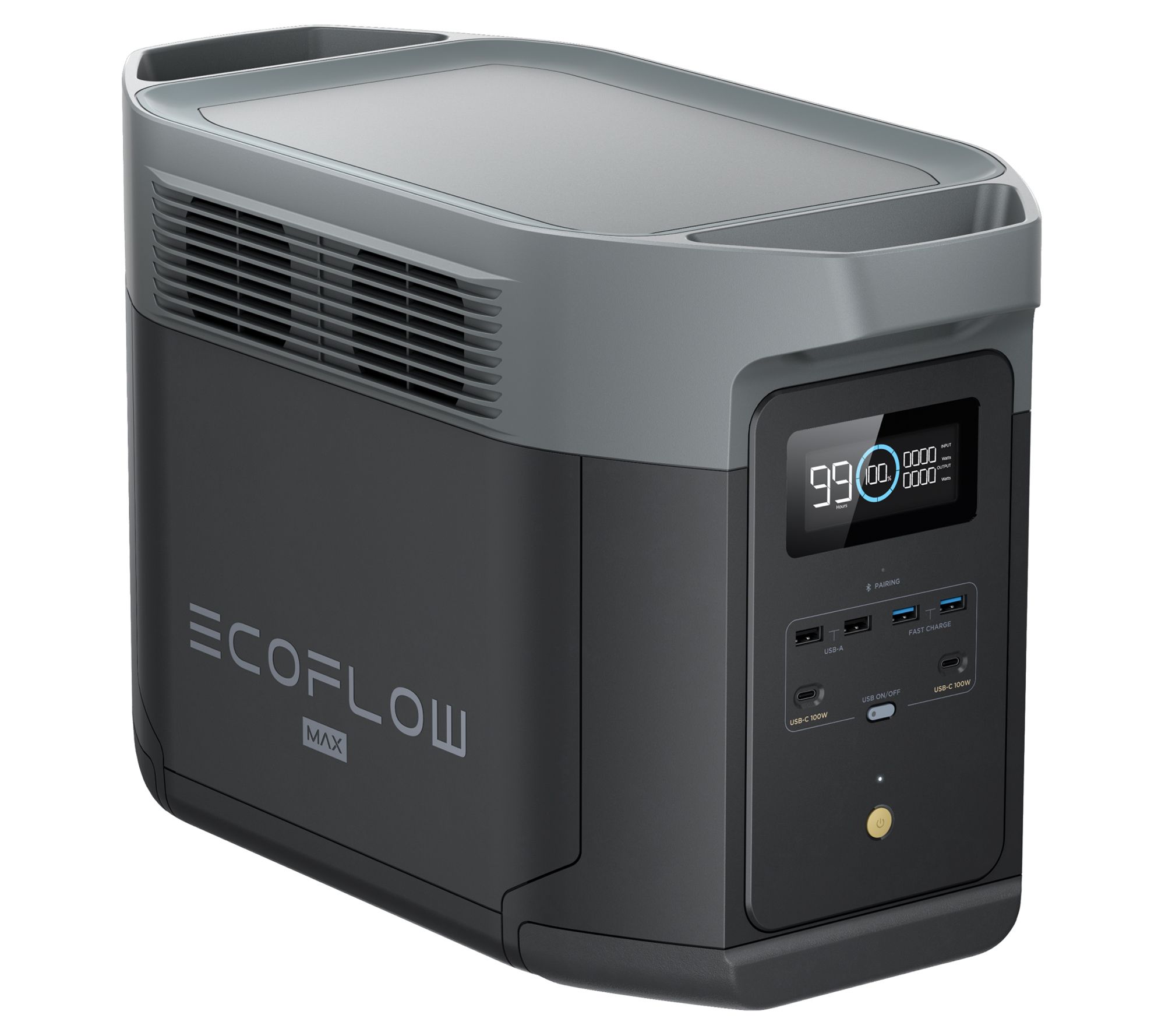
The Delta 2 Max steps up to a 2,048 Wh LFP battery in a single integrated unit and bumps AC output to 2,400W continuous (5,000W surge). The dramatically higher surge rating means the Delta 2 Max can handle motor-start loads that the standard Delta 2 cannot — think well pumps, larger air compressors, or heavy power tools with 3-horsepower-plus motors. For homeowners who want genuine whole-home circuit coverage during outages (paired with a transfer switch), the Max's higher surge tolerance is often the deciding factor.
Solar input scales to 1,000W on the Delta 2 Max, accepting two separate solar input channels simultaneously. This means you can deploy up to four 250W panels and realistically replenish the 2 kWh battery in 3–4 hours of peak sun — an entirely off-grid viable setup for a weekend cabin or prolonged camping trip. The Max also supports an Extra Battery expansion port, capable of reaching up to 4 kWh total, making it EcoFlow's most expandable consumer-tier system.
The tradeoff for all this capability is size and weight. The Delta 2 Max weighs 50 lbs and measures roughly 19.6 × 11.0 × 12.6 inches — noticeably larger than the base Delta 2. It's a two-handed carry and will feel cumbersome on any hiking trail. For car campers with a truck bed or SUV cargo area, this is a non-issue. For those prioritizing portability above all else, the base Delta 2 is a better match. The Max also carries a notably higher price — you should honestly assess whether you need 2,400W output before upgrading.
Despite the extra heft, the Delta 2 Max retains all of the base unit's software ecosystem advantages: the same app, X-Stream fast charging (0–80% in about 43 minutes via a 2,400W AC brick), real-time monitoring, and OTA firmware updates. The port selection is also more generous — you get six AC outlets versus five on the base unit, plus the same USB complement and a 30A RV port that makes campground hookup straightforward. If you're building a semi-permanent van setup or a garage backup system and want a single unit to anchor it, the Delta 2 Max is the logical choice.
Pros
- 2,400W / 5,000W surge — handles motor loads
- 1,000W dual solar input for faster off-grid recharging
- 2,048 Wh in a single integrated unit
- 30A RV port included
- Expandable to ~4 kWh with Max Extra Battery
- Same excellent app and OTA update ecosystem
- Still LFP chemistry — 3,000+ cycle life
Cons
- 50 lbs — not truly portable for solo hikers
- Significantly higher price than base Delta 2
- Larger footprint limits tight-space installations
- Requires 20A circuit for maximum charging speed
Affiliate disclosure: we may earn a commission on qualifying purchases at no extra cost to you.
EcoFlow Delta 2 Solar Panel Bundles
EcoFlow sells the Delta 2 bundled with its own lineup of foldable solar panels — the 220W Bifacial and the 160W Portable being the most common pairings. These bundles are worth considering because EcoFlow has engineered the MPPT charging controller in the Delta 2 to work optimally with their own panels, and the XT60 connectors are plug-and-play with no adapters needed. Pricing on bundles typically saves you 10–20% compared to buying each component separately, and both the panel and station arrive in a single shipment.
The 220W Bifacial Panel is EcoFlow's flagship portable offering. "Bifacial" means the panel captures light from both its front face and any light reflected off the ground or nearby surfaces from the rear — typically adding 5–10% real-world efficiency over a monofacial design. At 220W peak output, two of these panels wired in series (fitting within the Delta 2's 500W / 60V input ceiling) can bring an empty Delta 2 from 0 to 100% in approximately 4–5 hours in good conditions. The panel folds into a carry bag slightly smaller than a large suitcase and weighs about 13 lbs — reasonable for car camping.
The 160W Portable Panel is a more budget-friendly option that sacrifices some output for a lower price. It's monocrystalline (not bifacial) and folds more compactly, making it a popular choice for backpackers using a lightweight setup or anyone who already has one panel and wants to add a second for the Delta 2's full 500W input capacity. One 160W panel alone will top off an empty Delta 2 in roughly 7–8 hours — acceptable for an overnight recharge in a fixed camp, but slow for a single active day of use.
For most buyers, the Delta 2 + 220W Bifacial dual-panel bundle is the sweet spot for serious solar use. Two panels deliver close to the unit's maximum 500W input, and the bifacial design squeezes every photon available. If budget is a constraint, a single 220W panel provides a good balance of recharge speed and cost. Keep in mind that solar output is highly weather-dependent — a partially cloudy day may halve your effective input, so always size your panel array generously relative to your expected daily consumption.