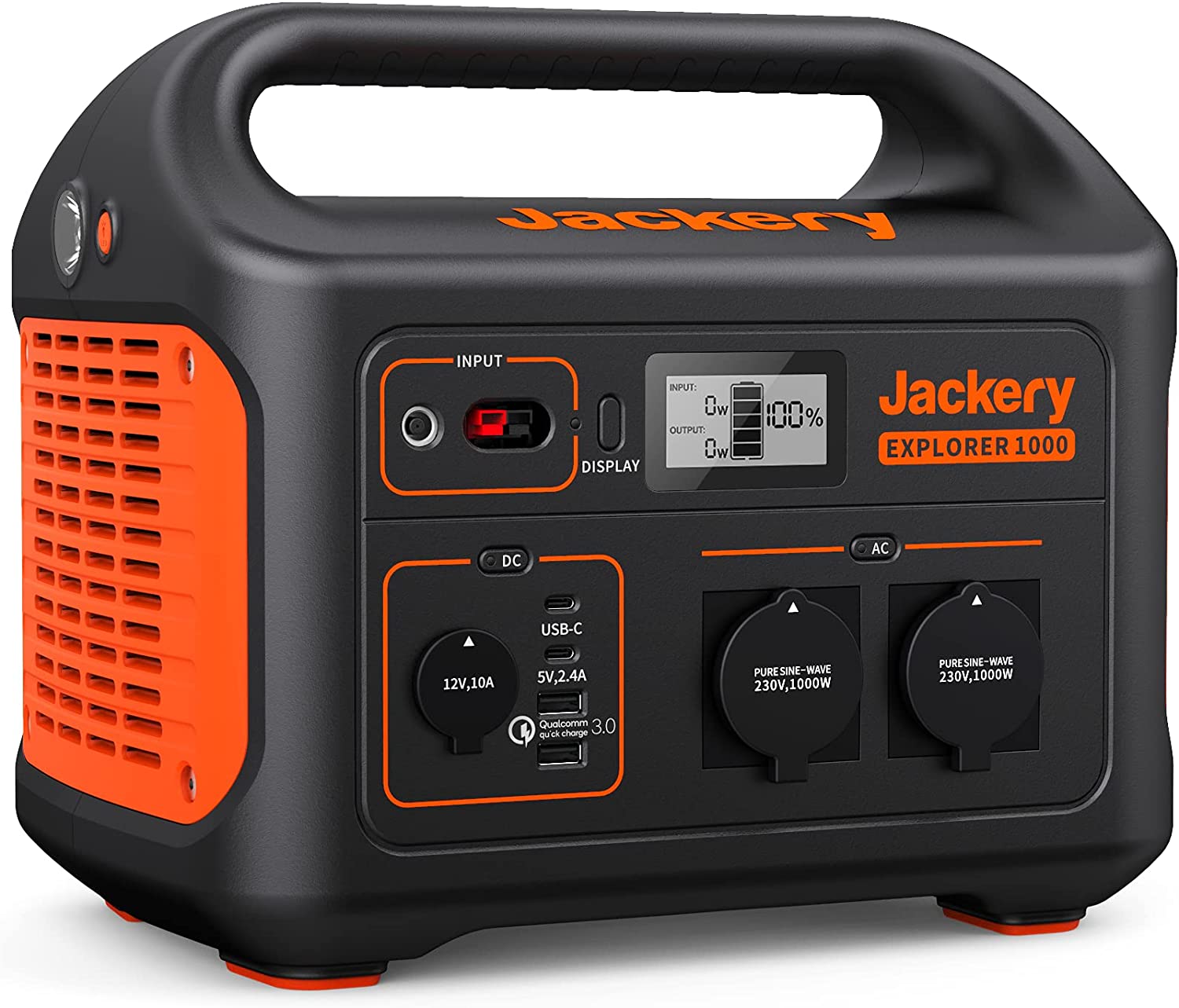
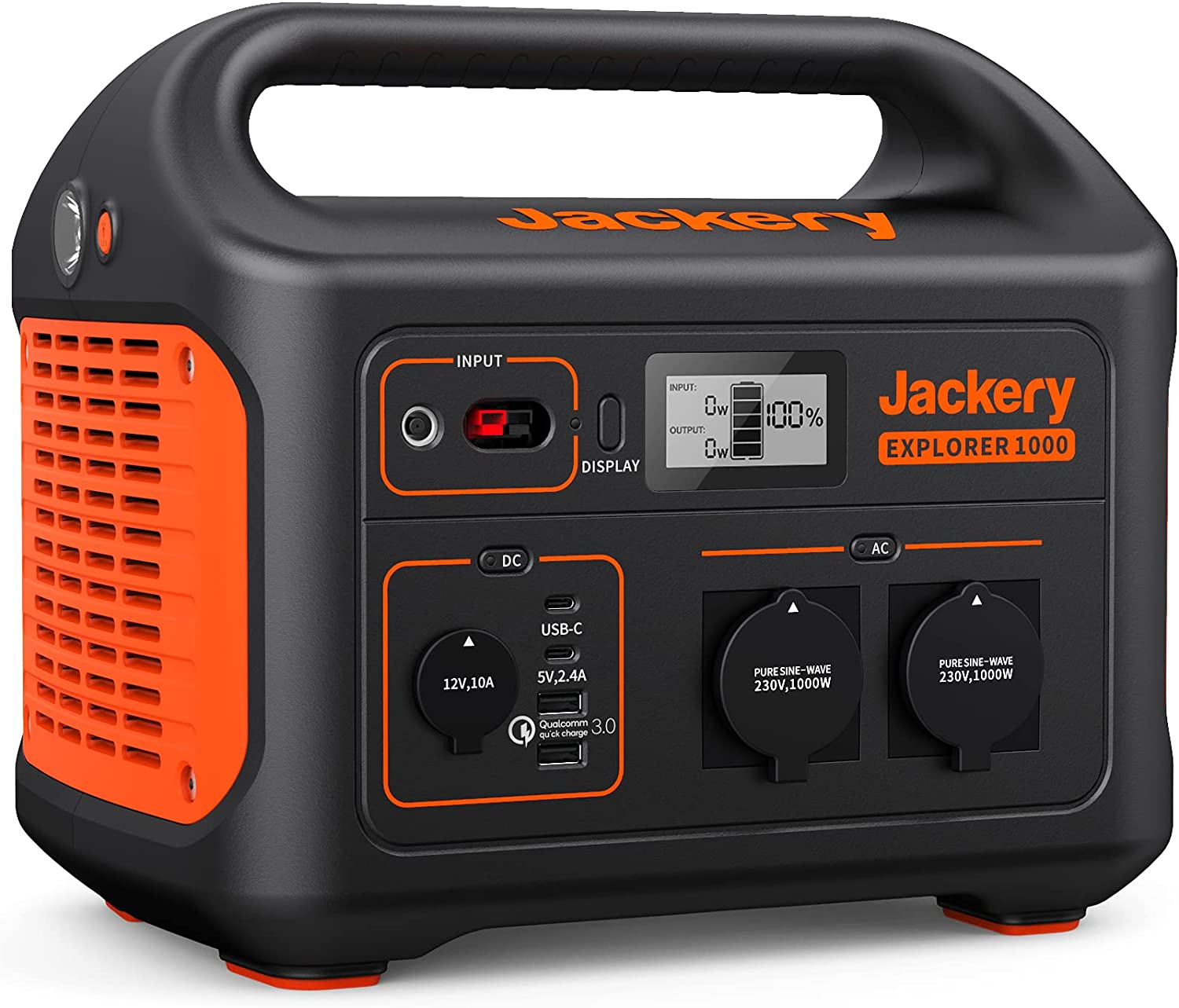
Whether you're powering a weekend camping trip, prepping for a grid outage, or keeping your home office alive during a blackout, a portable power station can be a genuine lifesaver — but choosing the right one takes more than glancing at a watt-hour number. The Jackery Explorer 1000 Portable Power Station has become one of the most recognizable names in the mid-capacity power station segment, and for good reason. In this complete buying guide we break down everything you need to know before you decide whether it belongs in your gear kit. For a deeper hands-on perspective on performance and value, see our Jackery Explorer 1000 review.
See current price and details for Jackery Explorer 1000 Portable Power Station.
TL;DR — Quick Summary
- 1,002 Wh lithium-ion battery with a 1,000 W AC inverter (2,000 W surge)
- Three AC outlets, two USB-A, two USB-C, one DC carport, and one 12 V DC barrel port
- Recharges via solar (up to 400 W), AC wall outlet (~7 hrs), or 12 V car adapter
- Best for: campers, van-lifers, remote workers, and light emergency backup
- Not ideal for: high-draw appliances like central AC units or large electric ranges
- Weight: 22 lbs (10 kg) — portable but not featherlight
Jackery Explorer 1000 — Full Review
The Jackery Explorer 1000 sits at the sweet spot of the portable power market: big enough to run a full-size CPAP machine all night, charge a laptop a dozen times, or keep a mini-fridge cold for 8–10 hours, yet light enough that one person can carry it to a campsite without a cart. The 1,002 Wh capacity gives you real-world headroom without the price penalty of jumping to 1,500 Wh or 2,000 Wh units. Jackery has been refining this form factor since its first Explorer models, and the 1000 benefits from years of user feedback in its port layout, carry handle design, and cooling-fan management.
Related parts & accessories
Under the hood you'll find a lithium-ion NMC (nickel manganese cobalt) cell pack rated for around 500 full charge cycles before dropping to roughly 80 % capacity — a figure that's industry-standard for NMC chemistry. The pure-sine-wave inverter is a critical detail here: unlike modified-sine inverters found in cheaper units, pure sine wave output is safe for sensitive electronics including CPAP machines, variable-speed power tools, and medical devices. The 1,000 W continuous rating covers the vast majority of portable appliances, and the 2,000 W surge headroom handles the brief spike when compressor-based devices like mini-fridges and small AC window units first kick on.
Charging flexibility is where the Explorer 1000 really earns its reputation. Pair it with two Jackery SolarSaga 200W Foldable Bifacial Portable Solar Panels (sold separately) and you can top the unit off from empty in roughly 5–6 hours on a sunny day — a genuinely useful figure for multi-day off-grid trips.
Wall charging takes about 7–8 hours using the included AC adapter, while a 12 V car outlet gets you a slower ~16-hour top-up that's better suited to maintaining charge on a road trip than recovering from a deep discharge. The Explorer 1000 also supports pass-through charging, meaning you can power devices while the unit itself is charging from solar or wall power.The LCD display gives you real-time input/output wattage readings and a battery percentage estimate, which is more useful than a simple bar-graph indicator. The interface is intuitive: power buttons for AC, DC, and USB outputs are clearly labeled, and the fan only spins up when the unit is working hard or warm — it stays whisper-quiet during low-draw use, which matters when it's sitting at the foot of your sleeping bag. At 22 lbs the Explorer 1000 isn't a unit you'll casually swing into a backpack, but the padded grab handle makes solo transport over short distances manageable, and a folding trolley (a popular accessory) makes campsite-to-car runs trivial.
| Spec | Detail |
|---|---|
| Capacity | 1,002 Wh |
| AC Output | 1,000 W continuous / 2,000 W peak (pure sine wave) |
| AC Outlets | 3 × standard 110 V outlets |
| USB-A | 2 × USB-A (5 V, 2.4 A each) |
| USB-C | 2 × USB-C (5 V / 9 V / 12 V / 20 V, up to 18 W each) |
| DC Output | 1 × DC carport (12 V, 10 A), 2 × DC5521 barrel (12 V, 7 A each) |
| Solar Input | Up to 400 W, 12–30 V, max 10 A (MPPT) |
| AC Charging Time | ~7.5 hrs (included 144 W adapter) |
| Solar Charging Time | ~5.5 hrs (2 × 200 W SolarSaga panels, ideal conditions) |
| Car Charging | ~16 hrs (12 V / 24 V, included cable) |
| Weight | 22.04 lbs (10 kg) |
| Dimensions | 13.1 × 9.2 × 11.1 in (33.3 × 23.3 × 28.2 cm) |
| Battery Chemistry | Lithium-ion NMC |
| Cycle Life | ~500 cycles to 80% capacity |
| Operating Temp. | 14 °F to 104 °F (−10 °C to 40 °C) |
| Warranty | 24 months (standard); extendable to 36 months with registration |
Pros
- Pure sine wave inverter safe for sensitive electronics
- Versatile port selection covers almost any device
- Up to 400 W solar input with MPPT charge controller
- Relatively compact and manageable at 22 lbs
- Quiet cooling fan during low-demand use
- Clear LCD showing real-time watts in/out
- Pass-through charging supported
- Well-established brand with good customer support
Cons
- NMC chemistry: fewer cycles than LFP alternatives
- No app or Bluetooth monitoring
- USB-C ports limited to 18 W — no 100 W PD
- Wall charging takes 7+ hours without a dual-charger upgrade
- Not expandable (fixed battery capacity)
- 1,000 W limit excludes some home appliances
- No built-in UPS / instant switchover function
Our Top Pick: Jackery Explorer 1000
With a 1,002 Wh capacity, pure sine wave inverter, and best-in-class solar compatibility, the Jackery Explorer 1000 remains one of the most well-rounded mid-capacity power stations money can buy — especially for outdoor enthusiasts and occasional emergency use.
Who Is the Jackery Explorer 1000 For?
The Jackery Explorer 1000 Portable Power Station is purpose-built for people who need reliable, portable power in the 500 W–1,000 W continuous range. That covers a surprisingly wide range of real-world scenarios. If you're a weekend camper or van-lifer, you can run a portable fridge, charge all your devices, power lights and a fan, and still have capacity left over for a couple of nights. For overlanders who pair the unit with roof-mounted or folding solar panels, the Explorer 1000 becomes a genuinely self-sustaining power source for multi-week trips away from hookups.
Home emergency users will find the 1,000 Wh capacity useful for keeping essential devices — phone chargers, a small TV, a CPAP machine, and LED lighting — running during a 12–24 hour outage. For those protecting their basements, we recommend pairing backup power with a dedicated battery backup system, critical water management tools—such as those detailed in our sump pump comparison guide—like the Ridgid SP-650C sump pump or best submersible utility pumps. To ensure your pump stays running during a blackout, see our Wayne ESP25 battery backup guide and full performance review. For those upgrading their whole-home safety, check out our ADT Self Setup guide or explore our Ring Alarm Pro 14-Piece buying guide or ensure your water quality with a whole-house water filter for integrated home monitoring. It won't replace a whole-home generator, but it will keep the most important things on — readers needing more capacity should consider the Anker PowerHouse 757 Portable Power Station or the higher-output Jackery Explorer 2000 Plus instead. Remote workers and content creators who need to run laptops, camera battery chargers, and portable monitors in the field will also find the Explorer 1000 more than adequate for a full-day shoot or work session. If you're managing a damp home studio, you might also find our GE ADEL50LZ dehumidifier guide (and performance review) helpful. If you're upgrading your space's airflow, consider a Panasonic WhisperGreen ventilation system or a MrCool DIY mini-split for climate control.
Photographers and videographers on location will particularly appreciate the clean pure sine wave output, which eliminates the hum or interference that modified-sine-wave inverters can inject into audio equipment. Drone pilots can use it to charge multiple battery sets between flights. Medical equipment users — particularly those relying on CPAP or BiPAP devices — should note that most of these machines draw well under 100 W per night, making the Explorer 1000 capable of several consecutive nights of operation without recharging.
Solar Pairing: Getting the Most From the Explorer 1000
The Explorer 1000's MPPT (maximum power point tracking) solar charge controller is one of its most compelling features. MPPT technology dynamically optimizes the power drawn from solar panels as conditions change throughout the day, squeezing out significantly more energy than older PWM controllers. The input window of 12–30 V at up to 10 A means you have genuine flexibility in what solar panels you attach — it's not locked to Jackery's own panels, though those are the easiest plug-and-play option.
For practical purposes, a pair of 100 W panels is a reasonable entry point, delivering roughly 150–180 real-world watts in good sun and filling the Explorer 1000 in about 6–8 hours. Step up to two 200 W panels and you're looking at 5–6 hours in optimal conditions. The maximum 400 W input means there's no benefit to going beyond two 200 W panels unless you're chaining compatible panels in a configuration that stays within voltage and amperage limits. Always check that your panel array's open-circuit voltage doesn't exceed 30 V and total amperage doesn't exceed 10 A when using third-party panels.
For van-lifers and overlanders who want a semi-permanent setup, the Explorer 1000 can also accept input from a vehicle's alternator via the included 12 V car charging cable. This is a slow method (~16 hours for a full charge), but it's excellent as a maintenance or top-up strategy while driving between destinations, and it means you're never tru