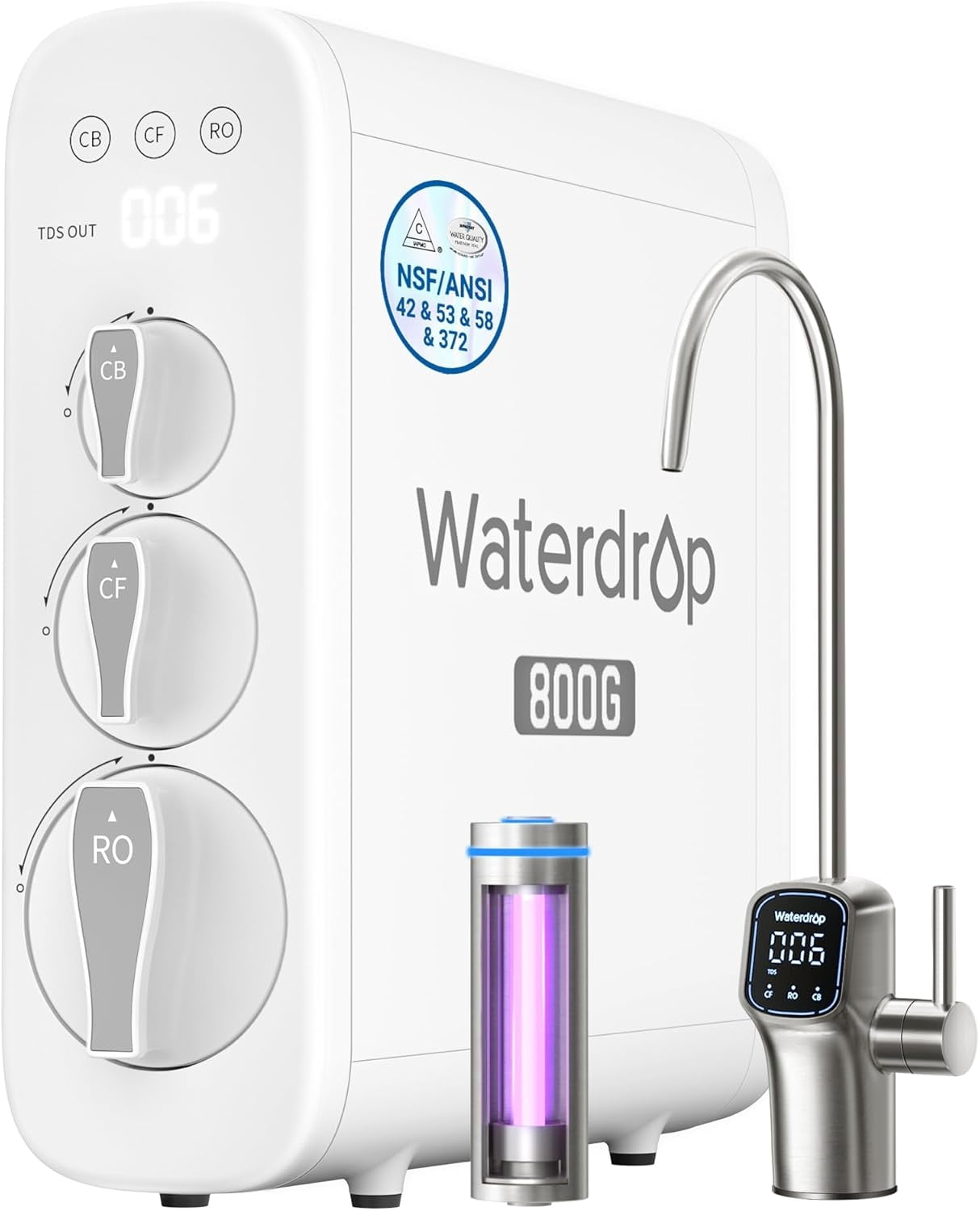
Waterdrop Tankless Under-Sink Reverse Osmosis System 800 GPD (G3P800)
Score: 8.8/10 — A fast, space-saving tankless RO system that is well worth considering for households that want high-capacity filtered drinking water and can accommodate the under-sink installation requirements.
Overview
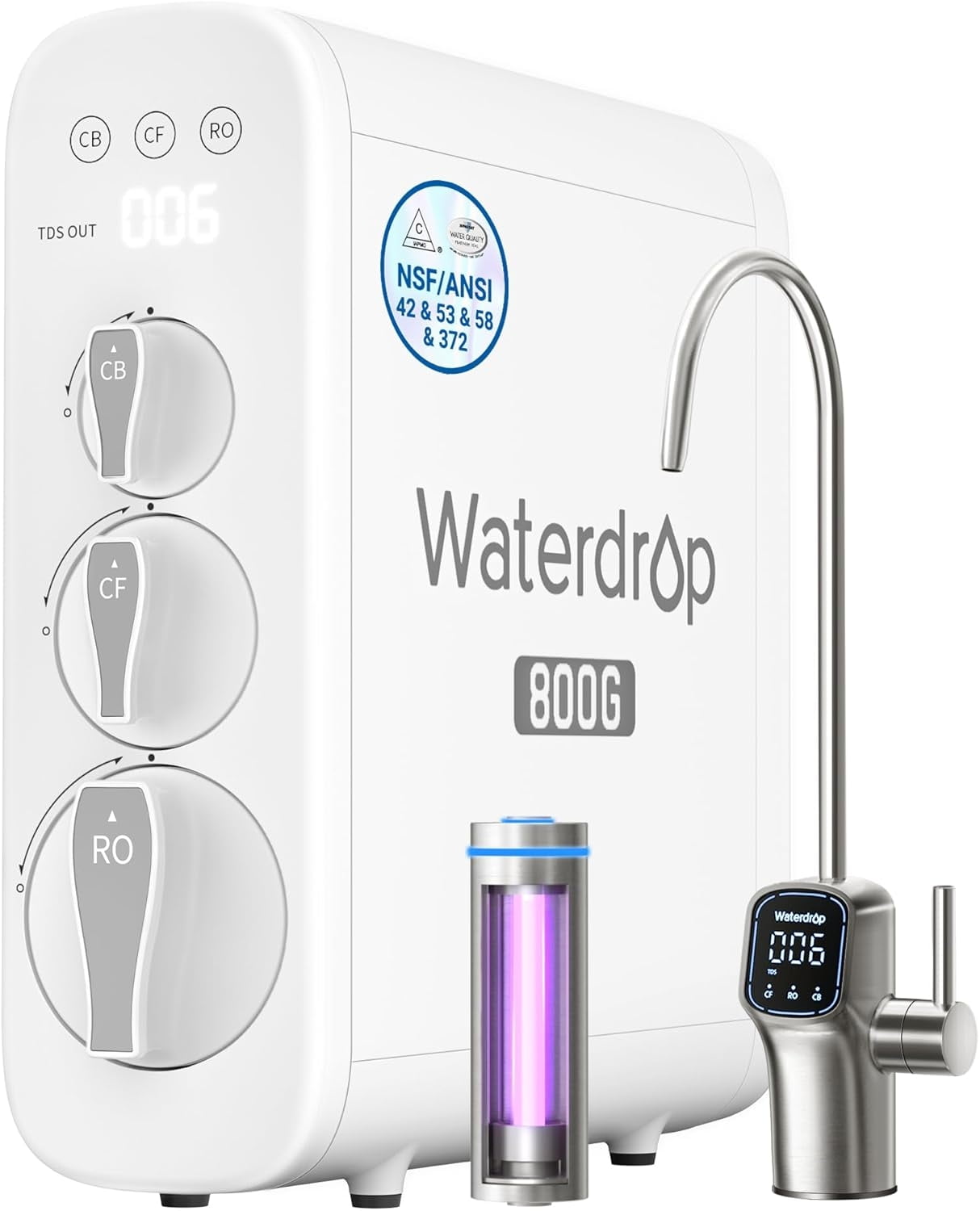
The Waterdrop Tankless Under-Sink Reverse Osmosis System 800 GPD is a high-performance RO solution
designed to provide fast, space-saving filtered water for the modern residential kitchen. Unlike traditional reverse osmosis (RO) systems that rely on a large, pressurized storage tank to hold filtered water, the G3P800 processes water on demand. This architectural shift allows for a significantly smaller footprint, which is a critical advantage in modern kitchens where under-sink real estate is often occupied by garbage disposals, dishwashers, and cleaning supplies.With a rated production capacity of 800 Gallons Per Day (GPD), this system is engineered for high-volume demand. In practical terms, this means you aren't waiting for a tank to refill or dealing with the sluggish flow rates common in budget RO setups. It is specifically tailored for families, home chefs, and health-conscious individuals who want to eliminate their reliance on single-use plastic bottled water without sacrificing the convenience of a fast-flowing tap.
While the performance is impressive, the Waterdrop Tankless Under-Sink Reverse Osmosis System 800 GPD is a permanent home upgrade. It requires a dedicated power source, a connection to your cold water line, and a link to your drainage system. For homeowners comfortable with basic plumbing or those who hire a professional installer, it represents one of the most efficient ways to ensure a consistent supply of ultra-pure drinking water.
The Science of Pure Water: How the G3P800 Works
To understand the value of the Waterdrop Tankless Under-Sink Reverse Osmosis System 800 GPD, it is helpful to understand the physics of reverse osmosis. For those looking to combine this with a GE High Flow Whole House Water Filtration System (see our GE GXWH40L whole house water filter buying guide) for maximum protection, the benefits are compounded. Standard osmosis occurs when water naturally flows from an area of low solute concentration to an area of high solute concentration. Reverse osmosis flips this process by applying external pressure to force water through a semi-permeable membrane.
In the Waterdrop Tankless Under-Sink Reverse Osmosis System 800 GPD, this process happens in several critical stages to ensure maximum purity and equipment longevity:
1. Sediment and Carbon Pre-filtration: Before the water reaches the RO membrane, it passes through pre-filters that remove larger particles, sediment, and chlorine. This is crucial because chlorine is chemically aggressive and can degrade the delicate RO membrane, leading to premature system failure.
2. The High-Pressure RO Membrane: This is the heart of the system. The membrane has incredibly small pores that allow water molecules to pass through while blocking larger contaminants like lead, arsenic, fluoride, nitrates, and dissolved salts. Because this membrane requires significant pressure to operate efficiently, the G3P800 utilizes an integrated electric pump to drive water through the filter in real-time.
3. Post-Filtration and Polishing: After the membrane, the water typically passes through a final polishing filter. This stage removes any lingering odors and ensures a crisp, clean taste before the water reaches your dedicated faucet.
Key Features
The Waterdrop Tankless Under-Sink Reverse Osmosis System 800 GPD (G3P800) avoids a separate storage tank, helping preserve cabinet space and reducing the chance of stale stored water.
The high rated production capacity is aimed at faster dispensing and better support for busy households than lower-output RO systems.
Designed to reduce dissolved solids and common tap-water contaminants such as lead, chlorine, fluoride, and other impurities that affect taste.
Because there is no storage tank, the system fits more neatly under most kitchen sinks, leaving room for other appliances.
The 800 GPD rating allows the system to deliver filtered water quickly, making it practical for filling large pots and kettles.
The filter design simplifies routine maintenance, allowing for cartridge changes without the need for specialized tools or complex teardowns.
Technical Specifications
| Feature | Value |
|---|---|
| Product Name | Waterdrop Tankless Under-Sink Reverse Osmosis System 800 GPD |
| Model Number | G3P800 |
| Category | Water Treatment Systems |
| System Type | Tankless Reverse Osmosis |
| Production Capacity | 800 Gallons Per Day (GPD) |
| Filtration Targets | Lead, Chlorine, Fluoride, TDS (Total Dissolved Solids) |
| Storage Tank | None (Tankless) |
| Installation Area | Under-sink / Cabinet |
| Maintenance Style | Twist-and-lock filter replacement |
| Power Requirement | Electric (Plug-in) |
Pros & Cons
Pros
- High 800 GPD capacity significantly reduces wait times for filtered water.
- Tankless architecture saves massive amounts of under-sink cabinet space.
- Superior reduction of dissolved solids compared to standard carbon filters.
- Eliminates the need for purchasing and transporting heavy bottled water.
- Easy-to-use twist-and-lock filters make maintenance accessible for non-experts.
- Consistent water quality since water is filtered fresh on demand.
Cons
- Installation is invasive, requiring a dedicated faucet and drain line.
- Requires constant electrical power to operate the RO pump.
- Higher initial investment than pitcher or faucet-mounted filters.
- Wastes a portion of water during the filtration process (standard for RO).
- Overkill for single-person households with very low water usage.
Performance and Real-World Impressions
In real-world application, the Waterdrop Tankless Under-Sink Reverse Osmosis System 800 GPD excels where traditional RO systems fail: speed and space. When we test a standard tank-based system, there is often a noticeable "pressure drop" as the tank empties. With the G3P800, the flow remains consistent and brisk. Filling a 64-ounce sports bottle takes seconds, not minutes, which fundamentally changes how a family interacts with filtered water. You are more likely to use filtered water for cooking pasta or steaming vegetables if the process doesn't feel like a chore.
From a taste perspective, the impact is immediate. Municipal water often carries a "chemical" or "metallic" tang due to chlorine or mineral buildup. The Waterdrop Tankless Under-Sink Reverse Osmosis System 800 GPD strips these away, producing water that is neutral, crisp, and clean. This is particularly evident in coffee and tea; without the interference of dissolved solids, the nuanced flavors of the beans or leaves are more prominent.
Maintenance is another area where the G3P800 shines. Traditional RO systems often involve "filter housings" that require a heavy-duty wrench and a prayer that you've seated the O-ring correctly to avoid a leak. The twist-and-lock system on the Waterdrop Tankless Under-Sink Reverse Osmosis System 800 GPD turns a potentially messy plumbing job into a 30-second task. This encourages users to actually stick to their maintenance schedule, which ensures the system operates at peak efficiency for years.
However, the installation process is the primary hurdle. This is not a "plug-and-play" device. You will be dealing with your home's plumbing. If you have a modern sink with a pre-drilled hole for a soap dispenser, the faucet installation is a breeze. If you are upgrading your entire sink setup, consider checking out our MOEN Chateau 7430 faucet guide for installation and Kohler Artifacts faucet guide for luxury options. If not, be prepared to drill through granite or stainless steel (refer to our Pfister Stellen faucet buying guide or a detailed MOEN Chateau 7430 review for mounting precision). Additionally, the requirement for a power outlet under the sink means that if your cabinet doesn't have one, you'll need to run an extension cord or have an electrician install a new outlet.
Comprehensive Installation and Setup Guide
Setting up the Waterdrop Tankless Under-Sink Reverse Osmosis System 800 GPD requires a systematic approach. While Waterdrop provides comprehensive instructions, here is a detailed breakdown of the process for planning purposes.
Step 1: Site Preparation and Pre-Check
Clear out your under-sink cabinet entirely. You will need enough room for the main unit and the tubing to run without sharp kinks. Check for a nearby GFCI outlet. If you don't have one, ensure you have a safe way to power the unit; using a surge protector is recommended to protect the internal pump from power spikes. Ensure you have a clear path to your cold water supply line and your drain pipe.
Step 2: Faucet Mounting
The dedicated RO faucet must be installed on the sink or countertop (see our kitchen faucet reviews for mounting tips). If you are using an existing hole, simply drop the faucet in and tighten the mounting nut from below. If you are drilling a new hole, use a diamond-tipped bit for stone or a metal bit for steel, ensuring you have a template to avoid misalignment. The faucet is the primary interface for your filtered water, so ensure it is securely tightened to prevent leaks during high-flow use.
Step 3: Plumbing Connections
The system connects to your cold water line using a T-adapter. This allows the Waterdrop Tankless Under-Sink Reverse Osmosis System 800 GPD (G3P800) to pull water from the main line while still providing water to your main kitchen faucet. Simultaneously, you must install a drain saddle on your sink's drain pipe (for more on connecting home plumbing fittings, see our SharkBite coupling guide). This is where the "brine" or waste water (the contaminants filtered out) is sent. Ensure the drain saddle is tight and the hole is cleanly drilled to prevent leaks into your cabinetry. If you're dealing with a wet basement environment, you may also want to consult our Ridgid SP-650C review or our guide to the best submersible utility pumps or a battery backup sump pump guide for overall water management.
Step 4: Filter Activation and Initial Flushing
Once the tubing is connected and the unit is powered on, it is critical to perform an initial flush. New filters contain carbon fines and air pockets. Running the water for several minutes ensures that the membrane is fully saturated and that any manufacturing residue is cleared out before the first glass of water is consumed. Do not be alarmed if the water looks cloudy or "milky" for the first few gallons; this is simply trapped air being purged from the system.
Detailed Maintenance and Long-Term Care
To maintain the 800 GPD flow rate and the purity levels of the Waterdrop Tankless Under-Sink Reverse Osmosis System 800 GPD, a consistent maintenance schedule is non-negotiable. Unlike simple carbon pitchers that can be ignored for months, an RO system is a high-precision instrument.
Filter Replacement Cycles
The G3P800 uses a multi-stage filter approach. Typically, the pre-filters (sediment and carbon) need replacement every 6 to 12 months, depending on your local water quality. If you live in an area with high sediment or "hard" water, you may find the pre-filters clogging faster; in these cases, an Aquasana Salt-Free Whole-Home Water Softener and Conditioner (or a GE GXWH40L whole house water filter) can protect your RO system from premature wear. The RO membrane, which is the most expensive and critical part of the system, generally lasts significantly longer—often 24 months or more. The system often includes indicators or prompts to alert you when it is time for a change.
The Twist-and-Lock Mechanism
The genius of the G3P800 is the tool-less replacement. In older systems, users had to deal with "sump housings" that required specialized wrenches and often leaked after being opened. With the Waterdrop G3P800, you simply twist the cartridge to unlock it and click a new one into place. This removes the "fear factor" associated with RO maintenance and ensures that the seal is tight every time.
Sanitization and Leak Prevention
While the tankless design eliminates the primary source of bacterial growth (the storage tank), it is still wise to inspect the tubing and connections every few months. Look for "sweating" or small droplets around the T-adapter and drain saddle. Ensuring the unit is mounted securely to the cabinet wall prevents the tubing from being accidentally yankged or kinked when you move cleaning supplies around the sink area.
Buyer's Guide: Is the G3P800 Right For You?
Choosing a water filtration system is often a trade-off between purity, convenience, and installation effort. To help you decide if the Waterdrop Tankless Under-Sink Reverse Osmosis System 800 GPD is the right choice, consider the following factors.
Water Quality Needs
If your primary concern is just removing the smell of chlorine, a simple carbon filter—see our GE GXWH40L whole house water filter buying guide for more options—or a Brita Standard 10-Cup Pitcher might suffice for those with minimal needs. However, if you are dealing with high Total Dissolved Solids (TDS), heavy metals like lead, or fluoride, a Reverse Osmosis system is practically a requirement. The G3P800 is designed specifically for these high-threat environments, offering a level of purity that carbon-only filters simply cannot achieve. If you have a well or live in an area with older plumbing (lead pipes), the RO membrane is the only reliable way to ensure these contaminants are physically blocked; for those seeking comprehensive whole-home options, our Culligan WH-HD200-C whole house filtration guide provides a deeper dive into large-scale filtration. If you prefer remineralized water, the Express Water 10-Stage Alkaline Reverse O