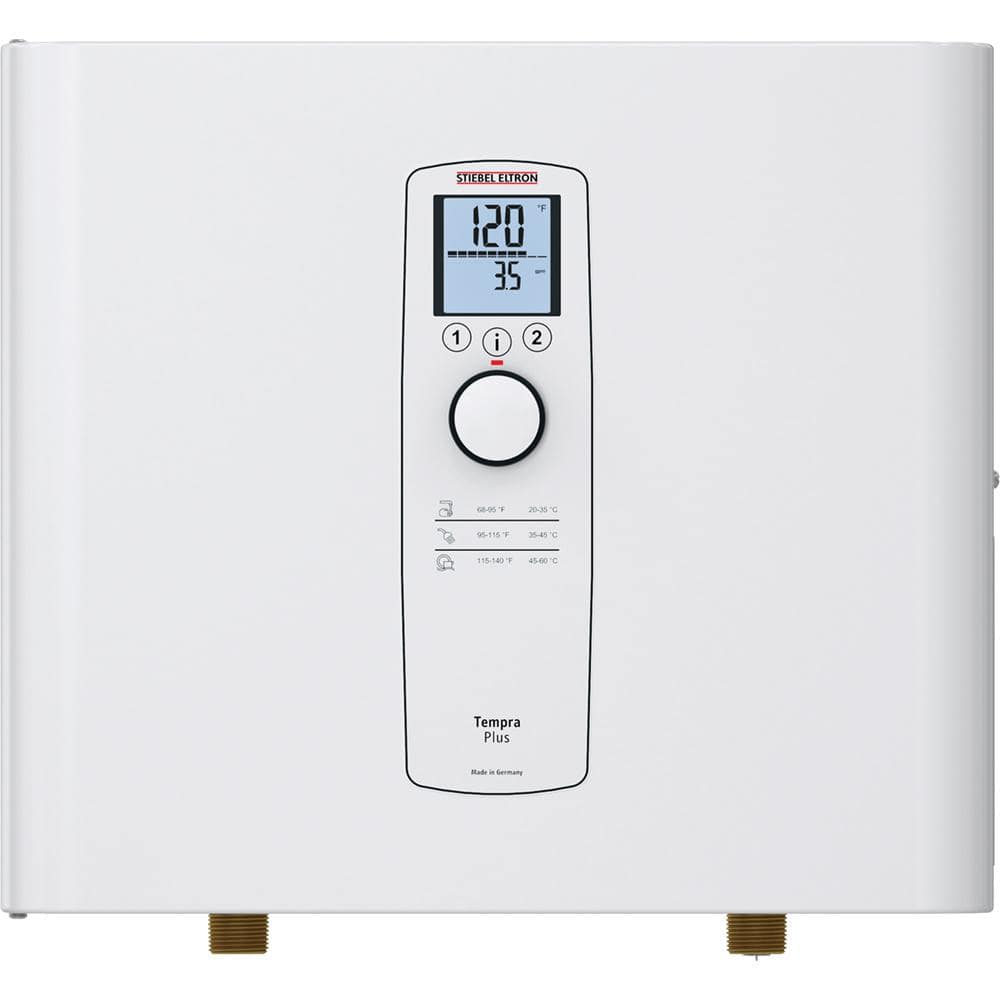
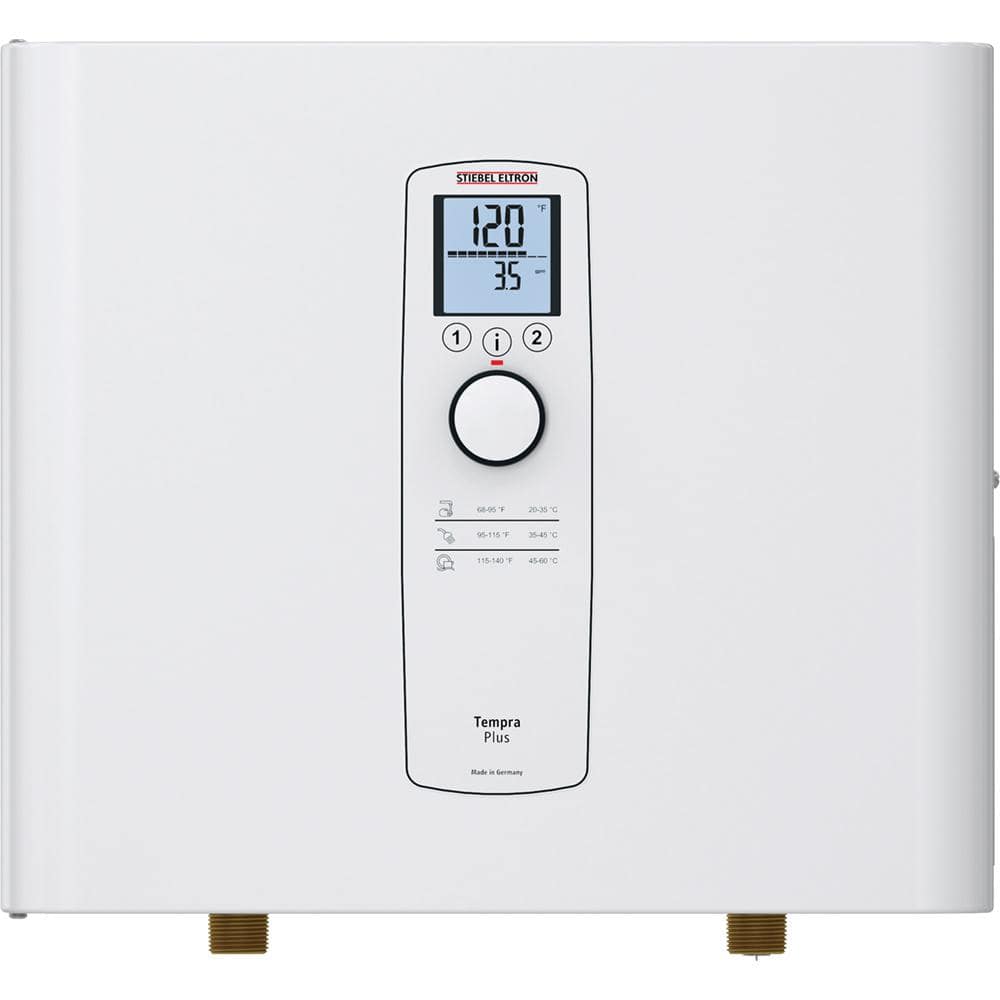
Stiebel Eltron Whole-House Electric Tankless Water Heater 36kW — 8.7/10
A powerful and efficient whole-home electric tankless water heater with excellent temperature control, best suited to homes with enough electrical capacity to support its demanding installation requirements.
We may earn a commission from qualifying purchases made through links in this review.
Overview
The Stiebel Eltron Whole-House Electric Tankless Water Heater 36kW is a professional-grade solution for homeowners who want a high-performance, space-saving alternative to traditional tank heaters without sacrificing hot water volume. Designed to provide endless hot water on demand, it is one of the most powerful options for larger homes and high-demand households.
To protect the unit's heating elements from scale buildup, pairing it with a whole-house water filter—essential for protecting heating elements from scale—is highly recommended. For an alternative high-performance option, check out the Waterdrop G3P800 review. See our Culligan WH-HD200-C review for more options. Instead of storing heated water in a tank, it heats water as it flows through the unit, which helps reduce standby energy losses and frees up space compared with a conventional tank-style system, such as the A.O. Smith 40-Gallon Tall Electric Water Heater. If you are weighing tankless vs. tank, comparing capacity and recovery times is key (see our A.O. Smith 40-Gallon Tall Electric Water Heater for a tank-based perspective.
This model is best suited to larger households, homes with multiple bathrooms, or owners who want a cleaner wall-mounted setup in a utility room, garage, or mechanical space (often alongside other basement essentials like Ridgid SP-650C high-capacity sump pumps or high-efficiency dehumidifiers (or a battery backup system for added security) (see our guide to the best submersible utility pumps for fast draining)). Its 36 kW heating capacity makes it one of the more powerful electric tankless options in the Tempra Plus line, and its Advanced Flow Control technology is the key feature that separates it from more basic electric tankless models.
The main caveat is electrical demand. The Stiebel Eltron Whole-House Electric Tankless Water Heater 36kW can be an excellent choice in the right home, especially in warmer or moderate climates, but it requires substantial 240-volt electrical service. Buyers should confirm panel capacity, breaker requirements (including checking compatible options like the Siemens Q115 circuit breaker), (see our guide on best 20-amp circuit breakers and our comparison of AFCI vs Standard Circuit Breakers), wiring needs, and local code compliance before planning an installation.
Best fit: Larger homes that want continuous hot water and have enough electrical capacity for a 36 kW whole-house electric tankless water heater.
Key Features
Provides strong electric heating output for multiple hot water fixtures, especially in warmer climates or moderate-demand homes.
Automatically adjusts flow when demand is high to help maintain a consistent outlet temperature rather than letting water run cold.
Heats water on demand, so it is not limited by a storage tank’s capacity during back-to-back showers or extended use.
Frees up floor space and can be easier to place than a traditional tank water heater.
Reduces standby heat loss because it does not keep a large volume of stored water hot all day.
Allows more precise output temperature adjustment than many basic tankless or tank-style systems.
| Feature | Value |
|---|---|
| Product Name | Stiebel Eltron Whole-House Electric Tankless Water Heater 36kW |
| Model Number | TEMPRA36PLUS |
| Category | Water Heaters |
| Water Heater Type | Whole-house electric tankless water heater |
| Heating Capacity | 36 kW |
| Voltage | 240 volts |
| Installation Style | Wall-mounted |
| Hot Water Delivery | On-demand continuous hot water |
| Standout Technology | Advanced Flow Control |
| Best Climate Fit | Warmer climates or moderate climates |
| Best Household Fit | Larger households or homes with multiple bathrooms |
| Primary Benefit | Space-saving continuous hot water with reduced standby energy loss |
| Primary Consideration | Requires significant electrical capacity and professional installation |
Pros & Cons
Pros
- Powerful 36 kW output for whole-house electric tankless use
- Advanced Flow Control helps maintain steady water temperature under demand
- Continuous hot water without a storage tank running out
- Compact wall-mounted design saves floor space
- Reduces standby energy losses compared with tank-style heaters
- Good fit for larger households in warmer climates
- Precise digital temperature control improves usability
Cons
- Requires substantial 240-volt electrical capacity
- Installation may require panel upgrades, dedicated breakers, or new wiring
- Performance depends heavily on incoming groundwater temperature
- May reduce flow to preserve temperature during very high simultaneous demand
- Not always the most cost-effective choice for homes with inexpensive natural gas
Performance
In real-world use, the Stiebel Eltron Whole-House Electric Tankless Water Heater 36kW is built around consistency. The most important performance feature is Advanced Flow Control, which helps prevent the classic tankless problem of temperature drop when too many fixtures (such as a Delta Essa 14453LF-SS or a Bosch Tronic 3000T 4-Gallon Mini-Tank Electric Water Heater) are opened at once (similar to the flow seen with a MOEN Chateau 7430 kitchen faucet). Instead of simply allowing the outlet temperature to fall, the unit can reduce water flow to keep the delivered water closer to the selected temperature.
That behavior is a major advantage for comfort. For example, if someone is showering while another person starts a sink or appliance, the system is designed to prioritize temperature stability. The trade-off is that users may notice slightly reduced flow during peak demand. In practice, that is usually preferable to a sudden cold-water surprise, but it is still important to size expectations correctly.
The 36 kW rating gives this model strong capability for an electric tankless system, but no electric tankless water heater is immune to climate and flow-rate limits. In warmer regions, where incoming water is already relatively mild, the Stiebel Eltron Whole-House Electric Tankless Water Heater 36kW can support more simultaneous use.
In colder regions, where the unit must raise water temperature much more dramatically, maximum usable flow will be lower.
Compared with a conventional tank water heater, the biggest everyday advantage is that hot water is not limited by tank size. Long showers, back-to-back showers, and recovery-time waiting are less of a concern when the installation is properly matched to the home. The biggest everyday limitation is that total hot water flow is still finite; this is a high-capacity model, not a magic way to run every shower, tub, sink, and appliance at full output at the same time.
Installation tip: Before choosing the Stiebel Eltron Whole-House Electric Tankless Water Heater 36kW, have a qualified electrician or installer verify that the home’s electrical panel and service can support the unit.
How It Works: The Science of Tankless Heating
Unlike a traditional water heater that keeps 40 to 80 gallons of water hot 24 hours a day, the Stiebel Eltron Whole-House Electric Tankless Water Heater 36kW utilizes a "heat-on-demand" mechanism. When you turn on a hot water tap, a flow sensor inside the unit detects the movement of water and immediately activates high-power heating elements. Because the water passes through a compact heat exchanger, the energy is transferred almost instantaneously.
The 36 kW capacity refers to the maximum amount of electrical power the unit can pull to heat the water. To put this in perspective, 36 kW is a massive amount of energy—roughly equivalent to running 15 high-end space heaters simultaneously. This is why the unit requires multiple dedicated breakers (see our Eaton BRCAF115 review or our comprehensive guide on AFCI vs Standard Circuit Breakers for a code-compliant setup). The heating elements are designed to be highly efficient, but the physics of electric heating means that the "rise" (the difference between the incoming cold water temperature and the desired outgoing temperature) determines how many gallons per minute (GPM) the unit can deliver.
The Advanced Flow Control mentioned earlier is the "brain" of the operation. In basic tankless units, if you open a second tap, the water velocity increases, meaning the water spends less time in contact with the heating elements, leading to a temperature drop. The Stiebel Eltron 36kW system monitors the temperature in real-time and modulates the flow valve to ensure the water leaving the unit remains at your set temperature, sacrificing a bit of pressure to maintain heat.
Buyer's Guide: Is 36kW Right for Your Home?
Choosing a tankless water heater is less about "brand preference" and more about "mathematical compatibility." If you buy a unit that is too small, you'll have cold showers; if you buy one that is too large, you may find your electrical panel cannot handle the load.
1. Calculating Your GPM (Gallons Per Minute)
To determine if the Stiebel Eltron Whole-House Electric Tankless Water Heater 36kW is sufficient, you must calculate your peak simultaneous demand. Common fixtures typically use (see our guide on how to choose the best bathroom sink faucet for more on fixture types):
- Low-flow showerhead: 1.5 - 2.0 GPM
- Standard showerhead: 2.5 GPM
- Kitchen faucet: 1.0 - 2.0 GPM
- Dishwasher: 1.0 GPM
If you typically have two showers running at once and a dishwasher active, you need roughly 6-7 GPM. In a moderate climate, the 36kW unit can handle this, but in a cold-water region (like the Northeast US in winter), the GPM capacity drops significantly because more energy is required to raise the water from 40°F to 120°F.
2. The Electrical Hurdle
This is the most critical part of the purchase. A 36 kW unit does not plug into a standard outlet. It generally requires three separate 40-amp or 50-amp double-pole breakers (depending on the specific wiring configuration) and heavy-gauge copper wiring. Most older homes with 100-amp service panels cannot support this unit without a service upgrade to 200-amps (see our guide on how to replace a circuit breaker safely at home for general electrical safety, and our comparison of Square D vs Eaton breakers to help you choose the right hardware). You must account for the cost of a licensed electrician (and for safety tips, see how to replace a circuit breaker safely at home), which can sometimes exceed the cost of the unit itself; ensure your pro uses the correct AFCI breakers (refer to our guide on AFCI vs Standard Circuit Breakers for more detail) to meet current electrical safety codes.
3. Climate Considerations
Your local climate dictates your actual GPM. For those considering other energy sources, see our A.O. Smith 40-Gallon Tall Electric Water Heater review to see how tank-based recovery handles temperature swings.
In Florida or Arizona, the "incoming" water is already warm. The unit only needs to add a few degrees of heat, allowing for maximum flow. In Maine or Canada, the unit must work much harder. If you live in a freezing climate, you may find that the 36kW unit performs more like a 20kW unit in terms of delivered flow during January.
Setup and Long-Term Maintenance
Installation of the Stiebel Eltron 36kW is a professional-grade task. Because it is wall-mounted, it requires a sturdy supporting surface and proper plumbing (see our Uponor AquaPEX review for high-quality piping options). The unit is designed to be installed in a location where it is protected from freezing, though it is compact enough to fit into tight utility closets.
Initial Setup
Once mounted and wired, the digital interface allows the user to set the desired temperature. We recommend starting at 120°F (49°C) to prevent scalding while still providing enough heat for cleaning. The digital display is intuitive, allowing for quick adjustments without needing to turn a physical dial with a screwdriver, as is common in old tank heaters.
The Importance of Descaling
The enemy of any tankless water heater is calcium and magnesium buildup (scale). Because the water is heated rapidly in a small space, minerals can crystallize on the heating elements. This acts as an insulator, forcing the unit to work harder and eventually causing the elements to burn out.
- Hard Water Areas: If your home has hard water, you should perform a "flush" every 6 to 12 months. This involves circulating a mild descaling solution (like food-grade citric acid) through the unit using a small pump.
- Soft Water Areas: