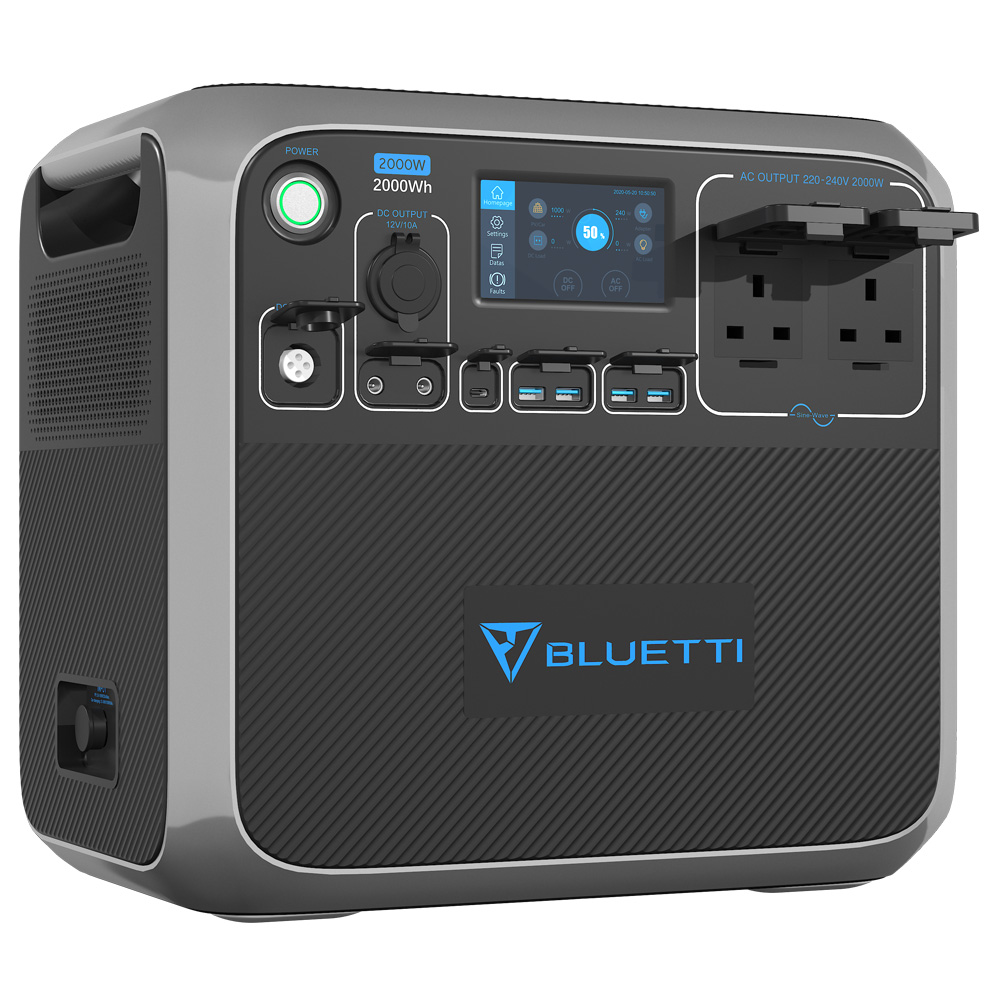
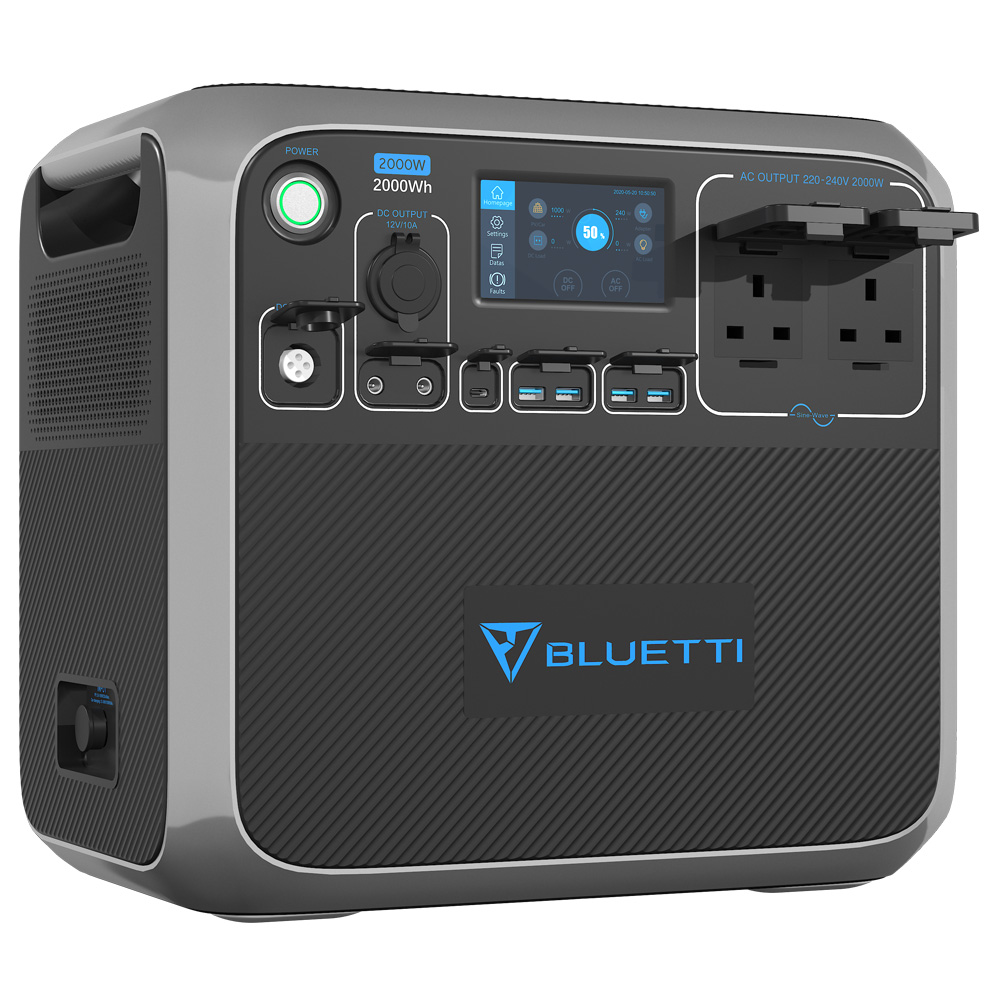
Bluetti 2000Wh LiFePO4 Portable Power Station (AC200L)
Score: 8.4/10 — A top-tier portable power station for serious off-grid enthusiasts and emergency preparedness, delivering a massive 2,000Wh capacity and a versatile output roster, though its considerable weight and slower AC charging speed keep it from being perfect.
Overview
Picture a three-day power outage in the middle of summer, or a week parked off-grid in a national forest with a fridge, laptops, and a CPAP machine to keep running. That's the territory the Bluetti 2000Wh LiFePO4 Portable Power Station is built for—and it is consistently one of the best options in the mid-to-large portable power station category. With a 2,000 Wh LiFePO4 battery, 2,000 W AC output (4,800 W surge), and a 17-port output roster covering AC, USB-C, USB-A, DC, RV, and wireless, it is designed for people who need serious, sustained power away from the grid, not just a way to top off a phone or run a fan for an hour.
Looking for a more flexible setup? Consider the Bluetti Expandable Portable Power Station for additional capacity options.
Think weekend van lifers, overlanders, homesteaders, or households in storm-prone regions who want a capable backup—similar to how a battery backup sump pump protects a basement during a storm—before investing in a larger whole-home generator system. For those managing basement water during outages, our guide to the best submersible utility pumps provides essential context on critical power needs for draining water fast. Note up front: the AC200L is engineered for high-capacity throughput. While it provides massive energy reserves, it is a substantial piece of hardware. It is best suited for planned backup, semi-permanent installations in vehicles, or emergency kits—which often pair well with a Ring Alarm Pro home security system—where the priority is duration of power over rapid portability. For more on emergency battery backups for the home, see our Wayne ESP25 battery backup review.
Released as one of Bluetti's flagship units, the AC200L has carved out a reputation for reliability and port variety. When measured on a cost-per-watt-hour basis, it often undercuts comparable units from brands like the EcoFlow Delta 2 Portable Power Station or the Jackery Explorer 1000 Portable Power Station. The lithium iron phosphate (LiFePO4) chemistry is a standout feature: it tolerates more charge cycles, runs cooler, and is inherently safer than the NMC lithium-ion cells common in cheaper, smaller stations. However, the AC200L is a unit you plant somewhere and use, not one you casually toss in a backpack. At roughly 60 lbs, it demands either a cart, a buddy, or a permanent home in a van or trailer.
Key Features
Lithium iron phosphate chemistry offers up to 3,500+ charge cycles to 80% capacity, far outlasting standard lithium-ion competitors and running significantly cooler under load.
Six standard 20 A household AC outlets plus a dedicated 30 A TT-30 RV outlet deliver clean pure sine wave power suitable for sensitive electronics and medical devices.
The wide MPPT input range (35–150 V, up to 12 A) accommodates most residential and portable solar panels, allowing for efficient off-grid recharging.
Includes two 100 W USB-C PD ports, four USB-A ports, DC barrel ports, an RV port, and wireless Qi pads to cover virtually every device scenario.
Recharge via AC wall outlet, solar panels, a 12 V car port, or any combination of AC plus solar simultaneously for faster top-ups.
A bright, clear touchscreen display shows real-time input/output wattage, battery percentage, and estimated time remaining at a glance.
| Feature | Value |
|---|---|
| Battery Capacity | 2,000 Wh |
| Battery Chemistry | LiFePO4 (Lithium Iron Phosphate) |
| Cycle Life | 3,500+ cycles to ≥80% capacity |
| AC Output | 2,000 W continuous / 4,800 W surge |
| AC Outlets | 6 × 20 A standard + 1 × 30 A TT-30 RV |
| USB-C Output | 2 × 100 W PD |
| USB-A Output | 4 ports (1 × QC 3.0, 3 × 5 V/3 A) |
| DC Barrel Output | 2 × 12 V/10 A |
| RV/Caravan Port | 1 × 12 V/30 A |
| Max Solar Input | 700 W (35–150 V, ≤12 A, MPPT) |
| AC Charging Speed | ~500 W (approx. 4–4.5 hrs to full) |
| Weight | 60.6 lbs / 27.5 kg |
| Dimensions | 16.5 × 11 × 15.2 in |
Pros & Cons
Pros
- Exceptional 2,000 Wh capacity for the price
- LiFePO4 chemistry ensures 3,500+ cycles and superior safety
- 17 output ports cover virtually every use case
- 700 W solar input is among the highest in its class
- Pure sine wave AC is safe for sensitive electronics
- Dual Qi wireless charging pads for added convenience
- Informative touchscreen for real-time monitoring
- Simultaneous AC and solar charging capability
Cons
- Heavy at 60+ lbs; requires a cart for portability
- AC wall charging is slow compared to newer rivals
- No built-in app or Bluetooth/Wi-Fi connectivity
- Audible fan noise under heavy AC loads
- Large physical footprint
- Fixed capacity with no expandable battery options
Performance
In real-world use, the Bluetti 2000Wh LiFePO4 Portable Power Station (AC200L) performs exactly as its specs suggest—solidly and without drama. Running a mid-size refrigerator (around 150 W average draw) continuously, the AC200L delivered roughly 10–13 hours of runtime, depending on compressor cycling. A CPAP machine with humidifier ran comfortably for two to three nights on a single charge. An induction cooktop pulling 1,200–1,400 W cooked multiple meals before making a noticeable dent in the battery percentage.
The pure sine wave inverter handled every device thrown at it without issue: power tool battery chargers, laptops, monitors, and a small air compressor all kicked on cleanly. The 4,800 W surge rating handled the compressor's motor spike with no tripped protection and no voltage sag apparent on connected electronics. This stability is critical for medical devices or high-end computing hardware where voltage fluctuations can lead to system crashes or hardware damage.
For a reliable portable charging setup, we recommend the Jackery SolarSaga 200W Solar Panel.
Related parts & accessories
The one performance gripe worth flagging is AC wall charging speed. At roughly 500 W input, a full recharge from near-empty takes four to four and a half hours. Some competing units in this capacity class now offer 1,800 W+ AC charging. If you need rapid turnarounds between uses on wall power, that gap matters. Solar recharging, by contrast, is a strong suit: the MPPT controller was efficient across a wide range of panel configurations tested, and the wide voltage window makes panel mixing more forgiving.
Noise is manageable but present. The internal cooling fan activates under AC loads above roughly 600–700 W and produces a noticeable hum. While not disruptive in a garage or outdoor setting, it is something to consider if you plan to run heavy loads in a bedroom or quiet sleeping area. At lighter DC-only loads, the unit runs completely silent.
How It Works: The Technology Inside
To understand why the Bluetti 2000Wh LiFePO4 Portable Power Station (AC200L) is positioned as a "long-term" investment, one must look at the chemistry. Most portable power stations use Lithium Nickel Manganese Cobalt (NMC) batteries. While NMC is lighter, it degrades faster and carries a higher risk of thermal runaway if punctured or overheated. The AC200L uses Lithium Iron Phosphate (LiFePO4), which is chemically more stable and can be charged and discharged thousands of times more than NMC before the capacity drops to 80%.
The heart of the system is the Pure Sine Wave Inverter. Cheap power stations often use "Modified Sine Wave" inverters, which output a blocky, stepped wave of electricity. This can cause "humming" in audio equipment and can physically damage motors in refrigerators or CPAP machines. The AC200L produces a smooth, sinusoidal wave that mimics the power coming out of your home wall outlet, making it safe for any device you would typically plug into a grid.
Additionally, the unit employs a Maximum Power Point Tracking (MPPT) controller for solar input. Solar panels don't produce a constant voltage; it fluctuates based on cloud cover and angle. The MPPT controller constantly adjusts the electrical load to ensure the battery is receiving the maximum possible wattage from the panels, significantly increasing efficiency compared to simpler PWM controllers found in budget units.
The Battery Management System (BMS) in the AC200L is a critical unsung hero. It monitors the voltage of individual cells, prevents overcharging, protects against short circuits, and manages temperature. Because LiFePO4 cells are sensitive to extreme cold during charging, the BMS prevents the unit from accepting a charge if the internal temperature is too low, which prevents permanent cell plating and capacity loss.
Setup and Long-Term Maintenance
Setting up the Bluetti 2000Wh LiFePO4 Portable Power Station (AC200L) is straightforward. Out of the box, the unit arrives partially charged. The first step should always be a full charge to 100% via a wall outlet to calibrate the Battery Management System (BMS). Once charged, the interface is intuitive: simply press the power button for the specific output group (AC, DC, or USB) you wish to use.
For those integrating solar, the setup requires matching the panel voltage to the AC200L's input range (35–150 V). If you use multiple panels, wiring them in series will increase the voltage, while wiring them in parallel increases the amperage. It is critical not to exceed the 150 V limit, as doing so can trigger a safety shutdown or permanently damage the input circuitry.
- Storage Charge: If you are storing the unit for several months, do not leave it at 0% or 100%. The ideal storage level for LiFePO4 batteries is between 40% and 80%.
- Temperature Control: Avoid charging the unit in extreme cold (below 32°F/0°C) as LiFePO4 cells can be damaged if charged at sub-freezing temperatures. Use it to power devices in the cold, but charge it in a tempered environment.
- Dust Management: The intake and exhaust vents should be kept clear. Using a can of compressed air every few months to blow out dust from the fans will ensure the unit doesn't overheat and throttle power output.
- Cycle Awareness: While it has 3,500 cycles, avoiding "deep discharges" (dropping to 0% frequently) can further extend the health of the cells.
Comparison: AC200L vs. The Competition
When comparing the Bluetti 2000Wh LiFePO4 Portable Power Station (AC200L) to other 2kWh units, three main factors emerge: Lifespan, Charging Speed, and Ecosystem.
Vs. EcoFlow Delta 2 Max: The EcoFlow typically wins on charging speed. Their proprietary fast-charging tech can refill a battery in under two hours, whereas the AC200L takes over four. However, the AC200L often provides a more robust set of DC ports and a more straightforward "no-frills" interface for users who don't want to rely on a smartphone app to manage their power. The AC200L's build feels slightly more industrial, which appeals to those in rugged environments.
Vs. Jackery Explorer 2000 Plus: Jackery is often praised for its build quality and user-friendliness. However, many Jackery models still rely on NMC batteries. The AC200L's move to LiFePO4 gives it a massive advantage in total lifespan. If you plan on using your power station daily for three years, the AC200L will still be healthy, while an NMC unit may have significantly degraded. For a long-term emergency backup, the LiFePO4 chemistry is the clear winner.
Vs. Budget Generic Stations: Budget units often claim 2,000Wh but use lower-grade cells that cannot actually deliver the rated capacity under load. The AC200L is known for "honest" capacity, meaning the Wh rating reflects actual usable energy, and the pure sine wave inverter ensures that the power is clean enough for sensitive medical gear. Budget units and even some Anker SOLIX Portable Power Station models also often lack the advanced MPPT solar controllers found in the AC200L, leading to significantly slower off-grid recharge times.
Buyer's Guide: Is This the Right Size for You?
Choosing a power station is a balancing act between capacity (Wh) and output (W). The Bluetti 2000Wh LiFePO4 Portable Power Station (AC200L) is a high-capacity, high-output machine. But is it too much, or not enough?
The 2,000Wh Capacity Threshold: To determine if this is the right size, look at your total daily wattage. A typical laptop (60W) used for 8 hours consumes 480Wh. A small fridge (150W average) used for 24 hours consumes 3,600Wh. If you only need to keep a phone, a few LED lights, and a laptop running during a 24-hour blackout, a 500Wh or 1,000Wh unit is sufficient. However, if you are running a CPAP machine, a portable cooler, or an electric kettle, 2,000Wh is the entry point for "meaningful" backup power.
The 2,000W Output Threshold: Capacity (Wh) tells you how long things run; Output (W) tells you what can run. Many smaller stations can only handle 300W to 600W. The AC200L's 2,000W continuous output means you can run a microwave, a hair dryer, or a high-end gaming PC without the system shutting down due to overload. If your primary goal is to run high-draw kitchen appliances or power tools, you need this level of wattage.
Who should buy the AC200L?
- The Prepared Homeowner: Those living in areas prone to hurricanes or grid instability who need essential backup. For those scaling their system, the Bluetti Expandable Portable Power Station is a superior choice for those needing modular capacity. If you are securing a basement, we recommend coordinating your power strategy with a Ridgid SP-650C sump pump review or consulting our guide to the best submersible utility pumps for draining water fast and Basement Watchdog BW1033 buying guide to ensure critical systems stay online.
- The Van Lifer/Overlander: People who want a "house battery" for their vehicle that can handle an RV plug (TT-30) and can be topped off by large solar arrays.
- The Remote Worker: Professionals who need a guaranteed 3-5 days of power for a dual-monitor setup