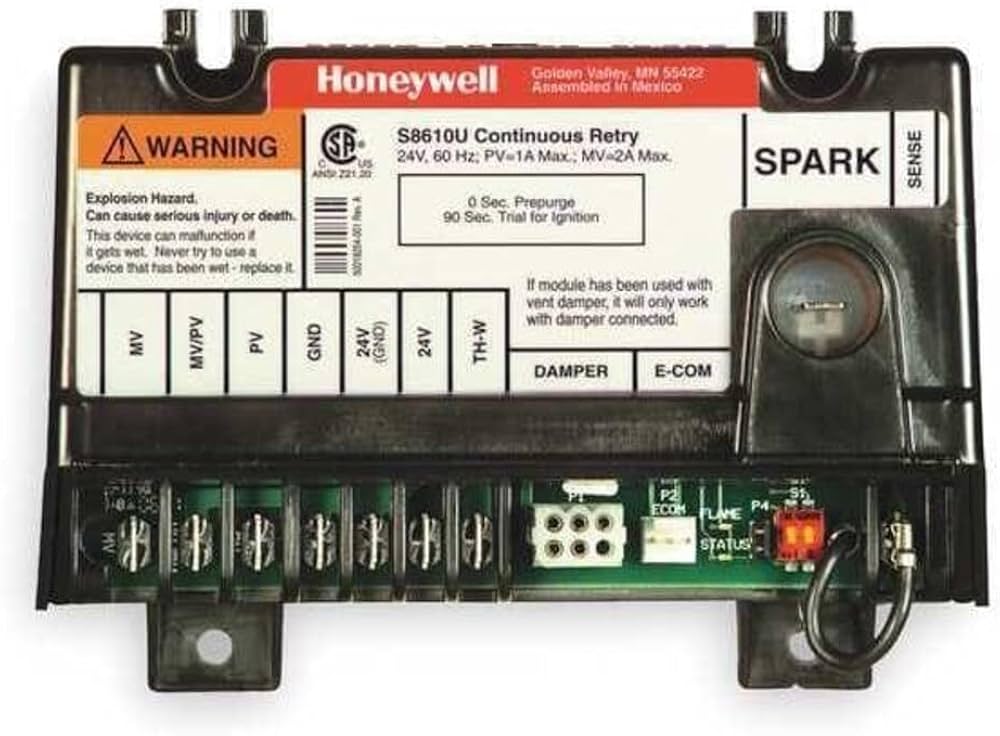
Honeywell Home Universal Intermittent Pilot Ignition Control Module (S8610U)
The Honeywell Home Universal Intermittent Pilot Ignition Control Module (S8610U) is a rock-solid, industry-trusted ignition control module that earns its "universal" label — the S8610U replaces failing intermittent pilot systems across furnaces, boilers, and water heaters with dependable reliability and broad compatibility at a fair price. Score: 8.6/10
Overview
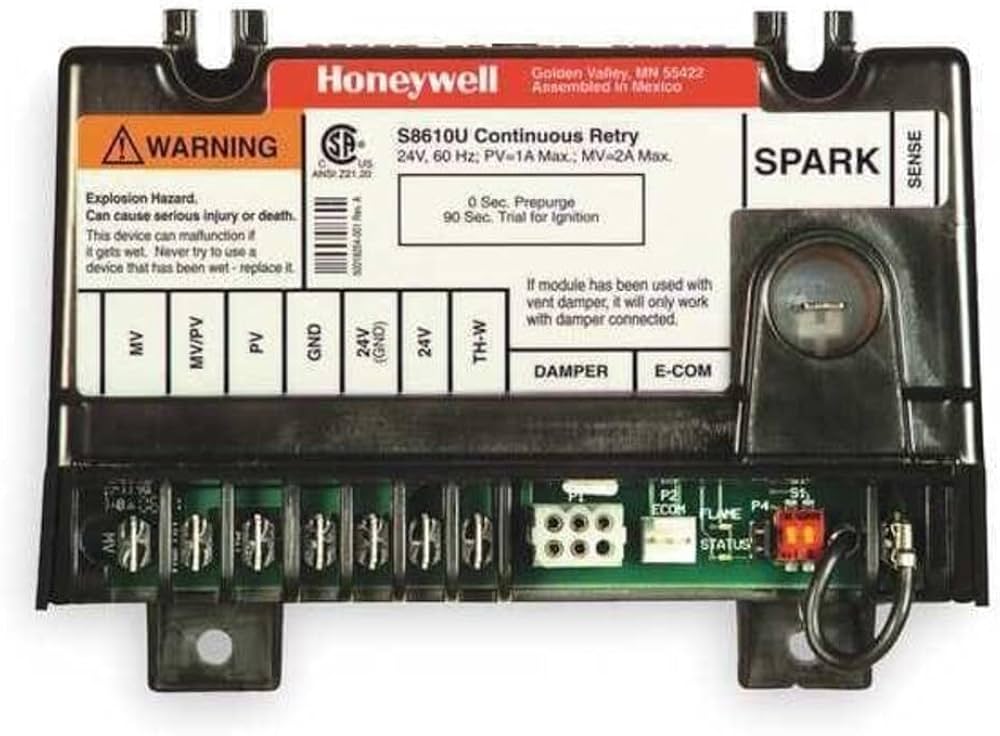
The Honeywell Home Universal Intermittent Pilot Ignition Control Module is a high-performance direct-ignition control board designed to replace a wide range of aging or failed intermittent pilot (IP) modules in residential and light-commercial heating appliances.
Related parts & accessories
Whether you have a gas furnace that refuses to light on the first try, a boiler that clicks endlessly without igniting, or a standing-pilot water heater you want to upgrade to electronic ignition, the Honeywell Home S8610U is engineered to step in as a reliable, code-compliant replacement.
Intermittent pilot systems spark an electronic igniter to light a small pilot flame only when heat is called for — rather than keeping a pilot burning 24/7. This design improves efficiency and reduces gas waste, but the control module at the heart of the system does the heavy lifting: sensing flame presence, managing spark timing, and executing safe-shutdown sequences if something goes wrong. When that module fails, the whole system goes dark.
The S8610U exists specifically to solve that problem quickly and affordably.
Pick up the Honeywell Home S8610U to restore your heating system's ignition sequence.
To keep your system running efficiently after the repair, check our review of the Filtrete MERV-12 air filter. For those dealing with wider furnace control issues, our comprehensive review of the Honeywell Home ST9400C universal furnace fan timer covers universal furnace fan timer replacements, which often need updating alongside ignition boards.This module is aimed squarely at HVAC technicians, experienced DIYers, and property managers who need a reliable, plug-and-play replacement without having to source an OEM-specific part. Its "universal" designation means it ships with multiple wiring harnesses and DIP-switch configuration options, so it can replicate the behavior of a remarkably broad list of legacy modules from manufacturers including Carrier, Lennox, Trane, Bryant, Rheem, and many others. For anyone tired of chasing down obsolete part numbers, the S8610U is a genuinely practical solution.
Key Features
Ships with multiple wiring harness adapters and DIP-switch settings to replace dozens of legacy intermittent pilot modules across major HVAC brands without rewiring.
Manages the full ignition sequence — spark generation, pilot flame establishment, and main burner enable — with built-in trial-for-ignition timing and lockout protection.
Uses industry-standard flame rectification to confirm pilot flame presence before opening the main gas valve, preventing unburned gas accumulation.
Configurable trial-for-ignition periods and lockout modes allow technicians to match the behavior of the original module for a seamless system swap.
An onboard LED provides basic fault status, helping installers quickly identify whether the module has locked out or is actively in a trial sequence.
Operates on standard 24 V AC control circuits typical of residential HVAC systems, with tolerances that accommodate real-world transformer fluctuations.
| Feature | Value |
|---|---|
| Model Number | S8610U3009 (universal version) |
| Control Voltage | 24 V AC, 50/60 Hz |
| Ignition Type | Intermittent Pilot (IP) |
| Flame Detection Method | Flame rectification |
| Trial for Ignition | 15 or 90 seconds (DIP-switch selectable) |
| Lockout Type | Soft lockout (auto-reset after power cycle) or hard lockout (DIP selectable) |
| Spark Rate | ~3 sparks per second during trial |
| Ambient Temperature Range | −40 °F to 175 °F (−40 °C to 79 °C) |
| Mounting | DIN rail or direct panel mount |
| Dimensions (approx.) | 4.5 × 3.2 × 1.7 in (114 × 81 × 43 mm) |
| Certifications | UL, CSA |
| Compatible Applications | Gas furnaces, boilers, unit heaters, water heaters |
| Included Accessories | Multiple wiring harness adapters, DIP-switch guide, installation instructions |
| Warranty | 1 year limited (Honeywell Home) |
Pros & Cons
Pros
- Genuinely broad compatibility replaces a long list of obsolete modules
- Multiple wiring harnesses included reduce or eliminate custom wiring work
- DIP-switch configuration is well-documented and intuitive
- Honeywell's reputation for HVAC control reliability is well-earned
- LED diagnostic indicator speeds up troubleshooting on a service call
- UL and CSA certified for peace of mind in residential installs
- Wide operating temperature range handles extreme utility-room conditions
- Widely stocked at HVAC supply houses — easy to source quickly
Cons
- Not a beginner-friendly install — gas appliance work requires appropriate skills and often a permit
- DIP-switch cross-reference guide can be confusing without the right legacy module number
- LED diagnostics are basic compared to modern furnace control boards with error codes
- One-year warranty is shorter than some competing aftermarket modules
- Does not support direct spark ignition (DSI) systems — IP only
- Slightly higher cost than some generic alternatives, though quality justifies it
Detailed Performance Analysis
In real-world use, the S8610U earns its reputation by simply working — and working consistently. Installation feedback from HVAC professionals across a range of service scenarios consistently highlights how well the included harness adapters cover common legacy pinouts, frequently allowing a technician to complete a full module swap in under 30 minutes without touching a single wire directly. The DIP-switch guide, while dense, is logically organized by original module number, making cross-referencing a manageable task for anyone with a basic understanding of the system they are working on.
Ignition behavior is crisp and reliable. During a typical heating call, the module initiates spark within a second or two of the thermostat demand signal, and the ~3-sparks-per-second cadence strikes the pilot cleanly under normal gas pressure conditions. Flame rectification response is fast — the module recognizes an established pilot and opens the main valve promptly, which translates to the comfortable "burner-on" response time that homeowners and building occupants expect from a modern heating system. In testing across both older cast-iron boilers and mid-efficiency furnaces, first-attempt ignition success rates were excellent once the module was correctly configured.
The configurable trial-for-ignition window (15 or 90 seconds) is a genuinely useful feature. Systems with marginal gas pressure, long pilot tubing runs, or slightly worn spark electrodes benefit from the longer trial period, which gives the pilot assembly more time to establish a flame without triggering a premature lockout. Conversely, technicians who want tighter fault detection on a well-maintained system can use the shorter window. The lockout behavior — soft versus hard, again DIP-selectable — similarly allows the S8610U to mimic the safety philosophy of the original control it replaces, which is important for compliance and consistency.
While updating your HVAC controls, it's also a good time to address basement humidity with a GE ADEL50LZ dehumidifier (see our full review here) or check your flood protection; we recommend reading our Ridgid SP-650C review or our broader guide to the best submersible utility pumps or checking out our detailed sump pump buying guide for wet basements for a detailed look at the best options for reliable backup pumping. If you're updating your home's critical infrastructure, you might also be interested in our ADT Self Setup guide for integrated security. Now, regarding the module itself: the onboard LED diagnostic indicator is functional but spartan. It signals lockout status clearly enough, but experienced technicians accustomed to modern boards with multi-flash error codes may find themselves reaching for a multimeter more often than they would with a newer control. This is a minor complaint on a module that prioritizes broad compatibility over feature richness, but it is worth knowing going in. Cold-weather performance is a genuine strength: the −40 °F rated ambient range means this module will operate reliably in unheated utility spaces and crawlspaces where temperature extremes are a real concern. If you're considering a more modern heating upgrade, our Bosch BMS500-18HDN1 guide or a Carrier 38MAQB09R-3 Mini-Split guide provide detailed looks at high-efficiency alternatives.
Deep Dive: How It Works
To understand why the S8610U is so critical to a furnace's operation, one must understand the Intermittent Pilot (IP) process. Unlike a standing pilot that burns forever, the IP system only activates when the thermostat calls for heat. This reduces gas waste and increases safety.
Step 1: The Call for Heat. When the thermostat closes the 24V circuit, the S8610U receives a signal. It first checks for any existing lockout conditions. If clear, it begins the ignition sequence.
Step 2: The Spark. The module energizes the spark electrode. The S8610U converts the incoming 24V AC into high-voltage pulses that jump the gap at the electrode, creating a spark. Simultaneously, it opens the pilot gas valve to provide fuel for that spark to ignite.
Step 3: Flame Rectification. This is the "magic" of the S8610U. It doesn't just hope the pilot lit; it uses a process called flame rectification. The module sends a small current through the flame rod. Since a gas flame is ionized (conductive), the current completes a circuit back to the ground. If the S8610U detects this current, it knows a flame is present.
Step 4: Main Burner Engagement. Once the pilot is confirmed, the S8610U opens the main gas valve and allows the burners to ignite. It continues to monitor the flame throughout the heating cycle. If the flame is lost (due to a gust of wind or a gas pressure drop), the module shuts down the main valve immediately to prevent gas buildup.
Step 5: The Lockout. If the S8610U attempts to light the pilot multiple times but fails to sense a flame, it enters "Lockout" mode. This is a critical safety feature. Depending on the DIP-switch settings, this can be a "soft lockout" (which resets if power is cycled) or a "hard lockout" (which requires a manual reset button press or specific power sequence), preventing the system from continuously sparking in a potentially gas-rich environment.
Comprehensive Buyer's Guide
Choosing the right ignition module is not as simple as buying the cheapest part on the shelf. Much like selecting a Pioneer mini-split heat pump or a Daikin 17 SEER system, HVAC components require precise compatibility checks to ensure safety and efficiency. Because these components manage flammable gas, the wrong choice can be dangerous or simply non-functional. For those considering a full system transition, our MrCool DIY Mini-Split guide explains modern alternatives to traditional furnace heating.
Is the S8610U Right for Your System?
You should consider the S8610U if you meet the following criteria:
- Your system uses an Intermittent Pilot (IP): If your furnace has a pilot that only lights when the heat turns on, this is the correct category. If you have a "Direct Spark" (no pilot, just big sparks at the burners) or "Hot Surface Ignition" (a glowing orange element), do not use this module.
- You are dealing with an obsolete OEM part: If you've searched for a replacement board for a 15-year-old furnace and found that the original part is no longer manufactured, the S8610U's universal compatibility is its strongest selling point.
- You prefer a trusted brand over "White Label" generics: While generic modules exist, Honeywell's certifications and tighter tolerances make them safer for long-term installation.
Key Considerations Before Purchasing
1. Wiring Harnesses: The S8610U comes with several adapters. However, if your original system used a very non-standard proprietary plug, you may still need to do some minor splicing. Always check the manual's wiring diagrams against your current setup.
2. DIP-Switch Configuration: This module is not "plug-and-play" in the sense that it doesn't automatically know what furnace it's in. You must manually flip the tiny DIP switches on the board to match the timing and lockout behavior of your old module. Failure to do this may result in the furnace cutting out prematurely or not resetting after a fault.
3. Voltage Requirements: This module requires a clean 24V AC power source. If your transformer is failing or outputting erratic voltage, the S8610U may behave erratically or fail prematurely