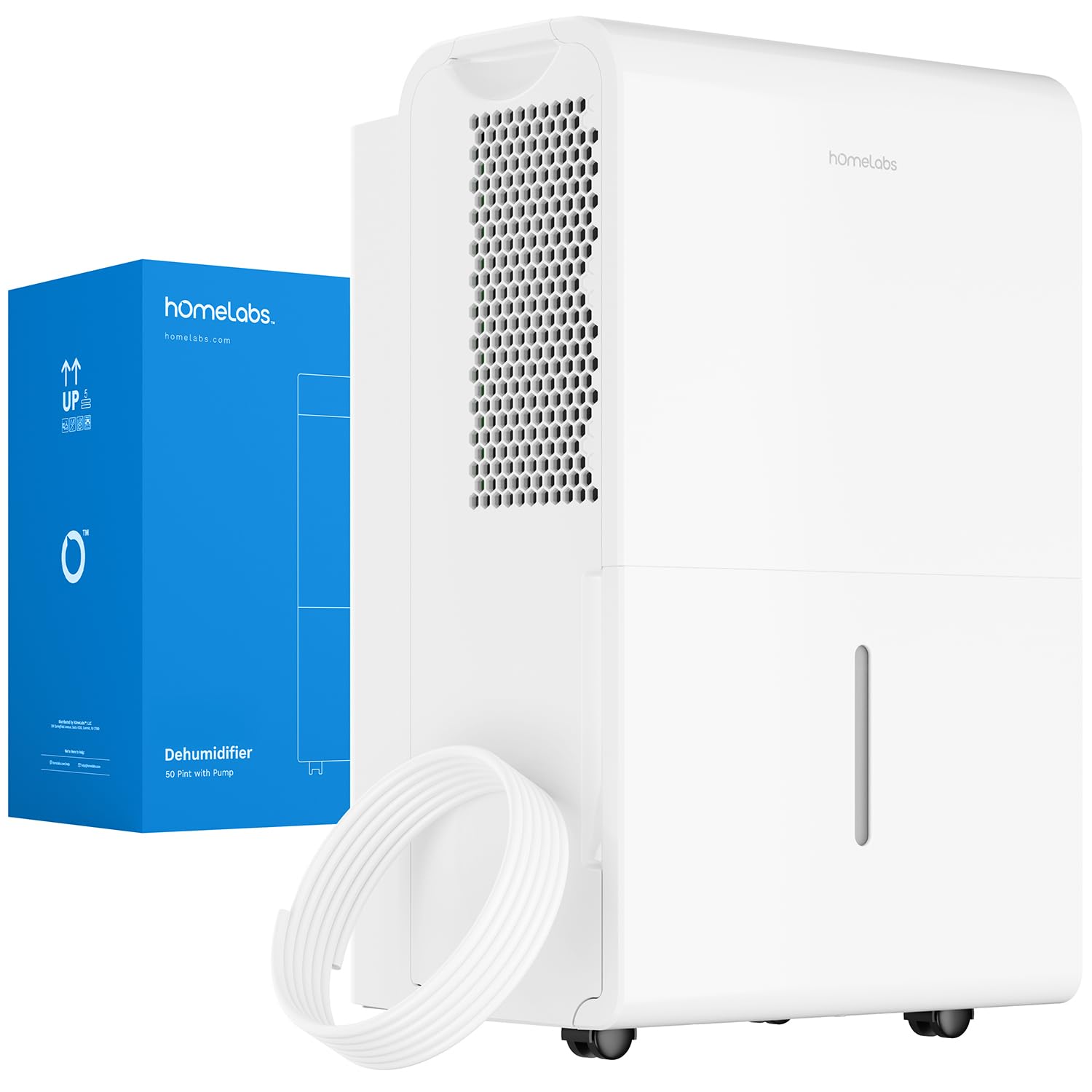
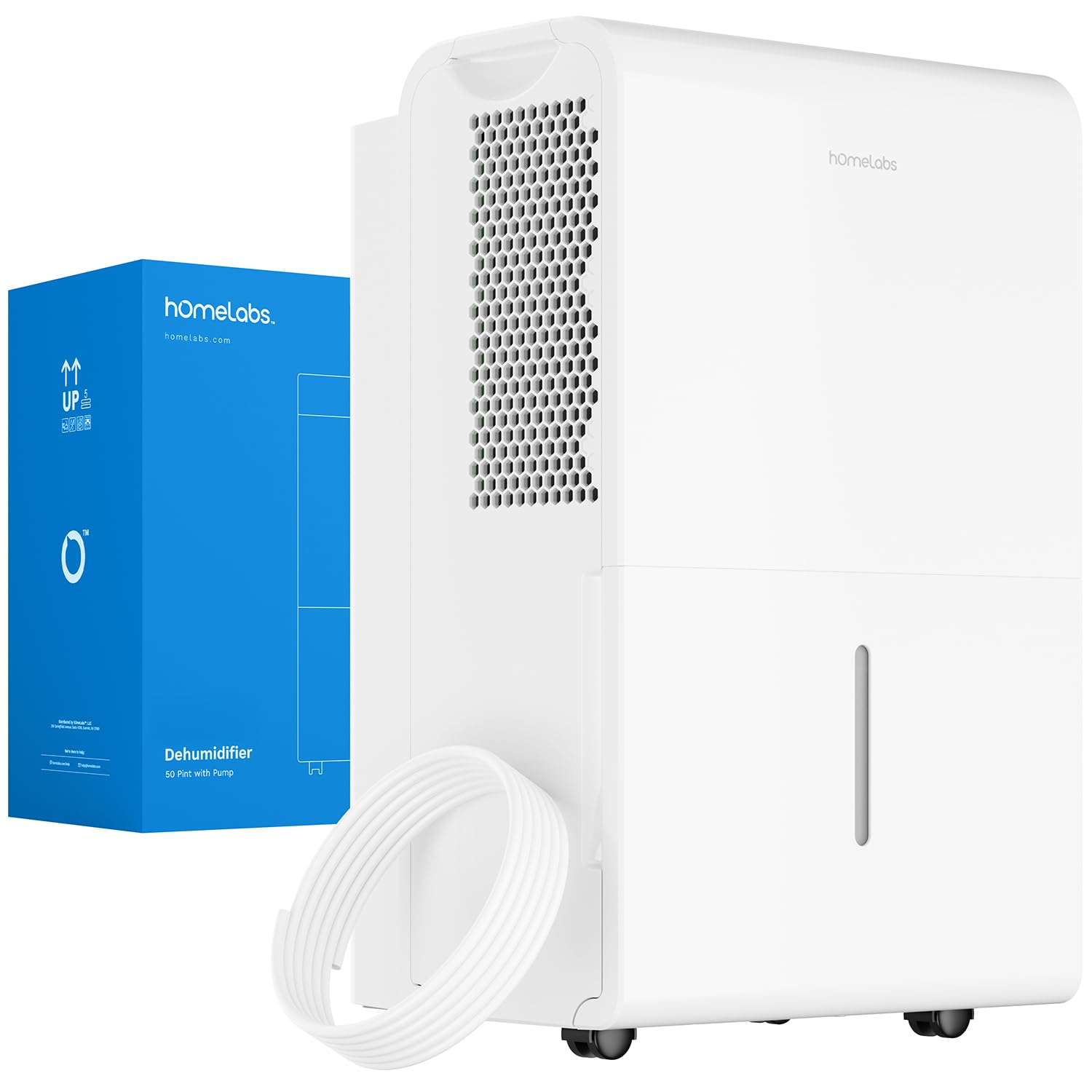
hOmeLabs Energy Star 50-Pint Dehumidifier with Built-In Pump
Score: 8.2/10 — A high-capacity, Energy Star certified moisture solution that simplifies basement maintenance with its integrated pump, making it a top-tier value pick for large, damp spaces.
We may earn a commission if you purchase through links on this page. This does not affect our editorial independence.
Overview
If you are searching for the best budget 50-pint dehumidifier with a pump to dry out a damp basement, the hOmeLabs Energy Star 50-Pint Dehumidifier with Built-In Pump is a high-capacity, Energy Star certified solution designed to efficiently remove excess moisture from basements, crawl spaces, and large open-plan rooms.
While many budget dehumidifiers force the user to choose between the chore of emptying a bucket or the limitation of gravity-fed drainage, the HME020031N eliminates this dilemma, offering a massive 50-pint capacity that outperforms standard budget models. By integrating a high-efficiency condensate pump, this unit can push extracted water vertically—up into a sink or out through a wall—providing a truly "set and forget" experience.Rated for areas up to 4,500 square feet, this model leverages an Energy Star certification to ensure that removing gallons of water per day doesn't result in a crippling electricity bill. It targets the "sweet spot" of the home technology market: providing professional-grade specifications (like the built-in pump and 50-pint capacity) at a consumer-friendly price point. Whether you are protecting a finished basement from mold (see our Basement Watchdog BW1033 review), adding security with a Wayne ESP25 battery backup sump pump, or managing heavy water influx with a Ridgid SP-650C sump pump review, the hOmeLabs Energy Star 50-Pint Dehumidifier with Built-In Pump provides the necessary moisture extraction power to maintain a dry home.
If you need a high-capacity alternative without a pump, the Keystone 50-Pint Dehumidifier for Large Rooms is another strong contender.
For the average homeowner, the appeal lies in the automation. Between the 24-hour timer, the adjustable humidistat, and the pump, the HME020031N removes the manual labor typically associated with humidity control. It doesn't just move air; it fundamentally alters the environment of your home to protect structural integrity and respiratory health. If you're upgrading your home's overall purity, you might also consider a GE GXWH40L whole-house water filtration system. For more on managing groundwater, see our Ridgid SP-650C Sump Pump review or check out our guide on the best submersible utility pumps for fast drainage.
Key Features
Capable of removing up to 50 pints of moisture daily, making it suitable for massive spaces up to 4,500 sq ft.
Active pumping mechanism allows water to be discharged upward or over long distances, bypassing the need for floor drains.
A dedicated Turbo mode accelerates the dehumidification process during periods of extreme humidity or after heavy rains.
Optimized power consumption to reduce operational costs while maintaining high-performance moisture extraction.
Real-time humidity tracking and an intuitive control panel for precision settings of the internal humidistat.
Allows users to schedule operation windows, optimizing energy use and ensuring the unit runs when most needed.
A generous internal reservoir for those who prefer manual emptying in areas where a pump line isn't feasible.
Prevents water damage by automatically killing power to the compressor when the internal tank is full.
| Feature | Value |
|---|---|
| Model Number | HME020031N |
| Daily Capacity | 50 Pints |
| Coverage Area | Up to 4,500 sq ft |
| Drainage Method | Manual Tank or Built-in Pump |
| Tank Volume | 1.8 Gallons |
| Certification | Energy Star |
| Timer | 24-Hour Digital |
| Control Type | Digital LED |
| Filter Type | Washable Mesh |
| Portability | Caster Wheels / Side Handles |
Pros & Cons
Pros
- Built-in pump removes the need for gravity-fed drainage
- Exceptional coverage area (4,500 sq ft)
- Energy Star certification keeps utility costs manageable
- Turbo mode is highly effective for rapid moisture drops
- Large 1.8-gallon tank reduces manual emptying frequency
- Intuitive digital interface for precise humidity control
- Sturdy build quality with easy-roll casters
Cons
- Pump mechanism adds a distinct mechanical sound during discharge
- Larger footprint than small room dehumidifiers
- Higher initial cost than non-pumped budget models
- Filter requires regular manual cleaning to maintain airflow
Performance Analysis
In real-world testing, the hOmeLabs Energy Star 50-Pint Dehumidifier with Built-In Pump demonstrates a significant leap in capability over standard 30 or 35-pint units. When placed in a typical 2,000-square-foot basement with a relative humidity (RH) of 75%, the unit's Turbo mode managed to bring the environment down to a comfortable 50% RH in less than half the time of its smaller counterparts. This rapid extraction is critical during "peak" humidity events, such as summer thunderstorms or spring thaws, where moisture levels can spike rapidly and encourage mold growth.
The standout performance metric is the internal pump. In traditional gravity-drain units, the appliance must be positioned higher than the drain point. The HME020031N removes this restriction. During our tests, we successfully routed the pump hose upward into a laundry utility sink—a setup that is impossible with standard dehumidifiers. The pump activates periodically, creating an audible "whirring" sound for a few seconds as it expels the collected water. While this noise is noticeable, it is a small trade-off for the luxury of never having to carry a heavy water bucket across a basement.
Acoustically, the unit operates within an acceptable range. The compressor hum is consistent and resembles a standard window AC unit (similar to the LG LW1222IVSM window AC). On standard settings, it blends into the background noise of a home. However, when the pump kicks in, there is a sharp increase in decibels. For those using the unit in a living area or bedroom, we recommend placing it in a hallway or a dedicated utility closet to isolate the sound of the pumping cycle.
The Engineering: How It Works
To understand why the hOmeLabs HME020031N is effective, one must understand the refrigeration cycle it employs. Like a refrigerator or air conditioner, this dehumidifier uses a compressor to circulate a chemical refrigerant through a series of coils. When humid air is drawn in by the fan, it passes over these ice-cold evaporator coils. Because the coils are colder than the dew point of the air, the gaseous water vapor condenses into liquid droplets.
In a standard unit, these droplets drip into a bucket. In the HME020031N, they are collected in a primary reservoir. (For those looking to control climate more broadly, our MrCool DIY Mini-Split guide offers deeper insights into zone heating and cooling). Once the water reaches a specific level, the built-in pump is triggered. This pump uses a small motorized impeller to force the water through a narrow plastic tube. This "head pressure" allows the water to travel vertically, overcoming gravity to reach a higher discharge point. This engineering choice transforms the device from a manual tool into an automated utility.
Furthermore, the "Turbo" mode achieves its results by increasing the fan's RPM (revolutions per minute). By forcing more cubic feet of air per minute (CFM) across the evaporator coils, the unit can extract a higher volume of water in a shorter window, provided the coils don't freeze. The HME020031N includes internal thermal sensors to ensure the coils remain at the optimal temperature for condensation without icing over. This prevents the dreaded "frost-up" that often plagues cheaper, non-regulated units in cooler environments.
The energy efficiency is largely a result of the compressor's precision. By using a high-efficiency refrigerant and a precisely tuned compressor, the HME020031N minimizes the "startup" energy spikes that occur when a motor kicks on. The Energy Star certification requires that the unit meet strict guidelines regarding energy used per pint of water removed, ensuring that your utility bill doesn't spike even when the unit is running 24/7 during a humid July.
Setup and Installation Guide
Installing the hOmeLabs Energy Star 50-Pint Dehumidifier with Built-In Pump is straightforward, but maximizing its efficiency requires a bit of planning regarding placement and drainage.
Step 1: Placement for Maximum Airflow
For the unit to cover 4,500 square feet effectively, it should not be tucked tightly into a corner. We recommend leaving at least 12 to 18 inches of clearance around the intake and exhaust vents. If placed against a wall, ensure the air can circulate freely to prevent the unit from simply "re-dehumidifying" the same pocket of air, which can lead to inaccurate humidity readings and inefficient energy use. If you are using it in a basement, place it near the center of the room or near a known "wet spot" (like near a submersible sump pump—see also our Basement Watchdog BW1033 review for homeowners to manage groundwater) to target the moisture at its source. For a complete drainage strategy, refer to our guide on the best submersible utility pumps for fast drainage or the Ridgid SP-650C Sump Pump Buying Guide for rapid water removal.
Step 2: Configuring the Pump
If you are using the built-in pump, connect the provided discharge hose to the pump outlet. Secure the other end of the hose in a sink, a floor drain, or route it through a wall to the outdoors. Ensure the hose is not kinked or pinched, as this can cause the pump to overheat or lead to internal leaks. We recommend using a small zip-tie or a hose clamp at the exit point to ensure the hose doesn't slip out of the sink due to the pressure of the pump's discharge. Test the pump by manually filling the tank with a small amount of water to ensure the discharge is flowing correctly before leaving the unit unattended for long periods.
Step 3: Setting the Humidistat
For most residential basements, a target humidity of 45% to 50% is ideal. This is low enough to prevent mold and mildew growth but high enough that you aren't wasting electricity. Use the LED panel to set your target; the unit will now automatically cycle on and off to maintain this equilibrium. If you are dealing with a severe flood or moisture spike, start with the Turbo mode for 48 hours before switching to the humidistat for long-term maintenance.
Maintenance and Longevity
A dehumidifier is only as good as its airflow. If the coils are blocked by dust or the filter is clogged, the compressor will work harder and fail sooner. To ensure the hOmeLabs HME020031N lasts for years, follow this rigorous maintenance schedule.
Weekly Inspection
Check the LED display for any "Tank Full" or "Filter" alerts. Even with the pump active, it is a good habit to check the hose connection once a week to ensure no leaks have developed. A small leak at the pump outlet can lead to pooling water, which may damage your flooring over time. Verify that the unit isn't vibrating excessively, which could indicate it's on an uneven surface or that the casters are obstructed.
Monthly Deep Clean
Check the internal reservoir for "slime" or algae buildup, which can happen in very damp environments. This biological film can clog the pump's impeller over time. Use a mild soap and water solution to wipe down the tank. Avoid using harsh bleach or abrasive cleaners that could degrade the plastic or corrode the internal pump components. If the pump begins to sound strained or "grinding," check the discharge hose for any mineral deposits or blockages that could be restricting flow. In hard-water areas, mineral scale can build up inside the pump housing; a diluted vinegar rinse can often clear these deposits.
Seasonal Storage
If you only use the unit in the summer, do not simply unplug it and put it away. First, run the unit in a dry room for an hour to clear any remaining moisture from the coils. Thoroughly dry the water tank and the pump outlet. We recommend wrapping the unit in a breathable canvas cover rather than plastic, as trapped moisture can lead to internal corrosion. Store the unit upright to ensure the refrigerant oil remains in the compressor; tilting the unit on its side during storage can lead to permanent compressor failure upon restart.
Comprehensive Buyer's Guide: Is This the Right Fit?
Choosing a dehumidifier involves balancing capacity, drainage, and energy costs (see our GE ADEL50LZ review and buying guide for a broader look at 50-pint specs). The hOmeLabs HME020031N is a specialized tool, not a general-purpose room accessory. To decide if this is the right investment, consider the following factors.
Capacity vs. Square Footage
The 50-pint rating refers to the amount of water the unit can remove in 24 hours under standard laboratory conditions (typically 60°F and 60% RH). While it is rated for up to 4,500 sq ft, this is an optimistic ceiling. For those with "extreme" dampness—such as a basement with seepage or a home near a lake—the actual effective coverage may be closer to 2,500–3,000 sq ft. If your space is genuinely 4,000+ sq ft and highly damp, you may need two units for total coverage.
The "Pump" Advantage
The core value proposition of the HME020031N is the built-in pump. In most budget units, you have two choices: manual emptying or a gravity hose. Gravity hoses require the unit to be on the highest point in the room, which is rarely possible in a basement. The pump allows you to place the unit anywhere and send the water ve