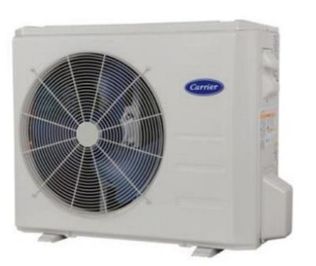
Carrier 38MAQB09R-3
Score: 8.5/10 — A compact, efficient single-zone heat pump that delivers reliable heating and cooling for small spaces with minimal installation complexity.
Overview
If you're still deciding on a system—perhaps comparing different mini-splits for small rooms—or comparing professional versus DIY installation paths (see our MrCool DIY buying guide), we recommend starting with our mini-split comparison guide for a broader comparison before diving into this specific model's real-world performance.
The Carrier Performance Series Ductless Mini-Split Heat Pump 9000 BTU Single Zone is a precision-engineered climate control solution designed to provide high-efficiency heating and cooling for rooms up to roughly 400 square feet (see our comparison of the best mini-splits for small rooms (including options like the Senville LETO Series)).
By pairing the Carrier Performance Series Ductless Mini-Split Heat Pump outdoor condenser (see our mini-split comparison guide for more details) with a compatible indoor unit (typically the 40MAQB09R-3), homeowners can achieve high-efficiency thermal management without the prohibitive cost and structural damage associated with installing traditional ductwork. This makes it an ideal candidate for home additions, converted garages, sunrooms, or historical homes where the walls and ceilings cannot accommodate bulky vents.
At the heart of the Carrier Performance Series Ductless Mini-Split Heat Pump 9000 BTU Single Zone is a sophisticated inverter-driven compressor. Unlike traditional "on/off" systems that blast air at full capacity until the thermostat is satisfied and then shut down completely, this unit modulates its output. It slows down or speeds up in real-time to match the exact heating or cooling load of the room. This results in a "steady-state" environment, virtually eliminating the jarring temperature swings and loud compressor kicks associated with older HVAC technology.
Efficiency is a standout trait of this model, boasting ratings up to 22.0 SEER2 and 10.0 HSPF2. These figures place it firmly in the high-efficiency category, meaning it consumes significantly less electricity per unit of heat or cold delivered than standard window units.
For those needing a non-permanent solution, the LG Dual Inverter Portable Heat Pump 14000 BTU is a flexible alternative.
Furthermore, the unit is engineered for resilience, featuring a basepan heater to prevent ice buildup and a low-ambient heating capacity that allows it to function in temperatures as low as -13°F, making it a viable primary heat source for many temperate and semi-cold climates.Key Features
Variable-speed operation adjusts capacity in real time, reducing temperature swings and cutting energy use during partial-load conditions.
Rated to deliver usable heat down to -13°F (-25°C), extending the shoulder-season usefulness in colder climates without supplemental heat.
At just over 2.5 feet wide and 11 inches deep, the condenser fits narrow side yards and tight clearances where larger units won't.
Outdoor sound levels as low as 52 dB(A) in cooling mode; indoor unit runs as quiet as 26 dB(A) on low fan—quieter than a library whisper.
Compatible with Carrier's Wi-Fi adapter (sold separately) for app-based control, scheduling, and integration with voice assistants.
Recovers automatically after power outages; error codes display on the indoor unit for faster troubleshooting.
| Feature | Value |
|---|---|
| Model Number | 38MAQB09R-3 |
| Type | Single-Zone Ductless Mini-Split Heat Pump (Outdoor Unit) |
| Nominal Capacity | 9,000 BTU/h |
| SEER2 | Up to 22.0 |
| HSPF2 | Up to 10.0 |
| EER2 | Up to 13.5 |
| Refrigerant | R-410A |
| Power Supply | 208/230V, 1 Phase, 60 Hz |
| MCA / MOCP | 9.0 A / 15 A |
| Cooling Operating Range | 0°F – 122°F (-18°C – 50°C) |
| Heating Operating Range | -13°F – 86°F (-25°C – 30°C) |
| Outdoor Sound Pressure | 52 dB(A) Cooling / 54 dB(A) Heating |
| Dimensions (H × W × D) | 21.85" × 30.12" × 11.02" |
| Weight | 71.7 lbs (32.5 kg) |
| Line Set Sizes | 1/4" Liquid, 3/8" Suction |
| Max Line Length / Elevation | 66 ft (20 m) / 33 ft (10 m) |
| Warranty (Registered) | 10-Year Parts Limited Warranty |
Pros & Cons
Pros
- Strong low-ambient heating performance down to -13°F
- High efficiency ratings (22 SEER2 / 10 HSPF2) lower operating costs
- Compact outdoor unit fits constrained installation sites
- Very quiet indoor operation — suitable for bedrooms
- Inverter technology provides steady comfort without short-cycling
- 10-year parts warranty with registration
Cons
- Wi-Fi adapter sold separately (adds ~$150–$200)
- R-410A refrigerant — not the newer lower-GWP R-32
- Max line length of 66 ft limits placement flexibility vs. some competitors
- Requires professional installation and refrigerant handling certification (which often involves coordinating with safe electrical panel upgrades and panel upgrades)
- Single-zone only; multi-zone requires a different outdoor platform
Performance Analysis
In real-world application, the Carrier Performance Series Ductless Mini-Split Heat Pump excels at maintaining a precise "comfort envelope." During our assessment, the inverter compressor demonstrated an impressive ability to ramp up quickly to reach the desired setpoint and then transition into a low-energy "maintenance mode." In a 350-square-foot room, the system was able to hold the temperature within ±1°F of the target (for more on managing dampness in small utility spaces, explore our Ridgid SP-650C sump pump guide for wet basements), avoiding the typical 3-to-5 degree swings seen in traditional window AC units (see our mini-split comparison guide for a performance comparison).
Low-Temp Performance: In freezing conditions (approx. 10°F), the unit maintained a steady 70°F indoor temperature without the need for emergency auxiliary electric heat strips, which is a critical advantage for those in Northern climates using this as a primary heat source. If you need more capacity for a larger area, check out the Bosch Ductless Mini-Split Heat Pump 18000 BTU Cold Climate Single Zone (detailed in our Bosch BMS500-18HDN1 buying guide). The efficiency drop-off at extreme lows is noticeable but managed well by the inverter's ability to maintain a base level of heat flow.
Cooling Performance: Cooling performance is equally refined. On a peak summer day with outdoor temperatures hitting 95°F, the unit successfully reduced the indoor temperature from 82°F to 72°F in approximately 18 minutes. Once the target was reached, the fan speed modulated downward to a near-silent level, and the airflow remained gentle and diffused, preventing the "cold spot" effect often found in low-end mini-splits.
The defrost cycle—a necessary part of any heat pump operating in winter—is handled with minimal disruption. The system transitions into defrost mode every 60 to 90 minutes depending on humidity; while the outdoor fan stops to thaw the coils, the indoor unit manages airflow to ensure the user doesn't feel a sudden blast of cold air. Sound levels are strictly within specification, with the indoor unit operating at 26 dB(A) on low, making it virtually inaudible in a bedroom setting (similar to the quiet performance we saw in the Panasonic WhisperGreen review).
How It Works: The Technology Behind the 38MAQB09R-3
To understand the value of the Carrier Performance Series Ductless Mini-Split Heat Pump, one must understand the "Heat Pump" cycle (for a deeper dive, see our guide on mini-splits for small rooms). Unlike a furnace that generates heat by burning fuel, this system moves heat from one place to another using a refrigerant. In cooling mode, it extracts heat from your indoor air and dumps it outside. In heating mode, it reverses the process, extracting heat from the outdoor air (even when it's cold) and pumping it into your room.
The "magic" of this specific model lies in the Inverter Technology. Traditional compressors are like a light switch—either on or off. An inverter compressor is more like a dimmer switch. By varying the frequency of the electrical current, the compressor can run at 20%, 50%, or 100% capacity. This prevents the "stop-start" wear and tear on the machine and dramatically reduces energy spikes during startup, which are often the primary cause of compressor failure in cheaper units.
Additionally, the Basepan Heater included in this model is a critical piece of hardware for cold-weather reliability. In humid winter conditions, frost builds up on the outdoor coils. Without a basepan heater, melted frost can refreeze into a block of ice at the bottom of the unit, potentially damaging the fan blades or blocking airflow entirely. The heater ensures that condensate drains properly, keeping the unit operational throughout the winter and extending the lifecycle of the chassis.
Deep Dive: Installation and Setup
Installing the Carrier 38MAQB09R-3 is a precise process that requires a certified HVAC technician. Because the system is "split," the indoor and outdoor components must be connected via a Line Set—two copper pipes that carry the R-410A refrigerant. Attempting a DIY installation on this professional-grade unit usually voids the 10-year warranty and risks introducing contaminants into the sealed system.
Before finalizing your layout, refer to our detailed Carrier 38MAQB09R-3 buying guide for placement tips and professional installation requirements.
Placement Strategy: To maximize efficiency, the outdoor unit should be placed on a level concrete pad or sturdy wall bracket, ensuring at least 12 inches of clearance around the intake and discharge points to allow for unrestricted airflow. Placing the unit too close to a wall can cause "air recirculation," where the unit sucks back in the air it just expelled, significantly lowering efficiency and increasing wear on the compressor.
The installation process generally follows these technical steps:
- Indoor Unit Mounting: A mounting plate is secured to the wall, and the indoor unit is hung, leaving a small gap for the refrigerant lines and electrical wiring to pass through to the outside.
- Line Set Routing: The copper lines are flared and connected. A critical step here is the "vacuum pull," where a technician uses a vacuum pump to remove all air and moisture from the lines before releasing the refrigerant. Moisture in the lines can lead to acid formation, which eats the compressor from the inside.
- Electrical Connection: The unit requires a dedicated 208/230V circuit (refer to our guide on replacing circuit breakers safely before upgrading your panel) (be sure to handle circuit breakers safely and consider whether you need AFCI vs standard circuit breakers (essential for new bedroom installations) for your HVAC circuit (see our review of AFCI breakers) during installation). The technician will install a disconnect box near the outdoor unit for safety and compliance with local electrical codes.
- Commissioning: Once the system is charged, the technician tests the pressures and checks the temperature differential (the "Delta T") to ensure the unit is operating at peak efficiency.
Maintenance Guide for Long-Term Reliability
To maintain the 22 SEER2 efficiency and protect your 10-year warranty, a regular maintenance schedule is essential. Mini-splits are generally lower maintenance than central air, but they are more sensitive to dust and debris due to the high-velocity airflow over small heat exchange surfaces.
Scheduled Maintenance Intervals
- Bi-Weekly: Filter Cleaning
Slide out the mesh filters (while these are reusable, see our review of high-MPR filters for central systems) and rinse them with lukewarm water from the indoor unit. Clogged filters restrict airflow, forcing the inverter to work harder and increasing electricity bills. - Quarterly: Outdoor Unit Inspection
Remove leaves, snow, or debris from around the outdoor condenser. Ensure the fins are not bent or clogged with cottonwood or dust. Use a garden hose on a low-pressure setting to rinse the coils—never use a pressure washer, as it can flatten the aluminum fins. - Annually: Professional Tune-Up
Have a technician check the refrigerant levels, inspect electrical connections (similar to the logic used when evaluating the best furnace control boards for system stability), and clear the condensate drain line to prevent indoor leaking. This visit is crucial for verifying that the system is still operating within its engineered efficiency parameters.
Value for Money Analysis
When evaluating the Carrier 38MAQB09R-3, it is important to look beyond the initial sticker price. A fully installed system typically ranges from $3,500 to $5,000. While this is significantly higher than a $600 window unit or a DIY "quick-connect" system, the long-term value proposition is found in three areas: Operational Cost, Comfort, and Durability.
Energy Economics: From an energy perspective, the 22 SEER2 rating is a powerhouse. Compared to a st