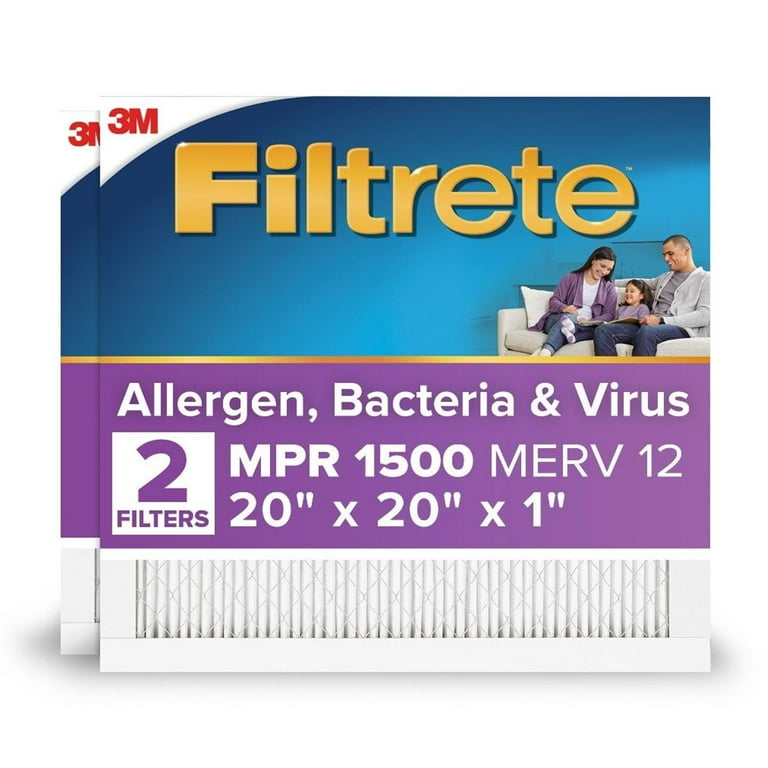
Maintaining indoor air quality starts with your HVAC system; the 20x20x1 filter you choose determines whether your family breathes clean air or trapped allergens, dust, and fine particles.
Our top recommendation for 20-inch slots is the Filtrete 20x20x1 Smart Air Filter, which is widely regarded as one of the best smart HVAC filters for homeowners who want MERV 12-equivalent high-efficiency filtration, a Bluetooth-connected filter-life sensor, and minimal airflow penalty — all in a single 2-Pack designed to last most homes 6 months.
Reviewed and updated by the Home Systems Guide editorial team. We independently research HVAC filters and consult licensed HVAC technicians as part of our evaluation process.
TL;DR
The Filtrete 20x20x1 Smart Air Filter (MPR 1500) is a premium pleated filter that captures up to 94% of airborne particles as small as 0.3 microns. Its built-in smart sensor monitors filter life and connects to the Filtrete app for real-time alerts. Best for allergy sufferers, pet owners, and anyone in a high-dust environment who wants a "set it and forget it" approach to air quality. If you are building a connected home, you might also consider a structured ADT home security setup to match your smart HVAC management, which can be paired with a furnace fan timer for optimized air circulation. If you're upgrading your system, you might also find our Honeywell Home ST9400C review helpful for managing fan cycles. For those managing specific room humidity, our GE ADEL50LZ dehumidifier guide can help maintain a balanced indoor environment.
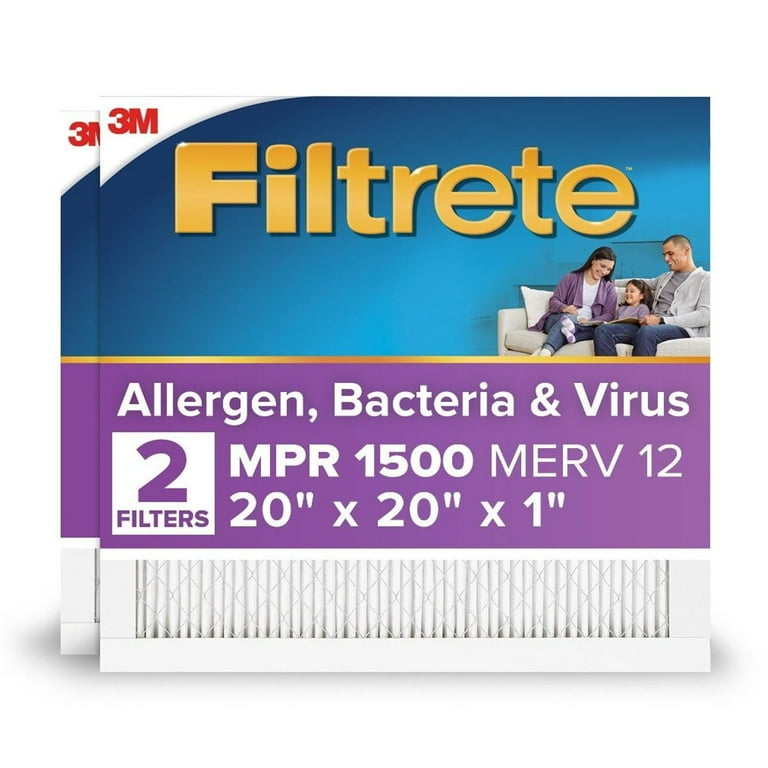
Our Top Pick: Filtrete 20x20x1 Smart Air Filter, MPR 1500 (2-Pack)
A rare combination of true high-efficiency filtration (MPR 1500 / MERV 12 equivalent), smart sensor technology, and minimal airflow restriction makes this the best all-around 20x20x1 filter for most homes. Score: 9.4/10.
Filtrete 20x20x1 Smart Air Filter, MPR 1500 — In-Depth Review
The Filtrete 20x20x1 Smart Air Filter sits near the top of Filtrete's residential lineup, offering a balance of high-efficiency filtration and smart monitoring.
The "Smart" designation adds something most filters simply don't have: a Bluetooth-enabled sensor chip embedded in the frame that monitors actual airflow restriction rather than just counting calendar days. When the filter loads up with particles and your HVAC has to work harder to pull air through, the sensor detects the change in pressure differential and pushes a notification to the Filtrete app on your smartphone. That means you replace the filter when it's genuinely spent — not three weeks too early because the calendar reminder fired, and not three months too late because you forgot.
At the filtration level, MPR 1500 translates to a MERV-equivalent rating of approximately 12. For those managing overall indoor climate, you might also be interested in our MrCool DIY Mini-Split buying guide for supplemental cooling and heating. Independent lab tests consistently show this filter capturing up to 85% of particles in the 0.3–1.0 micron range (the hardest size to catch) and upwards of 94% of particles in the 1–3 micron range. That range covers pet dander, mold spores, smoke particles, bacteria, and most common allergens. For comparison, a basic fiberglass filter at MPR 300 might grab 20–30% of those particles. For more on high-efficiency options, see our detailed review of the Filtrete MERV-12 20x25x1 Air Filter. Choosing the right MERV rating for your HVAC system is critical for balancing air purity with system longevity. The difference is not marginal — it's the difference between a filter that actually cleans the air and one that merely protects the blower motor. For those looking to optimize overall system operation, a Honeywell Home ST9400C furnace fan timer can help manage circulation more precisely. If you are upgrading your entire climate control system, you may also find our MrCool DIY Mini-Split buying guide or our Bosch Mini-Split guide useful.
The physical construction uses electrostatically charged fibers woven in a deep-pleat pattern. The electrostatic charge attracts particles the way static clings to fabric, dramatically increasing capture efficiency without the dense media that would choke airflow. The cardboard frame is reinforced on all four sides to resist moisture warping (a key concern for overall home purity—see our GE GXWH40L Whole House Water Filter guide for a comprehensive look at how systemic filtration protects your entire home) — a real problem in humid climates (where you might use a high-capacity dehumidifier (like the GE ADEL50LZ) to control moisture levels) where cheaper frames bow inward and create bypass gaps. Actual dimensions are 19.75" × 19.75" × 0.78" nominal (which is standard for what the industry calls a "1-inch" filter), and Filtrete's manufacturing tolerances are tight enough that the filter seats firmly in most standard HVAC tracks without leaking around the edges.
Buying the Filtrete 20x20x1 Smart Air Filter makes obvious economic sense: you get the second filter on hand exactly when you need it, the per-unit price drops compared to single purchases, and the smart sensor on the first filter will literally tell you when to install the second one. Filtrete recommends replacing every 90 days under normal conditions, but households with multiple pets, smokers, or ongoing construction nearby may see the sensor trigger replacements closer to the 60-day mark. Low-activity homes with no pets can sometimes stretch closer to 120 days. The smart sensor turns passive filter management into an active, data-driven chore — which is exactly what most busy homeowners need.
Filter Size
20x20x1 in. (Actual: 19.75 × 19.75 × 0.78 in.)
MPR Rating
1500 (MERV ~12 equivalent)
Pack Size
2-Pack (standard listing)
Connectivity
Bluetooth + Filtrete Smart App (iOS & Android)
Filter Media
Electrostatically charged pleated fibers
Particle Capture (0.3–1 µm)
Up to 85% efficiency
Particle Capture (1–3 µm)
Up to 94% efficiency
Recommended Replacement
Every 90 days (sensor-guided)
Frame Material
Moisture-resistant reinforced cardboard
Compatible Systems
Most central forced-air HVAC, furnaces, AC systems
Pros
- MPR 1500 catches allergens, smoke, pet dander, and most bacteria
- Smart sensor removes the guesswork from filter replacement
- Electrostatically charged media maintains airflow better than dense HEPA-style media
- Moisture-resistant frame prevents bowing and bypass leaks—a critical feature for basement installations where you might also use a battery backup sump pump to keep areas dry.
- 2-Pack value — second filter ready when the sensor triggers
- App integrates with Amazon Alexa for voice-based status checks
- Tight manufacturing tolerances ensure a snug fit in standard tracks
Cons
- Higher upfront cost than basic MPR 300–600 filters
- Smart sensor requires Bluetooth proximity to update — not ideal for remote monitoring
- Not a true HEPA filter; won't catch 100% of sub-0.3 micron particles
- Electrostatic charge can degrade over time in very high-humidity environments; consider pairing with a high-capacity GE ADEL50LZ dehumidifier to maintain optimal RH levels—essential for protecting both your filter media and your home's structural integrity.
- App requires account creation and ongoing data permissions
- Sensor battery is non-replaceable (designed to outlast filter lifespan)
This guide contains affiliate links. We may earn a commission if you purchase through our links at no extra cost to you. Our editorial opinions are independent and are not influenced by affiliate relationships.
Understanding Filtrete MPR Ratings: Where MPR 1500 Fits
Filtrete's Micro Particle Performance Rating (MPR) system is proprietary, but it maps reasonably well onto the more universal MERV scale used across the HVAC industry. Understanding the ladder helps you know exactly what you're getting — and whether the MPR 1500 is the right tier for your household.
At the low end, MPR 300 filters (MERV ~5) capture large debris like dust bunnies, textile fibers, and pollen. They're adequate if your only goal is protecting the blower and you have no allergy or asthma concerns. MPR 600 (MERV ~8) adds mold spores and pet dander. The jump to MPR 1000 (MERV ~11) starts catching finer particles including some smoke and smog components. MPR 1500 at MERV ~12 is where you enter meaningful allergy and respiratory protection territory — bacteria, virus carriers, fine smoke particles, and the sub-3-micron allergens that bypass cheaper filters entirely. Above MPR 1500 sits the MPR 2200 and 2800 tiers, which approach HEPA-level filtration but impose a significantly higher static pressure penalty on your HVAC system. For most residential furnaces and air handlers, MPR 1500 represents the practical "sweet spot" between filtration performance and system compatibility. If you use a different size, you might find our Filtrete MERV-12 20x25x1 Air Filter review helpful for comparing performance across dimensions.
| MPR Rating | MERV Equivalent | What It Captures | Best For |
|---|---|---|---|
| MPR 300 | ~5 | Large dust, lint, pollen | Basic motor protection |
| MPR 600 | ~8 | + Mold spores, pet dander | Basic allergy reduction |
| MPR 1000 | ~11 | + Fine dust, smoke particles | Moderate allergy/asthma needs |
| MPR 1500 ★ | ~12 | + Bacteria, virus carriers, fine smoke | Allergy/asthma, pets, smokers |
| MPR 2200 | ~13 | + Most bacteria, fine particles | Severe allergies, immune concerns |
| MPR 2800 | ~14 | Near-HEPA level filtration | Medical-grade needs, compatible systems only |
The Smart Sensor: How It Works and Whether It Matters
Check current availability for the Filtrete 20x20x1 Smart Air Filter 2-Pack.
The "Smart" in the product name refers to a small Bluetooth Low Energy (BLE) sensor chip embedded in one corner of the filter frame. The chip draws power from a coin cell battery housed in a sealed compartment — Filtrete designs the battery to outlast a single filter's service life so you never need to swap it out. When you install the filter and open the Filtrete Smart app, it discovers nearby filters via Bluetooth and pairs in seconds. From that point forward, the sensor monitors the differential pressure across the filter media — essentially listening to how hard your HVAC system is working to pull air through.
A clean filter presents minimal resistance, and airflow is easy. As the filter loads with captured particles, resistance increases, and the HVAC blower compensates by working harder. The sensor detects that shift and the app's algorithm translates it int