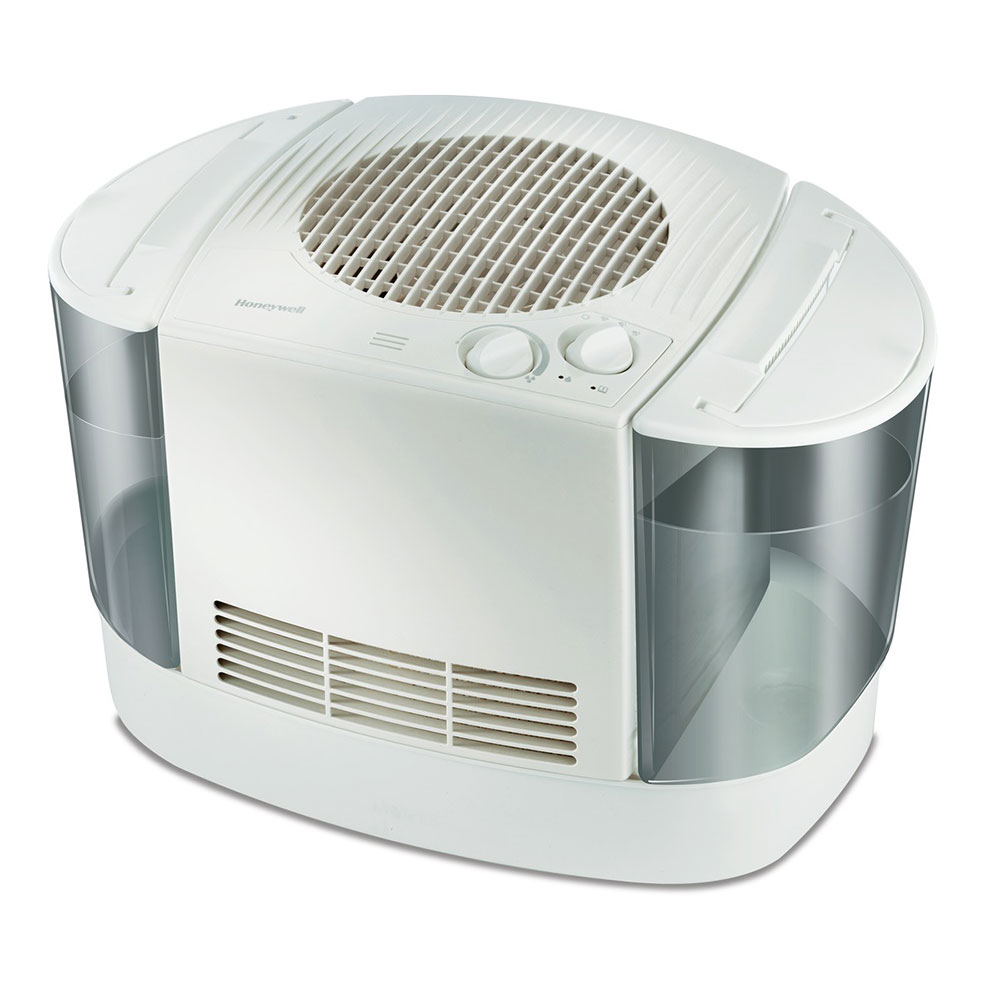
The Honeywell Cool Moisture Whole-Room Humidifier with Wicking Filter is a professional-grade top-fill console humidifier designed to add moisture to large rooms quietly and efficiently. Using evaporative wicking technology, it releases an invisible cool mist that's ideal for bedrooms, living rooms, and open-plan spaces during periods of dry air. This complete guide to the Honeywell HEV685W walks you through its features, performance, setup, maintenance, and whether it's the right fit for your home.
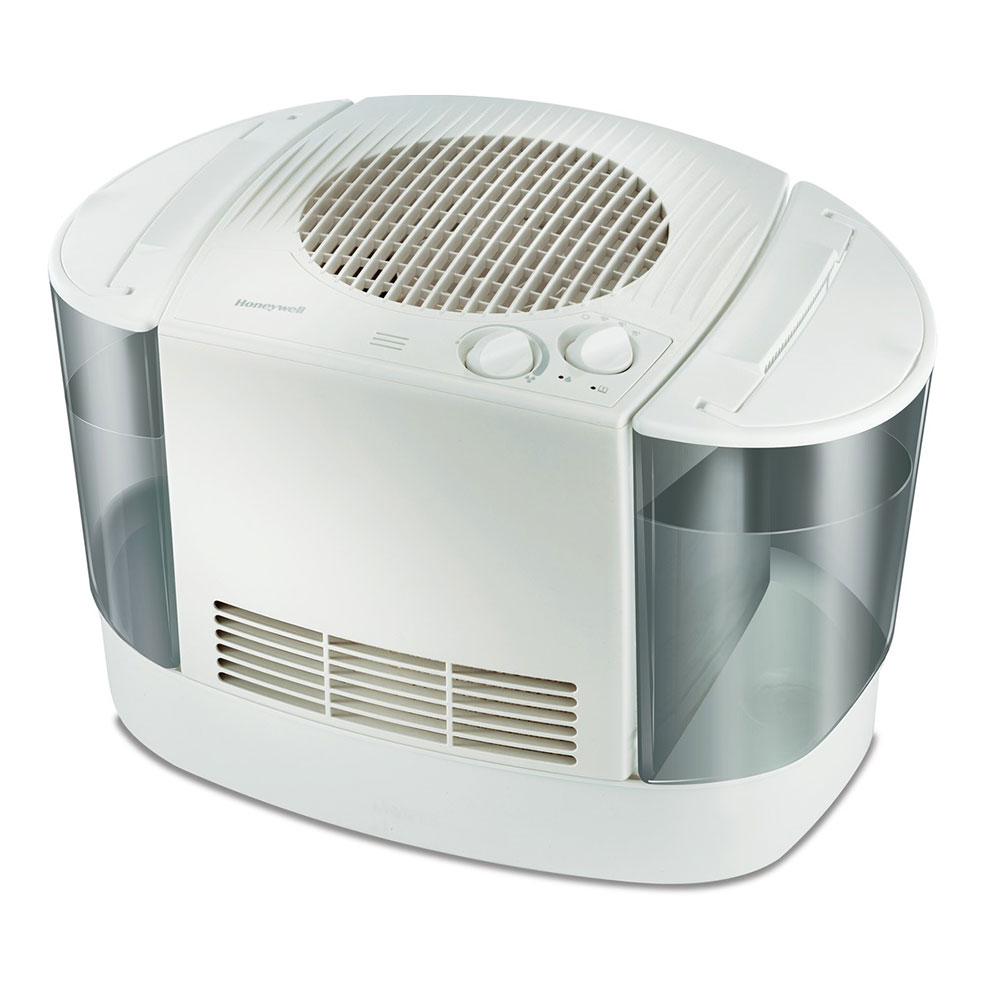
Top Pick: Honeywell Cool Moisture Whole-Room Humidifier with Wicking Filter
Score: 9/10 — A reliable, low-maintenance choice for medium-to-large rooms where invisible, mineral-free humidification matters more than smart features or visible mist.
TL;DR: The Honeywell HEV685W is a large-capacity evaporative humidifier that covers rooms up to roughly 500 square feet. It offers easy top-fill convenience, three speed settings, an adjustable humidistat, and a self-regulating evaporative system that won't over-humidify a room. It's best for users who want low-maintenance, mineral-free humidification in a medium-to-large space.
Honeywell Cool Moisture Whole-Room Humidifier with Wicking Filter
The HEV685W belongs to Honeywell's "Designer Series" line of cool moisture console humidifiers. Unlike ultrasonic units that mist visible water droplets, this is an evaporative model: a fan blows room-temperature air through a saturated wicking filter, releasing pure water vapor into the air. The result is humidification without white dust, mineral fallout, or excessive condensation on windows. For those looking to upgrade their entire climate control system, our MrCool DIY Mini-Split guide offers a comprehensive look at high-efficiency heating and cooling. This fundamental difference in technology drives nearly every aspect of the user experience — from maintenance requirements to health outcomes.
Designed for spaces up to 500 square feet, the HEV685W targets the sweet spot between portable tabletop humidifiers and whole-house filtration systems (like the GE GXWH40L). It's large enough to handle a master bedroom, living room, or finished basement, yet compact enough to sit unobtrusively against a wall. The 1.7-gallon tank capacity translates to up to 24 hours of runtime on the low setting, meaning most users will only need to refill once per day during peak heating season.
Three output settings and an auto-shutoff function make it a practical choice for bedrooms, living rooms, or home offices. The adjustable humidistat (similar in logic to the Honeywell Home ST9400C timer for furnace control) allows you to set a target relative humidity (typically 30–50%), and the unit cycles on and off automatically to maintain that level. This self-regulation is a key advantage of evaporative technology: as room humidity rises, the evaporation rate naturally slows, providing a built-in safety buffer against over-humidification even if the humidistat calibration drifts.
The antimicrobial-treated wicking filter (model HFT600) captures minerals and pollutants from the water before releasing clean, invisible moisture into the air. This is especially valuable in hard-water areas where ultrasonic humidifiers produce visible white dust that settles on furniture and electronics. The filter does require periodic replacement — typically every 1–3 months depending on water hardness and runtime — which represents an ongoing cost but also ensures the air stays clean. For more on maintaining overall air quality, see our Filtrete MERV-12 filter review or check out our Panasonic WhisperGreen Select review for professional ventilation tips.
| Specification | Detail |
|---|---|
| Type | Evaporative cool mist (wicking filter) |
| Coverage Area | Up to ~500 sq ft (large room) |
| Tank Capacity | Approx. 1.7 gallons (top-fill design) |
| Runtime | Up to 24 hours per fill on low |
| Settings | 3 speeds + adjustable humidistat |
| Replacement Filter | Honeywell HFT600 wicking filter |
| Dimensions | 13.2 x 8.5 x 17.5 inches (W x D x H) |
| Weight | ~10 lbs empty |
| Power Consumption | ~60W on high, ~20W on low |
| Noise Level | ~35 dB (low) to ~55 dB (high) |
| Color | White |
| Warranty | 3-year limited |
Pros
- Easy top-fill tank reduces refill hassle — no flipping heavy tanks upside down
- No white mineral dust thanks to wicking filter technology
- Self-regulating evaporative system won't over-humidify
- Large coverage area suitable for living rooms or master bedrooms
- Adjustable humidistat conserves water and energy
- Quiet on low setting (suitable for light sleepers)
- Antimicrobial-treated filter inhibits mold and bacteria growth
- Auto-shutoff when tank is empty or target humidity reached
- 3-year limited warranty provides peace of mind
- No heating element — safer around children and pets
Cons
- Requires regular wicking filter replacement (ongoing cost of ~$15–20 per filter)
- Higher fan speeds are noticeably audible (white noise character)
- Larger footprint than tabletop humidifiers (requires floor space)
- No visible mist may confuse first-time evaporative users
- Filter can develop odor if not maintained on schedule
- No smart/app connectivity or remote control
- Humidistat accuracy can vary ±5% from actual room humidity
- Top-fill opening could be wider for easier cleaning access
- No built-in hygrometer display — shows target, not current humidity
- Replacement filters must be purchased separately (not always in local stores)
We may earn a commission if you purchase through links on this page. This does not affect our editorial independence.
How Evaporative Humidification Works: Deep Dive
Understanding the physics behind the HEV685W helps set realistic expectations and explains why this technology excels in certain scenarios while falling short in others. Evaporative humidification relies on a simple principle: when dry air passes over a wet surface, water molecules evaporate into the air until equilibrium is reached. The HEV685W accelerates this natural process using a high-surface-area wicking filter and a forced-air fan.
The wicking filter is constructed from layered paper or synthetic material with a honeycomb structure that maximizes surface area while minimizing airflow resistance. As water is drawn up from the reservoir via capillary action, it saturates the filter matrix. The fan then pulls room air through the saturated filter, where it picks up water vapor through evaporation. Critically, this is a phase-change process — liquid water becomes gaseous water vapor — which requires energy (latent heat of vaporization). This energy is drawn from the air itself, producing a slight cooling effect (typically 1–3°F) that can be welcome in winter-heated rooms.
Unlike ultrasonic humidifiers, which use high-frequency vibration to aerosolize water droplets (including any dissolved minerals, bacteria, or contaminants), evaporative units only release pure H₂O molecules. Minerals, metals, and microorganisms are left behind in the filter matrix. This is why evaporative humidifiers don't produce white dust and are recommended by the EPA and allergy specialists for households with respiratory sensitivities.
The self-regulating nature of evaporation is a unique advantage. The evaporation rate is governed by the vapor pressure deficit — the difference between the current vapor pressure in the air and the saturation vapor pressure at that temperature. As room humidity increases, this deficit shrinks, naturally slowing evaporation. Even if the humidistat fails or is set incorrectly, the physics prevents runaway humidification. This makes evaporative humidifiers inherently safer for unattended operation.
Trade-offs exist. The fan adds mechanical noise (though it's a consistent white noise many find soothing). The filter represents a recurring consumable cost and maintenance task. And the unit cannot raise humidity above the natural saturation point for the current temperature — in very cold rooms, maximum achievable humidity is lower. But for most residential applications in heated homes, these are minor constraints.
Buyer's Guide: Choosing a Whole-Room Humidifier
Before committing to the HEV685W or any console humidifier, consider these key decision factors that differentiate product categories and models.
Evaporative vs. Ultrasonic vs. Warm Mist vs. Steam
Evaporative (HEV685W): Fan blows air through wet wick. Pros: No white dust, self-regulating, safe, energy-efficient. Cons: Filter replacement, fan noise, larger size. Best for: Large rooms, hard water areas, allergy sufferers, overnight use.
Ultrasonic: Vibrating diaphragm creates fine mist. Pros: Quiet, compact, visible mist, no filter. Cons: White dust with tap water, can over-humidify, mineral buildup on surfaces. For those seeking premium air purification and humidification, the Dyson Humidifier and Cool Fan with UV Cleanse Technology or the Levoit Large-Room Warm and Cool Mist Ultrasonic Humidifier are high-end alternatives. Best for: Small bedrooms (see the Pure Enrichment MistAire), distilled water users, and those with a visible mist preference. Those prioritizing UV sterilization might consider the Honeywell Germ-Free Cool Mist Humidifier with UV Technology.
Warm Mist: Using a unit like the Vicks Warm Mist Humidifier with Medicine Cup for Medium Rooms, a heating element boils water. Pros: Kills most microbes, warm mist feels comforting, no filter. Cons: High energy use, burn risk, mineral scale on heating element, smaller coverage. Best for: Cold/flu relief, small spaces, users wanting warm vapor.
Steam (Electrode/Canister): For those needing total home control, an Aprilaire Whole-Home Bypass Humidifier is a professional choice. Pros: Highest output, precise control, sterile steam. Cons: Expensive, high energy, installation complexity. Best for: Whole-house integration, luxury applications.
Related parts & accessories
Related parts & accessories
Coverage Area: Right-Sizing Your Humidifier
Manufacturer coverage ratings assume ideal conditions: closed doors, average ceiling height, moderate air exchange. Real-world performance varies. A 500 sq ft rating like the HEV685W's typically translates to effective humidification of 300–400 sq ft in a typical home with normal air leakage. For open-plan spaces exceeding 500 sq ft, consider multiple units, or if you struggle with seasonal swings, balance your environment with a GE ADEL50LZ 50-Pint Dehumidifier review or by consulting our dehumidifier buying guide for damp rooms or a GE GXWH40L whole-house water filtration system. Undersizing leads to constant high-speed operation (more noise, more refills, shorter filter life). Oversizing wastes energy and space but provides headroom for extreme dry conditions.
Tank Capacity and Runtime
Tank capacity determines refill frequency. The HEV685W's 1.7 gallons yields ~24 hours on low, ~12 hours on medium, ~8 hours on high. For bedroom overnight use, low setting covers a full night plus morning. For living room all-day use, expect one mid-day refill. Larger tanks (2.5–3+ gallons) exist but increase unit size and weight when full (water weighs 8.3 lbs/gallon). Top-fill design mitigates the hassle of large tanks.
Humidistat Precision and Automation
Basic mechanical humidistats (like the HEV685W's rotary dial) target a humidity range, not an exact point. Expect ±5% accuracy. Digital humidistats with external sensors improve precision but add cost. Smart humidifiers like the Dreo Smart Humidifier or the Levoit Classic 300S Smart Ultrasonic Humidifier with app control, scheduling, and integration (HomeKit, Alexa, Google) offer convenience but introduce dependency on cloud services and firmware updates. For most users, a reliable mechanical humidistat is sufficient and more durable.
Maintenance Requirements
Evaporative: Weekly rinse, bi-weekly descale, filter every 1–3 months. Ultrasonic: Weekly clean, descale, demineralization cartridge if using tap water. Warm mist: Weekly descale heating element. Steam: Canister replacement annually. Consider your willingness to maintain — neglected humidifiers become microbial amplifiers. The HEV685W's maintenance is straightforward but non-negotiable.
Noise Sensitivity
Evaporative units have fan noise. The HEV685W runs ~35 dB on low (quiet library), ~45 dB on medium (quiet conversation), ~55 dB on high (background music). Ultrasonic units are quieter (~25–30 dB) but may produce high-frequency whine. Warm mist units have boiling sounds. If you're extremely noise-sensitive, test in person or look for "sleep mode" features that ramp down automatically.
Setup and First Use: Step-by-Step
- Unbox and inspect. Remove all packaging. The HFT600 wicking filter may be included inside the unit or packed separately — check the box and base compartment. Inspect for shipping damage (cracked tank, bent filter frame, loose fan blade).