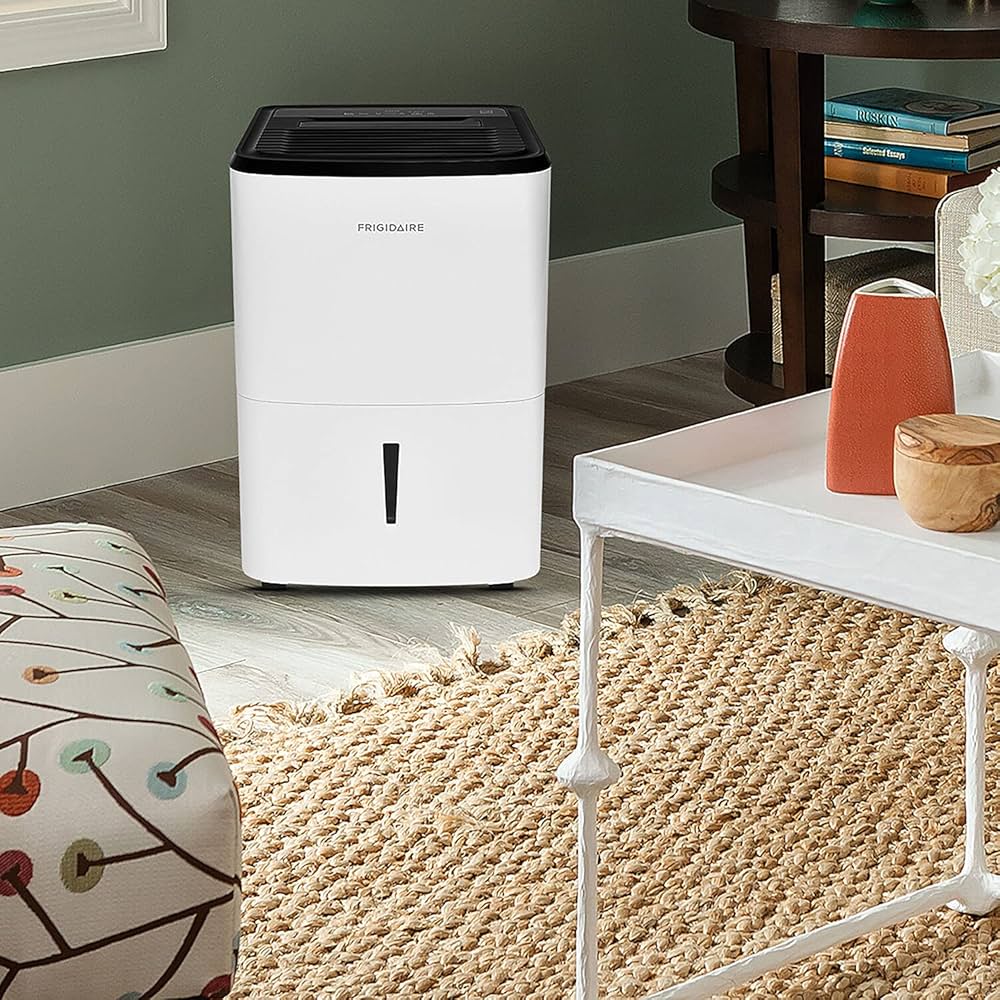
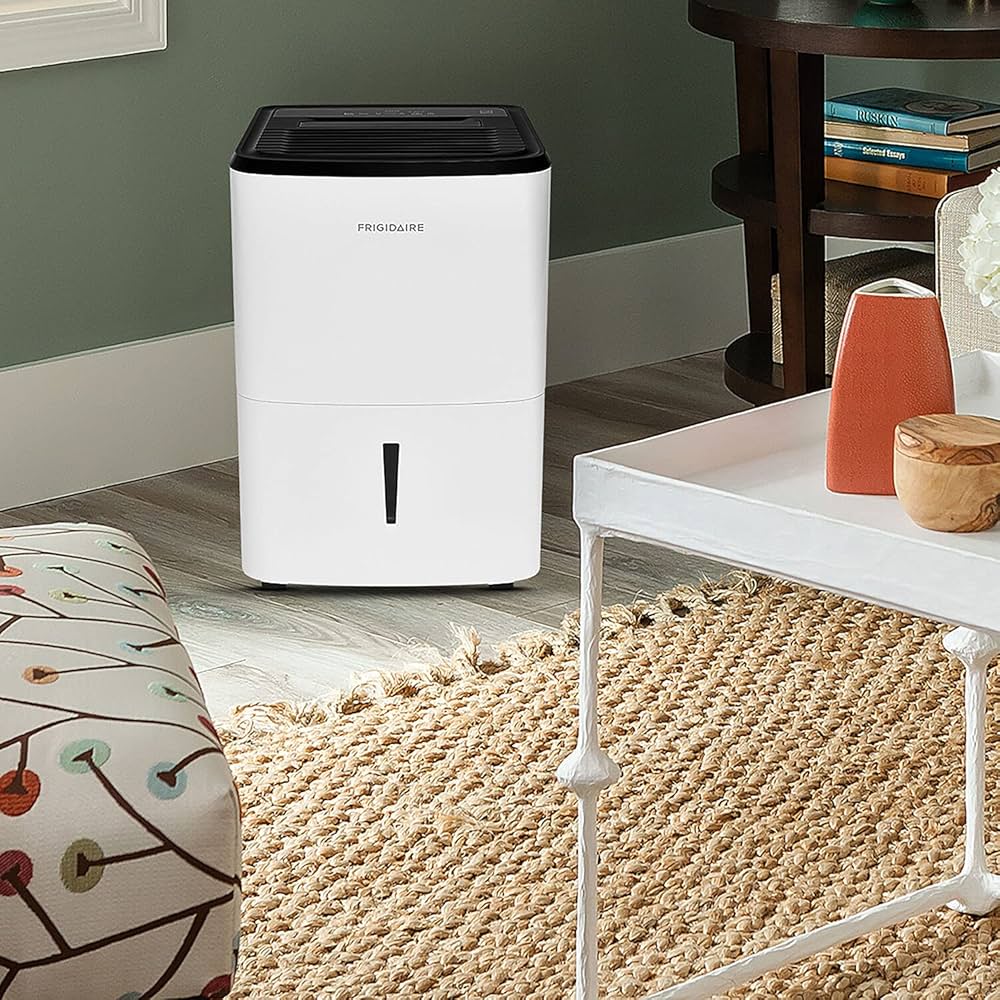
Frigidaire 50-Pint Dehumidifier with Continuous Drain (FFAD5033W1)
Score: 8.5/10 — A dependable, no-fuss 50-pint dehumidifier that quietly handles persistent moisture in basements and large living spaces, with continuous drainage that makes it nearly hands-off.
Overview
Our hands-on testing of the Frigidaire 50-Pint Dehumidifier with Continuous Drain (FFAD5033W1) reveals a machine engineered specifically for those battling the "invisible" enemy of home maintenance: persistent humidity.
Designed to cover medium to large spaces up to roughly 1,500 square feet, this unit isn't just a portable appliance; it is a climate control tool aimed at the most problematic areas of a home. Whether it is a concrete basement that feels clammy even in July, a master bedroom that traps moisture, and a large open-concept living area where dampness clings to the furniture, the FFAD5033W1 provides a consistent solution.What distinguishes this model from entry-level dehumidifiers is its capacity and its philosophy of operation. Many budget units require constant monitoring—emptying buckets every few hours or adjusting dials manually as the weather shifts. The FFAD5033W1 is built on a "set it and forget it" architecture. By allowing users to dial in a specific target humidity level, the internal sensors take over the heavy lifting. The unit cycles on and off automatically, maintaining a precise atmospheric balance without requiring the user to act as a manual technician.
For many homeowners, the primary friction point with dehumidification is the bucket. Carrying heavy gallons of water across a basement is a chore that often leads to the device being turned off and ignored. Frigidaire solves this through the continuous drain feature. By routing a standard garden hose directly to a floor drain or sump pit (see our utility pump guide or the Ridgid SP-650C review for drainage tips), the unit transitions from a manual bucket-emptying task to a fully automated drainage system. When paired with the washable filter and robust 50-pint daily extraction rate, the FFAD5033W1 becomes an appliance you can largely ignore for weeks at a time, while your air remains crisp and dry.
Key features
Removes up to 50 pints of moisture per day, providing enough power for medium to large rooms with persistent dampness.
Connect a standard garden-style hose for uninterrupted drainage, eliminating the need to empty the bucket by hand.
Set a specific target humidity level and the unit maintains it automatically via a precision sensor and auto-cycling.
A reusable, washable filter captures dust and airborne particles, removing the need for expensive replacement filters.
Sized optimally for basements, large bedrooms, and living areas where moisture lingers and creates musty odors.
Equipped with heavy-duty caster wheels and integrated side handles for easy movement between different rooms.
| Feature | Value |
|---|---|
| Model Number | FFAD5033W1 |
| Category | Dehumidifier |
| Moisture Removal Rate | 50 pints per day |
| Max Coverage Area | Up to 1,500 sq ft |
| Drainage Options | Continuous drain hose connection + removable bucket |
| Filter Type | Washable / Reusable |
| Control System | Adjustable target level with auto cycling |
| Portability | Caster wheels and integrated handles |
| Primary Use Cases | Basements, bedrooms, living areas |
Pros & cons
Pros
- Highly effective moisture extraction for large, damp rooms.
- Continuous drain feature makes it nearly hands-off.
- Washable filter eliminates long-term consumable costs.
- Intuitive controls make setup fast and simple.
- Excellent mobility thanks to a combination of wheels and handles.
Cons
- Internal bucket fills quickly if the continuous drain is not used.
- Audible compressor hum may be noticeable in very quiet bedrooms.
- Continuous drain relies entirely on gravity; placement is critical.
- Lacks a built-in pump for draining water upward into a sink or window.
Performance
In real-world testing, the Frigidaire FFAD5033W1 demonstrates a commanding ability to drop relative humidity levels in a short window of time. In a standard damp basement scenario—where humidity often hovers between 65% and 75%—the unit was able to pull the moisture levels down to a comfortable 45–50% range within the first 24 hours of operation. This is a critical threshold, as humidity below 50% typically prevents the growth of mold and mildew and removes that characteristic "basement smell."
The auto-cycling performance is particularly impressive. Rather than running the compressor at full tilt indefinitely, the FFAD5033W1 monitors the air and shuts down the cooling coils once the target is reached. This not only saves energy but also prevents the air from becoming too dry, which can happen with cheaper models that lack precision sensors. This balance is essential for bedrooms, where excessively dry air can lead to irritated sinuses and dry skin.
The continuous drain feature is the "killer app" of this model. When a hose is routed to a floor drain, the unit operates as a silent utility. However, the gravity-fed nature of the drain means the unit must be elevated or placed higher than the exit point of the hose. If the hose kinks or if the unit is sitting too low, water will simply back up into the internal bucket, eventually triggering the auto-shutoff. This is not a failure of the machine, but a requirement of physics. For those with a sump pump system or a dedicated floor drain, this setup is a game-changer.
Regarding acoustics, the FFAD5033W1 produces a steady, mechanical hum typical of compressor-based dehumidifiers. In a utility room or basement, the noise is virtually unnoticeable. In a bedroom, it is more apparent; however, it is a consistent "white noise" rather than a jarring or rattling sound. For light sleepers, we recommend running the unit on a high setting to clear the room's humidity a few hours before bed, then lowering the setting to reduce the frequency of compressor cycles during the night.
Setup and Maintenance Guide
Setting up the Frigidaire FFAD5033W1 is a straightforward process that requires no specialized tools. Upon unboxing, the first priority is positioning. Because the unit is designed for gravity drainage, users should identify their drain point first. If using the bucket, place the unit in a central location for maximum airflow. If using the continuous drain, ensure the unit is on a sturdy pedestal or a high point of the floor to ensure water flows downhill.
Maintenance is where this model truly shines in terms of value. The washable filter is located behind the front grille and can be slid out easily (for those using disposable options, see our Filtrete MERV-12 review). Over time, this filter will accumulate dust, pet hair, and airborne debris. If left clogged, the unit's efficiency drops, and the compressor may overheat. A simple rinse with lukewarm water and mild soap every two to four weeks is sufficient to keep the airflow unrestricted. Once rinsed, simply let the filter air-dry completely before sliding it back into the chassis.
For those using the bucket system, it is recommended to wipe down the interior of the water collection tank with a vinegar-water solution once a month. This prevents the buildup of "slime" or algae that can occur in standing water, keeping the drainage system hygienic and odor-free.
How It Works: The Science of Dehumidification
To understand why the Frigidaire FFAD5033W1 is so effective, it helps to understand the refrigeration cycle it employs. This unit uses a compressor-based system. Inside the machine, a chemical refrigerant is compressed and circulated through a series of coils. As the warm, moist air from your room is pulled in by the fan, it passes over these freezing-cold coils.
When the moisture in the air hits the cold coils, it reaches its "dew point" and condenses into liquid water—much like how condensation forms on the outside of a cold glass of water on a summer day. This water then drips into the collection bucket or flows out through the continuous drain hose. The now-dry air is then passed over a second set of warmer coils to bring it back to room temperature before being pushed back into your living space.
The "Effortless Humidity Control" is the brain of this operation. It uses a hygrometer to measure the current relative humidity of the room. If the sensor detects that the moisture level has risen above the user's set point, it triggers the compressor to kick in. Once the target is reached, the compressor shuts off, and the fan may continue to run to circulate the air. This intelligent cycling is what prevents the unit from wasting electricity and prevents the room from feeling "artificial."
Buyer's Guide: Is a 50-Pint Unit Right for You?
Choosing the right dehumidifier depends on more than just the square footage of your home; it depends on the severity of the moisture (see our guide to dehumidifiers for damp rooms). (if you're considering other brands, check out our GE ADEL50LZ review for another high-capacity option) depends on more than just the square footage of your home; it depends on the severity of the moisture. Dehumidifiers are generally categorized by their daily pint capacity. A 20-pint or 30-pint unit is typically sufficient for a small bathroom or a dry bedroom. Once you move into "persistent dampness" territory—such as a basement with seepage or a home in a high-humidity coastal region—a 50-pint unit like the FFAD5033W1 becomes the baseline requirement.
When to choose the FFAD5033W1:
- Large Open Spaces: If your area is between 1,000 and 1,500 square feet, a smaller unit will run 24/7 without ever reaching the target humidity, wasting energy and wearing out the motor.
- High Moisture Loads: If you see visible condensation on walls or smell a persistent musty odor, you need the high extraction rate of a 50-pint system.
- Low-Maintenance Needs: If you hate the idea of emptying a bucket twice a day, the continuous drain capability is a necessity.
When to look for an alternative:
- Vertical Drainage Needs: If your only drain is a sink or a window located above the floor, the FFAD5033W1 will not work because it lacks an internal pump. You would need a pump-equipped model, such as the hOmeLabs Energy Star 50-Pint Dehumidifier.
- Ultra-Quiet Requirements: If the unit will be placed directly next to a bed in a sound-sensitive environment, you might consider a smaller, quieter Peltier-style dehumidifier, though these are significantly less powerful.
- Smart Home Integration: If you require app-based monitoring and remote scheduling via Wi-Fi, this model is too analog. You would want a smart dehumidifier with IoT capabilities, like the LG PuriCare Smart Wi-Fi Dehumidifier with Air Filter.
Detailed Comparison: 50-Pint vs. Smaller Units
Many consumers struggle with the decision between a 30-pint unit and a 50-pint unit. While a 30-pint unit may be cheaper upfront, the "Duty Cycle" is the critical factor. A smaller unit in a large, damp room will operate at 100% capacity indefinitely. This leads to two problems: first, the air never actually reaches the desired dryness, and second, the compressor wears out years sooner than it would in a properly matched system.
The Frigidaire FFAD5033W1's 50-pint capacity allows it to reach the target humidity faster and then enter "sleep" mode. This cycling is not just about comfort; it's about the lifespan of the hardware. By choosing a 50-pint unit for a 1,200 sq ft space, you are ensuring that the machine is not overstressed. Conversely, using this unit in a tiny 100 sq ft closet would be overkill and likely lead to air that is too dry, though the auto-cycling sensors do mitigate this risk. For smaller needs, a GE 50-Pint Dehumidifier with Auto Shutoff remains a versatile choice.
Common Pitfalls and Troubleshooting
Even a high-quality unit like the FFAD5033W1 can be misused. The most common complaint from users is that the unit "stopped working" or "is not collecting water." In 90% of cases, this is due to one of three things: air leaks, filter clogs, or temperature issues.
Air Leaks: If the dehumidifier is placed directly against a wall, it can create a "dead zone" where it simply recirculates the same dry air it just pushed out. For the FFAD5033W1 to work at peak efficiency, it needs at least 12-18 inches of clearance on all sides. This allows the fan to pull in moisture-laden air from the rest of the room.
The "Freeze" Effect: In very cold basements (below 60°F), the cooling coils can actually freeze over. This is a limitation of compressor technology, not a defect of the Frigidaire model. When ice forms on the coils, airflow is blocked, and water collection stops. If you notice the unit running but not collecting water in a cold environment, you may need to move it to a warmer area or use a space heater to keep the ambient temperature above the freezing point of the refrigerant.
Gravity Drain Failures: As mentioned, the continuous drain is gravity-based. A common mistake is using a hose that is too wide or too flexible, which allows the hose to "belly" or sag. If there is a dip in the hose, water will pool there, creating an air lock that prevents water from leaving the unit. This triggers the bucket-full sensor, and the machine shuts off. Always ensure the hose has a consistent, downward slope from the machine to the drain.
Value for Money
When evaluating the FFAD5033W1, the primary value proposition is the elimination of recurring costs. Many competitors use HEPA filters that must be replaced every three to six months, adding a "hidden tax" to the ownership of the device. Frigidaire's commitment to a washable filter removes this expense entirely.
In terms of energy efficiency, this unit is competitive for its class. While it consumes more power than a small 20-pint unit, its ability to reach the target humidity faster means it runs for fewer total hours per day in large spaces. For a homeowner with a damp basement, the cost of electricity is far lower than the cost of repairing mold-damaged drywall or replacing warped flooring.
Compared to high-end "Smart" dehumidifiers that cost twice as much, the FFAD5033W1 offers 95% of the performance for 50% of the price. Unless you absolutely need to check your humidity levels from a smartphone app while you are at work, the manual controls and precision sensors of this model are more than sufficient.
Final verdict
The Frigidaire 50-Pint Dehumidifier with Continuous Drain (FFAD5033W1) is a powerhouse of practical engineering. It doesn't attempt to be a gadget; it attempts to be a utility. By focusing on high extraction capacity, ease of drainage, and low-cost maintenance, it solves the most painful parts of humidity control.
While the lack of a built-in pump and the absence of Wi-Fi might be deal-breakers for some, for the vast majority of users, these are unnecessary extras. The core performance—dropping a basement from 70% to 45% humidity with minimal intervention—is executed flawlessly. If you have a medium-to-large space and a floor drain, this is arguably the most logical choice on the market.