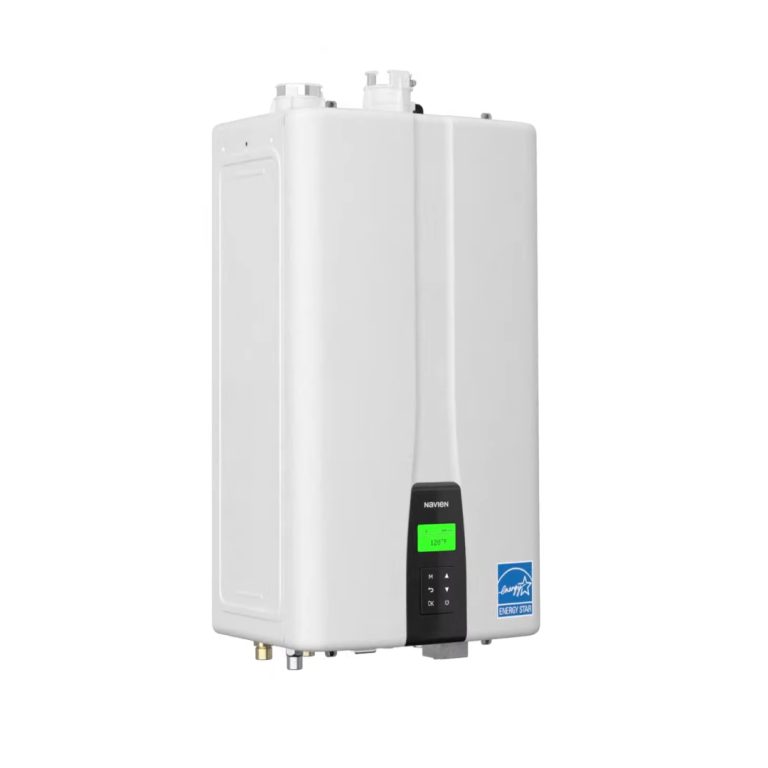
Navien Condensing Tankless Water Heater with Recirculation Pump and Buffer Tank (NPE-240A2)
Score: 9/10 — A premium condensing tankless water heater that delivers near-instant, whole-home hot water thanks to its built-in recirculation pump and ComfortFlow buffer tank, justifying its price for larger households.
Overview
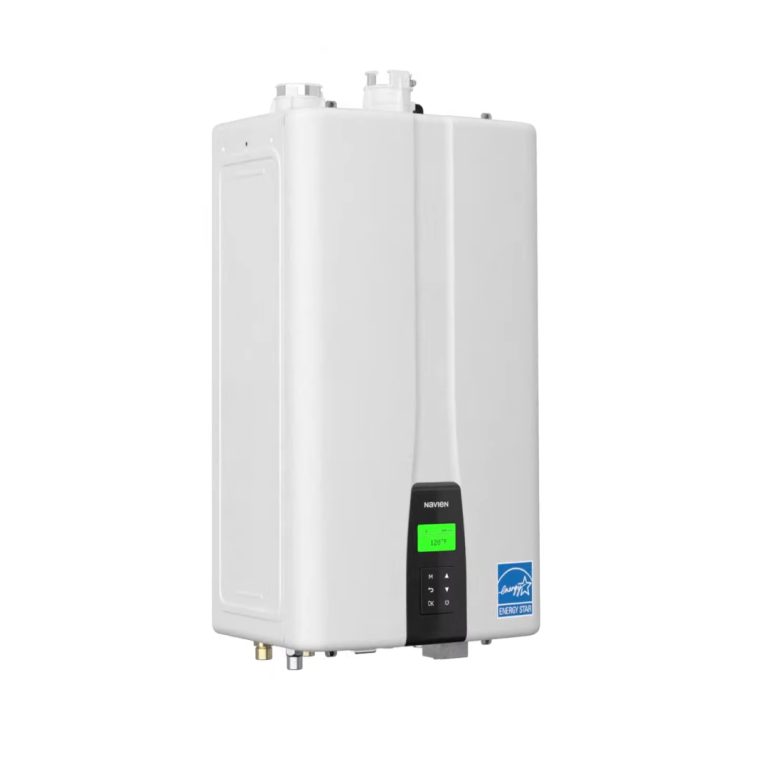
The Navien Condensing Tankless Water Heater with Recirculation Pump and Buffer Tank is one of the best high-efficiency solutions designed to eliminate wait times and provide consistent, whole-home hot water.
Unlike traditional cylinder tanks that store and reheat gallons of water throughout the day, this unit heats water on demand, utilizing high-efficiency condensing technology to extract maximum energy from the fuel source. By using dual stainless steel heat exchangers, the NPE-240A2 captures heat from the exhaust gases that would otherwise be wasted, pushing its thermal efficiency far beyond that of standard non-condensing models.What truly separates the Navien Condensing Tankless Water Heater from the crowded tankless market is its holistic approach to the "user experience." The most common complaints regarding tankless systems are the "cold water sandwich"—a pocket of cool water that occurs when the unit cycles—and the long wait for hot water to travel from the heater to a distant bathroom. Navien solves both issues by integrating a built-in recirculation pump and a ComfortFlow buffer tank. This combination ensures that a small volume of conditioned water is always primed and ready, significantly reducing the lag time at the tap.
This unit is specifically engineered for medium to large homes where multiple family members may be showering, running the dishwasher, and using kitchen taps simultaneously. Its flexibility in installation, including compatibility with both ½-inch and ¾-inch gas lines, makes it an attractive option for both new constructions and retrofits of existing homes. For those with extreme demands, the system's cascading capability allows multiple units to be linked, providing a scalable solution that can grow with the household's needs.
Key Features
The condensing design recaptures exhaust heat for industry-leading thermal efficiency while the stainless steel construction ensures long-term corrosion resistance.
Actively reduces wait times by circulating hot water through the plumbing loops, ensuring hot water is available almost immediately upon opening a faucet.
An internal reserve that stabilizes temperature fluctuations and eliminates the "cold water sandwich" effect during intermittent water draws.
Engineered to work with both ½-inch and ¾-inch gas lines, reducing the need for expensive pipe upgrades during installation in many homes.
Allows the linkage of multiple NPE-240A2 units to increase total flow capacity for oversized homes or light commercial applications.
A sophisticated on-unit panel allowing homeowners and technicians to precisely set temperatures and monitor system health.
| Feature | Value |
|---|---|
| Model | NPE-240A2 |
| Type | Condensing Tankless Water Heater |
| Heat Exchangers | Dual Stainless Steel |
| Recirculation Pump | Integrated/Built-in |
| Buffer Tank | ComfortFlow (Integrated) |
| Gas Line Compatibility | ½-inch and ¾-inch |
| Cascading Support | Yes |
| Control Interface | Digital LCD/Push-button |
| Application | Whole-home high-demand delivery |
Pros & Cons
Pros
- Extreme thermal efficiency via condensing technology
- Rapid hot water delivery via integrated recirculation
- Buffer tank eliminates temperature dips (cold water sandwich)
- Highly flexible gas line requirements for easier install
- Scalable via cascading for massive flow requirements
- Stainless steel build ensures longevity and rust resistance
Cons
- Significantly higher initial purchase price than basic units
- Requires professional installation and condensate drainage
- Complex venting requirements due to condensing nature
- Excessive capacity for very small apartments or cottages
Performance Analysis
In real-world residential environments, the Navien NPE-240A2 excels in "stress-test" scenarios. Most tankless heaters struggle when multiple high-flow fixtures are engaged simultaneously—for example, a master shower running while a child takes a bath in another room. In these instances, standard units often drop the temperature or reduce the flow rate to compensate. The NPE-240A2, however, leverages its high BTU output and the stabilizing effect of the ComfortFlow buffer tank to maintain a consistent temperature across all outlets.
The recirculation pump is the standout feature for daily convenience. In a typical tankless setup, if your water heater is in the garage and your master bath is at the opposite end of the house, you might wait 60 to 90 seconds for hot water. With the NPE-240A2's recirculation active, that wait is slashed to a few seconds. This not only improves the luxury of the home but also significantly reduces water waste, as gallons of cold water no longer need to be flushed down the drain every time a tap is turned on.
From a thermal perspective, the condensing technology is highly effective. By recapturing the latent heat from the water vapor in the exhaust, the unit operates with a much higher efficiency rating than non-condensing alternatives. While this does mean the unit produces acidic condensate that must be drained, the trade-off is lower monthly gas bills and a smaller carbon footprint for the home.
In-Depth: How the NPE-240A2 Works
To understand why the Navien NPE-240A2 is priced as a premium product, it is helpful to look at the mechanical engineering inside the chassis. Most tankless heaters use a single heat exchanger. When cold water enters, the burner ignites, and the water is heated as it passes through the exchanger. The heat that isn't absorbed by the water escapes through the vent. The NPE-240A2 departs from this basic design through three primary innovations:
The Condensing Process: This works by adding a second heat exchanger. The exhaust gases from the first stage are passed through this second exchanger, which cools the gases further. This causes the water vapor in the exhaust to condense into liquid water (condensate). This process releases additional energy, which is then used to pre-heat the incoming cold water. This "double-dip" of energy is what drives the unit's high efficiency. Because the exhaust is cooler, the venting can be made of plastics like PVC, which are cheaper and easier to install than metal flues, though they require a specific installation method to handle the condensation.
The ComfortFlow Buffer Tank: This serves as a thermal reservoir. One of the primary weaknesses of tankless systems is the "cold water sandwich." This happens when the unit shuts off, a pocket of cold water enters the heat exchanger, and then the unit fires up again. When you turn the tap back on, you get hot water, then a burst of cold, then hot again. The buffer tank holds a small amount of hot water that is constantly circulated, acting as a bridge to ensure the flow remains thermally consistent. It effectively "masks" the transition between the dormant state and the active heating state.
The Recirculation Pump: This works in tandem with the home's plumbing. It can be configured to push hot water back from the furthest fixture in the house to the heater. By keeping the water in the pipes warm, the "dead leg" of cold water is eliminated, providing that "instant-on" feel that was previously only possible with massive, inefficient storage tanks. This is achieved through a smart pump that can be programmed based on the household's typical wake-up and bedtime routines, preventing the pump from running 24/7 and wasting energy. The pump's logic ensures that it only moves water when necessary, balancing convenience with efficiency.
Installation and Setup Guide
Installing the Navien NPE-240A2 is a complex task that should be handled by a licensed HVAC or plumbing professional. Because it is a condensing unit, the setup requires more than just a gas line and a water pipe; it requires a comprehensive approach to venting and drainage.
Gas Line Requirements
One of the biggest advantages of the NPE-240A2 is its flexibility with gas lines. Many high-output tankless heaters require a 3/4-inch gas line to provide enough BTUs to reach maximum flow. If a home only has 1/2-inch piping, the homeowner would typically face a massive bill to rip out and replace the gas lines. The NPE-240A2 is designed to operate efficiently on both, though a 3/4-inch line will always provide the best performance during peak demand. (If modifying pipes, a SharkBite 1/2-inch coupling can simplify the process; see our full buying guide for more details). This flexibility reduces the installation friction significantly for older homes where upgrading gas mains is prohibitively expensive. However, a professional must still calculate the total BTU load to ensure the gas pressure remains stable during peak operation.
Venting and Condensate Management
Because this is a condensing unit, the exhaust is cooler and more moist than a standard heater. It requires specialized venting materials (typically PVC or polypropylene) rather than traditional metal flues. Furthermore, the process of condensing water vapor creates a mildly acidic liquid. The unit must be installed with a condensate neutralizer—a small canister filled with neutralizing pellets—and a proper drain line to ensure the acidic water doesn't erode the home's plumbing or damage the garage floor. Failure to install a neutralizer can lead to long-term structural damage to PVC pipes in some jurisdictions. The slope of the condensate drain is critical; if it is not pitched correctly, the unit may trigger an error and shut down to prevent internal flooding.
Electrical and Controls
The unit requires a standard 120V electrical connection to power the digital controls and the recirculation pump. Once powered, the digital interface allows the user to set the specific target temperature. This is a major upgrade over traditional tanks, where you are often fighting against a thermostat that is imprecise. With the NPE-240A2, if you want your water at exactly 120°F, the unit will deliver exactly that. The control panel also provides diagnostic codes, allowing technicians to quickly identify if the unit requires a descaling flush or if there is an ignition failure. Homeowners can also program the recirculation schedules directly from this interface.
Long-Term Maintenance and Care
To keep the Navien NPE-240A2 running at peak efficiency, a proactive maintenance schedule is essential. Tankless heaters are more susceptible to scale buildup than tank heaters, especially in homes with "hard water" (high mineral content). To protect your system and plumbing, consider a GE GXWH40L whole house water filter (see our whole house filtration guide) or explore our Culligan whole-house filtration guide to reduce mineral intake before the water even reaches the unit.
Descaling and Flushing
Mineral deposits (calcium and magnesium) can accumulate on the interior walls of the stainless steel heat exchangers. Over time, this creates an insulating layer that forces the unit to work harder to heat the water, eventually reducing efficiency and potentially causing the unit to throw an error code. A professional "flush" using a food-grade descaling solution should be performed every 12 to 24 months, depending on water hardness. This process involves pumping a cleaning solution through the unit for several hours to dissolve mineral deposits. Navien units often have a built-in descaling mode that simplifies this process for the technician.
Filter Cleaning
The unit features an inlet water filter that catches sediment and debris before they can enter the heat exchangers. This filter should be checked and cleaned periodically to ensure the flow rate remains high and the internal components are protected from particulate damage. A clogged filter can lead to a noticeable drop in water pressure throughout the home. If you live in an area with high sediment in the municipal water supply, cleaning this filter quarterly may be necessary.
Checking the Condensate Trap
The condensate trap can occasionally become clogged with debris or biological growth. Ensuring the trap is clear is critical; if the condensate cannot drain, the unit may shut down as a safety precaution to prevent water from backing up into the combustion chamber. Homeowners should periodically inspect the drain line for leaks or blockages. In freezing climates, the condensate drain must be properly insulated or routed to prevent the liquid from freezing and blocking the line, which would cause the unit to fail during the coldest winter days.
Buyer's Guide: Is the NPE-240A2 Right for You?
Choosing a water heater is no longer just about capacity; it is about the specific needs of your home's architecture and your family's habits. The Navien NPE-240A2 is a high-end machine, and for some, it may be overkill. For others, it is the only logical choice.
Scenario A: The Large Family Home
If you have 3+ bathrooms and a family that tends to use water simultaneously (e.g., someone showering while the dishwasher is running and another person is washing hands), the NPE-240A2 is an ideal fit. Its high BTU output and the buffer tank ensure that no one experiences a sudden drop in temperature. The recirculation pump is a luxury that becomes a necessity in homes where the water heater is located far from the primary bathrooms.
Scenario B: The Eco-Conscious Homeowner
If your primary goal is reducing your carbon footprint and lowering monthly utility bills, the condensing technology is a major draw. By capturing heat from the exhaust, you are essentially getting "free" energy that would otherwise be vented out of the house. While the upfront cost is higher, the long-term savings on gas can make this a financially sound investment over a 10-year period.
Scenario C: The Small Apartment or Cottage
For a small 1-bedroom apartment or a tiny home, the NPE-240A2 is likely excessive.
For low-demand households, a basic model like the Stiebel Eltron Whole-House Electric Tankless Water Heater 36kW is a more cost-effective alternative without a recirculation pump and is easier to install.
The added complexity of condensate drainage and the higher price point wouldn't provide a proportional increase in quality of life for a low-demand household.Comparing the NPE-240A2 to Standard Tankless Units
To truly understand the value proposition, we must compare the NPE-240A2 against "standard" tankless models (non-condensing, no pump).
| Feature | Standard Tankless | Navien NPE-240A2 |
|---|---|---|
| Efficiency | Moderate (80-85%) | Extreme (up to 95%+) |
| Wait Time | Long (depends on distance) | Near-Instant (Recirculation) |
| Temp Stability | Occasional "Cold Sandwiches" | Stable (Buffer Tank) |
| Venting | Metal/High Heat | PVC/Polypropylene (Lower Heat) |
| Cost | Budget-Friendly | Premium Investment |
| Installation | Simple | Complex (Drainage required) |
The transition from a standard unit (such as the A.O. Smith EES-40 electric model) to the NPE-240A2 is effectively a transition from a