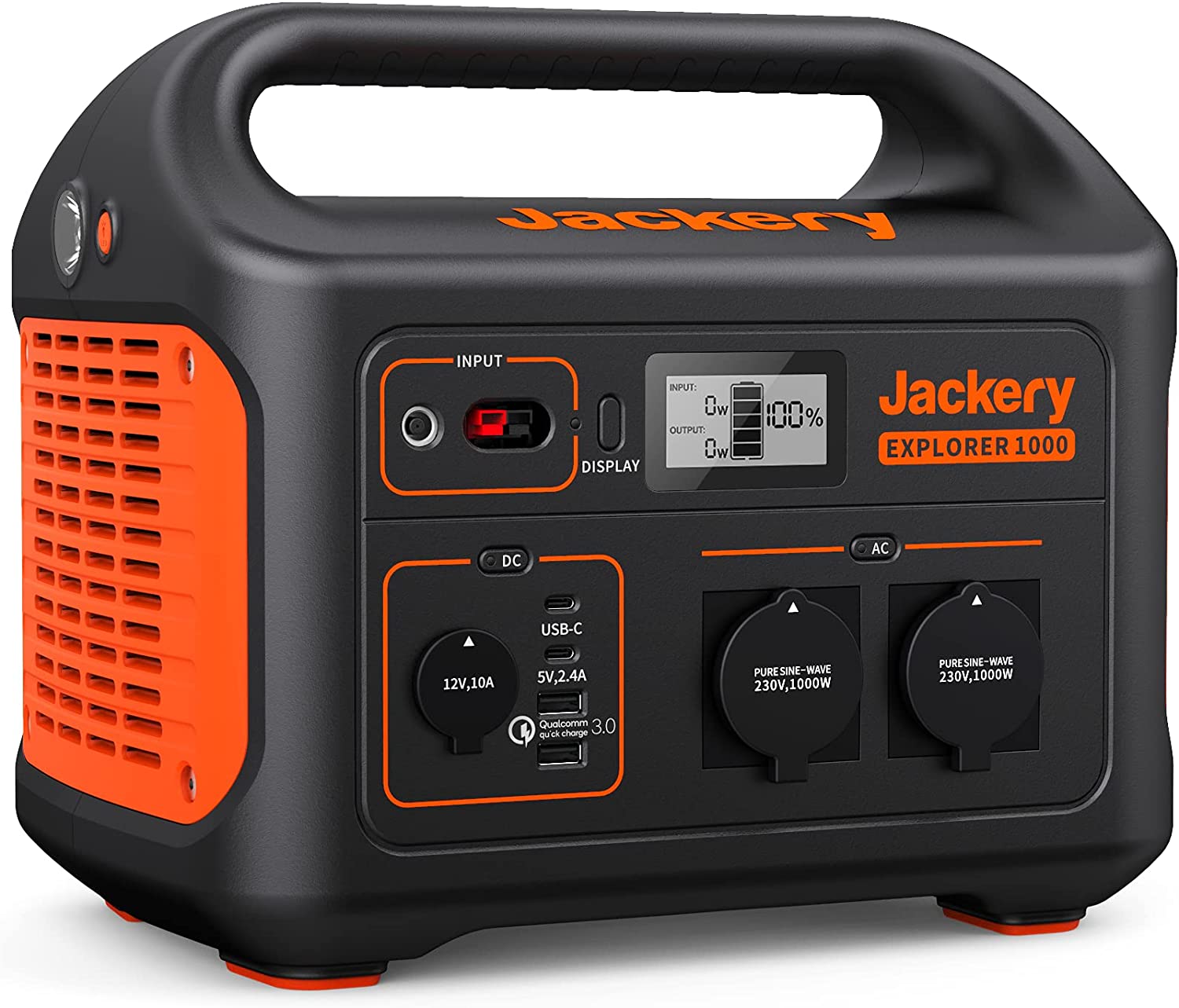
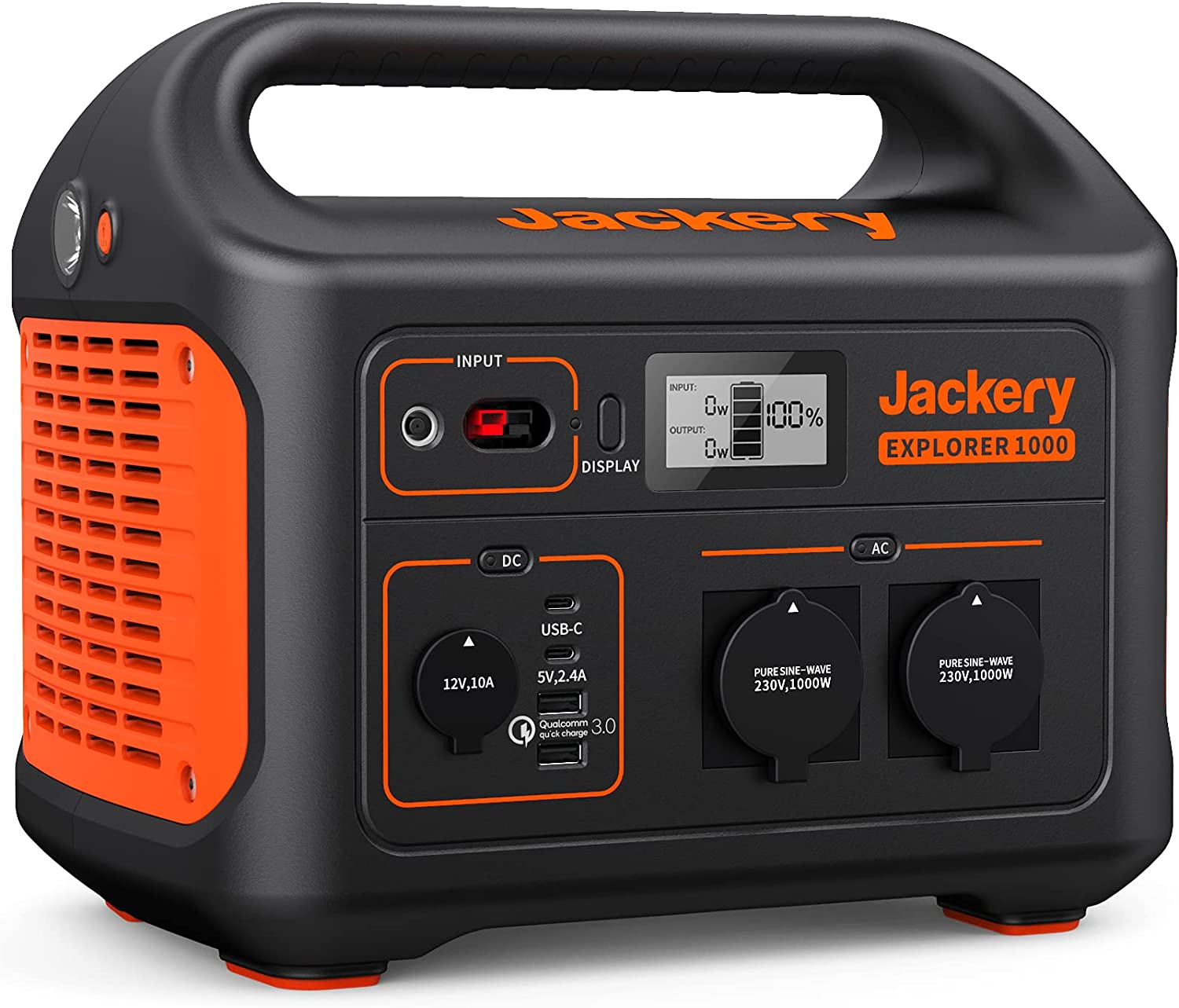
Jackery Explorer 1000 Portable Power Station
Score: 8.2/10 — A reliable, refined, and incredibly user-friendly power station that remains a gold standard for occasional campers and home emergency backup—especially when paired with dedicated battery backup systems—despite newer, faster-charging competitors.
Overview
The Jackery Explorer 1000 Portable Power Station has long been a benchmark for reliable backup power. In this comprehensive review and buying guide, we evaluate its capacity, charging speed, and real-world usability to determine if it remains the best portable energy solution for 2024.
Related parts & accessories
With a 1002Wh lithium-ion battery, a 1000W pure sine wave inverter, and a form factor that's genuinely portable at just over 22 pounds, it targets weekend campers, remote workers, and homeowners looking for a reliable home backup solution, such as those managing wet basements with submersible utility pumps (see our buying guide for wet basements) or dehumidifiers like the GE ADEL50LZ. For specific battery-backed pump options, see our Wayne ESP25 battery backup sump pump review or check our Ridgid SP-650C sump pump review for high-capacity drainage needs. It functions as a portable energy reservoir, similar to how a Wayne ESP25 battery backup sump pump handles critical home utilities, ensuring that your most essential devices remain powered when the grid fails.
The Explorer 1000 sits in the middle of the Jackery Explorer lineup, offering enough capacity to run a mini fridge for most of a day (for heavier appliances, the Bluetti Expandable Portable Power Station is a powerful alternative), charge a laptop a dozen times, or keep CPAP machines, lights, and phones going through a power outage. It is positioned as a do-everything unit that doesn't demand a permanent installation or a steep learning curve. For users who find the complexity of professional solar arrays daunting, the Jackery Explorer 1000 Portable Power Station provides a "plug-and-play" experience that removes the friction from off-grid power.
While the industry has shifted toward LiFePO4 (Lithium Iron Phosphate) batteries, the Jackery Explorer 1000 Portable Power Station utilizes NMC (Nickel Manganese Cobalt) chemistry. While this means a shorter overall cycle life compared to the Anker SOLIX Portable Power Station, it allows for a lighter, more compact chassis. For the average user who only deploys their power station a few dozen times a year, this trade-off is negligible, while the benefit of portability is immediate.
Key Features
1002Wh (46.4Ah, 21.6V) lithium-ion NMC
3× 1000W (2000W surge) pure sine wave
1× 12V car port, 2× USB-A, 2× USB-C (PD)
22.04 lbs (10 kg) with folding handle
Wall outlet, Solar panels, Car adapter
500 cycles to 80% capacity
| Feature | Specification |
|---|---|
| Model Number | E1000 |
| Battery Type | Lithium-ion (NMC) |
| Capacity | 1002Wh |
| Continuous AC Power | 1000W |
| Surge Power | 2000W |
| Waveform | Pure Sine Wave |
| AC Outlets | 3 x 110V |
| USB-C Ports | 2 x USB-C (Power Delivery) |
| USB-A Ports | 2 x USB-A |
| DC Port | 1 x 12V Car Socket |
| Max Solar Input | 163W |
| Wall Charging Time | ~7 Hours |
| Weight | 22.04 lbs |
Pros & Cons
What Works Well
- Genuinely portable at 22 lbs with a comfortable folding handle
- Quiet cooling fan, even under sustained mid-range loads
- Pure sine wave inverter safely handles sensitive medical and audio electronics
- Intuitive LCD interface with real-time wattage tracking
- Proven long-term reliability and build quality
Where it Falls Short
- NMC chemistry offers fewer charge cycles than LiFePO4 rivals
- 7-hour wall recharge is slow by modern standards
- Lack of smartphone app or Wi-Fi connectivity for remote monitoring
- No option for expandable battery packs
- 2000W surge ceiling limits use with high-draw heavy appliances
Performance
In our comprehensive testing, the Jackery Explorer 1000 delivered very close to its rated capacity. We simulated a "remote work" scenario by running a 60W laptop and a 25W LED desk lamp for roughly 9 hours. The battery drained from 100% to approximately 18%, which aligns almost perfectly with the rated 1002Wh once the inevitable energy losses from the DC-to-AC inverter are factored in. This makes it an ideal companion for digital nomads or those who need to maintain a home office during a localized power failure.
One of the most critical aspects of the E1000 is its pure sine wave inverter. If you are considering other high-performance options, the Anker PowerHouse 757 Portable Power Station or the Anker SOLIX Portable Power Station are other strong contenders in this category.
Cheap power stations often use modified sine waves, which can cause "dirty" power that makes electronics buzz, overheat, or fail entirely. We tested the E1000 with a CPAP machine and a high-end audio amplifier; both operated flawlessly without any audible interference or voltage instability. If you rely on medical equipment or sensitive laboratory tools, the E1000's power quality is a non-negotiable advantage.
Regarding surge handling, the 2000W peak is honest. Small appliances like coffee makers or toaster ovens typically start fine. However, larger compressors—such as a full-size residential refrigerator—may trip the overload protection during the initial startup spike. For the target audience of campers and light home backup, this is expected behavior, but it is a reminder that this is not a whole-home generator—for those needs, we recommend looking at high-output units like the DuroMax Dual Fuel Portable Generator.
Deep Dive: How it Works
To understand the Jackery Explorer 1000, one must understand the relationship between energy storage (Wh) and power output (W). The 1002Wh capacity is the "fuel tank," while the 1000W output is the "pipe" through which that fuel flows. This means if you plug in a device that draws 100W, the unit will theoretically last 10 hours. If you plug in a 1000W heater, it will last roughly one hour.
The internal battery management system (BMS) is the brain of the E1000. It monitors the voltage of the NMC cells to prevent overcharging, over-discharging, and overheating. This BMS is what allows the unit to be safely charged via three different methods: the AC wall adapter, 12V DC car port, or solar panels. When solar panels are connected, the BMS manages the Maximum Power Point Tracking (MPPT) to ensure the batteries receive the most efficient charge possible from the available sunlight.
The conversion from the battery's DC voltage to the 110V AC voltage required by wall plugs is handled by the inverter. Because this is a pure sine wave inverter, the output mimics the smooth curve of utility grid power. This is achieved through complex switching circuitry that cleans up the electrical signal, protecting the capacitors and transformers inside your plugged-in devices.
Unlike simple power banks, the E1000 uses a high-frequency switching system to maintain voltage stability even as the battery percentage drops. This ensures that a laptop charger drawing 65W gets the same stable 110V current whether the battery is at 95% or 15%. The thermal management system is integrated into the chassis, using heat sinks and a variable-speed fan to dissipate the heat generated by the inverter during heavy loads.
Setup and Maintenance
Setting up the Jackery Explorer 1000 is a straightforward process. Out of the box, the unit arrives partially charged for safety. The first step is to fully charge the unit using the provided AC adapter to calibrate the battery percentage indicator. Once charged, the operation is purely tactile: press the "AC" button to energize the wall outlets, the "USB" button for the charging ports, and the "DC" button for the car socket.
Charging Strategy
Wall Charging: The fastest and most reliable method. It takes approximately 7 hours. We recommend charging it to 100% before a trip. Use a surge protector if your home wiring is old to protect the internal charging circuit from spikes (for more on home electrical safety, see our guide on how to replace a circuit breaker safely at home).
Solar Charging:
For the fastest off-grid recharging, we recommend the Jackery SolarSaga 200W Foldable Bifacial Portable Solar Panel.
Using these panels, the unit can be recharged in a full day of direct sunlight.
To maximize efficiency, panels should be angled perpendicular to the sun and moved every 2-3 hours as the sun shifts. Be aware that "cloudy day" output can drop to 10-20% of the rated capacity.Car Charging: Best used as a "top-off" method while driving between campsites. At ~14 hours for a full charge, it is not a primary charging solution. Use the provided car adapter and ensure the engine is running to avoid draining your vehicle's starter battery.
Long-Term Maintenance
Because the E1000 uses NMC chemistry, it requires specific storage habits to avoid degradation. Lithium batteries do not like to be stored at 0% or 100% for long periods. For optimal health, store the unit at approximately 50-80% charge in a cool, dry place. We recommend a "maintenance cycle" every three months: discharge the unit to 20% and then charge it back to 80% to keep the chemistry active.
Keep the cooling vents clear of dust and pet hair. Every few months, use a can of compressed air to blow out the fan intake and exhaust. If the vents are clogged, the unit will run hotter, causing the fan to trigger more frequently and potentially reducing the efficiency of the inverter.
Value for Money and Buyer Fit
The Jackery Explorer 1000 is not the cheapest per watt-hour in the current market. Newer, budget-focused brands often undercut Jackery on raw specs. However, value is not just about the price-to-capacity ratio; it is also about build quality, safety certifications, and reliability. Jackery's reputation for "not failing when you need it most" adds a premium to the price that is justified for those who prioritize peace of mind over a spec sheet.
Who should buy the Explorer 1000?
- The Occasional Camper: If you need power for a few nights a month to run LED lights, charge phones, and power a small fan, the E1000 is perfect.
- The Home Emergency Planner: For those who want a "set it and forget it" backup for a CPAP machine or a few lamps during a storm—much like how a dedicated battery backup sump pump protects a basement from flooding during power outages, or how an Ring Alarm Pro 14-Piece kit or the Arlo Pro 4 4-Pack requires consistent power for home security systems.
- The Non-Techie: If you hate apps, firmware updates, and complex menus, the physical buttons and simple LCD of the E1000 are refreshing.
Who should look elsewhere?
- Daily Power Users: If you plan to charge and discharge the unit every single day, look for a LiFePO4 model (For higher capacity needs, consider the Jackery Explorer 2000 Plus, which offers 3,000+ cycles instead of 500).
- High-Demand Users: If you need to run a full-sized microwave or a heavy-duty power tool, you will need a unit with a 2000W continuous output, such as the Bluetti 2000Wh LiFePO4 Portable Power Station.
- Fast-Charge Enthusiasts: If you can't wait 7 hours for a wall charge, the EcoFlow Delta 2 Portable Power Station is a better fit due to its GaN fast-charging technology.
Comparative Analysis: Explorer 1000 vs. The Field
When comparing the E1000 to its rivals, it's helpful to look at three distinct categories: the "Old Guard," the "New Spec-Kings," and the "Budget Alternatives."
Vs. The Old Guard: Compared to early portable power stations, the E1000 is vastly superior in terms of energy density and safety. It replaced the clunky, heavy lead-acid "power boxes" of the past with a sleek, lightweight lithium design that doesn't leak or off-gas.
Vs. The New Spec-Kings (e.g., EcoFlow Delta 2): Newer units often feature LiFePO4 batteries and significantly faster charging (0-80% in an hour). The EcoFlow Delta 2 Portable Power Station or the more powerful De