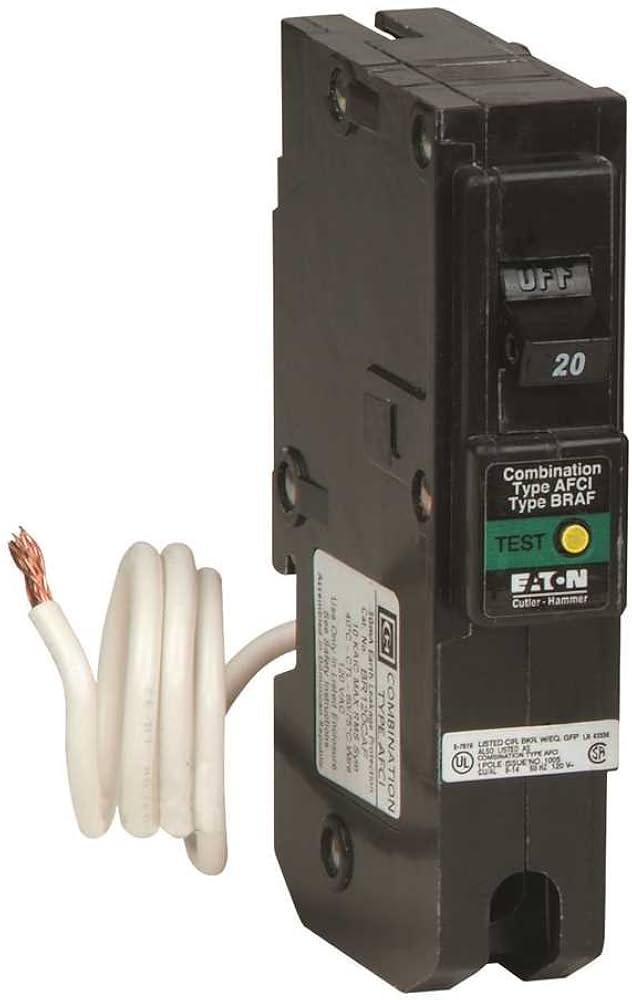
Upgrading your residential electrical panel to meet modern safety standards requires precision and the right hardware. If you are updating an Eaton 200-Amp 30-Space 40-Circuit Indoor Main Breaker Load Center to meet NEC safety codes and need to protect bedroom or living area circuits from dangerous electrical arcs, the Eaton Single-Pole Combination AFCI Circuit Breaker 15-Amp (BRCAF115) is the industry-standard solution for meeting strict National Electrical Code (NEC) requirements. Understanding the difference between AFCI vs standard circuit breakers is key to ensuring your home's safety for meeting strict National Electrical Code (NEC) requirements in residential bedrooms and living areas. This Eaton BRCAF115 buying guide explores the technical specifications, installation nuances, and safety benefits of this 15-amp combination AFCI breaker. For a deeper dive into real-world performance, testing benchmarks, and installation pros and cons, see our detailed Eaton BRCAF115 review and performance benchmarks.
Best Overall 15-Amp AFCI for BR Panels
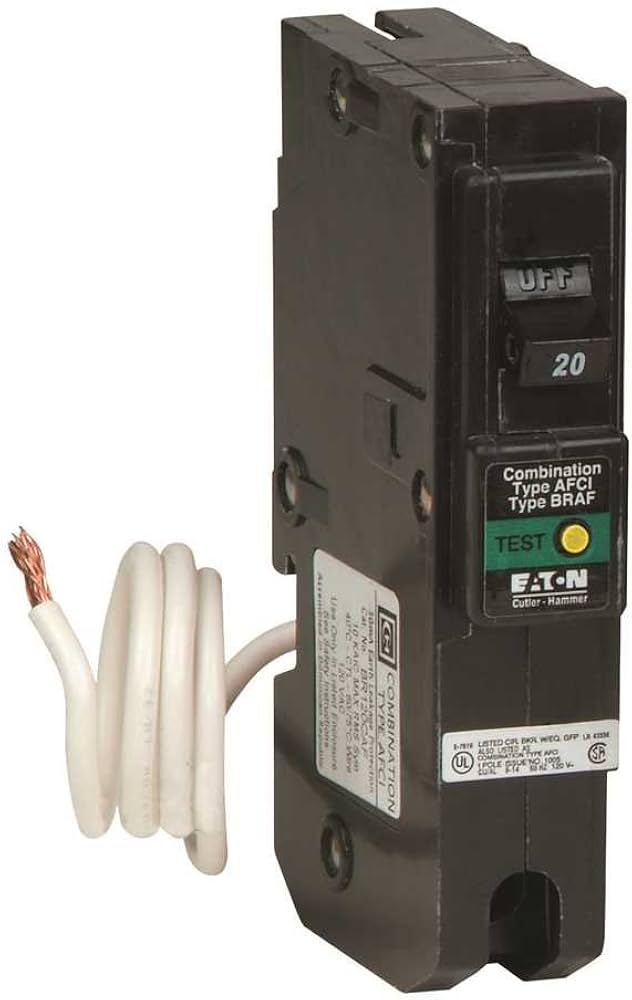
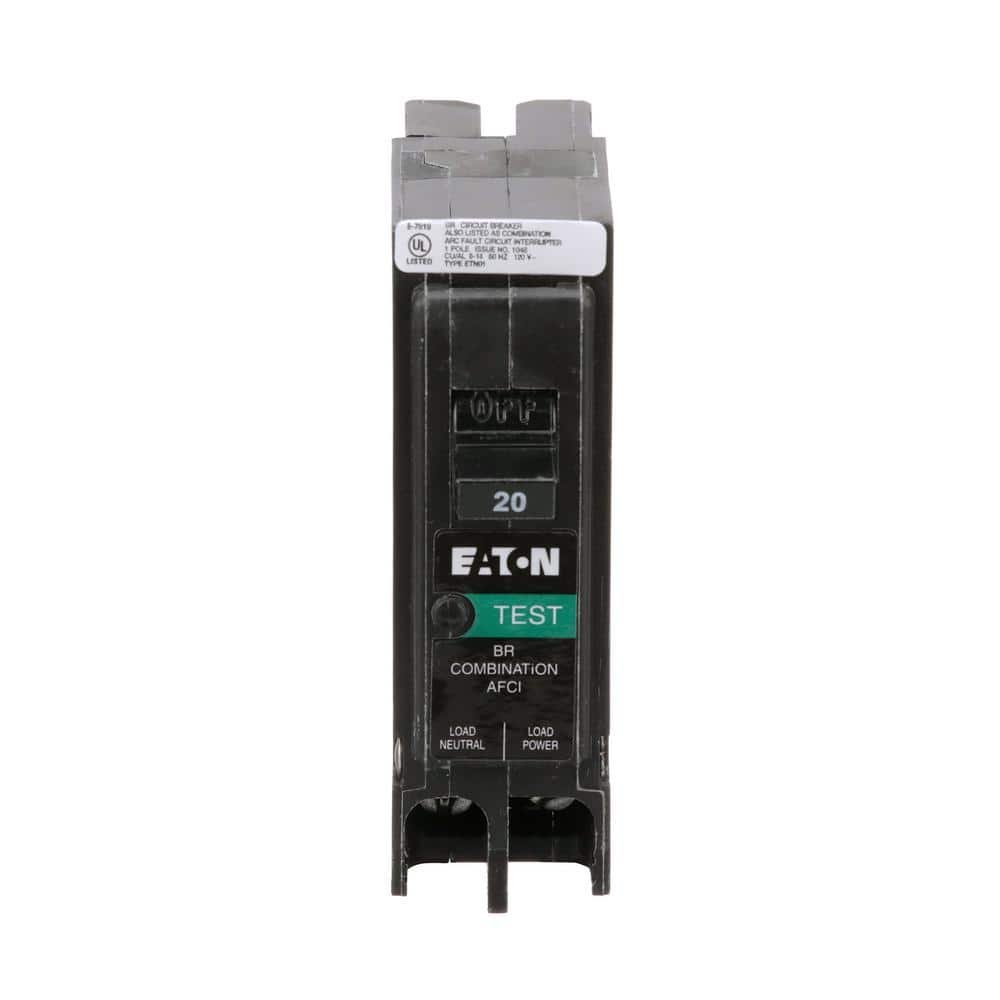
Score: 9/10. A strong buy for compatible Eaton BR panels when you need an Eaton Single-Pole Combination AFCI Circuit Breaker 15-Amp with arc-fault protection, a test button, and a trip indicator.
Eaton Single-Pole Combination AFCI Circuit Breaker 15-Amp
The Eaton Single-Pole Combination AFCI Circuit Breaker 15-Amp is engineered specifically for residential branch-circuit protection within the Eaton 200-Amp 30-Space 40-Circuit Indoor Main Breaker Load Center.
Unlike traditional thermal-magnetic breakers that only trip during a massive overcurrent or a dead short, this device is an active electronic monitor. Its primary objective is to identify and interrupt "arc-fault" conditions—small, high-temperature sparks that can ignite structural materials long before a standard breaker ever notices a problem.
The BRCAF115 model is a combination AFCI, meaning it is designed to detect both series and parallel arcs. For those managing wider home security and safety envelopes, integrating these breakers alongside systems like the ADT Self Setup 9-Piece Security Kit ensures a comprehensive approach to residential protection, including securing your perimeter with a SimpliSafe security system. This capability makes it indispensable for meeting NEC 2014 and subsequent electrical codes, which mandate AFCI protection in most living areas, including bedrooms, family rooms, and hallways. By utilizing advanced digital signal processing, the breaker can distinguish between the "normal" arc of a vacuum cleaner motor or a light switch and the "dangerous" arc of a frayed wire or a loose connection.
From a usability perspective, the BRCAF115 is designed for quick diagnostics. It features a prominent test button that allows homeowners or electricians to verify the internal circuitry is operational without needing external testing equipment. Additionally, the integrated trip indicator provides a clear visual cue when the breaker has tripped, significantly reducing the time spent troubleshooting "dead" outlets during a power failure or fault event.
This breaker is the ideal choice for users who are performing a permitted remodel, adding new circuitry to an existing BR panel, or proactively upgrading their home's fire safety. It is specifically tuned for 120-volt residential circuits and is best paired with 14-gauge copper wiring. Because it is a single-pole device, it occupies one slot in the panel and provides a dedicated safety layer for the specific circuit it controls.
Pros
- Provides combination AFCI protection for both series and parallel arc faults
- Designed specifically for Eaton BR load centers
- 15-amp rating suits many common residential lighting and receptacle circuits
- Built-in test button makes function checks straightforward
- Trip indicator helps with faster fault identification
- Good fit for code-related residential panel upgrades and remodels
Cons
- Not a universal breaker for every electrical panel
- Does not replace the need to diagnose wiring or device issues that cause trips
- Not the right choice if the circuit requires GFCI or dual-function AFCI/GFCI protection
- Installation should be handled by a qualified person familiar with panel work
This guide provides technical analysis and product recommendations based on manufacturer specifications. Commission may be earned on qualifying purchases.
| Spec | Eaton BRCAF115 |
|---|---|
| Catalog Product | Eaton Single-Pole Combination AFCI Circuit Breaker 15-Amp |
| Model Number | BRCAF115 |
| Breaker Type | Combination AFCI circuit breaker |
| Poles | Single-pole |
| Amperage | 15 amps |
| Primary Protection | Series and parallel arc-fault detection |
| Panel Compatibility | Designed for Eaton BR load centers |
| Key Features | Test button and trip indicator |
| Category | Read the full Eaton BRCAF115 Review |
Understanding AFCI Technology: How it Works
To appreciate the value of the Eaton Single-Pole Combination AFCI Circuit Breaker 15-Amp (and the general difference between AFCI vs standard circuit breakers), one must understand the physics of electrical arcing. For a high-level overview, see our comparison of AFCI vs standard circuit breakers. A standard circuit breaker is essentially a "dumb" switch; it reacts to heat (thermal) or massive magnetic surges (magnetic). If a wire is overloaded, the strip inside the breaker heats up and bends, tripping the switch. If there is a direct short-circuit, the magnetic field spikes and trips the switch. However, an arc fault is different. An arc is a discharge of electricity across a gap in a conductor or between two conductors.
Arcs create localized, intense heat—often exceeding several thousand degrees Celsius—which can easily ignite wood, drywall, or insulation. The terrifying part of arc faults is that they often do not draw enough total current to trip a standard 15-amp breaker. For example, a loose wire nut in a ceiling box might spark intermittently, heating the surrounding plastic and wood, while the actual current draw remains at a mere 2 or 3 amps. To a standard breaker, this looks like a normal lamp being left on. To an AFCI breaker like the BRCAF115, this is a catastrophic fire risk.
The BRCAF115 uses "Combination" technology to solve this. This means it monitors the current waveform with high-speed digital processing to identify two specific types of dangerous arcs:
Parallel Arcs: These occur when electricity jumps between two separate conductors, such as a hot wire and a neutral wire. This typically happens when the insulation on the wires is compromised—perhaps by a nail driven through a wall during a picture-hanging project or by rodent damage in the attic. The BRCAF115 detects the specific "noise" or signature of this jump and cuts power in milliseconds.
Series Arcs: These occur along a single conductor. Imagine a lamp cord that has been pinched by a heavy dresser for years. Eventually, some of the copper strands break, leaving only a few thin wires carrying the full load. The electricity "arcs" across the break in the wire. This creates a pinpoint of intense heat. Because the total current is still within the 15-amp limit, a standard breaker will never trip. The BRCAF115, however, recognizes the distorted waveform of a series arc and trips immediately.
Modern combination AFCI breakers are significantly more refined than early versions. Early AFCI models were notorious for "nuisance tripping," where the breaker would trip due to the normal sparking of a vacuum cleaner motor or a dimmer switch. The BRCAF115 employs advanced filtering to differentiate between "benign" arcs (like the ones inside a switch) and "hazardous" arcs (the ones that cause house fires), providing a balance of high safety and operational stability.
Detailed Buyer's Guide: Is the BRCAF115 Right for You?
Selecting a circuit breaker is not a generic purchase; it is a critical safety decision that must align with your home's specific infrastructure and local legal requirements. To determine if the Eaton BRCAF115 is the correct part for your application, you must verify these four pillars of compatibility.
1. Panel Compatibility (The "BR" Standard)
The most common mistake in breaker purchasing is ignoring the panel series. If you are undecided on hardware brands, compare Square D vs Eaton circuit breakers to see which brand is better for your specific panel needs. The BRCAF115 is designed specifically for Eaton BR-type panels (such as the Eaton 200-Amp 30-Space 40-Circuit Indoor Main Breaker Load Center). Eaton manufactures several different families of load centers, including the CH (Class Hain) series. While both might be Eaton products, a BR breaker will not physically fit or electrically lock into a CH panel. Attempting to force a BR breaker into a CH panel—or vice versa—can result in poor electrical contact, leading to overheating and potential fire hazards. Before purchasing, open your panel door and look for the labeling. If it says "BR" or "BR-Type," this is the correct hardware. If you are replacing the entire panel, consider a high-capacity option like the Eaton 200-Amp 30-Space 40-Circuit Indoor Main Breaker Load Center for future-proofing.
2. Amperage Rating (15 Amps)
The BRCAF115 is rated for 15 amps. In standard residential electrical design, a 15-amp breaker is paired with 14-gauge copper wire (14 AWG). If your circuit is wired with 12-gauge wire (12 AWG), it was likely intended for a 20-amp load (see our guide on the best 20-amp circuit breakers for home panels). While you can put a 15-amp breaker on a 12-gauge wire, you are effectively reducing the power capacity of that circuit, which may lead to more frequent trips if you are running high-wattage devices. However, the inverse is dangerous: never install a 20-amp breaker on 14-gauge wire. The wire will overheat and melt its insulation before the breaker ever trips, creating a severe fire hazard. The BRCAF115 is the gold standard for bedrooms and living rooms where 14 AWG wiring is common.
3. Code Requirements (NEC 2014 and Beyond)
The National Electrical Code (NEC) has evolved to treat AFCI protection not as an "extra" but as a requirement. In most modern jurisdictions, AFCI protection is mandatory for almost all 120-volt branch circuits in "non-habitable" and "habitable" rooms, including bedrooms, dining rooms, and family rooms. If you are performing a permitted renovation or adding a new bedroom, your electrical inspector will likely insist on the installation of combination AFCI breakers. Even in older homes where a permit isn't being pulled, replacing old standard breakers with the BRCAF115 during a panel refresh is one of the most effective ways to modernize home fire safety, similar to how integrated systems like the ADT Self Setup 9-Piece Security Kit or the Ring Alarm Pro 14-Piece system protect the home perimeter. For those looking to secure the physical structure, we also recommend checking our Rockwool Safe 'n' Sound review for soundproofing and fire-blocking tips.
4. AFCI vs. GFCI vs. Dual Function
It is critical to distinguish between the types of "advanced" breakers. A common error is assuming that an AFCI breaker also protects against electric shock in wet areas. This is not the case.
- AFCI (BRCAF115): Focuses on Fire Prevention. It detects arcing. It is used in bedrooms and living areas.
- GFCI (Ground Fault Circuit Interrupter): Focuses on Shock Prevention. It detects current leaking to ground (e.g., through a person). It is required in bathrooms, kitchens, and outdoors.
- Dual Function (AFCI/GFCI): Does both. These are used in specific areas like kitchens or laundry rooms where both fire and shock risks are high.
If you are installing a breaker for a bathroom outlet, the BRCAF115 is not the correct choice; you need a Siemens 20-Amp Single-Pole Self-Testing GFCI Circuit Breaker (see our Siemens (Q115) Circuit Breaker Review for more details).
For those working with DC systems, see our circuit breaker safety guide. If you are installing it for a bedroom outlet, the BRCAF115 is exactly what you need.| Feature | AFCI (BRCAF115) | Standard Breaker | GFCI Breaker |
|---|---|---|---|
| Primary Goal | Fire Prevention | Overload Protection | Shock Prevention |
| Detects Arcing | Yes (Series & Parallel) | No | No |
| Detects Ground Leaks | No | No | Yes |
| Common Use Case | Bedrooms / Living Rooms | General Utility | Kitchens / Bathrooms |
| Test Button | Yes | No | Yes |
Installation and Setup Process
While professional installation is mandatory for safety (refer to our comprehensive