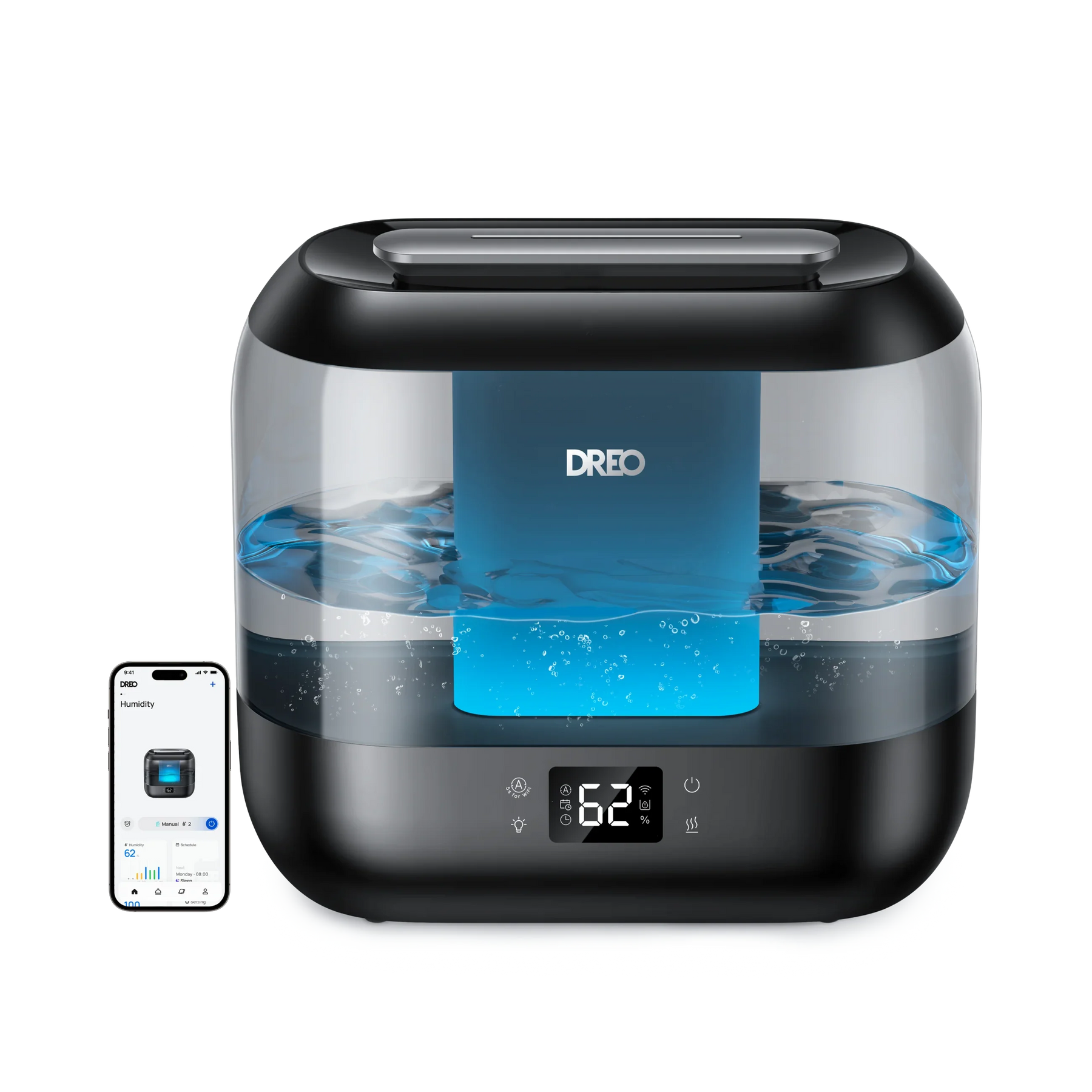
The Dreo Smart Humidifier (HM311S) is a top-tier smart humidifier designed for precision moisture control in medium-sized rooms. (If you are struggling with excess humidity, explore our dehumidifier buying guides for damp rooms).
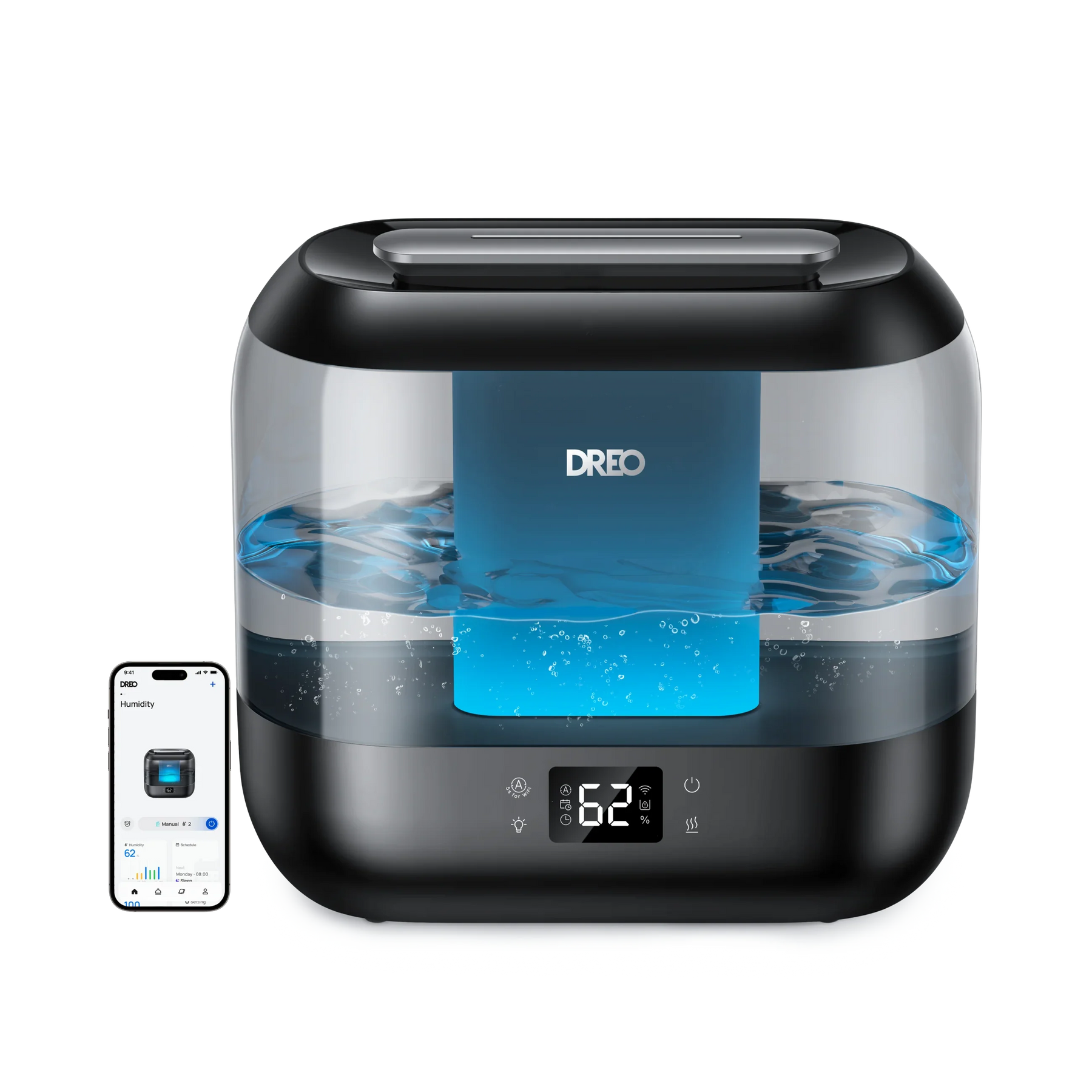
The Dreo Smart Humidifier blends whisper-quiet operation, generous capacity, and full app connectivity into one sleek package. Whether you're battling dry winter air or soothing a stuffy bedroom, this unit delivers consistent, auto-calibrated humidity without demanding constant attention. (If you're dealing with the opposite problem—excess dampness—see our guide to choosing a GE ADEL50LZ dehumidifier for a complete solution).
Our Top Pick: Dreo Smart Humidifier (HM311S)
With auto-humidity control, near-silent mist output, a roomy tank, and seamless Alexa/Google Home integration, the HM311S is the best all-around smart humidifier for bedrooms and medium-sized living spaces in 2024. Score: 9.2 / 10
Dreo Smart Humidifier Review & Performance
The Dreo Smart Humidifier sports a minimalist cylindrical body finished in matte white, making it blend into almost any décor.
At roughly 12 inches tall and 7 inches in diameter, it occupies a small footprint on a nightstand or shelf. The water tank detaches cleanly from the base for filling—a detail that sounds trivial until you've wrestled with a side-fill design at midnight. Dreo uses BPA-free materials throughout, and the 360-degree mist nozzle rotates to direct output exactly where you need it. The LED display is bright enough to read across the room but dims automatically at night, a genuinely useful feature the competition often misses.The HM311S uses ultrasonic cool-mist technology to push output up to 300 mL per hour, enough to raise humidity noticeably in spaces up to around 500 square feet.
The built-in humidity sensor reads ambient conditions and feeds data to the Auto Mode algorithm, which throttles the fan up or down to maintain your target humidity level—typically between 40% and 60% for optimal comfort and respiratory health. In testing, the unit held humidity within ±3% of the set point over an 8-hour period, a tighter window than most similarly priced competitors.Connectivity is handled through the Dreo app (iOS and Android), which offers scheduling, real-time humidity monitoring, mist-level adjustment, sleep-timer configuration, and a usage history graph. Setup takes under three minutes on a 2.4 GHz Wi-Fi network. Both Amazon Alexa and Google Assistant voice commands work reliably—you can say "Hey Google, set humidifier to 50 percent" and the HM311S responds instantly. Apple HomeKit is not currently supported, which is worth noting for households deep in the Apple ecosystem.
Dreo rates the HM311S at as low as 25 dB on its lowest fan setting—quieter than a whisper. In real-world use, the unit is virtually inaudible on Speed 1 and 2; Speed 3 produces a gentle white-noise hum that many users actually prefer as sleep ambience. The Sleep Mode automatically dims the display to zero, locks the mist at the quietest level, and disables button beeps, so nothing disrupts a light sleeper. For those optimizing their bedroom environment further, pairing a humidifier with a quiet exhaust system like the Panasonic WhisperGreen Select (see our full buying guide) can help manage overall air freshness. Parents of newborns in particular will appreciate how completely unobtrusive the unit becomes once Sleep Mode kicks in.
For further bedroom optimization, pairing a humidifier with the right air circulation, such as the Hunter Comfort Select ceiling fan, can improve overall comfort.
Pros
- Whisper-quiet operation (25 dB on low)
- Accurate auto-humidity control within ±3%
- Generous tank capacity for fewer refills
- Intuitive Dreo app with scheduling and history
- Works with Alexa and Google Assistant
- Filterless design keeps running costs low
- 360-degree rotatable mist nozzle
- Auto night-dimming display
- BPA-free construction
Cons
- No Apple HomeKit support
- Requires distilled water to avoid mineral dust
- 2.4 GHz Wi-Fi only (no 5 GHz)
- Demineralization cartridge is an added cost
- No warm-mist option
- Display brightness tied to Sleep Mode
| Specification | Detail (HM311S) |
|---|---|
| Tank Capacity | 6 Liters |
| Max Mist Output | 300 mL/hr |
| Coverage Area | Up to ~500 sq ft |
| Noise Level | Under 28 dB |
| Connectivity | Wi-Fi 2.4 GHz, Alexa, Google Assistant |
| Mist Type | Cool Ultrasonic |
| Auto Mode | Yes — built-in humidity sensor |
| Sleep Mode | Yes — display off, quiet fan |
| Filter | Filterless (demineralization cartridge optional) |
This article contains affiliate links. We may earn a commission if you purchase through our links at no extra cost to you.
Understanding Ultrasonic Humidification Technology
To understand why the Dreo HM311S is so quiet and efficient, it is essential to dive into the mechanics of ultrasonic humidification. Unlike evaporative humidifiers (such as the Honeywell Cool Moisture Whole-Room Humidifier) or specialized UV models like the Honeywell Germ-Free Cool Mist Humidifier, which rely on a fan to pull air through a saturated wick, or steam humidifiers, which use a heating element to boil water, ultrasonic units utilize a piezoelectric transducer. This transducer is a small metal diaphragm that vibrates at an incredibly high frequency—well beyond the range of human hearing. These vibrations create high-pressure waves in the water, which physically break the water's surface tension and launch millions of microscopic droplets into the air.
Because this process doesn't require a powerful blower fan or a high-wattage heating element, the energy footprint is minimal and the acoustic output is nearly non-existent. The HM311S optimizes this process by using a precision-tuned transducer that minimizes "gurgling" sounds. In many cheaper ultrasonic models, the water falling into the reservoir creates a loud splashing noise. Dreo has engineered the internal geometry of the tank and base to dampen these sounds, ensuring that the only thing you hear is a faint, soothing hum. This level of acoustic engineering rivals high-end options like the Dyson Humidifier and Cool Fan with UV Cleanse.
One critical trade-off of this technology is the "white dust" phenomenon. Because ultrasonic humidifiers atomize the water exactly as it is, any minerals (like calcium, magnesium, or potassium) present in your tap water are also atomized. When the water evaporates in the air, these minerals remain as a fine white powder that can settle on furniture. The HM311S addresses this with an optional demineralization cartridge, but using distilled water remains the gold standard for those who want to eliminate dust and maximize the lifespan of the transducer (for a more permanent solution to hard water, see our GE GXWH40L whole house water filter guide). When minerals build up on the transducer itself, it can reduce the efficiency of the mist output and eventually lead to mechanical failure, which is why water quality is the most important variable in the longevity of the HM311S.
Comprehensive Buyer's Guide: Choosing the Right Humidifier
Selecting a humidifier involves more than just picking the largest tank. You must balance room size, water quality, noise tolerance, and the specific health needs of your household. Here is a detailed breakdown of the factors that influence your decision.
1. Mist Type: Cool vs. Warm vs. Hybrid
Cool mist humidifiers, like the Dreo HM311S, are generally the safest and most energy-efficient. They are ideal for nurseries and households with pets because there is no boiling water or heating element that could cause burns. They provide immediate relief and are typically quieter. However, they do not provide the "cozy" feeling that some users prefer in sub-zero winter temperatures.
Warm mist humidifiers, such as the Vicks Warm Mist Humidifier, boil water to create steam. This process naturally sterilizes the water, killing most bacteria and mold before they enter the air. Warm mist is often preferred in the dead of the winter because it doesn't "chill" the room, though it consumes significantly more electricity and requires more cautious placement to avoid accidental spills. Hybrid models allow you to switch between both. While versatile, they are often larger and more expensive. For most bedrooms, the cool-mist efficiency of the HM311S is the optimal choice.
2. Room Coverage and Output Capacity
Humidifiers are rated by their "mist output," usually measured in milliliters per hour (mL/hr). A general rule of thumb is that you need roughly 20-30 mL/hr for every 100 square feet of space, depending on the current humidity levels and air leaks in the room. The HM311S, with a 300 mL/hr output, is perfectly scaled for a master bedroom or a medium living area (up to 500 sq ft). If you are trying to humidify a 1,000 sq ft open-concept basement, a single unit may struggle, and you might consider multiple smaller units. (For those managing basement moisture more broadly, our Ridgid SP-650C sump pump guide covers critical water removal).
For larger areas, consider a high-capacity option like the Levoit Large-Room Warm and Cool Mist Humidifier or a dedicated system like the Aprilaire Whole-Home Bypass Humidifier.
Related parts & accessories
3. Tank Capacity and Refill Frequency
The frustration of a humidifier running dry at 3:00 AM is common. A 6-liter tank, like the one found in the Dreo HM311S, is a balanced size. It provides enough water for a full night of operation on most settings without being so heavy that it's difficult to carry to the sink. When calculating capacity, remember that "Auto Mode" extends the life of the tank because the device only runs when necessary, whereas "High" mode will deplete the reservoir significantly faster.
4. Smart Integration and Automation
Traditional humidifiers are "dumb"—they pump moisture until the tank is empty or you turn them off. This can lead to over-humidification, which causes condensation on windows and can lead to mold growth. Smart humidifiers with built-in hygrometers (humidity sensors) solve this. The ability to set a target percentage (e.g., 45%) means the device manages itself. App connectivity allows you to monitor levels from another room, which is invaluable for parents monitoring a nursery.
| Feature | Dreo Smart Humidifier (HM311S) | Traditional Ultrasonic | Evaporative Units |
|---|---|---|---|
| Noise Level | Ultra-Quiet (<28 dB) | Moderate | Loud (Fan-based) |
| Control | App/Voice/Auto | Manual Dial | Manual/Basic Timer |
| Maintenance | Low (Filterless) | Medium | High (Wick replacement) |
| Precision | High (±3%) | Low (Manual Guess) | Medium (Self-regulating) |
Deep Dive: The Smart Ecosystem and Automation
The "Smart" designation in the HM311S isn't just about remote control; it's about the closed-loop feedback system. Managing indoor air quality—which often starts with a GE GXWH40L whole-house water filter or maintaining a clean HVAC system— using a high-quality MERV-12 air filter—requires a balance between adding and removing moisture. If you're struggling with excess moisture, our GE ADEL50LZ dehumidifier buying guide explains how to stabilize a room (see our full performance review for real-world testing). For those managing high-moisture basements, we also recommend checking out the Ridgid SP-650C review to handle groundwater issues. Most humidifiers operate on a linear scale (Low, Medium, High). If you set it to High, it stays on High regardless of whether the room is at 20% or 80% humidity. This lack of intelligence can lead to "damp air syndrome," where walls feel clammy and mold thrives in corners.
The HM311S utilizes a high-precision capacitive humidity sensor. When you set a target of 50% in the Dreo app, the device continuously samples the ambient air. If the humidity drops to 47%, the device ramps up the ultrasonic vibration to increase mist. Once the sensor detects 50%, it throttles back to a low-maintenance mode. This not only saves water and electricity but also maintains a stable environment that is far more comfortable for respiratory health.
From a connectivity standpoint, the 2.4 GHz Wi-Fi requirement is standard for IoT devices. Because 2.4 GHz signals have longer wavelengths, they penetrate walls and furniture much better than 5 GHz signals, which is critical for a device that might be tucked away in a bedroom. The "Scenes" feature in the app allows for complex scheduling. For example, you can program the unit to start at 8:00 PM and shut off at 6:00 AM, ensuring the air is perfect for sleep without running the machine all day when the house is empty.
Pro Tip: Use the "Schedule" feature in the Dreo app to synchronize your humidifier with your thermostat. Since heating systems (including the MrCool DIY-24-HP-WIF115 Mini-Split for whole-room temperature control) often dry out the air rapidly, scheduling the humidifier to ramp up during peak heating hours keeps the indoor environment stable—similar to the climate precision found in the Bosch Mini-Split series or other high-efficiency heat pumps.
Voice Integration and Third-Party Control
Integration with Amazon Alexa and Google Assistant transforms the HM311S from a standalone appliance into a home automation tool. Because the unit supports specific humidity percentages rather than just "on/off" states, you can create sophisticated routines. For instance, a "Goodnight" routine can turn off your smart lights, lock the front door, and set the HM311S to exactly 45% humidity—all with one voice command.
While the lack of Ap