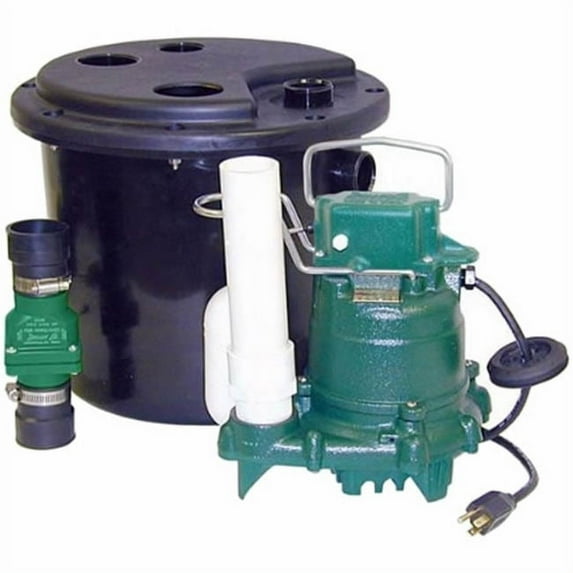
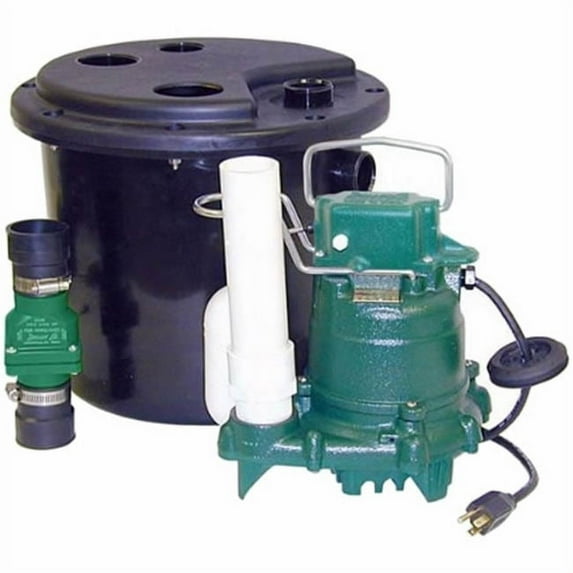
Zoeller Mighty-Mate Submersible Sump Pump 1/3 HP Cast Iron
If you are looking for a professional-grade solution for basement water removal, the Zoeller Mighty-Mate Submersible Sump Pump is a cast-iron workhorse with decades of proven reliability. The M53 earns its legendary status as the go-to choice for homeowners who refuse to compromise on flood protection. Score: 9.1/10
This review contains affiliate links. We may earn a commission if you purchase through them, at no extra cost to you.
Overview
The Zoeller Mighty-Mate Submersible Sump Pump is widely regarded as one of the most reliable sump pumps for your home, offering professional-grade flood protection for residential basements. If you're still deciding on a model, check out our sump pump buying guide for wet basements to compare specifications.
While a pump handles standing water, those dealing with high humidity may also want to consult our GE ADEL50LZ dehumidifier buying guide for a complete basement moisture strategy. Manufactured in Louisville, Kentucky by a company with roots going back to 1939, the Zoeller Mighty-Mate Submersible Sump Pump is a 1/3 horsepower submersible pump designed to sit at the bottom of a sump pit and automatically expel groundwater before it has a chance to invade your basement. It is built primarily from cast iron—a material choice that instantly separates it from the sea of plastic-bodied competitors flooding the market at similar price points.This pump is aimed squarely at homeowners who want a set-it-and-forget-it solution for a moderately wet basement or crawlspace.
It is not designed for extreme high-volume flooding situations or for properties with very deep pits and long vertical discharge runs, but for the average residential application, it handles its job with quiet confidence. Whether you are replacing a failed pump after a scare or proactively upgrading from a builder-grade unit, the M53 deserves serious consideration.
What makes the M53 particularly compelling is its combination of accessible pricing, domestic manufacturing, and a product lineage that has barely needed to change because it works. Plumbers and waterproofing contractors regularly specify Zoeller pumps on professional jobs, which says a great deal about real-world durability expectations. This review digs into everything you need to know before adding one to your cart. If you are debating between brands, see our Wayne CDU980E vs Zoeller M53 comparison to see which is better for heavy flooding.
Key Features
The motor housing and pump body are cast iron, not plastic or steel. Cast iron dissipates heat more efficiently, handles mechanical stresses better, and simply lasts longer under heavy use.
The M53 uses a reliable vertical float switch that activates when water reaches approximately 8–10 inches and shuts off at 4 inches, reducing nuisance trips.
A Permanent Split Capacitor motor runs cooler and more efficiently than shaded-pole alternatives, moving up to 43 gallons per minute at zero head.
Every external fastener is stainless steel rather than zinc-plated carbon steel, preventing rusted-solid bolts during future replacements.
Standard 1.5-inch NPT discharge outlet is compatible with common PVC fittings, with an adapter included for 1.25-inch pipe retrofits.
The motor is oil-cooled rather than water-cooled, which dramatically improves thermal management and protects the motor during intermittent dry running.
| Feature | Value |
|---|---|
| Motor Power | 1/3 HP |
| Motor Type | Permanent Split Capacitor (PSC) |
| Max Flow Rate | 43 GPM (0 ft head) |
| Flow Rate at 10 ft Head | ~30 GPM |
| Max Head Pressure | 19.25 ft |
| Discharge Size | 1.5-inch NPT (1.25-inch adapter included) |
| Switch Type | Automatic vertical float |
| Turn-On Level | ~8–10 inches |
| Turn-Off Level | ~4 inches |
| Body Material | Cast iron |
| Fasteners | Stainless steel |
| Cooling Method | Oil-filled |
| Voltage | 115V / 60 Hz |
| Amperage | 5.5A running / 9.5A starting |
| Cord Length | 9 ft (3-prong plug) |
| Minimum Pit Diameter | 11 inches |
| Weight | ~16 lbs |
| UL Listed | Yes |
| Country of Manufacture | USA (Louisville, KY) |
| Warranty | 1 year limited |
Pros & Cons
Pros
- Genuine cast-iron construction for superior heat dissipation and longevity
- Oil-filled PSC motor runs cooler and more efficiently than competitors
- Made in the USA—consistent quality control over decades
- Stainless steel fasteners prevent seized bolts at replacement time
- Float switch is reliable and largely debris-resistant
- Widely stocked—easy to find replacement parts and service
- Trusted by professional plumbers and waterproofing contractors
- Compact enough for standard 11-inch minimum pit diameter
Cons
- Only a 1-year warranty—shorter than some premium competitors
- No built-in alarm or Wi-Fi connectivity for remote monitoring
- Heavier than plastic alternatives at ~16 lbs
- Not ideal for very high water tables requiring extreme volume capacity
- Float switch can occasionally hang up in very small or cluttered pits
- 9-foot power cord can fall short in some basement layouts
Performance
In real-world use, the M53 consistently delivers what its specification sheet promises—and that dependability is the heart of its appeal. During a heavy spring storm cycle, the pump cycles efficiently and quietly compared to cheaper plastic-bodied alternatives (explore our guide to the best submersible utility pumps for draining water fast). The cast-iron housing absorbs vibration and dampens operating noise noticeably; the pump hums rather than rattles, which matters when the pit is located near a bedroom or finished living space.
The vertical float switch has a well-deserved reputation for reliability. Unlike tethered floats that can twist, bind against pit walls, or get tangled in debris, the vertical design keeps the activation mechanism compact and predictable. Based on extensive owner reports and professional installer feedback, false activations are rare. The turn-on level of 8–10 inches gives the pump a comfortable margin to begin working before water approaches the pit rim, and the 4-inch shutoff leaves enough water to keep the pump inlet submerged without short-cycling the motor.
Thermal performance is where the M53 visibly outclasses budget competitors. During extended rain events where the pump runs nearly continuously for hours, the cast-iron housing and oil-cooled motor stay well within operating temperature. Plastic-bodied pumps with water-cooled motors can overheat and trip thermal protection during exactly the worst situations. The M53 simply keeps working.
At 10 feet of vertical head—a realistic real-world figure for most two-story discharge runs—the pump delivers approximately 30 gallons per minute, which comfortably outpaces typical residential groundwater infiltration even in wet climates.
Pair the M53 with a Wayne Battery Backup Sump Pump for complete protection (see our Wayne ESP25 review and buying guide for detailed setup instructions).
The M53 is a superb primary pump, but every primary pump is powerless during an outage—which is exactly when severe storms knock out electricity.Detailed Technical Analysis: How It Works
To appreciate the M53, one must understand the mechanics of submersible pumping. The Zoeller M53 operates on a centrifugal principle. Water enters the pump through the intake screen at the bottom, where an impeller spins at high velocity, flinging the water outward and forcing it up the discharge pipe. While this sounds basic, the execution in the M53 is what separates it from "big box" store specials.
The Thermal Management Secret: Oil vs. Water Cooling
Most budget pumps use the surrounding water to cool the motor. This is problematic for two reasons: first, if the water level drops too low or the pump runs "dry" for a few moments, the motor can overheat almost instantly. Second, water-cooled motors are more prone to internal corrosion. The M53 utilizes an oil-filled motor. The oil serves as both a lubricant and a heat-transfer medium. Because oil is a better thermal conductor than air and doesn't evaporate or corrode like water, the M53 can withstand much higher operational temperatures without tripping its thermal overload switch. This is why the M53 doesn't "burn out" during a 48-hour rain event where other pumps might fail.
The Vertical Float Advantage
Traditional "tether" floats are essentially a ball on a string. These are notorious for getting stuck against the wall of the sump pit, causing the pump to either run dry (burning out the motor) or fail to turn on (flooding the basement). The M53 uses a vertical float switch. The float slides up and down a guided shaft. This eliminates the risk of the float "tangling" or getting pinned. It creates a deterministic trigger point: when the water reaches the preset height, the switch snaps shut, and the motor engages. This precision prevents "short-cycling," which is the rapid turning on and off of the motor that wears down the capacitor and windings.
Cast Iron Structural Integrity
Plastic pumps are subject to "creep" and thermal expansion. Over years of cycling from 50°F groundwater to 140°F motor temperatures, plastic housings can warp or develop hairline fractures. Cast iron is thermally stable. Not only does it provide a rigid structure that prevents the impeller from shifting off-axis (which causes noise and inefficiency), but the mass of the iron acts as a heat sink. This keeps the internal motor components at a more consistent temperature, significantly extending the life of the insulation on the copper windings.
Installation and Setup Guide
Installing the Zoeller M53 is a straightforward process, but doing it correctly is the difference between a 10-year pump and a 2-year pump. Because this is a heavy cast-iron unit, the first step is ensuring the sump pit is clean. Remove any accumulated silt, mud, or debris from the bottom of the pit. (For those managing overall water quality, check out our GE GXWH40L whole house water filter guide). If the pump sits in a layer of mud, it can suck in sediment that wears down the impeller or blocks the intake screen.
Step 1: Positioning
Place the M53 in the center of the pit. Ensure the vertical float has enough room to move freely without rubbing against the pit walls. If the float is pinched, the pump will not trigger. For those with very tight pits, check that the pump is centered perfectly. If you have a liner in your pit, ensure the pump sits flat and isn't tilted, as a tilt can cause the float switch to bind over time.
Step 2: Plumbing the Discharge
The M53 comes with a 1.5-inch NPT outlet. We strongly recommend using PVC pipe rather than flexible hoses for the main vertical run. Use a PVC coupling and solvent weld (PVC glue) to create a permanent, leak-proof seal. If your existing home plumbing uses 1.25-inch pipe, use the provided adapter. Ensure there is a check valve installed in the discharge line. A check valve prevents the water remaining in the pipe from flowing back into the pit once the pump shuts off, preventing the pump from cycling twice for every one volume of water. Failure to install a check valve leads to premature wear on the motor due to excessive cycling.
Step 3: Electrical Connection
The 9-foot cord is sufficient for most, but avoid using standard indoor extension cords. If you must use an extension, it must be a 14-gauge, UL-listed outdoor/industrial rated cord. Ideally, the pump should be plugged directly into a GFCI (Ground Fault Circuit Interrupter) outlet to protect against electrical shorts in the wet environment of a sump pit. Ensure the cord is secured and not hanging in a way that it could be pulled or snagged during maintenance.
Maintenance and Long-Term Care
While the M53 is marketed as a "set-and-forget" solution, a small amount of annual maintenance ensures it will actually last a decade. A sump pump that is never checked is a pump that will eventually surprise you with a failure during the wettest weekend of the year.
The "Bucket Test"
Twice a year (typically once in the spring and once in the fall), perform a manual test. Pour five gallons of water into the pit quickly. Listen for the pump to engage and watch it expel the water. This verifies that the float switch is moving freely and the motor is drawing current. If the pump takes too long to kick in, you may have debris obstructing the float switch.
Cleaning the Intake
Over time, iron bacteria or fine silt can clog the intake screen at the bottom of the pump. Once a year, pull the pump out of the pit (if your plumbing allows) and scrub the intake area with a stiff brush and water. A clogged intake forces the impeller to work harder, increasing the temperature of the motor and reducing the GPM (gallons per minute) flow.
Checking the Check Valve
Listen to the pump as it shuts off. You should hear a distinct "thump" from the check valve closing. If you hear a gurgling sound or see water rushing back into the pit after the motor stops, your check valve is failing. Replace the valve immediately to prevent the pump from short-cycling, which is the leading cause of capacitor failure in 1/3 HP motors.
Buyer's Guide: Is the M53 Right for You?
Selecting a sump pump is often a balance between price, power, and durability. To determine if the Zoeller M53 is the correct choice for your home, consider the following environmental factors.
When to Choose the M53
- Standard Residential Basements: If you have a typical concrete basement with a 12-18 inch sump pit and standard groundwater seepage, the M53 is the gold standard.
- Medium-Silt Water: Because of the cast-iron build and robust impeller, it handles small amounts of sediment better than lightweight plastic pumps.
- Longevity Priorities: If you are tired of replacing $80 "big box" pumps every three years, the investment in the M53's materials pays off in the long run.
- Standard Head Heights: For homes where the water needs to be pushed up 10 to 15 feet to reach the exterior grade, the 1/3 HP PSC motor is perfectly sized.
When to Look Elsewhere
- Extreme Flooding: If your basement is essentially a swimming pool during storms or you have a very high water table that requires constant pumping, you may need a higher capacity unit, such as