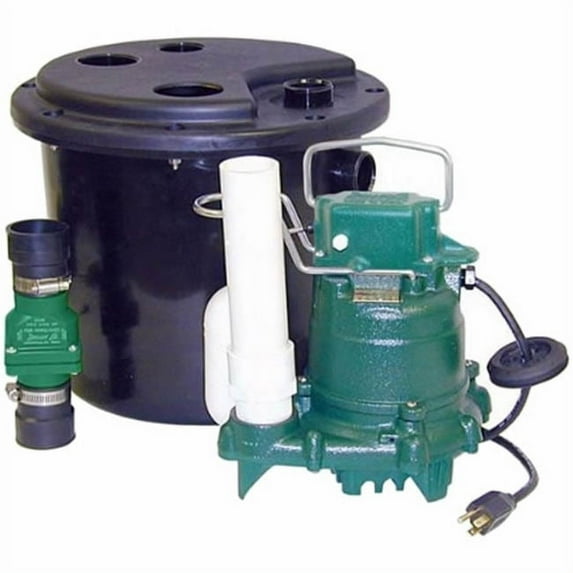
When your basement faces rising groundwater or heavy rainfall, a dependable sump pump is the difference between a dry home and a costly flood disaster. The Zoeller Mighty-Mate Submersible Sump Pump has earned a near-legendary reputation among homeowners and plumbers alike for its cast-iron durability and no-nonsense reliability. This complete guide breaks down everything you need to know before buying, installing, and living with the M53 (see our Wayne CDU980E vs Zoeller M53 comparison guide) — including full specs, a performance curve, step-by-step installation, maintenance schedules, recommended accessories, and how it compares against alternatives.
TL;DR — Quick Takeaways
- The Zoeller M53 is a 1/3 HP submersible sump pump built for residential basement drainage (similar to the Basement Watchdog 1/3-HP Cast Iron Submersible Sump; see our Basement Watchdog BW1033 review or buying guide)).
- Cast-iron construction makes it significantly more durable than plastic-bodied competitors.
- Automatic float switch activates at roughly 5 inches of water and shuts off around 2 inches.
- Pumps up to 43 gallons per minute (2,580 GPH) at 0 ft of head.
- Best for average to moderately high water intrusion in pits 10 inches or larger in diameter see full comparison.
- Not ideal for continuous-duty extreme flooding or very fine silt-heavy water without a filter (for non-pit applications, see our best submersible utility pumps for draining water fast).
Our Top Pick: Zoeller M53 Mighty-Mate
The M53 earns its spot as our top residential sump pump pick with an unmatched combination of cast-iron longevity, proven automatic switching, and a flow rate that handles most basement water intrusion scenarios with ease. Score: 9.2 / 10
Read our Wayne ESP25 battery backup review for storm performance data.
See Full Specs ComparisonZoeller M53 Mighty-Mate: In-Depth Review
Build Quality & Construction
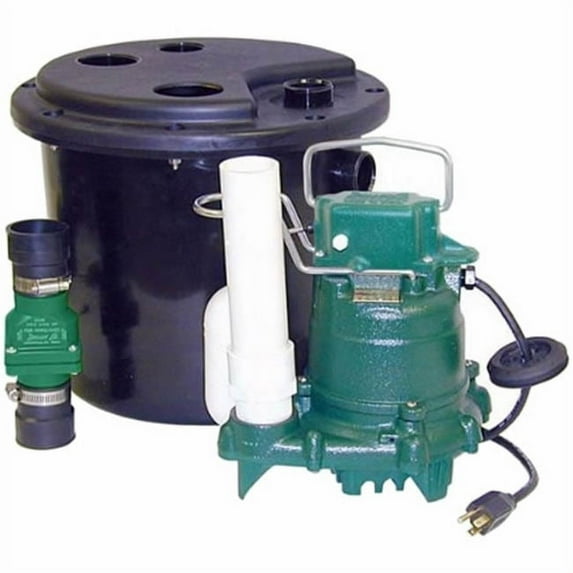
The first thing you notice when unboxing the Zoeller M53 is how substantial it feels. The pump body is constructed from cast iron, a material choice that sets it apart from the overwhelming majority of box-store pumps that use thermoplastic housings. Cast iron dissipates heat far more efficiently, meaning the motor runs cooler during extended pump cycles — a critical factor in motor longevity. The impeller is made of stainless steel, and the shaft seal is a durable mechanical type designed to resist wear from gritty water. Zoeller backs all of this up with manufacturing done in Louisville, Kentucky, giving the M53 a domestic-made pedigree that resonates with quality-conscious buyers.
The pump weighs in at approximately 18 pounds, which is heavier than most plastic alternatives but entirely manageable for a single adult during installation or replacement. The 1½-inch NPT discharge port is a standard size that connects easily to PVC or ABS piping without adapter gymnastics. The 9-foot power cord is long enough for most sump pit configurations, though some deeper or unconventionally placed pits may require an extension (always use a heavy-duty, outdoor-rated cord if extending). Overall, the construction quality signals that Zoeller built this pump to last a decade or more under normal conditions — something the brand's warranty and user reviews consistently corroborate.
Motor Performance & Pumping Power
Under the hood, the M53 runs a 1/3 horsepower, 115-volt AC motor that draws around 4.6 amps at full load. That translates to a maximum flow rate of approximately 2,580 gallons per hour at zero feet of head — an impressive figure for a residential 1/3 HP pump. In real-world basement drainage scenarios with typical 8–10 feet of vertical lift and horizontal run, expect effective throughput in the range of 1,200–1,800 GPH, which is more than sufficient for moderate to moderately heavy groundwater intrusion. The pump handles solids up to ½ inch in diameter, making it practical in pits where small debris, leaves, or sediment might accumulate without a dedicated filter basket.
The motor is permanently lubricated and sealed, meaning there are no oil changes or maintenance intervals to track beyond basic annual inspection. During operation the M53 is not whisper-quiet — cast iron does transmit some vibration — but it is far from disruptive. Most homeowners report noticing the pump activating only because of the audible water flow in the discharge pipe rather than the motor noise itself. If your sump pit is beneath a bedroom, consider adding vibration-dampening mounts under the pump, a low-cost addition that nearly eliminates any sound transfer into living spaces above.
Automatic Float Switch & Activation
The M53 ships with a factory-installed vertical float switch that activates the pump when water rises to approximately 5 inches and cuts it off when the level drops to about 2 inches. This simple vertical tethered-float design has proven remarkably reliable over decades of field use. Unlike wide-angle tethered floats that can wrap around pump bodies or get pinched against pit walls, the M53's vertical float stays aligned with the pump body and is less prone to mechanical snags. The switch is rated for millions of cycles, which translates to many years of trouble-free service under normal activation frequency.
One practical note: the M53's float switch is not easily user-adjustable without some mechanical aptitude. If your pit geometry requires a very specific activation height — for example, if your pit is unusually shallow or your discharge line has high back-pressure — you may need to consult Zoeller's technical support or consider a piggyback plug switch that allows manual activation-height adjustment. For the vast majority of standard residential pits, however, the factory float settings work perfectly right out of the box without any modification.
Who Is the Zoeller M53 Best For?
The M53 hits its sweet spot for a clear set of use cases:
- Homes in areas with seasonal heavy rain, high water tables, or wet basements
- Homeowners replacing a failed plastic pump and wanting a pro-grade upgrade
- New construction and waterproofing projects where contractors prioritize reliability
- Primary pump in a dual-pump system paired with a Wayne Battery Backup Sump Pump 2700 GPH for outage coverage (see our detailed review and buying guide)
Where the M53 is less ideal: extreme high-volume flooding scenarios (where a higher-capacity pump like the Wayne 3/4 HP Submersible Cast Iron and Steel Sump Pump (see our Wayne CDU980E review) is better) or models like the Ridgid Cast Iron Submersible Sump Pump Half Horsepower (detailed in our Ridgid SP-650C buying guide and comprehensive review) is more appropriate), or pits smaller than 10 inches in diameter where the float can't swing freely. In those cases, a Flotec Submersible Utility Pump 1/4 HP Thermoplastic may be a more flexible alternative (see our guide to the best submersible utility pumps).
Pros
- Cast-iron body dissipates heat and dramatically extends motor life
- Stainless steel impeller resists corrosion and debris wear
- Reliable vertical float switch with millions of rated cycles
- Handles solids up to ½ inch — practical for real-world pit conditions
- Made in the USA by a company with decades of pump engineering heritage
- Standard 1½-inch NPT discharge fits most existing plumbing setups
- Strong long-term user satisfaction and service record
- Available replacement parts are widely stocked at HVAC/plumbing suppliers
Cons
- Higher upfront cost than entry-level plastic sump pumps
- Float switch not easily adjustable without mechanical know-how
- Heavier than plastic pumps — minor inconvenience during DIY install
- Not designed for continuous-duty extreme-volume flooding
- Requires pit at least 10 inches in diameter for float to operate freely
- No built-in alarm or Wi-Fi monitoring (requires separate accessory)
- 9-foot cord may be too short for some deep or remote pit placements
This guide contains affiliate links. We may earn a commission if you purchase through these links, at no extra cost to you. Our editorial opinions are independent of any commercial relationships.
Full Technical Specifications
| Specification | Detail |
|---|---|
| Horsepower | 1/3 HP |
| Material | Cast Iron |
| Flow Rate | Up to 2,580 GPH |
| Discharge Size | 1.5" NPT |
| Voltage | 115V |