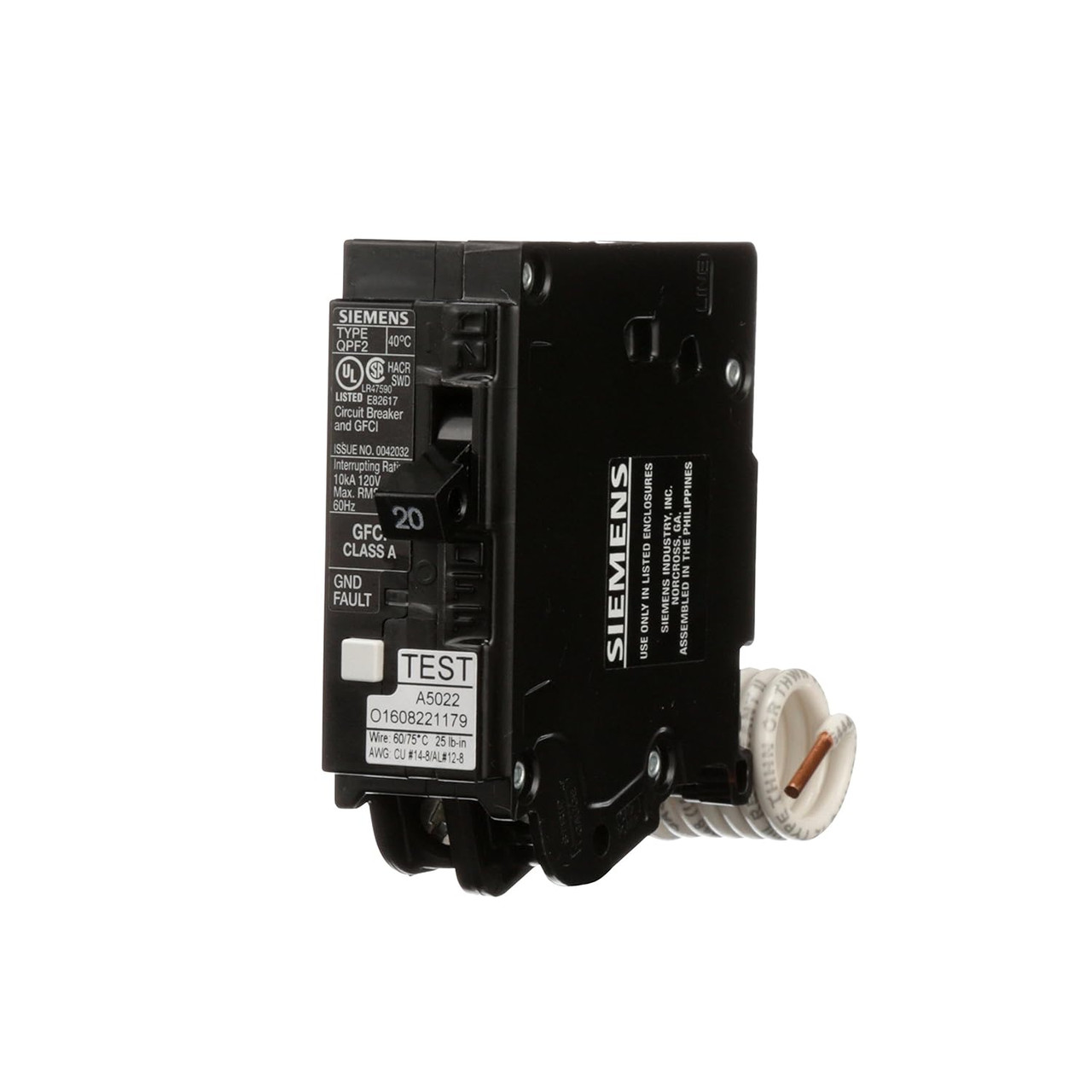
When upgrading your home's electrical safety, the Siemens 20-Amp Single-Pole Self-Testing GFCI Circuit Breaker provides comprehensive GFCI protection for an entire 20-amp branch circuit.
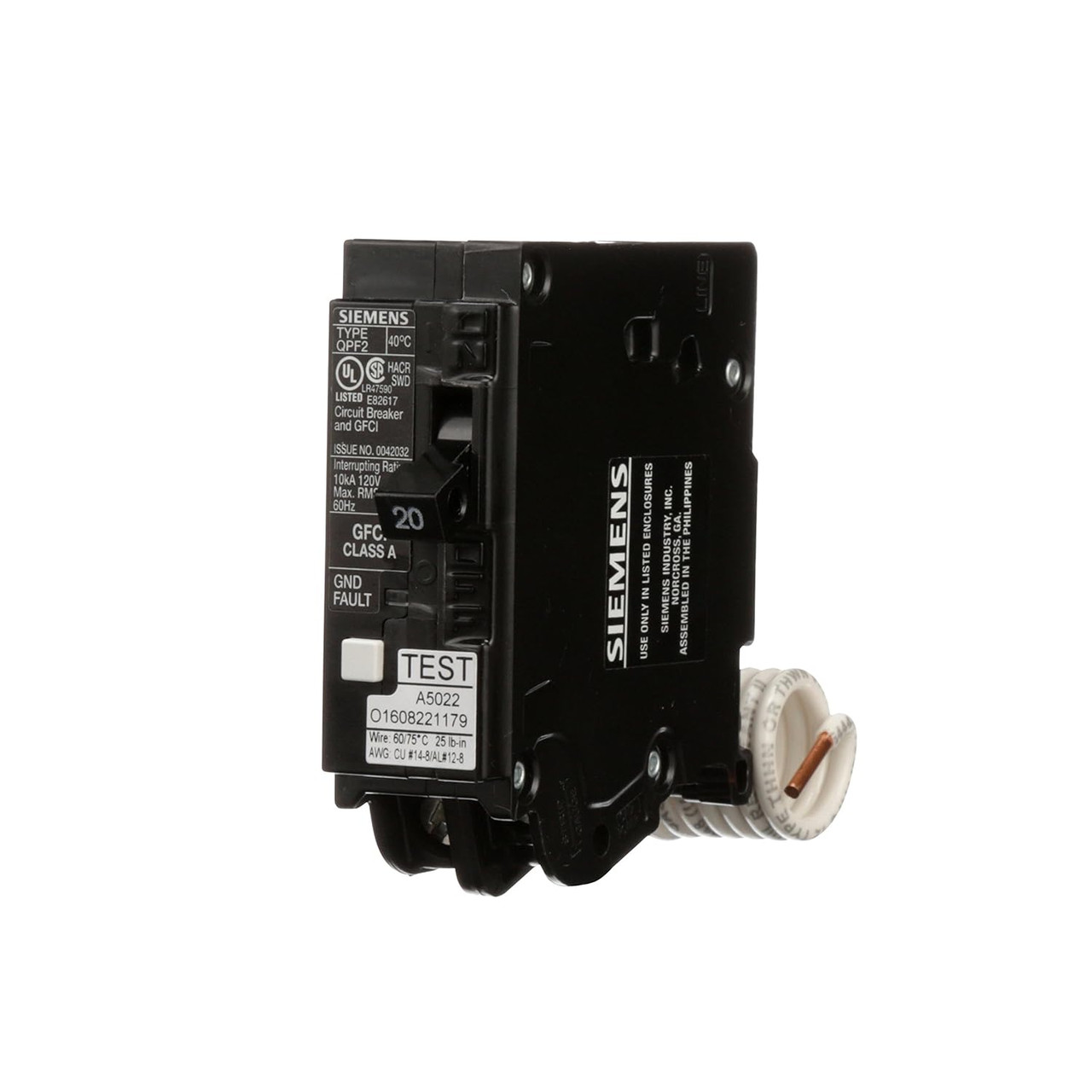
Best Overall: Siemens 20-Amp Single-Pole Self-Testing GFCI Circuit Breaker
Score: 9.1/10. A strong panel-level GFCI choice for compatible Siemens and Murray load centers when you need reliable 20-amp branch-circuit protection for bathrooms, kitchens, and outdoor areas.
Siemens 20-Amp Single-Pole Self-Testing GFCI Circuit Breaker
The Siemens 20-Amp Single-Pole Self-Testing GFCI Circuit Breaker is designed to provide ground-fault circuit interrupter protection at the electrical panel rather than at a single receptacle. This architectural shift in protection means the breaker safeguards the entire connected branch circuit, including downstream outlets and the wiring itself, provided it is installed correctly in a compatible load center.
This makes it especially useful for circuits serving areas where shock hazards are more likely, such as bathrooms, kitchens, garages, basements, laundry areas, utility spaces, and outdoor receptacles. Instead of relying on one GFCI outlet in the first position on the run—which can be difficult to access or prone to accidental tripping in a hidden location—a GFCI breaker places the protection at the origin of the circuit. This simplifies retrofit jobs and ensures that every single outlet on that line is protected, regardless of where the wire terminates.
The QF120A is a 20-amp, single-pole breaker, meaning it is intended for compatible 120-volt branch circuits. It is not designed for 240-volt heavy appliances or multi-pole applications. A standout feature of this model is its self-testing function. Traditional GFCI devices require manual testing via a "Test" button to ensure the internal circuitry is still capable of tripping during a fault. The QF120A periodically checks its own internal protection mechanism, helping homeowners and electricians identify a failed unit immediately rather than assuming a circuit is protected when it isn't.
This product is best for buyers who already own a Siemens 200-Amp 30-Space 40-Circuit Indoor Main Breaker Load Center or compatible Murray load center and need a straightforward GFCI breaker replacement or upgrade. It is critical to remember that this is not a universal breaker; panel compatibility is the most important buying checkpoint (if you're deciding between brands, check our Square D vs Eaton comparison). If your project involves areas that only require standard protection, consider the Siemens Single-Pole Plug-In Circuit Breaker 15 Amp (see our detailed review) or a Square D Single-Pole Plug-On Circuit Breaker 20-Amp for QO Load Centers (see our detailed review). However, if your project involves bedrooms or living areas where current NEC codes might require arc-fault protection (AFCI), you must verify if a GFCI-only breaker is sufficient or if a dual-function AFCI/GFCI breaker is required by your local building department (see our AFCI vs Standard guide and the Eaton BRCAF115 review for a deeper dive into how the Eaton Single-Pole Combination AFCI Circuit Breaker 15-Amp differs from ground-fault protection).
Pros
- Protects entire 20-amp branch circuit from the panel
- Self-testing design eliminates manual test guesswork
- Ideal retrofit for kitchens, garages, and outdoor circuits
- Compatible with widely used Siemens and Murray load centers
- Reduces the need for multiple GFCI receptacles on one line
Cons
- Strictly compatible only with specific Siemens/Murray panels
- Does not provide AFCI (Arc-Fault) protection
- Panel-level trips require a trip to the electrical box to reset
- Requires professional installation for those inexperienced with panels (see our guide on how to replace a circuit breaker safely at home) (similar to the precautions noted in our MrCool DIY mini-split guide)
Deep Dive: How the QF120A Works
To understand why the Siemens QF120A is a superior choice for certain installations, it is important to understand the physics of Ground Fault Circuit Interruption (GFCI). A standard circuit breaker—whether for home use or specialized Blue Sea Systems Marine Thermal Circuit Breaker for DC Applications (see our review of Blue Sea Systems breakers)—is designed to protect the wire from overheating (overload) or to prevent fires during a direct short (short circuit). However, a standard breaker will not trip if a small amount of current leaks to the ground through a human body—which is enough to cause cardiac arrest.
The QF120A monitors the balance of current between the "hot" wire and the "neutral" wire. In a healthy circuit, the current going out on the hot wire should exactly match the current returning on the neutral. If the QF120A detects a discrepancy as small as 4 to 6 milliamperes, it assumes the current is leaking somewhere—perhaps through a faulty tool, a wet extension cord, or a person—and trips the circuit in milliseconds. This happens far faster than the human nervous system can react, effectively preventing lethal shocks.
By moving this logic to the breaker panel, the QF120A eliminates the "daisy-chain" risk associated with GFCI outlets. When you use a GFCI outlet at the start of a run, any downstream outlets are protected. However, if that first outlet is damaged, improperly wired, or if a subsequent outlet is wired "upstream" of the GFCI by mistake, the downstream outlets may lose protection without the user realizing it. The QF120A ensures that the protection is centralized and managed at the source of power, meaning no matter how the outlets are wired downstream, they are all subject to the same ground-fault monitoring.
Furthermore, the "Self-Testing" aspect of the QF120A addresses a major failure point in electrical safety: human neglect. Many homeowners never press the "Test" button on their GFCI outlets, or they do so once every few years. Over time, the capacitors and sensing circuitry inside a GFCI device can degrade. A "silent failure" occurs when the outlet continues to provide power but the trip mechanism no longer works. The QF120A performs an internal electronic simulation of a fault at regular intervals. If the internal test fails, the breaker alerts the user, ensuring that the life-saving protection is actually operational.
Comprehensive Buyer's Guide: GFCI Breakers vs. Outlets
Choosing between the Siemens QF120A and a standard GFCI receptacle depends on your specific electrical environment, the age of your home, and your tolerance for walking to the electrical panel to reset a tripped circuit. Below is a detailed breakdown of the decision-making process.
When to Choose the Siemens QF120A (Breaker)
Retrofitting Old Wiring: If you have an older home where the wiring is "daisy-chained" in a complex way, it may be nearly impossible to find the "first" outlet in the run to install a GFCI receptacle. In some cases, the first outlet is hidden behind a wall or located in a crawlspace. Replacing the breaker at the panel provides instant protection for the whole line without needing to tear open drywall to find the circuit origin.
Outdoor and Wet Locations: For outdoor circuits that feed multiple outlets across a patio, garden, or deck, a breaker is often more reliable. GFCI receptacles contain sensitive electronics that can be degraded by extreme humidity, freeze-thaw cycles, and insect ingress, even with "in-use" covers. By using the QF120A, the sensitive GFCI circuitry stays inside the dry, climate-controlled environment of the electrical panel, while the outdoor outlets can remain simple, rugged, weather-resistant duplex receptacles. For more on electrical safety in various home zones, see our guide on the best 20-amp circuit breakers for home electrical panels.
Aesthetic Consistency: In high-end renovations, some homeowners dislike the bulky "Reset" and "Test" buttons of GFCI outlets, which can look out of place in a modern kitchen or a minimalist bathroom. By installing a panel-level breaker, you can use standard, sleek duplex outlets throughout the room while still maintaining full NEC safety compliance. The panel-level approach allows for a cleaner visual line across the walls.
High-Sump Pump Reliability: In basements with critical pumps (see our Ridgid SP-650C sump pump guide or our Basement Watchdog BW1033 review for flood prevention), having a self-testing breaker ensures that the ground-fault protection is active, which is vital for equipment sitting in standing water (see our Ridgid SP-650C review or the Wayne ESP25 review for more on backup pump safety). For those planning the installation themselves, ensure you follow our guide on how to replace a circuit breaker safely at home. While you must be careful not to use a GFCI on a pump that is prone to "nuisance trips" (which could lead to a flooded basement), the self-testing feature of the QF120A provides a higher level of confidence that the safety mechanism is functional.
When to Choose GFCI Receptacles
Convenience of Reset: The primary drawback of the QF120A is the reset location. If a GFCI trips in a distant garage or a backyard shed, it is much more convenient to push a button on the wall than to walk all the way back to the electrical panel in the basement or garage. For high-traffic areas where "nuisance trips" from damp tools are common, a receptacle is more user-friendly.
Non-Compatible Panels: The QF120A is not a universal part. If you are weighing different brands for a new installation, refer to our Square D vs Eaton comparison to see which brand fits your home's needs best. If you do not have a Siemens 200-Amp 30-Space 40-Circuit Indoor Main Breaker Load Center or compatible Murray load center (such as the Square D 200-Amp 30-Space 30-Circuit Indoor Main Load Center), this breaker will not physically fit or will not make a safe electrical connection. In these cases, the GFCI outlet is the universal solution as it works regardless of the brand of the main service panel. If you're exploring your options, see our guide on the best 20-amp circuit breakers for home electrical panels. For those upgrading a full panel, a Square D Homeline 200-Amp 60-Space 60-Circuit Indoor Main Load Center is a popular alternative.
Isolation and Zoning: If you only need one specific outlet (like a single sink) to be protected, while other outlets on the same 20-amp circuit (like a dedicated vacuum or a lamp) should remain non-GFCI to avoid interference, a receptacle is more precise. A breaker protects everything on the line; an outlet protects only what follows it.
Installation and Setup Considerations
Installing the Siemens QF120A is a straightforward process for a licensed electrician, but it requires precision to ensure safety and code compliance. Because this involves the main power distribution of the home, the stakes for errors are high.
Step-by-Step Logic for Installation
1. Panel Verification: The installer first verifies that the load center is a compatible Siemens or Murray model (for a full safety walkthrough, see our guide on replacing a circuit breaker safely). Using a breaker in a non-certified panel can lead to poor contact, overheating, and potentially electrical fires. The "fit" of the breaker onto the bus bar must be tight and secure; any wiggle room can cause arcing.
2. Wire Sizing: Because the QF120A is rated for 20 amps, the installer must ensure the branch circuit is wired with at least 12-gauge copper wire. Using 14-gauge wire on a 20-amp breaker is a major code violation and a severe fire hazard. 14-gauge wire is only rated for 15 amps; if a 20-amp breaker is used, the wire could overheat and melt its insulation before the breaker ever trips to stop the flow of current.
3. Physical Mounting and Neutral Connection: The breaker is snapped into the bus bar. Unlike standard breakers, GFCI breakers require a specific connection for the neutral wire. The QF120A usually features a "pigtail" or a specialized lug for the neutral wire, which must be connected to the panel's neutral bar. This allows the breaker to monitor the current returning from the circuit and compare it to the current leaving the circuit.
4. Testing the Loop: Once installed and the main power is restored, the "Test" button on the breaker face is pressed. This manually triggers a ground fault to ensure the internal trip mechanism is engaging. Once the initial manual test is passed, the internal self-testing feature takes over, monitoring the circuit's health automatically over time.
Maintenance and Troubleshooting
While the Siemens QF120A is designed for "install and forget" reliability, there are specific maintenance patterns and troubleshooting steps to be aware of. Unlike a standard breaker, which only trips during a massive overload, a GFCI breaker is an active electronic device.
Common Causes of Nuisance Tripping
GFCI breakers are significantly more sensitive than standard breakers. If your QF120A trips frequently, it is rarely a fault of the breaker itself, but rather an issue with the connected loads or the wiring environment:
- Moisture Ingress: Outdoor outlets that are not properly sealed with silicone or high-quality weather-covers can allow moisture to seep into the box. This creates a high-resistance path to ground, which the QF120A will detect immediately, triggering a trip.
- Old Appliance Leakage: Older refrigerators, vintage power tools, or poorly maintained space heaters can have degrading insulation. These devices may "leak" small amounts of current to the chassis, which the QF120A is designed to catch.
- Overloaded Circuits: It is important to distinguish between a ground fault and an overload. While the GFCI monitors for leaks, the 20-amp rating still applies to total load. If you plug in three high-wattage space heaters on one 20-amp circuit, the breaker will trip on