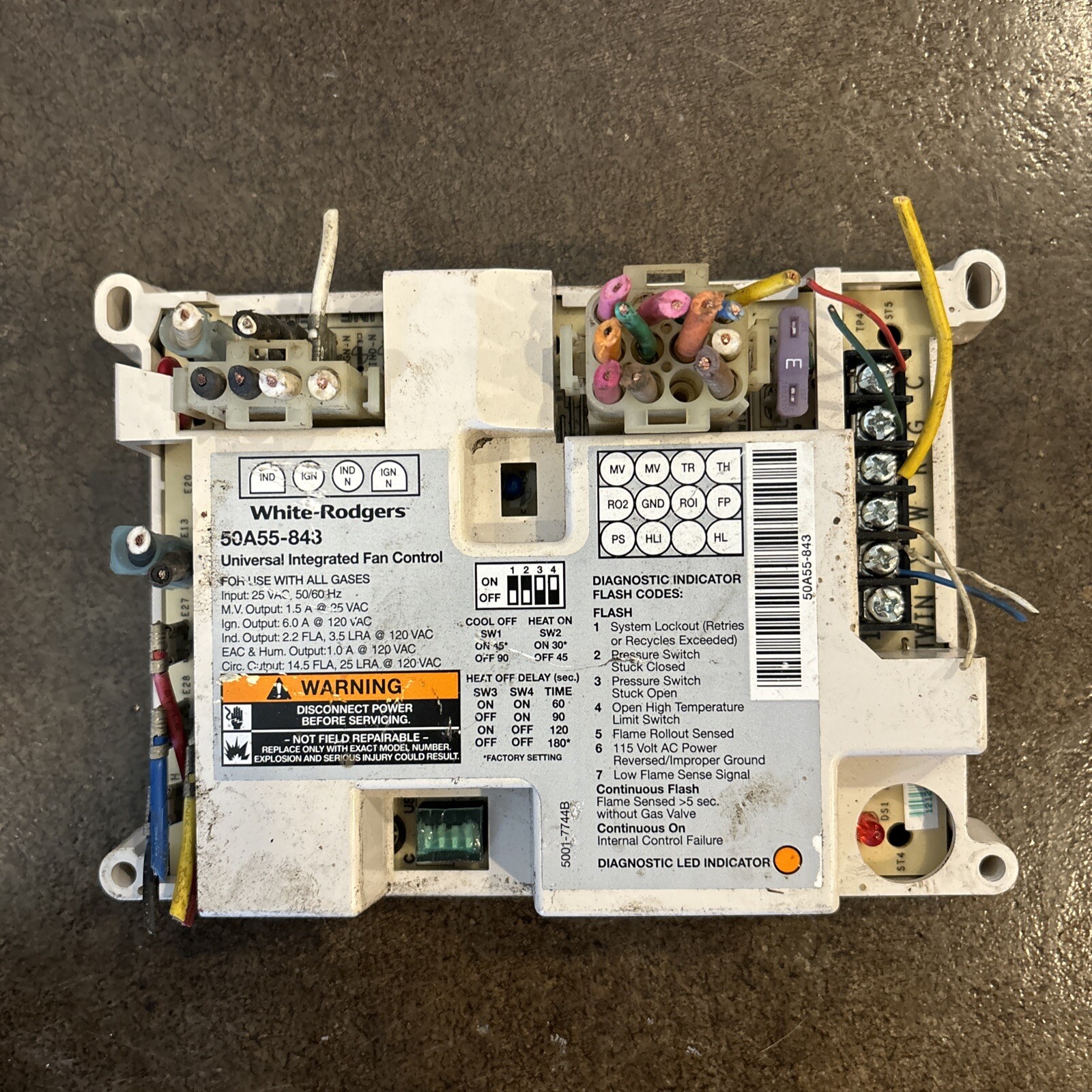
White-Rodgers Universal Integrated Furnace Ignition Control Board (50A55-843)
A dependable, widely compatible OEM-grade furnace control board that delivers reliable ignition sequencing and diagnostic fault codes — earning a solid 8.2 / 10 for homeowners and HVAC technicians who need a proven drop-in replacement without the premium price tag.
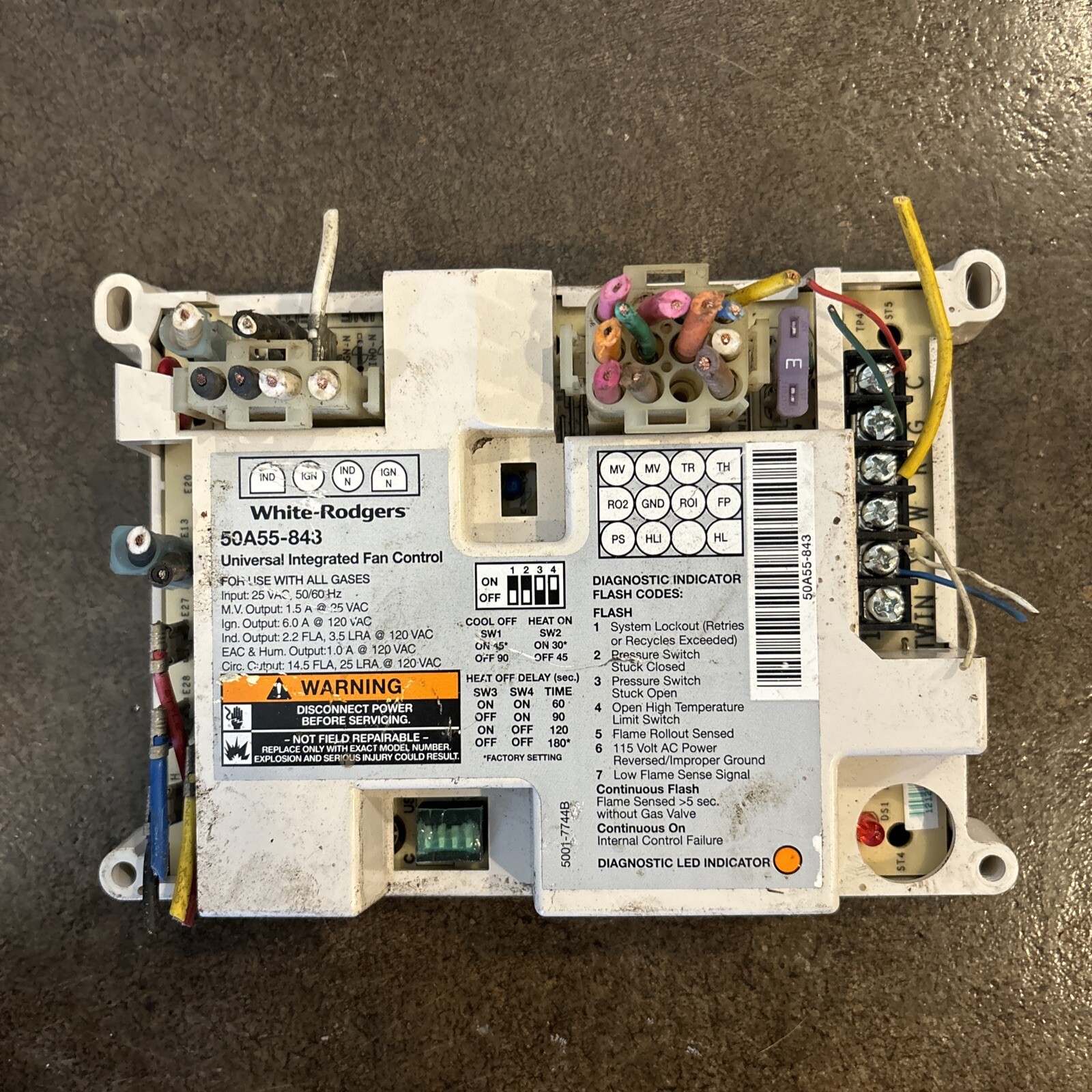
The White-Rodgers Universal Integrated Furnace Ignition Control Board (50A55-843) is a professional-grade replacement part manufactured by Emerson's White-Rodgers division — one of the most trusted names in residential HVAC controls.
For those considering broader HVAC upgrades, our Pioneer Mini-Split heat pump guide offers a perspective on modern alternative heating.For those looking to optimize their entire home air quality alongside furnace repairs, our Filtrete MERV-12 air filter review provides a great starting point. Designed primarily as a replacement board for a broad range of gas furnaces, it handles the full ignition sequence: inducer motor startup, hot surface ignition, gas valve control, blower timing, and flame sensing. If your furnace is flashing a fault code, cycling on and off erratically, or failing to ignite altogether, the control board is frequently the culprit, and the 50A55-843 is one of the most commonly specified replacements.
Important note before purchasing: this is not a "universal" board in the sense that it fits every furnace ever made, but rather a "universal" replacement for specific platforms. Cross-reference your existing board's model number carefully before ordering. That caveat aside, it is aimed squarely at two audiences: licensed HVAC technicians looking for a reliable OEM-equivalent part that cuts callback risk, and confident DIY homeowners who are comfortable working with low-voltage wiring and want to avoid a costly service call. It covers an impressively wide range of furnace brands and model years, including many Lennox, Armstrong, and Ducane units that originally shipped with White-Rodgers electronics.
Out of the box, the board feels substantial. The PCB traces are clean, the terminal blocks are clearly labeled, and the onboard LED diagnostic system means you can diagnose faults without a multimeter in hand. For a component that lives inside a hot, vibrating appliance and is expected to last a decade or more, build quality matters enormously — and the 50A55-843 delivers where it counts.
Key Features
An onboard LED flashes coded sequences to identify specific faults — from lockout conditions to pressure switch failures — saving diagnostic time in the field.
Manages the full HSI sequence with precise timing for igniter warm-up, gas valve opening, and flame verification to maximize first-attempt light-offs.
Monitors microamp flame signal and executes automatic retry and lockout logic, protecting the heat exchanger and gas valve from unsafe conditions.
Dip-switch selectable heat and cool blower on/off delays allow the installer to tune comfort and efficiency to the specific installation.
Sequences the draft inducer motor before and after each call for heat to clear combustion gases and maintain safe heat exchanger pressures.
Covers multiple Lennox, Armstrong, and Ducane furnace platforms, making it a practical stocking item for HVAC service fleets.
Full Specifications
| Feature | Value |
|---|---|
| Manufacturer | White-Rodgers (Emerson) |
| Model Number | 50A55-843 |
| Board Type | Integrated furnace control (IFC) |
| Ignition Type Supported | Hot surface ignition (HSI) |
| Supply Voltage | 120 V AC, 60 Hz |
| Low-Voltage Control | 24 V AC |
| Induced Draft Control | Yes |
| Flame Sensing | Microamp DC flame rectification |
| Blower Delay (Heat On) | Dip-switch selectable (typically 30 / 45 / 60 / 90 s) |
| Blower Delay (Heat Off) | Dip-switch selectable (typically 60 / 90 / 120 / 180 s) |
| Fault Code Output | Onboard LED flash codes |
| Retry / Lockout Logic | 3 attempts then hard lockout (manual reset or auto after 1 hour) |
| Compatible Brands | Lennox, Armstrong Air, Ducane (verify part cross-reference) |
| Typical Dimensions | Approx. 8.5 in × 6.5 in (verify against OEM) |
| Operating Temperature | 0 °F to 140 °F (−18 °C to 60 °C) |
| Warranty | 1 year (manufacturer limited) |
Pros & Cons
Pros
- Clear LED fault code system speeds up diagnosis significantly
- Solid OEM-grade build quality with clean, well-labeled terminals
- Dip-switch blower timing adjustments add useful installation flexibility
- Broad furnace compatibility reduces the need for multiple stocked SKUs
- Competitively priced compared to OEM board replacements through dealers
- Widely available from HVAC supply houses and online distributors
- Straightforward wiring layout eases direct replacement installs
Cons
- Not a true universal board — cross-referencing is mandatory before purchase
- No included installation instructions beyond basic terminal labeling
- 1-year warranty is shorter than some competing aftermarket boards
- Dip-switch positions can be ambiguous without the original furnace manual
- Counterfeit units pose a genuine safety risk — source from authorized distributors
Performance
In real-world installation scenarios, the 50A55-843 performs exactly as you would expect from a White-Rodgers board: predictably and without drama. Technicians who have swapped dozens of these boards consistently report that first-light success rates are high, and nuisance lockouts are rare once the board is properly installed and the rest of the system — flame sensor rod, pressure switches, limit switches — is in good condition. It is worth emphasizing that last point: a control board cannot compensate for a dirty flame sensor or a stuck pressure switch. If those components are marginal, the board's retry-and-lockout logic will simply do its job and shut things down safely.
If you require a standalone solution, the Honeywell Home Universal Electronic Furnace Fan Timer Control Board is an excellent alternative (see our Honeywell Home ST9400C review for details). The LED diagnostic system on the 50A55-843 is a genuine time-saver. Rather than having to connect a multimeter across multiple test points to chase a problem, a quick look at the flash pattern tells you whether you are dealing with a pressure switch fault, a limit trip, a flame rollout, or an ignition failure. The codes are printed on a label affixed to the board itself, so you do not even need to look them up — a small but thoughtful detail that matters when you are crouched inside a utility closet in a cold basement.
(If you're tackling other basement maintenance, check out our guide to the best submersible utility pumps or the Ridgid SP-650C sump pump review or explore Wayne ESP25 battery backup options for keeping your lower level dry; we also recommend a GE ADEL50LZ dehumidifier buying guide (or see our guide to utility pumps) to manage humidity and protect your HVAC electronics from corrosion).
Blower timing via dip switches works reliably. The selectable heat-on and heat-off delays let an installer balance comfort (longer heat-off delay extracts more residual heat from the heat exchanger) against wear and noise considerations. Default positions are sensible for most residential applications, meaning many installs will not require any adjustment at all. The inducer sequencing is smooth, with appropriate pre-purge timing that consistently satisfies pressure switch closure before the igniter energizes.
Deep Dive: How the 50A55-843 Operates
To understand why the White-Rodgers 50A55-843 is so critical to your heating system, one must understand the "Ignition Sequence." A furnace is not simply an "on/off" switch; it is a choreographed dance of safety checks and mechanical activations. The 50A55-843 acts as the brain (the CPU) of this process.
1. The Call for Heat: When your thermostat drops below the set point, it sends a 24V signal to the 50A55-843. The board first checks the internal logic to ensure the system isn't in a lockout state. If clear, it energizes the Rheem Furnace Draft Inducer Motor (or equivalent model). This motor clears the combustion chamber of any residual gases and creates a vacuum.
2. The Safety Handshake: The board does not move to the next step until the pressure switch closes. The pressure switch proves that the inducer is working and the vent pipe is clear. If the 50A55-843 doesn't see this closure within a set timeframe, it halts the sequence and flashes an LED error code.
3. Ignition Activation: Once the pressure switch is satisfied, the board sends high-voltage power to the igniter. If your original component has burned out, the Carrier Bryant Payne Furnace Hot Surface Igniter Replacement is a common high-quality alternative for compatible systems.
The igniter glows white-hot. After a precise delay to ensure the igniter has reached the correct temperature, the board opens the gas valve.
4. Flame Rectification: This is the most technical part of the board's job. The 50A55-843 uses "flame rectification." It sends a small current through the burner and the flame sensor. Because a flame acts as a conductor, the board can "feel" the flame. If the board doesn't detect this microamp signal within a few seconds of opening the gas valve, it immediately shuts off the gas to prevent an explosion—a critical safety feature.
5. Thermal Management: Finally, the board manages the blower motor. It doesn't turn the blower on immediately (which would blow cold air on the occupants); it waits for the heat exchanger to warm up. Once the limit switches signal that the air is hot enough, the board kicks in the blower. After the thermostat is satisfied, the board keeps the blower running for a "post-purge" period to cool the heat exchanger and maximize efficiency.
Buyer's Guide: Is This Board Right for You?
Choosing a furnace control board is not like buying a lightbulb; it is a precision component. Before purchasing the White-Rodgers 50A55-843, you must perform a three-point verification process.
Verification 1: The Model Number Match
Look at your existing board. There will be a sticker or a silk-screened part number on the PCB. If it says "50A55-843," this is a direct 1:1 replacement. If it says a different number, you must check the manufacturer's cross-reference chart. Many boards look identical but have different timing logic or voltage requirements for the igniters. Using the wrong board can lead to "short-cycling" or, in worst-case scenarios, damage to the gas valve.
Verification 2: Ignition Type
The 50A55-843 is specifically designed for Hot Surface Ignition (HSI). Those with older systems may require a Honeywell Home Universal Intermittent Pilot Ignition Control Module instead. If your furnace uses a standing pilot or an intermittent electronic spark ignition (which makes a "clicking" sound), this board is incompatible. HSI systems use a glow-plug style igniter; the board is tuned to the specific resistance and timing of those components.
Verification 3: Brand Ecosystem
While this board is "universal" for certain platforms, it is most at home in Lennox, Armstrong, and Ducane systems. If you have a high-efficiency condensing furnace with a variable-speed blower and complex multi-stage heating, ensure your specific sub-model is supported. Some ultra-modern furnaces require "communicating" boards that exchange digital data with the thermostat—the 50A55-843 is a standard 24V control board and does not support digital communication protocols.
Installation and Setup Guide
Replacing a control board is a high-stakes task. If you are not a licensed professional, the following steps are the minimum requirements for a safe installation. Warning: High voltage (120V) and combustible gas are present.
Step-by-Step Replacement Process
- Power Isolation: Turn off the furnace at the primary service switch. For added safety, lock out the circuit breaker. Verify the power is off using a non-contact voltage tester on the incoming line.
- Documentation: This is the most skipped and most regretted step. Before unplugging a single wire, take high-resolution photos of the old board from three different angles. Note where every wire goes. While the 50A55-843 has labels, your specific furnace wiring may have "jumper wires" or custom configurations.
- Wiring Disconnection: Gently pull the wiring harnesses. Do not pull by the wires; pull by the plastic connector housing. If a wire is pushed back into the terminal, you will have an intermittent connection that is a nightmare to troubleshoot.
- Physical Installation: Remove the old board by unscrewing the mounting hardware. Install the 50A55-843, ensuring it is seated firmly but not over-tightened, which could crack the PCB.
- Connecting the New Board: Plug in the harnesses according to your photos. Ensure all terminals are tight. A loose wire on a control board can arc, potentially melting the plastic housing or causing a premature board failure.
- Dip Switch Configuration: Before powering up, check the dip switches. If your previous board had specific settings for "Blower Delay On" (e.g., 45 seconds), mirror those settings on the 50A55-843. This ensures the furnace behaves as the manufacturer intended for your specific ductwork.
- The First Fire-Up: Restore power and set the thermostat to "Heat." Watch the board's LED. You should see the inducer start, followed by the igniter glow, and then the flame light. If the board flashes a code, refer to the chart on the board immediately.
Maintenance and Longevity
Control boards are solid-state electronics. Unlike a blower motor, they don't have bearings to grease or belts to tighten. However, they are subject to "electronic decay" caused by environmental factors.
Combatting Corrosion: Furnace compartments can accumulate dust and moisture. Over time, this creates a conductive layer of grime on the PCB that can cause "ghost" faults or short circuits. Every year during your annual furnace tune-up, use a can of compressed air to gently blow dust off the 50A55-843. Do not use a vacuum cleaner, as the plastic nozzle can create static electricity that may fry a CMOS chip on the board.
Dealing with Po