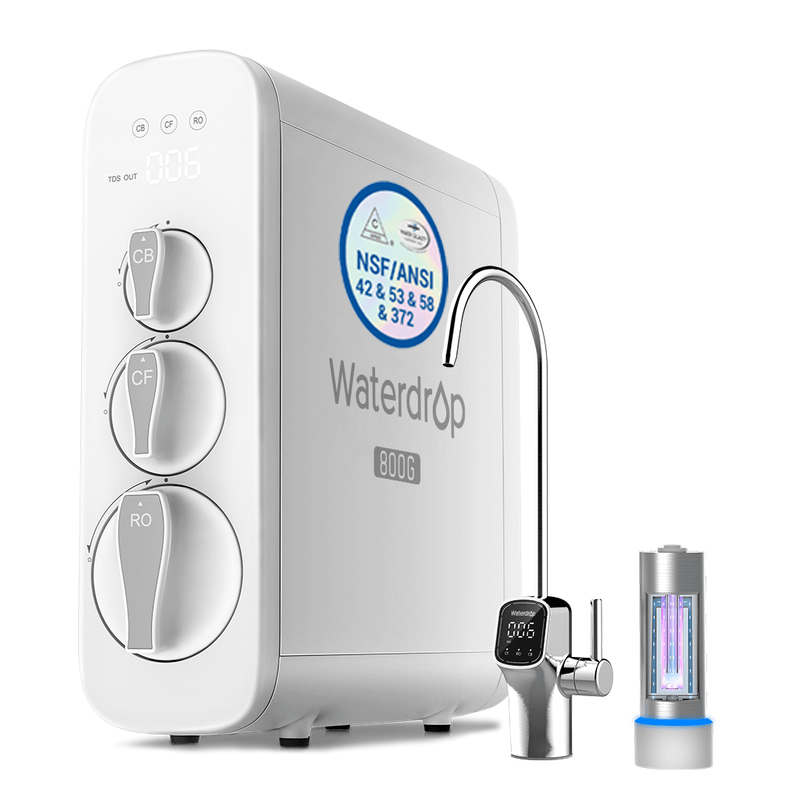
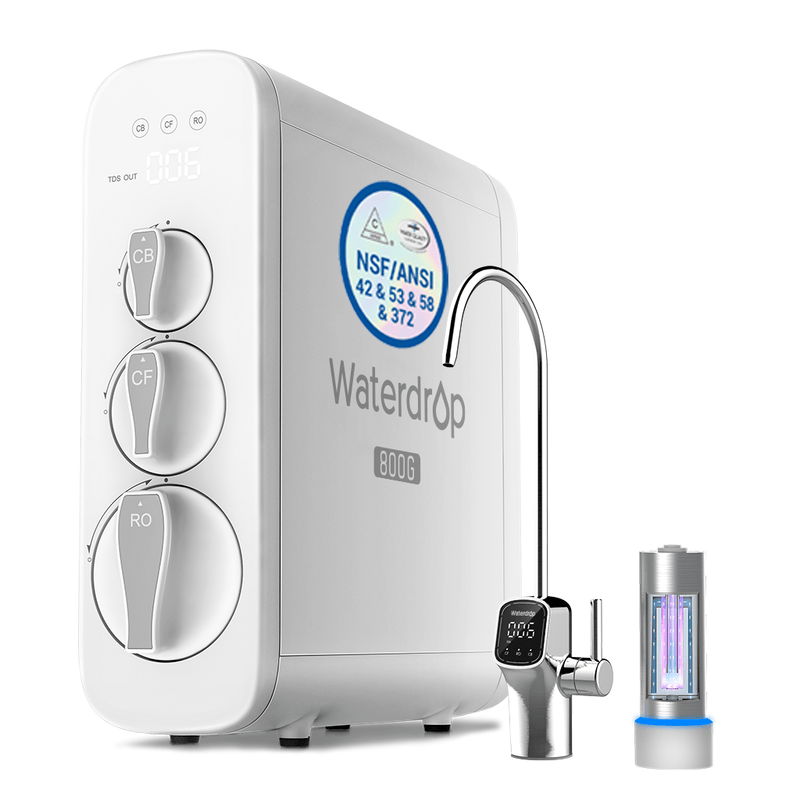
Waterdrop Tankless Under-Sink Reverse Osmosis System 800 GPD
Score: 8.7/10 — A fast, space-saving tankless RO system that is worth it for households wanting high output, smart monitoring, and cleaner-tasting drinking water without a bulky storage tank.
We may earn a commission from qualifying purchases made through links on this page.
Overview
In this Waterdrop G3P800 review, we evaluate if the
Waterdrop Tankless Under-Sink Reverse Osmosis System 800 GPD
is the best high-flow RO solution for your home. We'll dive into its 800 GPD output, space-saving tankless design, and long-term value to see if it's the right upgrade for your kitchen.It is designed to sit under a kitchen sink and deliver filtered water through a dedicated smart faucet. Its headline feature is the 800 gallons-per-day rated production capacity, which is much higher than many conventional under-sink RO systems and helps reduce the slow-flow feeling commonly associated with reverse osmosis.
This system is best suited to homeowners, renters with compatible plumbing access, families, coffee and tea drinkers, and anyone who wants a cleaner-tasting alternative to bottled water. It is also a strong fit for kitchens where cabinet space is limited, because the tankless design removes the need for a pressurized storage tank. By eliminating the storage phase, the system provides water that is filtered the moment you turn the handle, ensuring the highest possible freshness.
The main trade-off is cost and installation complexity. The Waterdrop Tankless Under-Sink Reverse Osmosis System 800 GPD (G3P800) is more advanced than a Brita Standard 10-Cup Pitcher or simple carbon filter, and it requires an electrical outlet, a drain connection, and a dedicated faucet installation. For the right home, though, the combination of speed, filtration depth, and smart maintenance reminders makes it a compelling premium RO option that bridges the gap between industrial filtration and home convenience.
Key Features
The Waterdrop Tankless Under-Sink Reverse Osmosis System 800 GPD (G3P800) is built for high-volume drinking water needs, with faster flow than many traditional RO systems.
The compact, tank-free body saves cabinet space and helps reduce the risk of stale water sitting in a storage tank.
The RO membrane targets dissolved solids and common contaminants that basic carbon filters are not designed to reduce as effectively. For those needing protection for every tap in the house, a GE high-flow whole house water filtration system is a better alternative if you need comprehensive protection for every tap, similar to what you'll find in our Culligan whole-house guide.
The included faucet provides useful at-a-glance information such as filter status and water quality monitoring via TDS display.
The system is designed to waste less water than older RO setups, optimizing the ratio of purified water to wastewater.
Filter cartridges are designed for straightforward twist-and-lock replacement, making ongoing maintenance easier.
| Feature | Value |
|---|---|
| Product Name | Waterdrop Tankless Under-Sink Reverse Osmosis System 800 GPD |
| System Type | Tankless under-sink reverse osmosis filtration system |
| Rated Production Capacity | 800 gallons per day |
| Installation Location | Under kitchen sink or compatible cabinet space |
| Water Delivery | Dedicated filtered-water faucet |
| Filtration Approach | Seven-stage filtration with RO membrane and carbon |
| Tank | No storage tank required |
| Smart Monitoring | Faucet display for TDS levels and filter-life indicators |
| Drain Connection | Required |
| Electrical Outlet | Required |
| Filter Replacement Style | Twist-and-lock cartridge replacement |
| Best For | High-flow RO water, reduced plastic waste, compact setups |
Pros & Cons
Pros
- Extremely fast flow rate for a tankless system
- Saves significant cabinet space compared to tanked RO
- Smart faucet removes guesswork from filter tracking
- Eliminates the risk of bacterial buildup in storage tanks
- High contaminant removal rate (up to 99.99%)
- Intuitive, tool-free filter replacements
Cons
- Higher initial investment than traditional RO (such as the iSpring 6-Stage Under-Sink Reverse Osmosis System or the Express Water 10-Stage Alkaline Reverse Osmosis Under-Sink Water Filter System)
Related parts & accessories for iSpring
Performance
In everyday use, the biggest advantage of the system is speed. Traditional reverse osmosis systems can feel frustratingly slow, especially when filling a large tea kettle or a pasta pot. The 800 GPD rating provides a flow rate that makes the system feel seamless. You aren't waiting for a tank to refill; the water is purified as it flows.
Taste is another area where the Waterdrop Tankless Under-Sink Reverse Osmosis System 800 GPD shines. Reverse osmosis is the gold standard for removing Total Dissolved Solids (TDS). If you live in an area with "hard" water (where an Aquasana Salt-Free Whole-Home Water Softener and Conditioner might be useful, or you're considering a whole-house filtration system) or notice a metallic tang to your tap water, the difference is immediate. The Waterdrop G3P800 effectively strips away the impurities that affect flavor, leaving behind water that is neutral and refreshing. This is particularly noticeable in coffee and tea, where the purity of the water allows the actual flavor of the beans or leaves to emerge without interference from chlorine or minerals.
The smart faucet is not just a gimmick; it is a critical maintenance tool. The real-time TDS (Total Dissolved Solids) display allows you to see exactly how well the system is performing. If the TDS number starts to creep up, you know the membrane is reaching the end of its life. This is far superior to the "guesswork" method of changing filters every six months regardless of actual water quality. The visual indicators for filter life ensure you never run a depleted filter, which would otherwise compromise the water quality.
Deep Dive: How the G3P800 Engineering Works
To truly appreciate the Waterdrop Tankless Under-Sink Reverse Osmosis System 800 GPD, one must understand the physics of the "tankless" transition. In a traditional RO setup, the osmotic pressure required to push water through a semi-permeable membrane is immense. Because the natural pressure of most residential plumbing is insufficient to create a satisfying flow, the water is processed slowly over hours and stored in a pressurized bladder tank. This creates two problems: the "stale water" phenomenon and the "cabinet vacuum," where a 3-to-5 gallon tank consumes nearly half of the available under-sink storage.
The G3P800 utilizes a high-efficiency booster pump. This pump acts as a forced-induction system for your water, artificially increasing the pressure specifically at the point of the RO membrane. By cranking up the pressure on demand, the system can push water through the membrane at a rate that allows for immediate delivery to the faucet. The "800 GPD" (Gallons Per Day) metric is a theoretical maximum, but in practical terms, it means you can fill a 1-liter carafe in seconds rather than minutes.
The filtration sequence is a sophisticated seven-stage process. It doesn't just rely on the membrane; it employs a tiered defense strategy:
- Sediment Pre-filtration: Traps larger particles like rust, sand, and silt to prevent the finer filters from clogging.
- Carbon Block Filtration: Neutralizes chlorine and organic compounds that can chemically damage the RO membrane.
- The RO Membrane: The core stage where water molecules are separated from dissolved salts, lead, arsenic, and fluoride.
- Post-Carbon Polishing: A final touch-up to remove any residual tastes acquired during the filtration process.
This architecture ensures that the RO membrane—the most expensive part of the system—is protected by pre-filters, extending its operational lifespan and maintaining the 99.99% contaminant removal rate. By integrating these stages into a single, compact housing, Waterdrop has minimized the footprint while maximizing the hydraulic efficiency of the water path.
Comprehensive Installation and Setup Guide
Installing the Waterdrop Tankless Under-Sink Reverse Osmosis System 800 GPD (G3P800) is a more involved process than swapping a pitcher filter, but it is designed for the "advanced DIYer." The package includes most of the necessary fittings, but you should be prepared for a few hours of work.
Step 1: The Faucet Mounting
The first step is installing the smart faucet. If you have a pre-existing hole in your sink, this is simple. If you're upgrading your overall setup, check out our MOEN Chateau 7430 review or our Kohler Artifacts buying guide or our Delta Essa guide or our Pfister Stellen buying guide for high-quality main faucet options. If not, you will need to drill a hole through your countertop. For granite, quartz, or marble, we strongly recommend professional installation to avoid cracking the stone. Once the hole is ready, the faucet is secured from underneath with the provided mounting hardware. Ensure the faucet is centered and stable before tightening the nuts to prevent it from wobbling during daily use.
Step 2: Water Line Connection
You will need to tap into your cold water supply line. This involves installing a T-adapter between your shut-off valve and the hose leading to your faucet. The G3P800 uses quick-connect fittings (similar to those found in our SharkBite coupling guide), which are generally easier to manage than threaded pipes, but you must ensure the cuts are perfectly square. A jagged cut on the tubing can lead to a slow leak that may go unnoticed for weeks, potentially damaging your cabinetry.
Step 3: Drain Line Attachment
Since RO systems create a brine stream (the wastewater containing the filtered-out contaminants), you must connect the system to your sink's drain pipe. This usually involves installing a "drain saddle" or a specialized adapter on the PVC pipe under the sink. It is critical that this is sealed properly. We recommend using a small amount of plumbing sealant or ensuring the rubber gaskets are perfectly seated to prevent leaks. For more tips on managing home water systems and preventing basement leaks, see our Wayne ESP25 battery backup sump pump review. The drain line should be routed to avoid any kinks that could back up the system.
Step 4: Power and Final Connection
The system must be plugged into a standard GFCI electrical outlet. Because it is located under a sink where water is present, using a GFCI outlet is a non-negotiable safety requirement. If you do not have a plug under your sink, you may need to call an electrician to install one. Once plugged in, you connect the pure water line from the main unit to the smart faucet. Turn the water supply on slowly and check every connection for "weeping" or moisture before sliding the unit into its final position.
Maintenance and Long-Term Upkeep
One of the most frustrating parts of older RO systems was the "messy" filter change—unscrewing housings, dealing with spilled water, and struggling with O-rings. The Waterdrop Tankless Under-Sink Reverse Osmosis System 800 GPD (G3P800) addresses this with a twist-and-lock mechanism. The filter cartridges are designed for tool-free replacement, meaning you don't need a wrench or a bucket to swap out the components.
The smart faucet provides a visual cue when a filter needs replacing. However, it is important to understand the replacement cycle. Typically, the pre-filters (sediment and carbon) need replacing more frequently than the RO membrane itself. The membrane is the heart of the system and usually lasts significantly longer, but failing to replace the pre-filters can lead to "fouling" of the membrane, which permanently reduces the flow rate and increases water waste.
To keep the system running at peak performance, we recommend the following maintenance schedule:
- Monthly: Check the TDS reading on the faucet. A sudden spike may indicate a leak in a seal or a filter that has reached its capacity prematurely due to poor source water quality.
- Quarterly: Inspect the drain line and the T-adapter for any signs of moisture or mineral buildup.
- Bi-Annually/Annually: Replace pre-filters according to the smart faucet indicators or the manufacturer's recommended timeframe.
Buyer's Guide: Is This the Right RO System for You?
Choosing a water filtration system—whether it's a point-of-use RO or a comprehensive whole house water filter—is a balance between water quality needs, budget, and spatial constraints. The Waterdrop G3P800 is a premium product, which means it is not the right choice for everyone. To help you decide, we've broken down the target profiles.
Scenario A: The Space-Constrained Kitchen
If you have a small apartment or a kitchen with deep but narrow cabinets, the G3P800 is an ideal choice. Traditional RO systems require a storage tank that typically takes up 12 to 18 inches of vertical and horizontal space. By removing the tank, the G3P800 opens up your under-sink area for trash bins, cleaning supplies, or larger pots. If you've been avoiding RO because you "don't have room for a tank," this is your solution.