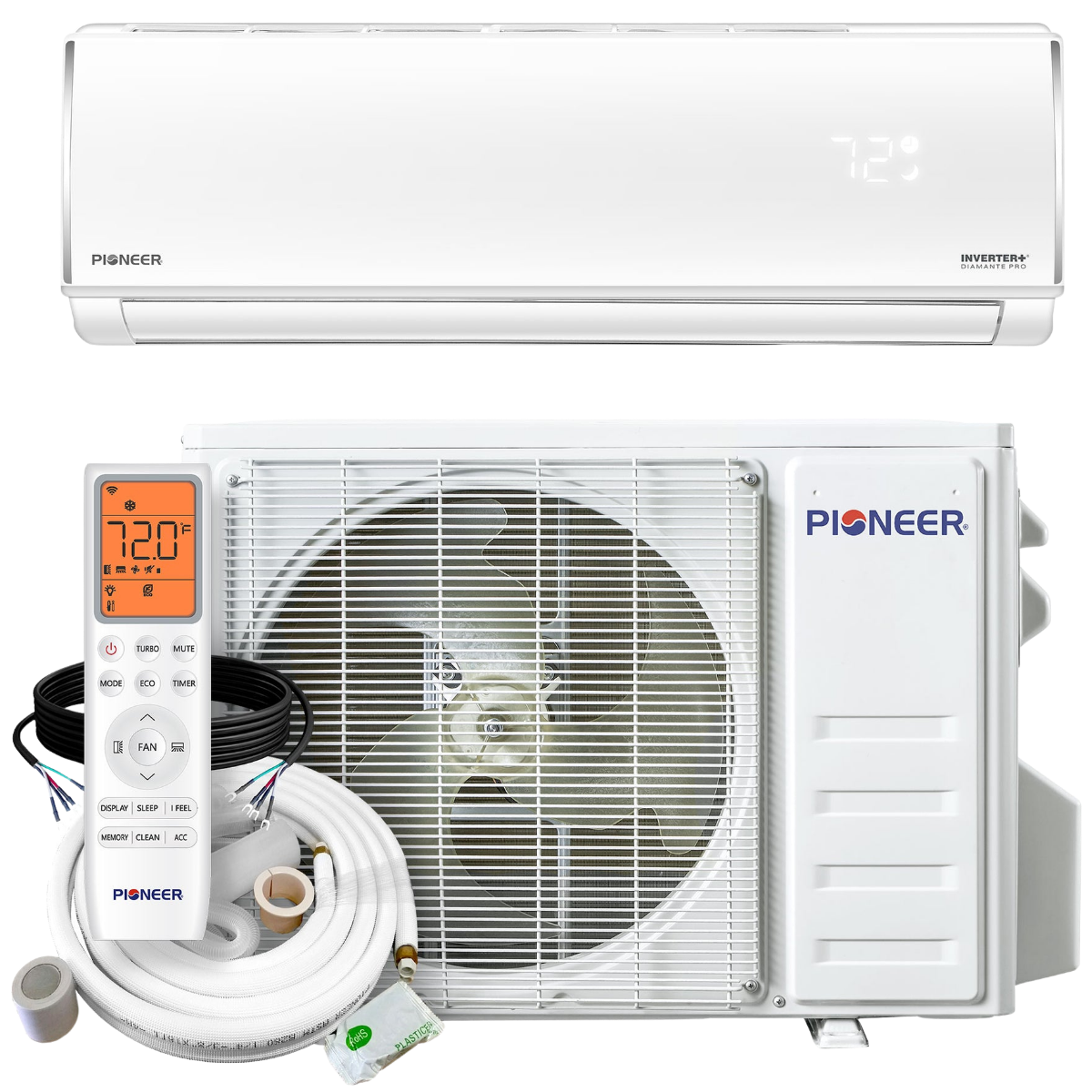
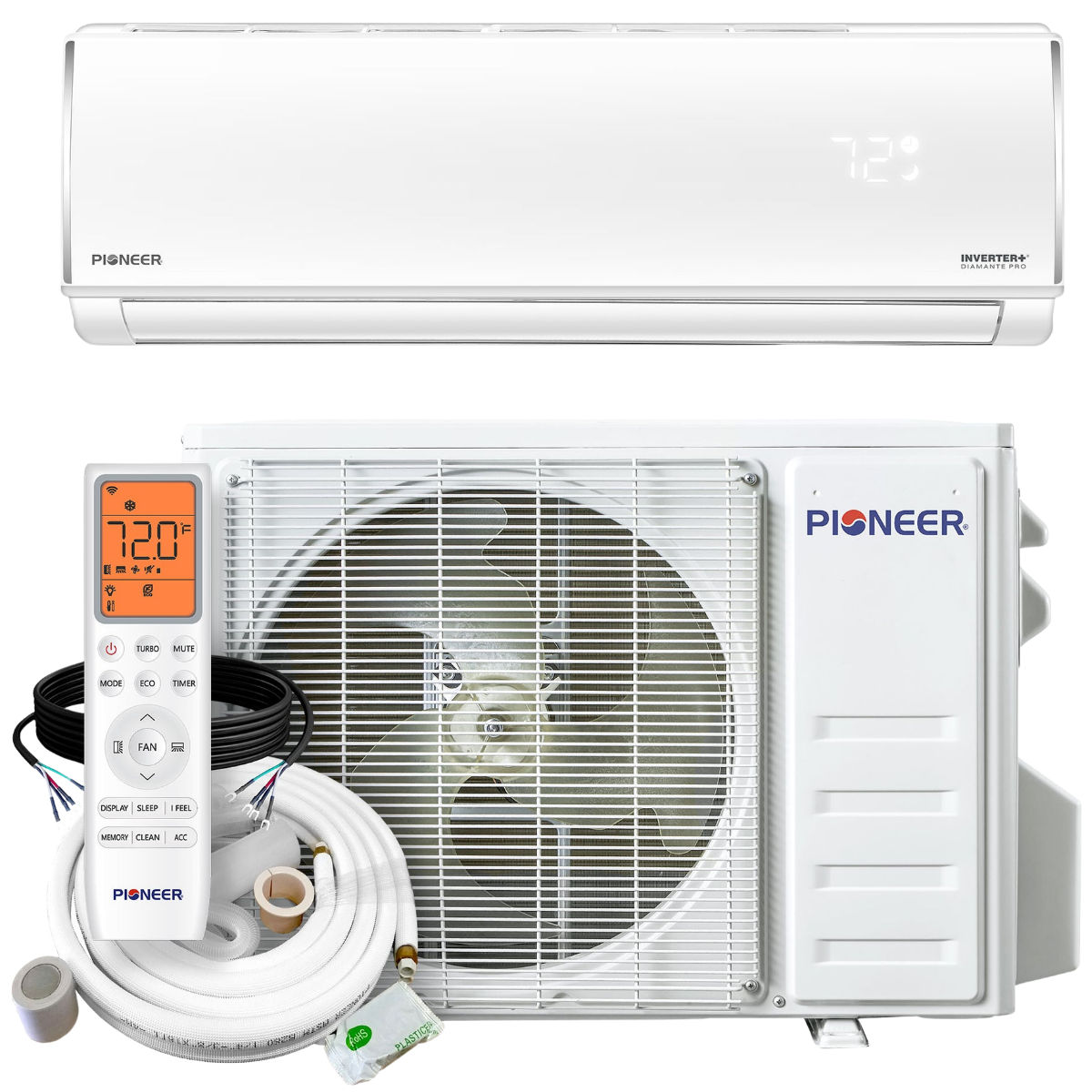
Pioneer Diamante Series 18,000 BTU Mini-Split Heat Pump (WYS018GMFI22RL)
Score: 8.8/10 — The Pioneer Diamante WYS018GMFI22RL delivers 22 SEER efficiency, whisper-quiet inverter operation, and dependable year-round heating and cooling at a price that undercuts most big-name single-zone systems, making it one of the best value mini-splits you can buy for a garage, sunroom, or large bedroom.
We may earn a commission from purchases made through links on this page, at no extra cost to you.
Overview
The Pioneer Diamante Series 18,000 BTU Mini-Split Heat Pump (model WYS018GMFI22RL) is a single-zone ductless system designed to heat and cool spaces of roughly 700 to 1,000 square feet, depending on insulation and climate. At its core is a variable-speed inverter compressor that continuously modulates output rather than cycling on and off, which translates into steadier room temperatures, lower noise, and meaningfully reduced energy bills compared with conventional window units or LG Dual Inverter Portable Heat Pump or older fixed-speed systems.
This model targets homeowners who want serious comfort in a space their central HVAC doesn't reach well — finished garages, sunrooms, home offices, master bedrooms, and additions are the classic use cases.
The Pioneer Diamante Series 18,000 BTU Mini-Split Heat Pump is ideal for these medium-to-large zones.
With a 22 SEER cooling rating, the Diamante sits comfortably in high-efficiency territory, and because it's a heat pump, it doubles as a primary heat source in mild-to-moderate winter climates.Pioneer has built a reputation as the value brand of the mini-split market; for those still deciding on capacity, check out our Pioneer WYS018GMFI22RL Mini-Split Heat Pump Buying Guide for a deeper dive into specs and requirements. You give up a few premium conveniences like built-in Wi-Fi on the base configuration, but the fundamentals — efficiency, build quality, and quiet operation — punch well above the price point. By eliminating the need for bulky ductwork, the WYS018GMFI22RL allows for "zonal" climate control, meaning you only pay to heat or cool the room you are actually using, rather than the entire house.
Key Features
Modulates capacity to match the load, holding temperatures within a degree of the setpoint while sipping electricity at partial output.
High-efficiency cooling performance that can cut energy costs substantially compared with window units and older split systems.
The system automatically switches between heating and cooling to maintain your target temperature — useful in shoulder seasons.
Multiple fan speeds plus a sleep mode that gradually adjusts temperature overnight for comfort and lower energy use.
Full-function remote handles mode, temperature, fan speed, louver direction, and timer settings from across the room.
One outdoor unit paired with one indoor air handler keeps installation straightforward and costs predictable.
| Feature | Value |
|---|---|
| Model | WYS018GMFI22RL |
| Capacity | 18,000 BTU/h |
| System type | Ductless mini-split heat pump (single zone) |
| Cooling efficiency | 22 SEER |
| Compressor | Variable-speed inverter |
| Modes | Cooling, heating, dehumidify, fan, auto-changeover |
| Fan | Multi-speed with sleep mode |
| Control | Wireless remote control |
| Recommended coverage | Approx. 700–1,000 sq ft (insulation dependent) |
| Typical applications | Garages, sunrooms, master bedrooms, additions |
Pros & Cons
Pros
- Excellent 22 SEER efficiency at a budget-friendly price
- Inverter compressor holds temperatures steady and runs quietly
- Heats and cools, replacing both a space heater and a dedicated AC
- Auto-changeover and sleep mode add real day-to-day convenience
- Strong value-to-performance ratio versus premium brands
Cons
- No built-in Wi-Fi or smart-home control on the base unit
- Professional installation is recommended for refrigerant work and warranty
- Heating output declines in severe sub-freezing climates
- Single-zone only — multi-room homes need additional systems
Performance
In day-to-day use, the WYS018GMFI22RL behaves exactly the way a good inverter mini-split should. Instead of the blast-and-coast cycle of a window unit, the compressor ramps up to pull the room to temperature, then settles into a low, nearly silent hum to hold it there. Temperature swings are minimal — typically within a degree of the setpoint — and the multi-speed fan lets you trade airflow for quietness when the room is occupied.
Cooling performance is where the 22 SEER rating shows its worth. An 18,000 BTU unit at this efficiency can cool a hot garage or sun-soaked addition quickly, and the dedicated dehumidify mode is genuinely useful in humid climates where moisture, not temperature, is the comfort problem (for extreme humidity, see our GE ADEL50LZ dehumidifier guide). Because the indoor unit is mounted high on the wall, it utilizes the natural physics of air (cool air sinks), ensuring that the entire room is cooled evenly rather than just the area immediately in front of the unit.
On the heating side, the Diamante performs well in mild and moderate winters. Like most standard heat pumps, its output tapers as outdoor temperatures fall well below freezing. For the garages, sunrooms, and bedrooms it's designed for, this is rarely a dealbreaker, but it is a critical consideration for those in the deep north who may need a supplemental heat source when temperatures drop below 20°F.
How it Works: The Inverter Advantage
To understand why the Pioneer Diamante WYS018GMFI22RL outperforms traditional air conditioners, you have to look at the inverter technology. Standard AC units use "on/off" compressors. When the room hits the target temperature, the compressor shuts off completely. When the temperature rises again, it kicks back on at 100% power. This creates a "sawtooth" temperature pattern and consumes significant energy during the startup spike.
The Diamante uses a variable-speed inverter. Think of this like a dimmer switch versus a standard light switch. The system can run at 20%, 50%, or 110% capacity depending on the immediate need. Once the room reaches 72 degrees, the inverter doesn't shut off; it simply slows down to the exact speed required to maintain that 72-degree mark. This results in three primary benefits:
- Energy Savings: Starting a motor is the most energy-expensive part of the cycle. By avoiding frequent restarts, the inverter drastically cuts power consumption.
- Consistent Comfort: There are no more "cold spots" followed by "hot bursts." The air delivery is a steady, gentle stream.
- Reduced Wear: Fewer start-stop cycles mean less mechanical stress on the compressor, which generally leads to a longer overall lifespan for the hardware.
The heat pump aspect utilizes a refrigeration cycle in reverse. By using a reversing valve, the unit absorbs heat from the outdoor air—even when it's cold—and pumps it inside. This is vastly more efficient than electric resistance heating (like a space heater), which converts electricity directly into heat and is often the most expensive way to warm a room. The WYS018GMFI22RL is essentially moving heat from one place to another rather than creating it from scratch.
Installation and Setup Process
Installing a mini-split is a significant home improvement project. While some brands market "DIY" kits (see our MrCool DIY-24-HP-WIF115 buying guide), the WYS018GMFI22RL is a professional-grade unit. To ensure the 22 SEER efficiency is actually achieved and the warranty remains intact, a licensed HVAC technician is highly recommended. The process is broken down into several critical phases. (For those upgrading a room's overall efficiency, you may also want to check out our Rockwool Safe 'n' Sound review for sound-proofing and insulation tips).
Phase 1: Site Selection
The indoor air handler should be mounted on an interior wall, ideally high up to allow the cool air to sink and the warm air to rise. Avoid placing the unit directly above a door or in a corner where airflow is obstructed. The outdoor condenser needs a flat, stable surface—typically a concrete pad or heavy-duty plastic brackets—with at least 12-24 inches of clearance for airflow and technician access. Proper placement prevents "short-cycling," where the unit breathes its own exhausted air, killing efficiency.
Phase 2: Physical Mounting
The installer will mount the wall bracket for the indoor unit and drill a 3-inch hole through the wall for the "line set" (the copper pipes and electrical cables). The outdoor unit is then positioned and secured. If the unit is being installed in a garage, ensure the outdoor section is placed away from areas where cars might accidentally nudge it. The angle of the hole is critical; it must slope slightly downward toward the outside to allow condensation to drain via gravity.
Phase 3: The Vacuum and Charge
This is the most critical step of the installation. The copper lines must be vacuumed using a specialized pump to remove all air and moisture from the system. If moisture remains in the lines, it can freeze or react with the refrigerant, leading to compressor failure within a few years. Once the vacuum is held and the system is pressure-tested for leaks, the technician releases the refrigerant charge into the lines. Skipping this step is the primary cause of "early death" in budget mini-splits.
Long-term Maintenance Guide
The longevity of your Pioneer Diamante depends almost entirely on how well you maintain the air filters and the outdoor coils. Because this is a high-efficiency system, any restriction in airflow will force the inverter to work harder, reducing efficiency and increasing noise.
Indoor Unit Care
The indoor air handler contains reusable plastic mesh filters. These should be slid out and rinsed with lukewarm water every 2-4 weeks, depending on whether you have pets or high dust levels. A clogged filter restricts airflow, which can cause the evaporator coils to get too cold and "ice over." This icing blocks the air and can eventually cause water to drip down your wall, potentially damaging your drywall.
Outdoor Unit Care
The outdoor condenser is essentially a giant radiator. Over time, it will collect cottonwood seeds, dried leaves, and dust. Once a year, preferably in the spring before the cooling season starts, use a garden hose to gently rinse the debris out of the coils. Important: Do not use a pressure washer, as the high-pressure stream can bend the delicate aluminum fins, which permanently restricts airflow and lowers the SEER rating. Cleaning the coils ensures the unit can "dump" heat efficiently during the summer.
Drain Line Management
Condensation is a byproduct of cooling. The unit pumps this water out through a PVC drain line. Ensure the line has a slight downward slope and that the exit point is clear of debris. In some climates, this line may freeze during winter heating cycles (where the unit acts as a dehumidifier for the outdoors), which is normal, but the drain pan must remain clear to prevent internal leaking.
Buyer's Guide: Is the 18,000 BTU Model Right for You?
Choosing the right BTU rating is the difference between a comfortable room and a wasted investment. The Pioneer Diamante WYS018GMFI22RL is an 18,000 BTU unit, which puts it in the "medium-large" category for single-zone systems. Here is how to determine if this specific capacity is the right fit for your project.
Calculating Your Space Needs
The general rule of thumb for HVAC is that 20 to 30 BTUs are needed per square foot. For a standard room with average ceilings and decent insulation, 18,000 BTUs comfortably cover 600 to 900 square feet. However, "real world" variables change this math significantly:
- Poor Insulation: If you are installing this in a garage with uninsulated walls or a room with old single-pane windows, you may need to derate the coverage to 500–700 sq ft.
- Ceiling Height: If you have vaulted ceilings (12ft+), you are cooling a larger volume of air, not just a larger floor area. Account for this by choosing a higher BTU unit.
- Heat Loads: A sunroom with south-facing glass is a "heat trap." The solar gain can add the equivalent of 3,000 to 5,000 BTUs of load, meaning an 18,000 BTU unit might be necessary for a room that is only 400 sq ft.
Comparing to Lower and Higher BTU Models
If you go too small (e.g., a Senville LETO Series 12,000 BTU Mini-Split Air Conditioner and Heat Pump in a 1,000 sq ft space), the system will run at 100% capacity indefinitely. This kills the energy savings of the inverter and puts immense wear on the compressor. Conversely, if you go too large (e.g., a 24,000 BTU unit in a small bedroom), the system will "short cycle." Even with an inverter, an oversized unit can struggle to remove humidity properly because it cools the air so quickly that it doesn't run long enough to pull moisture out of the air, leaving the room feeling cold and clammy.
Comparing the Pioneer Diamante to the Competition
When shopping for mini-splits, users typically choose between three tiers: budget DIY brands, value-driven professional brands like Pioneer, and premium luxury brands like Mitsubishi Ductless Mini-Split Heat Pump 15000 BTU Single Zone or Daikin 17 SEER Single-Zone Ductless Mini-Split Heat Pump 12000 BTU with WiFi (see our Daikin RXB12AXVJU buying guide). Here is how the WYS018GMFI22RL stacks up.
Pioneer vs. Budget DIY Brands
DIY brands often use fixed-speed compressors or very basic inverters. They often lack the build quality of the Diamante's outdoor unit and typically offer shorter warranties. While a MrCool DIY 24000 BTU Ductless Mini-Split Heat Pump with Wi-Fi is cheaper upfront, the Pioneer Diamante's 22 SEER efficiency usually pays for the price difference in electricity savings within two to three years. Furthermore, the Diamante's components are designed for professional installation, meaning they are more robust and have better tolerance for varying electrical loads.
Pioneer vs. Premium Luxury Brands
Premium brands offer "hyper-heating" (keeping full capacity at -15°F) and integrated smart-home ecosystems. The WYS018GMFI22RL does not have these features, which you will find in high-end models like the Bosch Ductless Mini-Split Heat Pump 18000 BTU Cold Climate Single Zone. However, the price of a premium 18,000 BTU system (detailed in the Bosch BMS500-18HDN1 Mini-Split Heat Pump Buying Guide) can be double or triple that of the Pioneer. For a garage or a guest room, the marginal increase in extreme-cold performance doesn't justify the massive price jump. The Diamante provides 90% of the performance for 50% of the cost.
Potential Pitfalls and Common Mistakes
Even high-quality hardware like the WYS018G