Choosing the right bathroom exhaust fan CFM rating requires matching airflow to your room’s square footage, fixtures, and duct layout. To balance power and noise, selecting a high-performance model like the Panasonic WhisperGreen Select review is critical for preventing mold. When upgrading your ventilation alongside Delta Essa bath fixture guide, matching the CFM to your specific layout is essential for maintaining indoor air quality. CFM stands for “cubic feet per minute,” and it tells you how much air the exhaust fan can move. Too little CFM leaves moisture, odors, and fog behind; too much CFM can be noisier, less efficient, and harder to duct properly. The goal is a fan that clears shower humidity consistently without creating unnecessary noise or ventilation problems.
Quick Answer
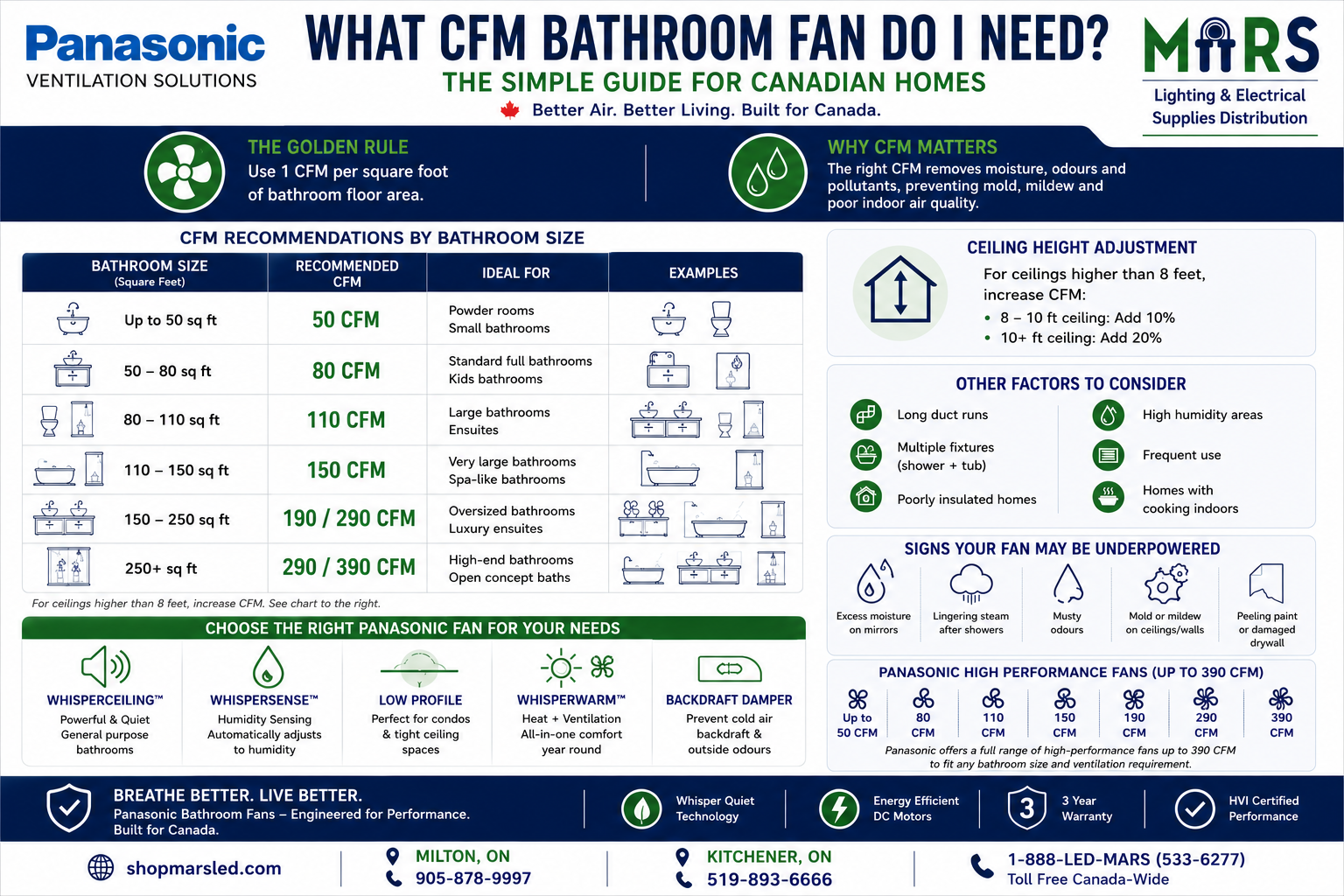
For most bathrooms up to 100 square feet, choose a bathroom fan rated at about 1 CFM per square foot, with 50 CFM as a common minimum. For bathrooms over 100 square feet, size the fan by fixture, then adjust for duct length, ceiling height, and noise rating before choosing the final fan.
- Small bathrooms: about 1 CFM per square foot.
- Common minimum: 50 CFM.
- Large bathrooms: add 50 CFM each for a toilet, shower, or bathtub, and 100 CFM for a jetted tub.
- Final check: round up to a common fan size only after considering duct length, duct diameter, and sone rating.
What CFM Means for a Bathroom Fan
CFM measures airflow: the higher the number, the more air the fan can exhaust in one minute. In a bathroom, that airflow removes humid air from showers and baths, helps reduce mirror fog, and lowers the risk of managing moisture in damp rooms such as peeling paint, mildew, and swollen trim.
The goal is not simply to buy the highest-CFM fan available. The right fan should move enough air for the bathroom while still being quiet, efficient, and compatible with the ductwork. For high-performance options, see our Panasonic WhisperGreen Select buying guide or the Hunter Comfort Select review.
Step 1: Measure the Bathroom
Start by measuring the room’s floor area. Multiply the length by the width to get square footage.
For example, a bathroom that is 8 feet long and 6 feet wide is 48 square feet:
8 × 6 = 48 square feet
For standard bathrooms with typical ceiling heights, square footage is usually enough to estimate CFM. If your bathroom has unusually high ceilings, you may need to increase the rating because there is more air volume to exchange.
Step 2: Use the Basic CFM Rule for Bathrooms Up to 100 Square Feet
For bathrooms up to 100 square feet, use this simple rule:
- Minimum airflow: 1 CFM per square foot of bathroom area.
- Common minimum: 50 CFM for most small bathrooms and powder rooms.
- Example: a 60-square-foot bathroom generally needs about 60 CFM.

That means a 60-square-foot bathroom generally needs a fan rated around 60 CFM. A 90-square-foot bathroom generally needs about 90 CFM.
Practical Tip
If the calculation lands between common fan sizes, round up to the next available rating. For example, if your bathroom needs 72 CFM, an 80 CFM fan is usually the better choice.
Common Bathroom Sizes and Suggested CFM
| Bathroom Size | Suggested Fan Rating |
|---|---|
| Small powder room, 35–50 sq. ft. | 50 CFM |
| Standard full bath, 50–70 sq. ft. | 50–70 CFM |
| Medium bathroom, 70–90 sq. ft. | 70–90 CFM |
| Large bathroom, 90–100 sq. ft. | 90–100 CFM |
Step 3: Size Large Bathrooms by Fixtures
For bathrooms larger than 100 square feet, a fixture-based method is usually more accurate. If you are also updating hardware, comparing budget faucet options can help manage your renovation costs. When updating your space with new fixtures like the Delta Essa modern bath series or a Kohler Artifacts buying guide, remember to add the recommended CFM for each major item in the room.
| Fixture | Add This Much CFM |
|---|---|
| Toilet | 50 CFM |
| Shower | 50 CFM |
| Bathtub | 50 CFM |
| Jetted tub | 100 CFM |
For example, a large primary bathroom with a toilet, shower, and bathtub would need about 150 CFM. If it also has a jetted tub, the total may be closer to 200 CFM.
Step 4: Adjust for Duct Length and Layout
The rated CFM on the fan assumes it can move air efficiently through the duct. Long duct runs, sharp turns, undersized ductwork, and restrictive exterior vents can reduce real-world airflow.
If your fan needs to exhaust through a long duct or several elbows, consider choosing a slightly higher CFM rating or improving the duct path. Smooth, short, properly sized ductwork helps the fan perform closer to its rating; crushed flex duct, tight elbows, and undersized termination caps can make an otherwise correct CFM rating perform like a weaker fan. Do not rely on extra CFM alone to fix a restrictive duct run—verify the fan’s recommended duct size and keep the exhaust path as direct as possible.
Do Not Vent Into an Attic
A bathroom fan should exhaust outdoors, not into an attic, crawlspace, soffit cavity, or wall cavity. Dumping humid air into enclosed spaces can cause condensation, mold, and structural damage (similar to the risks of water in wet basements), which can compromise the effectiveness of your Rockwool Safe 'n' Sound insulation—a critical component for soundproofing and thermal control.
Duct Layout Rule of Thumb
Shorter and straighter is better. If you are managing overall home climate and ventilation, you might also consider the efficiency tips found in our MrCool DIY Mini-Split ventilation guide. If the duct route is long, has multiple elbows, or uses a small termination cap, prioritize correcting the airflow path before simply buying a much larger fan. For those integrating full-home climate control, our Bosch Mini-Split guide offers further insight into efficient air management.
Step 5: Consider Ceiling Height
Most quick CFM calculations assume a standard ceiling height of about 8 feet. If your bathroom has a high ceiling, the room contains more air, so the fan may need a higher rating.
One way to estimate this is to calculate room volume:
Length × width × ceiling height = cubic feet
For a more precise high-ceiling estimate, use CFM = room volume × desired air changes per hour ÷ 60. Many bathrooms are planned around roughly 8 air changes per hour, so a 10 × 8 bathroom with a 10-foot ceiling is 800 cubic feet: 800 × 8 ÷ 60 = about 107 CFM. For typical 8-foot ceilings, the square-foot rule is simpler, but high ceilings are a good reason to round up.
Step 6: Do Not Ignore Noise Rating
CFM is airflow, but noise matters too. Bathroom fan noise is commonly rated in sones. A lower sone rating means a quieter fan.
A very quiet fan, such as those found in the Panasonic WhisperGreen Select series or the Hunter Comfort Select buying guide, may be rated around 0.3 to 1.0 sones, while louder fans may be 2.0 sones or higher. For bathrooms used at night or near bedrooms, a quieter model—like the real-world performance analyzed in our Panasonic WhisperGreen Select review—is usually worth prioritizing because people are more likely to leave a quiet fan running long enough to clear moisture.
Other Features to Consider
Automatically turns the fan on or boosts airflow when humidity rises.
Keeps the fan running after a shower so moisture continues to clear. If you want bathroom fan schedules or humidity-triggered routines tied into the rest of your home, consider a high-feature model like those in our Panasonic WhisperGreen Select guide or see the real-world performance in our Panasonic WhisperGreen Select review.
Efficient fans use less power, especially in bathrooms where the fan runs often. For those looking to improve overall home air quality and efficiency, combining a good exhaust fan with a Filtrete MERV-12 air filter review is a smart strategy for controlling humidity in damp rooms and overall home air quality.
Make sure the fan outlet matches or works with your existing duct size without choking airflow.
How Long Should a Bathroom Fan Run?
Even with the right CFM rating, the fan needs enough runtime to remove moisture. A good rule is to run the fan during the shower or bath and keep it running for about 15 to 20 minutes afterward.
If the mirror remains foggy, walls feel damp, or condensation lingers on windows, the fan may be undersized, poorly ducted, or not running long enough. If humidity problems extend beyond the bathroom, a dehumidifier can help nearby spaces, but it is not a substitute for a fan that vents outdoors; compare options in our GE ADEL50LZ dehumidifier guide or see if a specific model is worth it in our review of the GE 50-pint dehumidifier to manage overall room humidity.
Signs Your Bathroom Fan CFM Is Too Low
- Mirror fog remains long after showering.
- Paint bubbles, peels, or stains near the ceiling.
- Mildew appears around the shower, ceiling, or trim.
- The room feels humid after the fan has been running.
- Odors linger longer than expected.
Signs Your Bathroom Fan May Be Too Powerful
- The fan is noticeably loud or disruptive.
- It pulls conditioned air from the home unnecessarily.
- The ductwork whistles, rattles, or struggles with airflow.
- Exterior dampers flap loudly in windy conditions.
A slightly oversized fan is usually fine, especially if the bathroom is humid or heavily used. However, extreme oversizing can create noise and comfort issues without improving ventilation much.
Bathroom Fan CFM Recommendation
For bathrooms up to 100 square feet, start with 1 CFM per square foot and round up to a common fan size. For bathrooms over 100 square feet, add CFM by fixture. Then check the duct length, ceiling height, and noise rating before making a final choice. The best bathroom exhaust fan is not just powerful enough on paper; it must also be quiet, properly ducted, and used long enough to clear moisture.
Looking for a real-world test? See our Panasonic WhisperGreen Select review.
- Best default: 1 CFM per square foot for most bathrooms up to 100 square feet.
- Best upgrade reason: long duct runs, high ceilings, or heavy shower use.
- Best comfort check: choose a low-sone fan so it is not too annoying to run after showers.
FAQ
Is 50 CFM enough for a bathroom?
Yes, 50 CFM is often enough for a small bathroom or powder room. For larger full bathrooms, calculate the square footage and choose about 1 CFM per square foot.
Can I use a 100 CFM fan in a small bathroom?
You can, but it may be louder than necessary and may remove conditioned air faster than needed. If the bathroom has frequent moisture problems, a higher CFM fan can help, but ducting and runtime are just as important.
Is a higher CFM bathroom fan always better?
No. A higher CFM rating can help in humid, heavily used, or poorly ventilated bathrooms, but oversizing can add noise, pull out conditioned air, and stress undersized ductwork. Choose enough airflow for the room, then make sure the duct path and sone rating are appropriate.
What CFM do I need for a bathroom with a shower?
For a bathroom under 100 square feet, use the 1 CFM per square foot rule. For a larger bathroom, add 50 CFM for the shower plus the recommended CFM for each other fixture.
Does a bathroom fan need to vent outside?
Yes. A bathroom exhaust fan should vent outdoors. Venting into an attic or enclosed cavity can move moisture into hidden spaces and cause damage.
Should I round up or down when choosing CFM?
Round up to the next common fan size. For example, if your calculation suggests 68 CFM, choose a 70 or 80 CFM fan rather than a lower-rated option.
What sone rating should I look for in a bathroom fan?
For most bathrooms, a fan around 1.0 sone or lower will feel noticeably quiet. Higher-CFM fans can still be quiet, but compare both the CFM and sone rating so you do not solve moisture problems with a fan that is too loud to use consistently.
What CFM do I need for a 5 × 8 bathroom?
A 5 × 8 bathroom is 40 square feet, so 40 CFM is the basic calculation. Because 50 CFM is a common minimum bathroom fan size, a 50 CFM fan is usually the right starting point if the duct run is short and properly sized.