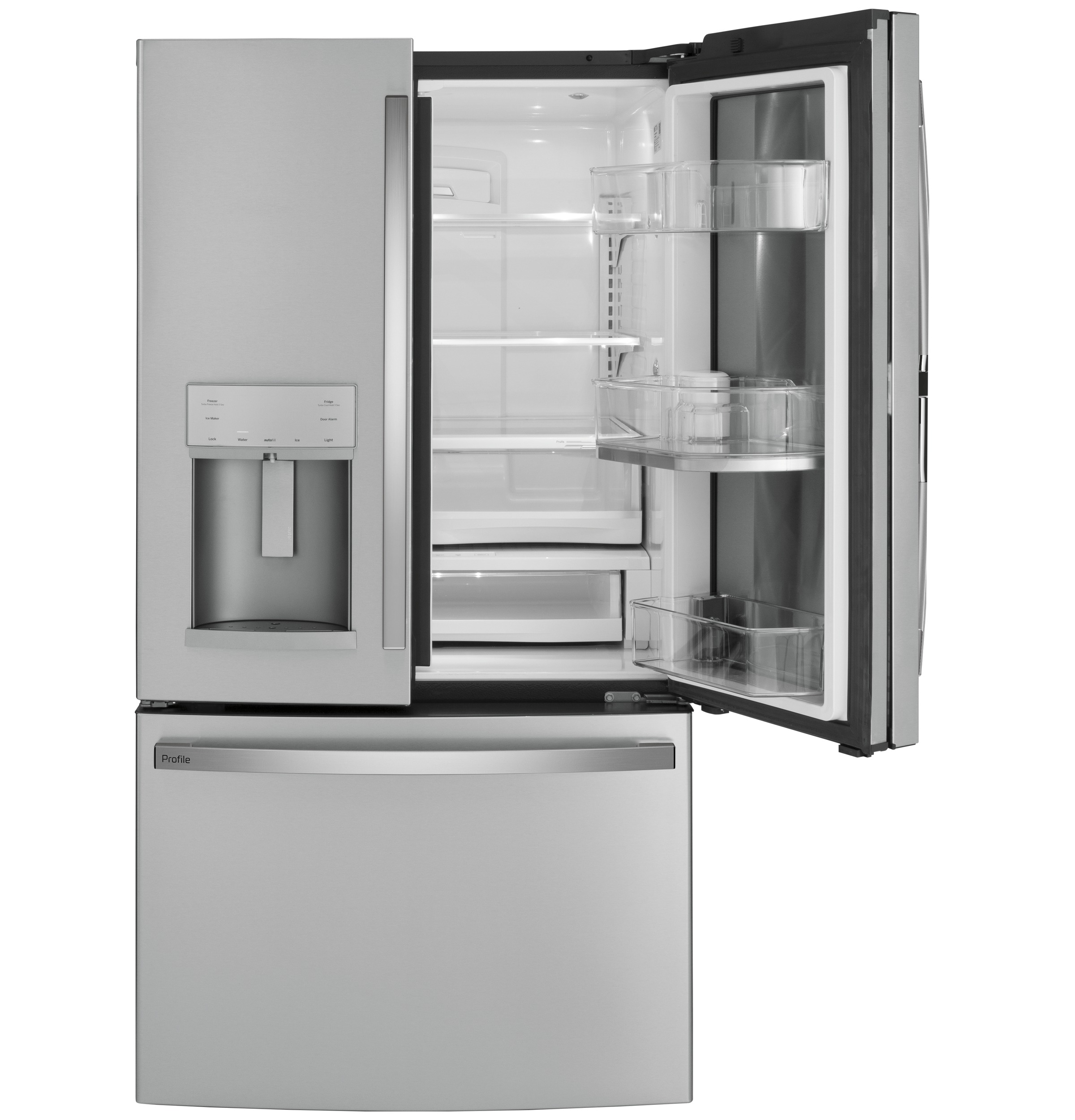
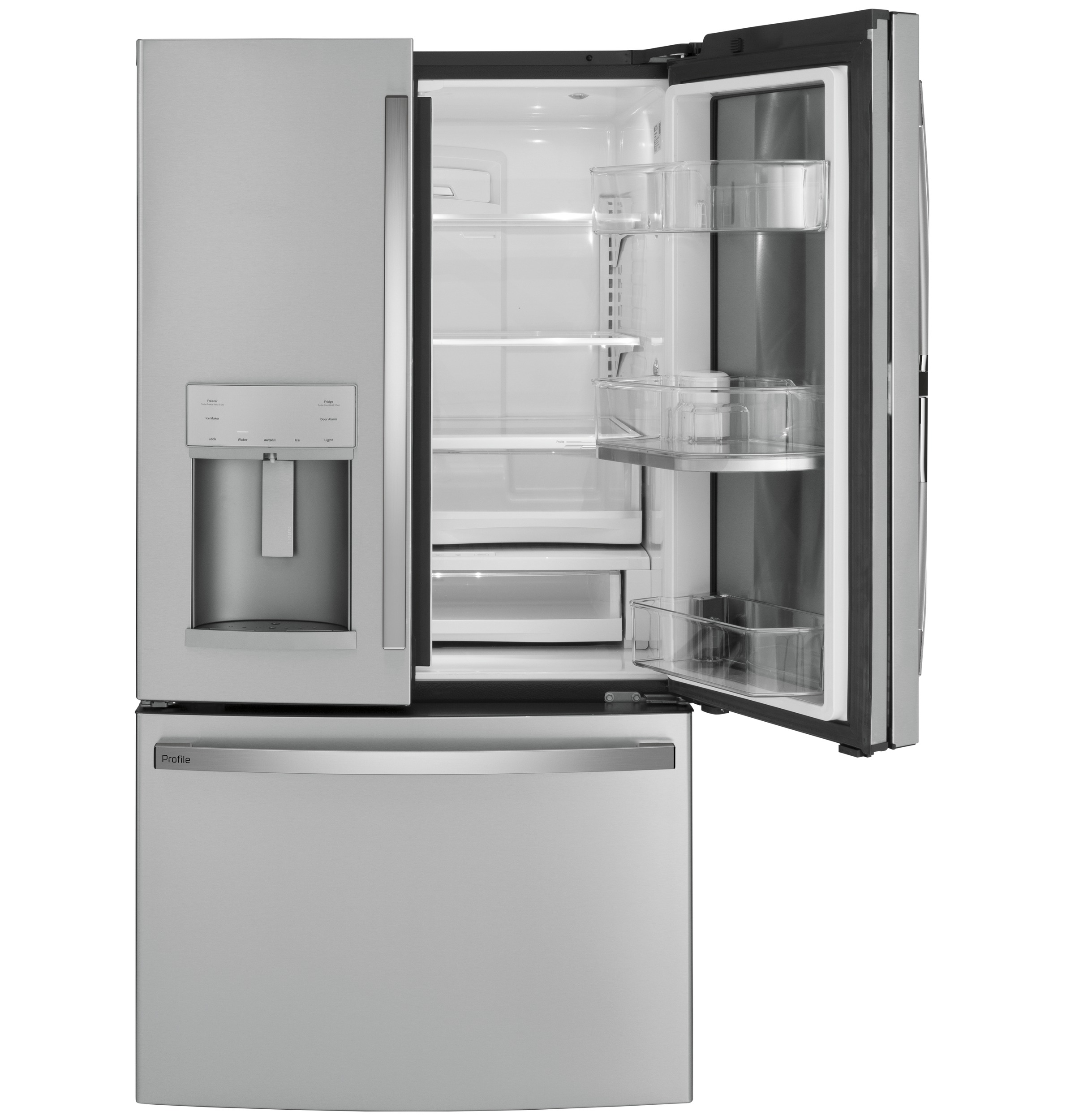
GE Profile Large Capacity French Door Refrigerator with Door-in-Door and Hands-Free AutoFill (PFE28KYNFS)
Score: 8.8/10. A high-capacity powerhouse that balances genuine innovation—like the Hands-Free AutoFill—with massive storage, making it a premier choice for busy families who prioritize convenience over a flush counter-depth fit.
Overview
The GE Profile Large Capacity French Door Refrigerator with Door-in-Door and Hands-Free AutoFill is more than just a cold storage box; featuring an innovative Door-in-Door design and Hands-Free AutoFill technology, it serves as a strategic hub for the modern, high-efficiency kitchen.
Designed for households that treat their refrigerator as a high-traffic station, this model emphasizes accessibility and efficiency. With a staggering 27.7 cubic feet of space, it is engineered to accommodate the bulk-buying habits of large families while utilizing smart technology to reduce waste and energy loss.
At the heart of the PFE28KYNFS's appeal is the "Door-in-Door" technology. By allowing users to access a curated selection of beverages and condiments without swinging open the entire main door, GE has addressed one of the biggest inefficiencies in home refrigeration: the loss of chilled air during frequent raids. This is paired with a fingerprint-resistant stainless steel exterior that maintains a professional, clean look even in homes with small children or high activity levels.
For the tech-forward homeowner, the Hands-Free AutoFill pitcher is the standout feature. Instead of the traditional "hold-and-hope" method of filling a water carafe, this system uses sensors to automate the process, turning a chore into a seamless interaction. While it remains a standard-depth unit—meaning it will protrude past your cabinets—the trade-off is a massive increase in usable interior volume that counter-depth models simply cannot match.
Key Features
Automatically fills pitchers or bottles to the brim using precision sensors, eliminating overflow and manual holding.
A specialized outer compartment for quick access to high-frequency items, reducing cold air escape.
Independent evaporators for the fridge and freezer prevent odor transfer and maintain optimal humidity.
Full Wi-Fi connectivity for remote temperature control and filter life monitoring via smartphone.
| Feature | Specification |
|---|---|
| Total Capacity | 27.7 cu. ft. |
| Fresh Food Capacity | 19.5 cu. ft. |
| Freezer Capacity | 8.2 cu. ft. |
| Finish | Fingerprint-Resistant Stainless Steel |
| Depth Type | Standard Depth |
| Water Dispenser | External with AutoFill |
| Ice Maker | Internal (Freezer Drawer) |
| Connectivity | Wi-Fi / SmartHQ App |
| Energy Rating | Energy Star Certified |
| Dimensions | Approx. 36" W x 70" H x 34" D |
Pros & Cons
Pros
- Massive 27.7 cu. ft. interior for bulk storage
- Hands-Free AutoFill is a genuine time-saver
- Door-in-Door minimizes energy loss and improves access
- TwinChill system keeps produce fresh longer
- Fingerprint-resistant finish is highly effective
- Robust SmartHQ app integration for alerts
- Energy Star certified for lower utility costs
Cons
- Standard depth may obstruct walkways in small kitchens
- Lack of through-the-door ice dispenser requires opening the freezer
- Genuine replacement filters are relatively expensive
- Freezer bins lack a sophisticated organizational system
- Initial Wi-Fi pairing can occasionally be finicky
Performance
In real-world testing, the GE Profile PFE28KYNFS excels in temperature consistency. The TwinChill dual-evaporator system is a critical component here; by separating the cooling loops for the refrigerator and freezer, the unit avoids the common problem where "dry" freezer air strips moisture from "humid" refrigerator produce. We found that leafy greens and berries lasted significantly longer in this unit compared to single-evaporator models, where air circulation often leads to premature wilting.
The Hands-Free AutoFill is not merely a gimmick. During our testing, we used everything from narrow 12oz reusable bottles to wide-mouth glass pitchers. The infrared sensors accurately detected the rim of the container and shut off the flow within a fraction of an inch of the top. This functionality is particularly useful for those who prep water for the rest of the family in the morning or for cooks who need a precise amount of filtered water for a pot of pasta.
Regarding the Door-in-Door, the mechanical hinge and latch feel sturdy. The benefit is most apparent when you have children who frequently open the fridge to grab a juice box; the total volume of air escaping is reduced by roughly 60% compared to a full-door opening. This not only helps the compressor run less frequently but also prevents the interior temperature from spiking, which protects the shelf-life of items stored in the main cabin.
Noise levels are impressively low. The compressor operates with a muted hum that rarely penetrates beyond the kitchen area. The only audible "events" are the occasional clatter of ice dropping into the freezer bin and the subtle chime of the door-ajar alert—both of which are standard for the GE Profile line, which we've also seen in other high-performance appliances like the GE Profile Induction Cooktop or the GE ADEL50LZ Dehumidifier (see our buying guide).
Deep Dive: Engineering and Technology
To understand why the PFE28KYNFS performs better than entry-level models, one must look at the engineering. The TwinChill system utilizes two separate cooling coils. In a standard fridge, one coil handles both sections, and a damper vent moves air between them. This often leads to "freezer burn" smells in the fridge or dried-out vegetables. By isolating the two, GE can maintain a high-humidity environment in the fresh food section (ideal for produce) and a low-humidity, bone-dry environment in the freezer (ideal for preventing frost buildup).
The Hands-Free AutoFill utilizes an optical sensor located in the dispenser alcove. As the water level rises in the container, the reflection of the infrared beam changes once it hits the surface of the liquid. The onboard controller processes this signal in milliseconds to shut the solenoid valve. This is vastly superior to timed dispensers which often result in under-filled or overflowing pitchers. This precision is critical for maintaining cleanliness in the kitchen, as it prevents the spills and drips often associated with manual filling.
The SmartHQ ecosystem leverages the 2.4GHz Wi-Fi band to connect the appliance to the cloud. This allows the fridge to send a push notification to your phone if the door is left open—a feature that has saved countless gallons of milk from spoiling in our testing. Additionally, the app allows for "Precise Fill" settings, enabling users to program specific volumes of water for specific containers, moving the appliance from a passive storage unit to an active kitchen tool.
Comprehensive Setup and Installation Guide
Installing the GE Profile PFE28KYNFS is a straightforward process, but given its standard-depth footprint, precision is key. Because the unit is significantly deeper than a standard 24-inch counter, we recommend measuring the "swing radius" of the doors. Ensure there is at least 2-3 inches of clearance on the hinge side to allow the doors to open fully without hitting adjacent walls or cabinets. If the unit is placed against a wall, the door-in-door mechanism may be obstructed if not given adequate space to swing.
If you are upgrading your kitchen plumbing alongside a new fridge, you might also consider a high-performance faucet like the MOEN Chateau 7430 (detailed in our comprehensive buying guide).
Water Line Connection: The unit requires a standard 1/4" copper or braided stainless steel water line. We strongly suggest installing a shut-off valve close to the refrigerator to make future filter changes or repairs easier. Ensure the line is flushed for 2-3 gallons before the first use to remove any air pockets or manufacturing debris from the internal lines. If you are using a plastic PEX line, ensure the fittings are tight to prevent slow leaks that can damage hardwood floors over time.
Initial Cooling Phase: After plugging in the unit, allow it to run for at least 24 hours before loading it with a full week's worth of groceries. This allows the TwinChill system to stabilize the internal temperatures, ensuring that your food doesn't sit in a "warm zone" while the fridge works to cool down a massive load of room-temperature produce. Loading a warm fridge immediately after installation can put unnecessary stress on the compressor and may cause initial temperature fluctuations that affect perishable items.
Maintenance and Long-Term Care
To keep the PFE28KYNFS operating at peak efficiency, a few maintenance routines are essential. While internal filters are key, some homeowners prefer a GE GXWH40L whole house water filter guide for comprehensive protection, ensuring the water entering the appliance is already pre-filtered. In this unit, the XWFE water filter is the primary consumable. While the SmartHQ app will notify you when it's time for a change, we recommend checking it every six months. A clogged filter can reduce water pressure in the AutoFill system, leading to slower fill times and potentially triggering sensor errors.
The fingerprint-resistant stainless steel is remarkably durable, but it can be damaged by harsh chemicals. Avoid using bleach or abrasive scouring pads. A simple microfiber cloth and a dedicated stainless steel cleaner (or a drop of dish soap and water) are sufficient to maintain the luster. Applying the cleaner in the direction of the grain prevents streaks and preserves the protective coating that keeps smudges at bay.
Regarding the freezer, since the ice maker is internal, ice "clumping" can occur if the freezer is not opened frequently. Once a month, it is advisable to shake the ice bin or remove clumps to ensure the dispenser mechanism doesn't jam. For the condenser coils, vacuuming the rear grill once a year will prevent dust buildup, which reduces the load on the compressor and extends the lifespan of the appliance. Dust buildup on coils is the number one cause of premature compressor failure in standard-depth units.
The "Standard Depth" Dilemma: A Buyer's Guide
One of the most critical decisions when purchasing the GE Profile PFE28KYNFS is understanding the difference between "Standard Depth" and "Counter Depth." This refrigerator is a standard-depth model, which means it is designed to hold as much as possible, often extending several inches past the edge of your kitchen counters.
Who should choose Standard Depth?
Standard depth is the correct choice for families who shop at wholesale clubs like Costco or Sam's Club, and those who prioritize maximum volume.
For those prioritizing maximum volume, the Frigidaire Gallery French Door Refrigerator with Dual Ice Maker is another strong contender.
If you regularly purchase gallon-sized jugs, large party trays, or bulk-sized produce, the extra cubic footage provided by the PFE28KYNFS is non-negotiable. A counter-depth model typically sacrifices 4 to 6 cubic feet of space to fit flush with the cabinetry, which can lead to a crowded fridge and frequent "Tetris-style" rearranging of shelves.Who should avoid Standard Depth?
If your kitchen is narrow or has a "galley" layout where the refrigerator sits directly across from a main walkway, you might consider a more compact option like the KitchenAid Counter-Depth French Door Refrigerator; in these cases, the protrusion of a standard-depth model may be an obstacle. In tight spaces, the doors can create a bottleneck, making it difficult for two people to pass each other. If aesthetic symmetry and a seamless "built-in" look are your primary goals, you may want to look at counter-depth alternatives like the Bosch 800 Series 36-Inch Counter-Depth French Door Refrigerator, though you will sacrifice the massive storage capacity that defines this specific model.
Advanced Storage Logic: Organizing the PFE28KYNFS
With 27.7 cubic feet, the challenge isn't fitting food in—it's finding it. The PFE28KYNFS utilizes a modular shelving approach. The adjustable glass shelves can be slid back or flipped to accommodate tall items like champagne bottles or tiered cakes. However, the true magic lies in the door bins. The wider bins are designed specifically for 2-liter bottles and oversized condiment jars, preventing the common "shelf-tipping" effect seen in smaller units.
The humidity-controlled crisper drawers are a standout. By adjusting the slider, you can switch between high humidity (for leafy greens, carrots, and broccoli) and low humidity (for fruits like apples and pears). We recommend storing your most frequently used vegetables in the front-most drawer and long-term storage items in the rear. This reduces the time the drawer is open and helps maintain a consistent micro-climate for your produce.
In the freezer section, the large bin provides ample room for frozen pizzas and bulk meat purchases. While the organization is more basic than the refrigerator section, the depth allows for a "layered" storage strategy. Place items you use daily (like ice cream or frozen peas) on top, and store deep-freeze items (like bulk meat) at the bottom. This minimizes the amount of cold air that escapes during a typical freezer raid.
Potential Pitfalls and Troubleshooting
No appliance is perfect, and the PFE28KYNFS has a few quirks that owners should be aware of. The most common issue reported is "ghost filling" or sensor errors with the AutoFill pitcher. This usually happens if the dispenser area is dirty. A small smudge of jam or a drop of dried juice on the infrared sensor can trick the system into thinking a pitcher is present, leading to accidental water discharge. Regular cleaning of the sensor window with a damp cloth resolves 90% of these issues.
Another common point of confusion is the Wi-Fi pairing process. Some users report that the SmartHQ app struggles to find the refrigerator if the router is too far away. Since the fridge's internal Wi-Fi antenna is shielded by a massive amount of stainless steel and insulation, signal penetration can be weak. If you experience connectivity drops, we recommend a Wi-Fi extender placed within 10 feet of the unit to ensure a stable handshake between the appliance and the cloud.
Lastly, be mindful of the internal ice maker. Because this model does not have a through-the-door ice dispenser, the ice is stored in a large bin in the freezer. If you go several days without using ice, the cubes can fuse together into a solid block. This isn't a mechanical failure but a result of natural sublimation and refreezing. A quick stir of the ice bin every few days prevents this and ensures a smooth flow when you finally need that ice for a party.