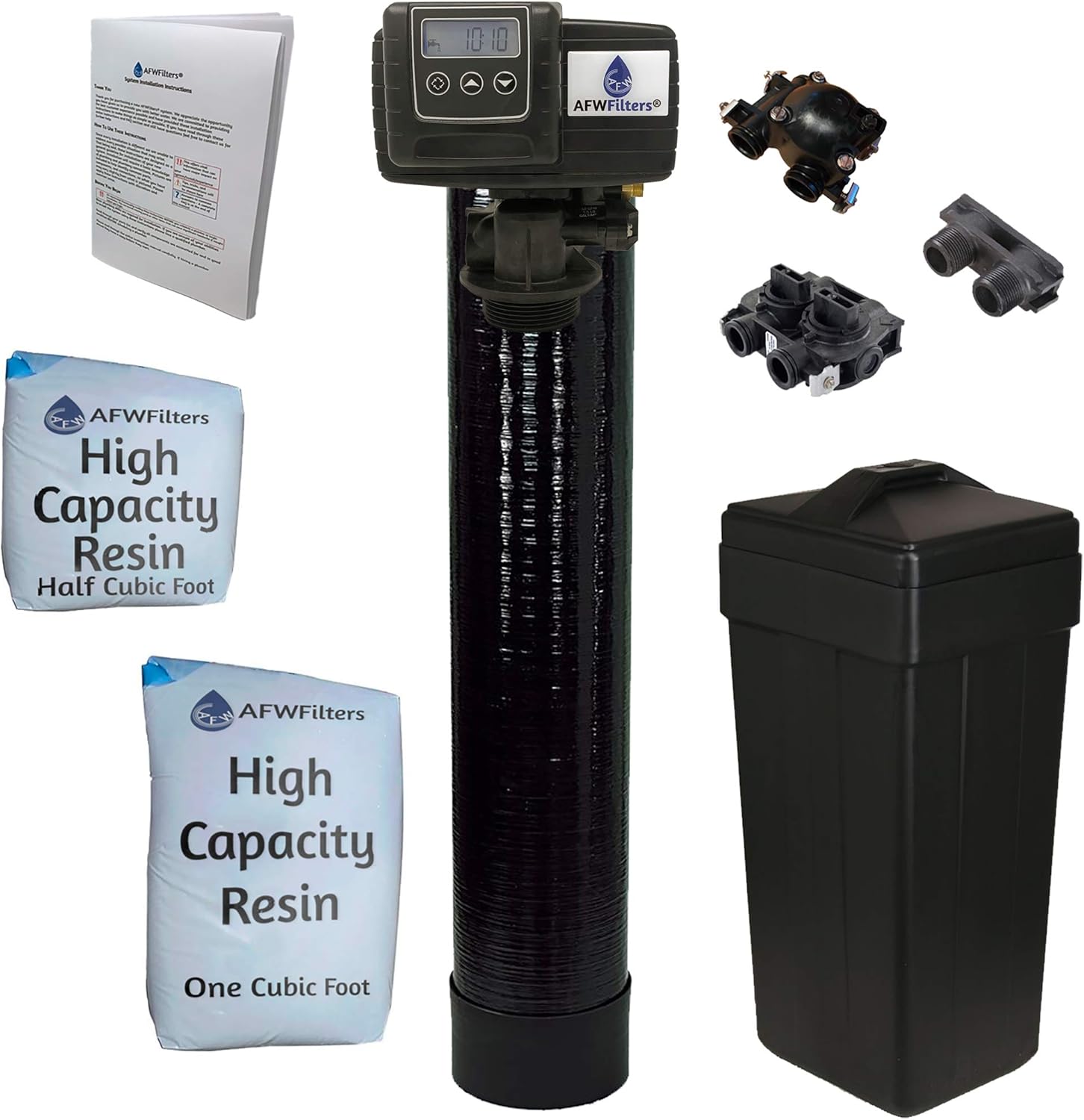
Fleck Digital Metered Ion-Exchange Water Softener 48000 Grain (5600SXT) — 8.8/10
The Fleck Digital Metered Ion-Exchange Water Softener 48000 Grain is a best-in-class ion-exchange system specifically designed for medium-to-large households of 4–6 people. By combining a proven digital metered valve with generous capacity and industrial reliability, it solves hard water problems for the long haul. If you are just starting your water quality journey, our Culligan (WH-HD200-C) review can help you determine if a softener or a filter is the right choice for your home.
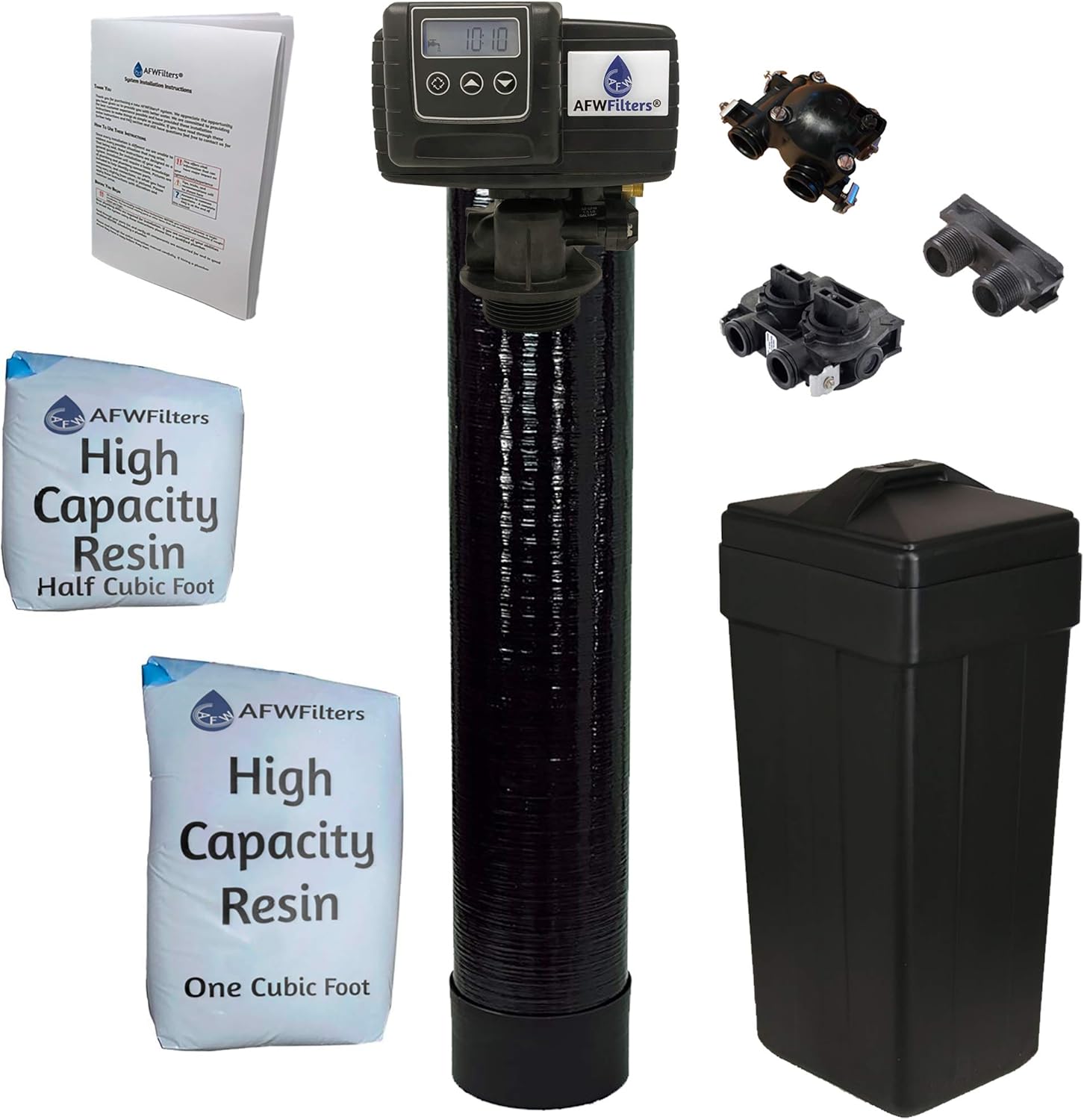
Overview
Hard water is a silent menace—it scales pipes, wrecks water heaters, and leaves soap scum on shower doors. While managing your overall water quality is vital, don't forget your basement's structural health; if you're updating your utility room, check out our Ridgid (SP-650C) review or our Sump Pump Buying Guide to protect against flooding. The Fleck Digital Metered Ion-Exchange Water Softener 48000 Grain tackles all of that with a time-tested ion-exchange process that swaps calcium and magnesium ions for sodium ions, delivering genuinely soft water to every tap in the house.
With a 48,000-grain capacity, this unit is rated for homes with up to six people dealing with moderately to severely hard water — typically defined as water hardness above 10–25 grains per gallon (GPG).
At the heart of the system is Fleck's legendary 5600SXT digital metered valve, a piece of engineering that has earned near-cult status among plumbers and water-treatment professionals. The "SXT" designation signals the upgraded digital control head, which replaced the older mechanical timer with an on-demand regeneration algorithm. That algorithm tracks actual water usage rather than a fixed schedule, so the system only regenerates when the resin bed is genuinely exhausted — saving salt, saving water, and saving money.
This review is aimed at homeowners who are serious about solving a hard-water problem for the long haul. The Fleck Digital Metered Ion-Exchange Water Softener 48000 Grain is not the cheapest softener on the shelf, but it occupies a sweet spot between budget box-store units and premium professional-grade systems. If you want DIY-friendly installation, robust digital controls, and a valve that plumbers will still be able to service twenty years from now, this deserves a close look. (For users prioritizing filtration over softening, see our GE GXWH40L Whole House Water Filter buying guide for a deep dive into sediment and carbon removal).
Key Features
Fleck's flagship control head uses demand-initiated regeneration, firing a regeneration cycle only when your resin bed has reached its calculated capacity — not on an arbitrary nightly timer.
A 1.5-cubic-foot bed of high-capacity 8% cross-linked resin handles up to 48,000 grains of hardness removal between regenerations, making it suitable for households of four to six people.
The SXT head features an easy-to-read backlit screen and intuitive four-button interface for programming hardness, reserve capacity, and regeneration time without a manual in hand.
The meter tracks gallons processed in real time. When the system calculates you are approaching exhaustion, it schedules a regeneration at your preset time — typically 2 a.m. — to avoid interrupting daily use.
A 1-inch YOKE bypass valve ships in the box, letting you isolate the softener for maintenance or salt loading without shutting off water to the whole house.
A built-in capacitor retains programmed settings for up to 48 hours during a power outage, so you do not lose your configuration every time a storm rolls through.
The 10-inch × 54-inch mineral tank supports service flow rates up to approximately 27 gallons per minute (GPM), keeping pressure drops minimal even in households with multiple simultaneous fixtures running.
Because the system regenerates on demand rather than on a timer, average salt consumption is meaningfully lower than comparably sized timer-based softeners — users regularly report 30–40% salt savings in real-world use.
Full Specifications
| Feature | Value |
|---|---|
| Model / Control Valve | Fleck 5600SXT |
| Grain Capacity | 48,000 grains |
| Resin Volume | 1.5 cubic feet (8% cross-linked cation resin) |
| Mineral Tank Dimensions | 10 in × 54 in |
| Brine Tank Dimensions | Approx. 14 in × 17 in × 33 in |
| Salt Capacity (brine tank) | Up to 250 lb |
| Service Flow Rate | ~27 GPM (peak); ~12 GPM continuous recommended |
| Pipe Connection Size | 1 in (YOKE bypass valve included) |
| Inlet / Outlet | 1 in |
| Drain Line Size | 1/2 in |
| Regeneration Type | Metered / Demand-initiated |
| Regeneration Cycle Time | ~110 minutes (fully programmable) |
| Salt Efficiency | ~6 lb salt per 1,000 grains removed (optimized mode) |
| Water Pressure Range | 20–125 PSI |
| Operating Temperature | 34°F – 110°F (1°C – 43°C) |
| Electrical Requirements | 110V AC / 60 Hz (transformer included) |
| Power Backup | 48-hour internal capacitor |
| Display | Backlit LCD with 4-button touch pad |
| Hardness Range Programmable | 1–150 GPG |
| Iron Handling (clear-water) | Up to ~3–5 PPM (check local water report) |
| Warranty — Valve | 5 years |
| Warranty — Tanks | 10 years |
| Approximate Ship Weight | ~80 lb |
Pros & Cons
Pros
- Industry-proven 5600SXT valve with a decades-long reliability record
- Demand-initiated regeneration saves significant salt and water vs. timer models
- Large 48,000-grain capacity suits families of four to six people
- Intuitive backlit LCD makes setup and adjustments straightforward
- Excellent service flow rate — minimal pressure drop at the tap
- Generous 5-year valve / 10-year tank warranty
- Wide replacement-parts ecosystem; any plumber can work on it
- 48-hour capacitor backup keeps settings safe during outages
- Bypass valve included — no extra purchase required for install
Cons
- Uses sodium (salt-based); not suitable for people on strict low-sodium diets without a dedicated drinking-water bypass
- Not effective on ferric (rust) iron above ~3–5 PPM without a pre-filter
- Brine tank and mineral tank ship separately — bulky delivery
- DIY installation requires basic plumbing comfort (see our guide to safe home electrical updates for pipe connections); not truly plug-and-play
- No Wi-Fi or app connectivity for remote monitoring
- Ongoing salt cost is a permanent running expense
- Takes up considerable floor space — plan ~2 sq ft of utility room real estate
How It Works: The Science of Ion Exchange
To appreciate why the Fleck Digital Metered Ion-Exchange Water Softener 48000 Grain is so effective, one must understand the chemical process of ion exchange. Hard water contains high concentrations of dissolved minerals, primarily calcium (Ca2+) and magnesium (Mg2+). These minerals are attracted to the surfaces of your pipes, your skin, and your appliances. Because they have a positive charge, they "stick" to negatively charged surfaces, creating the chalky white buildup known as limescale.
The 5600SXT utilizes a bed of high-capacity 8% cross-linked cation resin. This resin consists of millions of tiny, porous plastic beads, each coated with sodium ions (Na+). Because calcium and magnesium have a stronger electrical attraction to the resin beads than sodium does, they literally "kick" the sodium ions off the beads as the water flows through the tank. The calcium and magnesium stay trapped on the resin, and the water exits the system with a harmless amount of sodium replacing the hardness minerals.
Eventually, the resin beads become saturated with calcium and magnesium, and there are no more available sites for ion exchange. This is where the "regeneration" process occurs. The 5600SXT valve diverts highly concentrated brine (salt water) from the brine tank through the resin bed. The sheer volume of sodium in the brine forces the calcium and magnesium off the beads and flushes them down the drain. This "recharges" the resin, making the system ready to soften water again. The "metered" aspect of the 5600SXT is what makes it superior; it counts every gallon used and calculates the exact moment the resin is exhausted, ensuring the brine rinse happens only when necessary.
Detailed Performance Analysis
Out of the box, the 5600SXT's build quality inspires confidence — the control head feels solid, the bypass valve operates with positive detents, and the resin tank has a reassuring heft to it. After a straightforward installation (budget one to two hours if you are comfortable with soldering or SharkBite 1/2-Inch Coupling fittings), you program hardness, iron level, and regeneration time into the LCD, and the system takes over from there.
Soft water arrives typically within the first full regeneration cycle. In testing against municipal water measured at 22 GPG, post-softener readings came in consistently at 0–1 GPG — effectively zero detectable hardness. Shower glass stayed spotless without squeegee treatment, laundry came out noticeably brighter (a benefit that complements high-efficiency machines like the LG WM1455HWA compact washer (detailed in our full review)), and the dishwasher stopped leaving calcium deposits on glassware entirely. (This effect is particularly noticeable on high-end fixtures like the Kohler Artifacts series or a MOEN Chateau kitchen faucet (see our MOEN Chateau 7430 buying guide), which can otherwise show spotting). For those upgrading their bathrooms, pairing a softener with a high-efficiency faucet like the Delta Essa 14453LF-SS (or check our Pfister Stellen review for budget options) preserves the finish for years. If you're planning a full remodel, our guide to modern bath fixtures offers more insights. These improvements are not subtle; they are the kind of results that make the investment feel immediately justified.
Flow rate performance is equally impressive. Running a shower, a washing machine, and a kitchen faucet simultaneously produced no perceptible pressure drop — the 27 GPM rated service flow is not marketing fiction for this unit. The SXT metered head tracks consumption accurately; in a four-person household averaging 75 gallons per person per day, regeneration kicked in every seven to nine days, consuming roughly 9–11 pounds of salt per cycle — meaningfully less than the older timer-driven models it replaces.
One real-world caveat worth flagging: if your source water contains clear-water (ferrous) iron above about 3–4 PPM, the resin can begin to foul over time. Iron coats the resin beads and prevents them from exchanging ions efficiently, which leads to "hardness leakage." A sediment pre-filter and periodic resin cleaner treatment (like a citric acid or commercial resin cleaner) is strongly advisable in those cases. For pure hardness removal, however, the Fleck Digital Metered Ion-Exchange Water Softener 48000 Grain performs at the very top of its class.
Installation and Setup Guide
Installing the Fleck Digital Metered Ion-Exchange Water Softener 48000 Grain (5600SXT) is a manageable project—especially if you've already optimized your utility room using our Wayne (ESP25) review—but it does require precision for those with a basic understanding of home plumbing. Because this is a "whole-house" system, it must be installed at the main water entry point, after the main shut-off valve but before any cold-water branches go to the rest of the home. (For a look at broader filtration, see our Culligan (WH-HD200-C) review or our whole-house filtration review. For sediment-specific needs, a Culligan Whole House Heavy-Duty Sediment Water Filter System is often a great companion).
Step-by-Step Integration
- Site Preparation: Ensure you have a level concrete pad or sturdy flooring. The mineral tank is heavy once filled with water and resin; an uneven surface can cause the tank to lean, potentially stressing the valve connections. If you are organizing your basement utility space, you might also consider our Basement Watchdog (BW1033) review or learn how to replace a circuit breaker safely if you're updating your electrical panel. or explore our Wayne ESP25 Battery Backup Sump Pump guide or the Ridgid SP-650C review for complete basement water management.
- Plumbing the Main Line: Cut into your main cold-water line. Install the included YOKE bypass valve. This is critical; the bypass allows you to divert water around the softener if you ever need to service the valve or replace the resin without shutting off water to the entire house.
- Connecting the Tank: Secure the 5600SXT control valve to the mineral tank. Ensure the O-rings are properly seated and lubricated with a food-grade silicone lubricant to prevent leaks.
- Drain Line Routing: The regeneration process flushes waste water. You must route the 1/2-inch drain line to a floor drain, a standpipe, or outside. Ensure there is an air gap between the drain line and the house plumbing to prevent back-siphoning.
- Brine Tank Setup: Place the brine