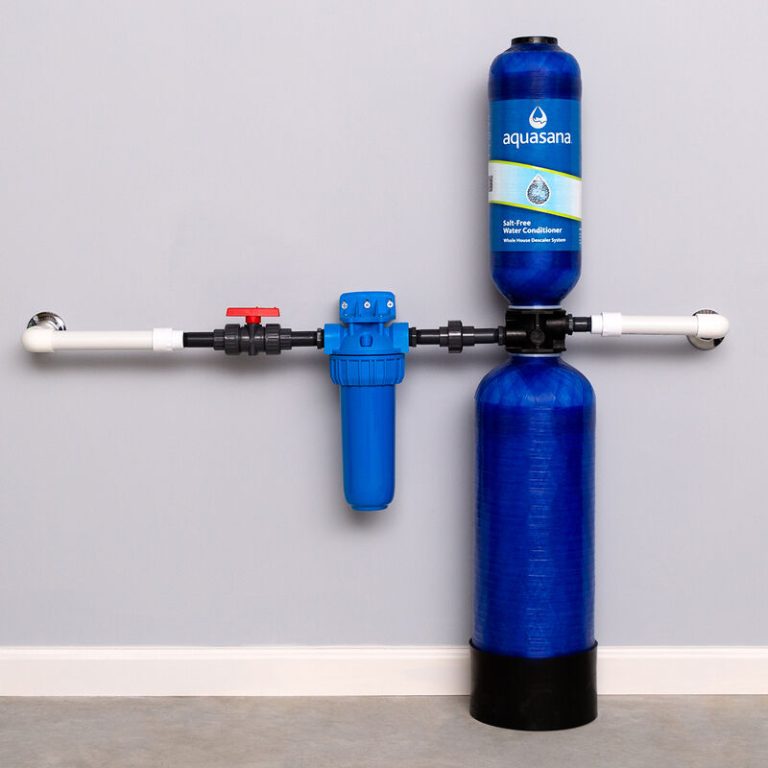
Hard water quietly wrecks appliances, irritates skin, and leaves chalky residue on every surface it touches — yet most homeowners don't investigate treatment options until they're replacing a water heater (like the A.O. Smith EES-40) or scrubbing permanent stains off their kitchen fixtures or budget-friendly faucets. The Aquasana Salt-Free Whole-Home Water Softener and Conditioner promises a salt-free solution that conditions your water without the maintenance headaches of traditional ion-exchange softeners. But does going salt-free actually deliver on its promises, or are you trading one set of compromises for another?
Check out the Aquasana Salt-Free Whole-Home Water Softener and Conditioner for detailed specs and current pricing.
We dug deep into how the EQ-SS20 works, who it's best suited for, and where it falls short so you can make a genuinely informed decision before spending several hundred dollars on your home's water supply. One thing to flag upfront: the EQ-SS20 is technically a water conditioner, not a softener — an important distinction we'll explain in detail below.
Our Top Pick: Aquasana EQ-SS20 SimplySoft Salt-Free Water Conditioner
The EQ-SS20 earns its place as our top salt-free conditioner recommendation for most households thanks to its zero-maintenance design, impressive 600,000-gallon filter life, and genuinely eco-friendly operation — all without the ongoing cost of salt or the water waste of a traditional softener. It won't remove hardness minerals, but for the vast majority of homes dealing with moderate hard water, it's the smartest long-term investment you can make.
This article contains affiliate links. We may earn a commission if you purchase through our links at no extra cost to you. Our editorial opinions are always independent.
TL;DR — What You Need to Know
- Type: Salt-free water conditioner (Template Assisted Crystallization / TAC)
- Flow Rate: Up to 7 gallons per minute (GPM)
- Filter Life: 600,000 gallons (~6 years for an average household)
- Installation: DIY-friendly whole-house point-of-entry
- Best For: Homeowners with moderate hard water (up to ~25 GPG) who want zero-maintenance conditioning (see also our Culligan whole-house filtration guide or our GE GXWH40L buying guide or the GE High Flow Whole House Water Filtration System)
- Skip It If: Your water hardness exceeds 25 GPG or you want minerals completely removed
Aquasana EQ-SS20 SimplySoft: Full Review
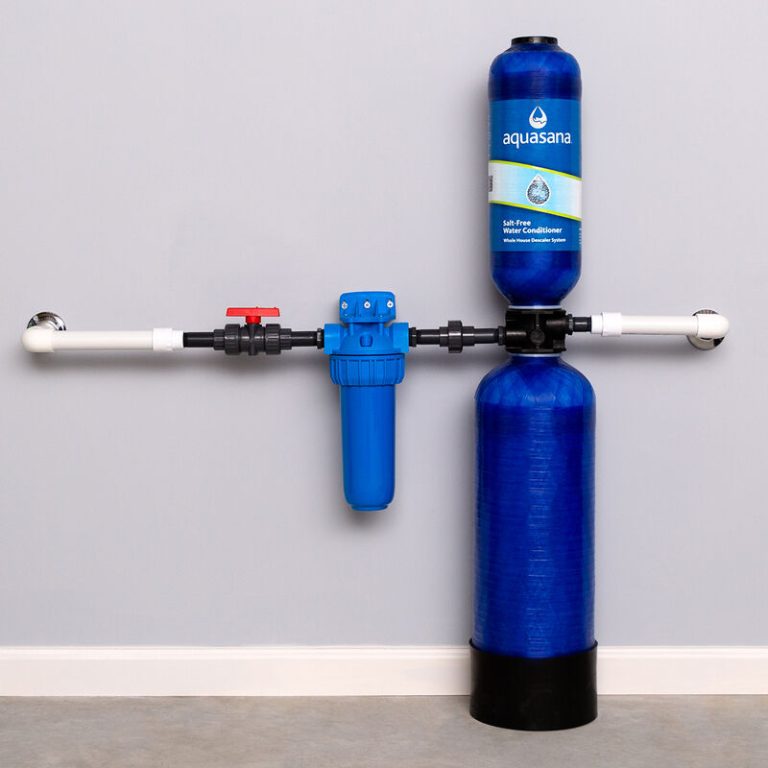
The Aquasana Salt-Free Whole-Home Water Softener and Conditioner (EQ-SS20) is a whole-house salt-free water conditioner that uses a process called Template Assisted Crystallization, or TAC, to neutralize the effects of hard water minerals.
Rather than removing calcium and magnesium from your water supply — the approach taken by traditional salt-based ion-exchange softeners — the EQ-SS20 transforms those minerals into microscopic crystals that can no longer bond to surfaces, pipes, or your skin. The minerals stay in the water (which has some nutritional upside), but they pass through harmlessly without forming scale.At the heart of the system is a single-tank design housing Aquasana's proprietary TAC media. Water flows in, passes through the conditioner media, and exits fully conditioned without any electricity, drain connections, backwashing cycles, or salt purchases required. For homeowners who've lived with the salt-hauling, brine-tank-cleaning ritual of a traditional softener, this zero-maintenance operation is genuinely transformative. The system just sits there and works, month after month, for up to six years or 600,000 gallons before the media needs replacing.
Installation is designed to be accessible to confident DIYers. The unit ships with a bypass valve and fitting kit, and the whole-house connection process follows a standard plumbing setup — essentially cutting into your main supply line after the pressure regulator and before water branches to fixtures. Aquasana estimates a 2–3 hour installation time for someone comfortable with basic plumbing. The tank itself is compact enough to fit in most utility rooms or garage installations without dominating the space. Professional installation is always an option if you'd prefer not to touch your main line.
The EQ-SS20 is rated for water hardness levels up to approximately 25 grains per gallon (GPG). If you're in that range — which covers the vast majority of American households dealing with hard water — it performs reliably. You'll notice softer-feeling water on your skin, less soap scum buildup in showers and sinks, and your appliances will accumulate scale at a dramatically reduced rate. It's worth noting that for extremely hard water regions (above 25 GPG), Aquasana recommends pairing the SimplySoft with a water softener or pre-treatment stage, which does somewhat undercut the all-in-one convenience appeal.
Pros
- Truly zero maintenance — no salt, no electricity, no drain line required
- Impressive 600,000-gallon media life (roughly 6 years for a family of four)
- Eco-friendly: no water waste from backwashing cycles
- Retains beneficial minerals like calcium and magnesium in drinking water
- Compact single-tank design fits most utility spaces
- Proven TAC technology with independent performance validation
- DIY installation is realistic for handy homeowners
- No risk of over-softening or sodium-laden water output
Cons
- Does not remove hardness minerals — technically a conditioner, not a softener
- Less effective for very hard water above 25 GPG without additional treatment
- Won't produce the classic "slippery" feel traditional softener users expect
- Media replacement (every ~6 years) is a cost to factor in long-term
- Does not address other contaminants like chlorine, sediment, or iron
- Upfront cost is significant compared to entry-level salt softeners
Prices for the Aquasana EQ-SS20 vary by retailer and can shift seasonally. We recommend checking current pricing before purchasing.
How TAC Technology Actually Works
Template Assisted Crystallization is worth understanding before you buy, because it completely reframes what "water softening" means in the context of this product. Traditional salt-based softeners use ion exchange resin to physically swap calcium and magnesium ions for sodium ions, effectively removing the hardness minerals from the water. TAC doesn't do this. Instead, the conditioner media acts as a template surface on which hardness minerals nucleate — they form tiny crystalline structures that are stable and non-adhesive.
Think of it this way: the minerals that would normally form sticky, cement-like scale on the inside of your pipes and appliance heating elements are instead converted into floating, harmless crystals that pass right through your plumbing. The water leaving the EQ-SS20 still has the same mineral content as what entered, but those minerals have been structurally changed so they can't bond to surfaces. Independent studies, including research from German standards body DVGW, have validated TAC media's ability to reduce scale formation by up to 99.6% under controlled laboratory conditions. These results apply to the TAC technology class broadly and align closely with real-world performance reports from long-term EQ-SS20 users, though individual results will vary based on water chemistry and usage conditions.
The practical implication is important for setting expectations correctly: your water will not feel "soft" in the traditional sense. Users accustomed to a salt softener will immediately notice that they don't get that slippery, almost over-lubricated feel that comes from sodium-exchanged water. Many people actually prefer conditioned water for drinking and cooking for exactly this reason — the mineral content remains, which many health experts consider beneficial. But if you've been a lifetime salt-softener household, the tactile adjustment can take some getting used to.
Performance & Real-World Results
Scale prevention is where the EQ-SS20 genuinely shines. Homeowners who install it consistently report that existing scale on showerheads and faucet aerators (like those on the MOEN Chateau) begins to break down gradually over weeks to months after installation, as the newly conditioned water slowly disrupts the crystalline structure of old deposits. New scale formation effectively stops. Dishwashers run cleaner, glass doesn't spot as aggressively, and water heater elements last significantly longer — which is arguably where the real financial return on your investment comes from, since a scaled water heater can lose up to 30% of its efficiency according to U.S. Department of Energy research (which is why choosing an efficient model like the A.O. Smith EES-40 is critical to maintaining home energy efficiency).
Skin and hair benefits are more subjective but consistently reported. The conditioned water doesn't strip skin and hair the way very hard water does, and most users notice a reduction in dryness and irritation. Soap lathers slightly better than it would with raw hard water, though not as dramatically as with a traditional softener. For households where someone has sensitive skin or eczema, the improvement can be meaningful without the sodium concern that comes with salt-softened water.
Flow rate performance holds up well in practice. The 7 GPM rating is adequate for most three- to four-bathroom homes under normal simultaneous use. Large households with five or more bathrooms and heavy simultaneous water use during peak morning hours may occasionally notice a slight pressure dip, but this is more a function of the home's overall water demand than a deficiency specific to the EQ-SS20. Aquasana's whole-house filter systems can be paired in series if higher flow rates are critical.
One area where the EQ-SS20 shows its limitations clearly is in iron-rich water. If your water test reveals iron above about 0.3 ppm, or if you have manganese or hydrogen sulfide issues (that rotten egg smell), the SimplySoft does nothing to address those problems. You'd need a dedicated iron filter upstream of the conditioner. Similarly, if chlorine taste and odor in your drinking water is a concern, a separate carbon filtration stage would be required,
For pure drinking water, we recommend pairing this with a Waterdrop Tankless Under-Sink Reverse Osmosis System.
The EQ-SS20 is purpose-built to solve one specific problem — scale — and it does that well, but it's not a comprehensive water treatment solution on its own.Performance Highlights
- Up to 99.6% scale reduction validated by independent laboratory testing of TAC technology class; real-world results vary based on water chemistry and usage conditions
- Gradually breaks down existing limescale deposits after installation
- Noticeably improves skin and hair texture for most users
- Protects water heater efficiency and extends appliance lifespans
- Consistent flow rate of 7 GPM for typical household demands
Performance Limitations
- No effect on iron, manganese, chlorine, or other contaminants
- Effectiveness drops in extreme hard water (above 25 GPG)
- Results take weeks to months to fully manifest on existing scale
- Won't produce the "slippery" feel of salt-softened water
Installation: What to Expect
The EQ-SS20 ships as a complete kit with the conditioner tank, a brass bypass valve, connection fittings, and installation instructions. The unit connects to your main supply line at the point of entry — typically near your water meter or pressure regulator, before the line branches out to service your home's fixtures and appliances. Aquasana designs the system around standard 1-inch plumbing connections, which matches most American residential supply lines, though homes with 3/4-inch lines will need reducing fittings (consider using a SharkBite coupling for easy plumbing for a leak-proof DIY connection).
A confident DIYer with basic pipe-cutting and fitting experience can realistically complete the installation in two to three hours. The bypass valve that ships with the unit is particularly well-designed — it allows you to isolate the conditioner for service or media replacement without shutting off water to the entire house. If you've never cut into a supply line before, or if your home has copper plumbing requiring soldering, hiring a plumber for a two-hour installation visit is money well spent. Most plumbers can complete the job in a single appointment.
The tank dimensions are roughly 9 inches in diameter and 48 inches tall, so it stands upright and needs a few inches of clearance around it for airflow and eventual media replacement access. A basement or garage utility area is the ideal location—often near where you'd find your sump pump system (refer to our guide to the best submersible utility pumps for managing basement water or the Wayne ESP25 review for battery backup protection for centralized water management. The unit is not rated for outdoor installation or freezing temperatures, so keep that in mind if you're in a climate that sees winter freezes and your utility room is an unconditioned space.
Cost of Ownership: The Long-Term Picture
The upfront price of the EQ-SS20 — typically in the $500–$700 range at time of writing, though prices vary by retailer and shift seasonally (always verify current pricing before purchasing) — is the most significant expense, and it positions this product firmly in the premium segment of the salt-free conditioner market. However, the total cost of ownership calculation is where the EQ-SS20's no-maintenance design becomes a genuine financial argument. Traditional salt-based softeners require 40–80 pound bags of salt added monthly, ongoing resin cleaning, and periodic professional service — costs that can easily total $150–$300 per year depending on your water hardness and household size.
The EQ-SS20's TAC media is rated for 600,000 gallons. For an average family of four using roughly 100 gallons per day, that translates to approximately six years before replacement is needed. The replacement media cost is a fraction of the original system price, making the long-term cost of ownership quite competitive when com