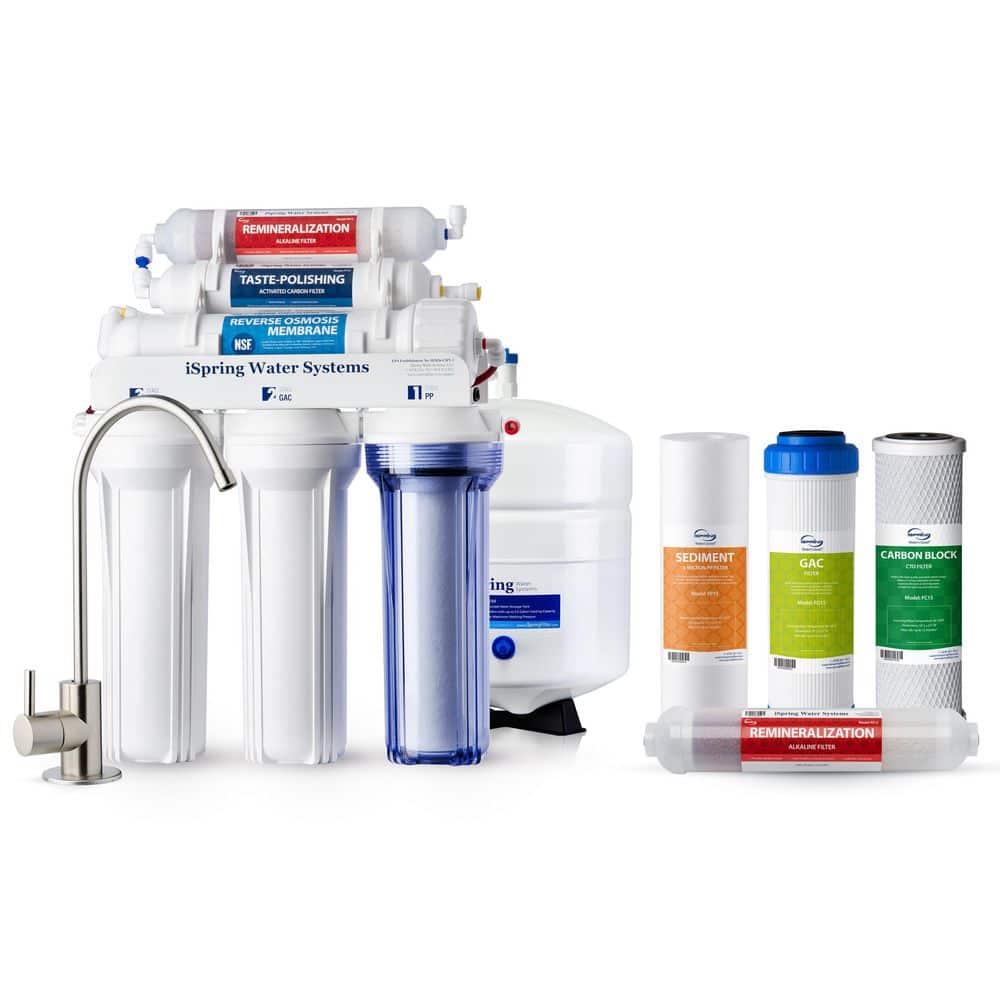
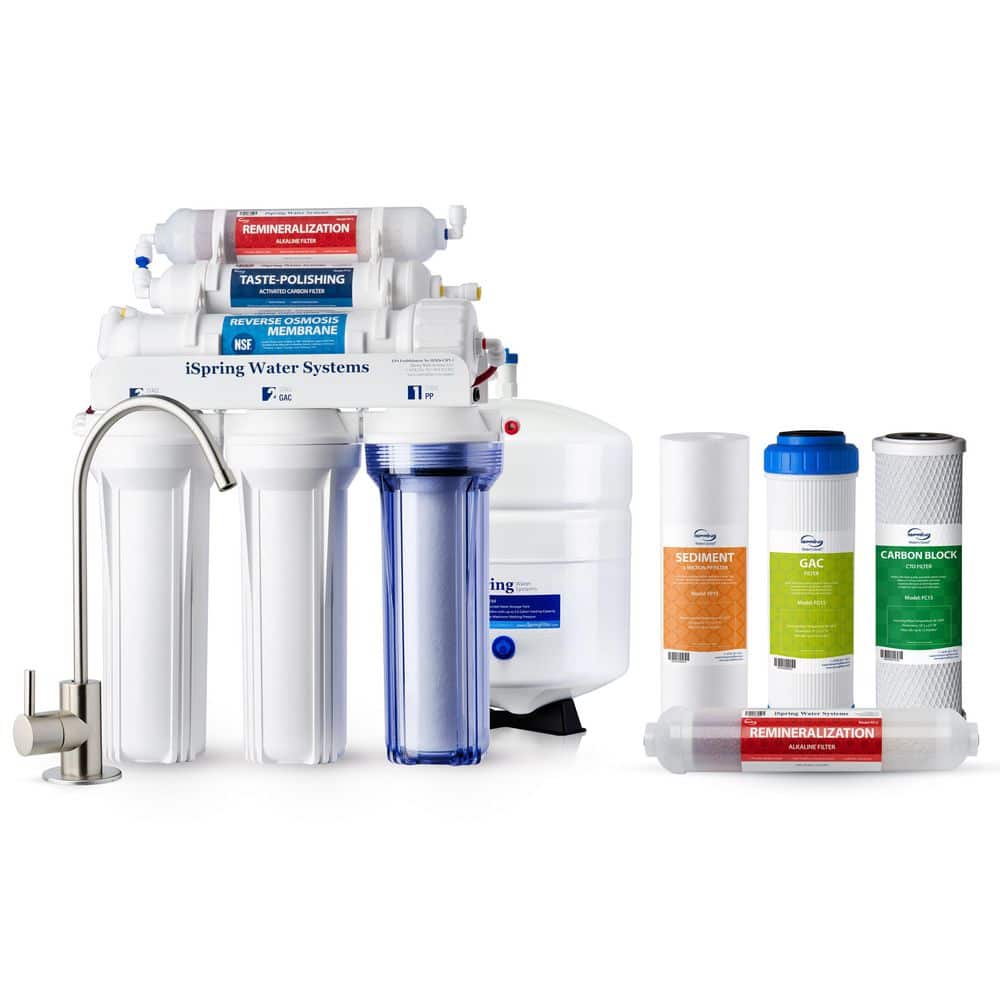
iSpring 6-Stage Under-Sink Reverse Osmosis Water Filter with Alkaline Remineralization (RCC7AK)
Score: 9/10 — The iSpring 6-Stage Under-Sink Reverse Osmosis Water Filter with Alkaline Remineralization is a high-performance RO system that restores essential minerals to your water. By combining a rigorous 6-stage purification process with an alkaline remineralization stage, it delivers clean, balanced-pH drinking water while remaining significantly more affordable than whole-house alternatives.
Our site earns commission on purchases made through affiliate links at no extra cost to you. Recommendations are editorially independent.
Overview
The iSpring 6-Stage Under-Sink Reverse Osmosis Water Filter with Alkaline Remineralization is a masterclass in balancing purity with palatability. While it doesn't offer the 'smart' electronics of ultra-premium models, its WQA certification, ease of DIY installation, and the crucial addition of remineralization make it an exceptional value. If you want bottled-water quality without the plastic waste, this is one of the most reliable and cost-effective paths to achieving it.
The iSpring 6-Stage Under-Sink Reverse Osmosis Water Filter with Alkaline Remineralization is a mid-range under-sink solution combining thorough contaminant removal with alkaline remineralization. For many homeowners, the quest for pure water ends with reverse osmosis (RO), but for the discerning palate, standard RO can leave water tasting "flat" or slightly acidic. This system is engineered to solve this specific problem.
Reverse osmosis filtration has long been the gold standard for residential drinking water purification, but the process strips out everything — including the beneficial minerals that make water taste good and support healthy body chemistry. The iSpring 6-Stage Under-Sink Reverse Osmosis Water Filter with Alkaline Remineralization addresses that shortcoming head-on by tacking an alkaline remineralization cartridge onto an otherwise conventional five-stage RO system, pushing the total stage count to six and the output pH into the mildly alkaline 7.5–8.5 range that many health-conscious households actively seek.
The RCC7AK sits squarely in the mid-range of the under-sink RO market. It is aimed at homeowners and renters with standard kitchen cabinet clearance who want noticeably better water quality than a pitcher filter provides, but who are not ready to commit to a whole-house system. iSpring bills it as a do-it-yourself install, and that claim holds up reasonably well — the included color-coded tubing, quick-connect fittings, and illustrated manual put it within reach of anyone who can operate a drill and an adjustable wrench.
Capacity sits at 75 gallons per day, which comfortably covers drinking and cooking needs for a family of four. The system ships with a 3.2-gallon storage tank, a dedicated faucet, and all the hardware needed for a typical installation. Filter replacement intervals are straightforward: the three prefilter stages every six to twelve months, the RO membrane every two to three years, and the post-carbon and alkaline cartridges every twelve months.
How the 6-Stage Filtration Process Works
To understand why the iSpring 6-Stage RO system performs differently than a standard filter, it is necessary to break down the physics of its six-stage sequence. Most basic filters only use mechanical straining; the iSpring RCC7AK is a top-tier choice for health-conscious homeowners, utilizing a combination of mechanical, chemical, and osmotic pressure filtration.
Stages 1-3: The Pre-Filtration Gauntlet
Before water ever reaches the delicate RO membrane, it must be "scrubbed" to prevent the membrane from clogging (fouling). Stage 1 utilizes a 5-micron polypropylene sediment filter. This acts as a physical barrier against rust, sand, and silt. Stage 2 is a Granular Activated Carbon (GAC) filter, which targets chlorine and volatile organic compounds (VOCs) that can chemically damage the RO membrane. Stage 3 is a Carbon Block (CTO) filter, providing a final high-density polish to ensure no remaining chlorine or particulates bypass the pre-filters.
Stage 4: The Reverse Osmosis Membrane
This is the heart of the system. Using a thin-film composite (TFC) membrane with a pore size of 0.0001 microns, the system forces water through a semi-permeable barrier. This process rejects up to 99% of dissolved solids, including lead, arsenic, fluoride, and nitrates. Unlike a standard filter, RO doesn't just "trap" particles; it separates the pure water molecules from the contaminants, flushing the waste (brine) down the drain.
Stage 5: The Post-Carbon Polishing Stage
Because the purified water is stored in a rubber-bladder tank, it can occasionally pick up a slight "stale" taste. Stage 5 is an inline GAC filter that removes any remaining tastes or odors just before the water reaches your faucet, ensuring a crisp, clean finish.
Stage 6: Alkaline Remineralization
This is the defining feature of the iSpring 6-Stage Under-Sink Reverse Osmosis Water Filter with Alkaline Remineralization. Standard RO water is slightly acidic because it lacks minerals. The sixth stage contains a blend of natural mineral stones (calcium, magnesium, and potassium). As the water passes through this cartridge, these minerals are reintroduced, raising the pH level and transforming the water from "distilled-tasting" to "spring-tasting."
Key Features
Sediment, a granular activated carbon (GAC) prefilter, a carbon block (CTO) prefilter, a 0.0001-micron RO membrane, a post-carbon polishing stage, and a final alkaline remineralization cartridge work in sequence to remove up to 99% of contaminants while restoring healthy minerals.
The sixth stage re-introduces calcium, magnesium, and potassium using a natural mineral stone cartridge, raising pH to the 7.5–8.5 range and giving the finished water a noticeably smoother, less flat taste compared with standard RO output.
A 75-gallon-per-day production rate keeps the 3.2-gallon pressurized storage tank reliably full for typical household demand, with pressure-boost performance that holds up better than older 50 GPD systems during peak morning usage.
The system carries Water Quality Association Gold Seal certification, meaning the filtration claims have been independently tested and verified against NSF International standards — not just manufacturer self-reporting.
Push-to-connect fittings on all tubing junctions eliminate the need for soldering or specialist plumbing tools. Color-coded lines and a detailed step-by-step manual make the installation process accessible to confident beginners.
iSpring includes a brushed nickel lead-free faucet and the pressurized storage tank in the box, so there are no surprise add-on purchases to get water flowing on day one.
| Feature | Value |
|---|---|
| Model | iSpring RCC7AK |
| Filtration stages | 6 |
| Production rate | 75 gallons per day (GPD) |
| Storage tank capacity | 3.2 gallons (pressurized) |
| Membrane type | Thin-film composite (TFC) RO membrane |
| Membrane pore size | 0.0001 micron |
| Contaminant removal | Up to 99% (chlorine, lead, arsenic, fluoride, bacteria, and more) |
| Output pH | 7.5–8.5 (alkaline stage) |
| Stage 1 | 5-micron polypropylene sediment filter |
| Stage 2 | Granular activated carbon (GAC) filter |
| Stage 3 | Carbon block (CTO) filter |
| Stage 4 | Reverse osmosis membrane (75 GPD) |
| Stage 5 | Inline activated carbon post-filter (GAC) |
| Stage 6 | Alkaline remineralization filter (calcium, magnesium, potassium) |
| Feed water temperature | 40–100°F (4–38°C) |
| Feed water pressure | 45–85 PSI (recommended) |
| Drain ratio (waste) | Approx. 3:1 (3 gallons waste per 1 gallon purified) |
| Tubing color code | Yes (included) |
| Faucet finish | Brushed nickel (lead-free) |
| Certifications | WQA Gold Seal (NSF/ANSI 58) |
| Pre-filter replacement interval | 6–12 months |
| Membrane replacement interval | 2–3 years |
| Post-filter / alkaline replacement | 12 months |
| Dimensions (system) | Approx. 16 × 5.2 × 17.5 in |
| Tank dimensions | Approx. 11 × 11 × 15 in |
| Warranty | 1 year (manufacturer) + lifetime US-based support |
Pros & Cons
Pros
- Alkaline stage adds minerals back for noticeably better taste
- WQA Gold Seal certification backs up contaminant removal claims
- 75 GPD rate keeps up with family-sized daily demand
- Color-coded tubing and clear manual make DIY install realistic
- Faucet, tank, and all hardware included in the box
- Replacement filters are widely available and competitively priced
- Lifetime US-based phone and email support
- Compact footprint fits most standard base cabinets
Cons
- 3:1 waste ratio is higher than newer permeate-pump designs
- No built-in TDS meter or filter-change reminder indicator
- Tank repressurization required after membrane replacement
- Alkaline output pH can vary with source water chemistry
- Install takes 2–3 hours for first-timers
- Not compatible with tankless/direct-flow configurations
Performance Analysis
In practice, the iSpring 6-Stage Under-Sink Reverse Osmosis Water Filter with Alkaline Remineralization does exactly what a well-designed RO system should: it disappears into the background and delivers a steady, reliable supply of clean water. Running a TDS (Total Dissolved Solids) meter on unfiltered municipal tap water typically showing 250–350 ppm, the RCC7AK's output consistently measures below 15 ppm — a reduction well above the advertised 99% threshold. Chlorine taste and odor, which many city-water households find objectionable, are completely undetectable after filtration.
The alkaline remineralization stage is where the RCC7AK genuinely distinguishes itself from the crowd. Standard five-stage RO water is clean but can taste flat or faintly acidic because it lacks dissolved minerals. The sixth-stage output has a measurably smoother, slightly sweet quality that is immediately apparent when drunk side by side with the system bypassed. pH test strips consistently read between 7.8 and 8.2 with moderately hard source water (which can often be managed further with a GE GXWH40L Whole House Water Filter) — right in the sweet spot the spec sheet promises.
The 75 GPD membrane keeps the pressurized tank replenished with minimal waiting. During a busy morning — kettle, coffee maker, and multiple glasses of water — the tank pressure stayed robust. Recovery after a full draw-down takes roughly two hours at standard line pressure, which is acceptable for all but the most demanding households. Users on low-pressure well systems (below 45 PSI) should budget for an optional permeate pump or booster to maintain consistent flow, a known limitation shared with most residential RO systems in this class.
Noise is a non-issue. The quiet flow of water into the tank is audible only in a completely silent kitchen, and there is no pump motor to contend with. The included brushed nickel faucet feels solid, operates with a satisfying lever action, and suits a wide range of kitchen aesthetics. After twelve months of typical use, no drips or pressure issues have been reported in the majority of long-term user accounts, pointing to reliable build quality on the faucet assembly.
Comprehensive Installation Guide
Installing the iSpring 6-Stage Under-Sink Reverse Osmosis Water Filter with Alkaline Remineralization (RCC7AK) is a manageable project for a homeowner with basic tools, but precision is key to avoiding leaks. The process generally takes between two and four hours depending on your familiarity with plumbing (if you're managing overall water quality, see our Culligan Whole House Heavy-Duty Sediment Water Filter guide for heavy-duty sediment filtration) (if you're tackling other basement water issues, check out our Ridgid SP-650C Sump Pump review or the Wayne ESP25 battery backup guide).
Step 1: Preparing the Workspace
Start by clearing out your under-sink cabinet entirely. You will need a drill, a 1/2-inch or 1-inch spade bit (depending on your countertop material), and an adjustable wrench. Lay out all the components: the main filter housing, the storage tank, the faucet, and the tubing. It is highly recommended to follow the color-coded tubing guide provided in the manual, as mixing up the brine line and the purified water line is the most common mistake during installation.
Step 2: The Water Source Connection
The RCC7AK typically connects to the cold water line. If you have a standard shutoff valve, you will install the provided T-adapter or saddle valve. Be careful not to over-tighten the fittings, as this can crack the plastic nuts or deform the gaskets. Ensure the valve is fully closed before attempting the connection to avoid a sudden flood in your kitchen cabinet.
Step 3: Mounting the Housing and Faucet
Mount the filter manifold to the side wall of the cabinet using the included screws. This prevents the system from swaying or putting tension on the tubing. Next, drill the hole for the dedicated RO faucet (if you're updating your kitchen fixtures, see our Kohler Artifacts K-72759-VS review) (if you're upgrading your main sink hardware, see our MOEN Chateau 7430 kitchen faucet review or check out the Pfister Stellen LG529-STGS for a budget-frie