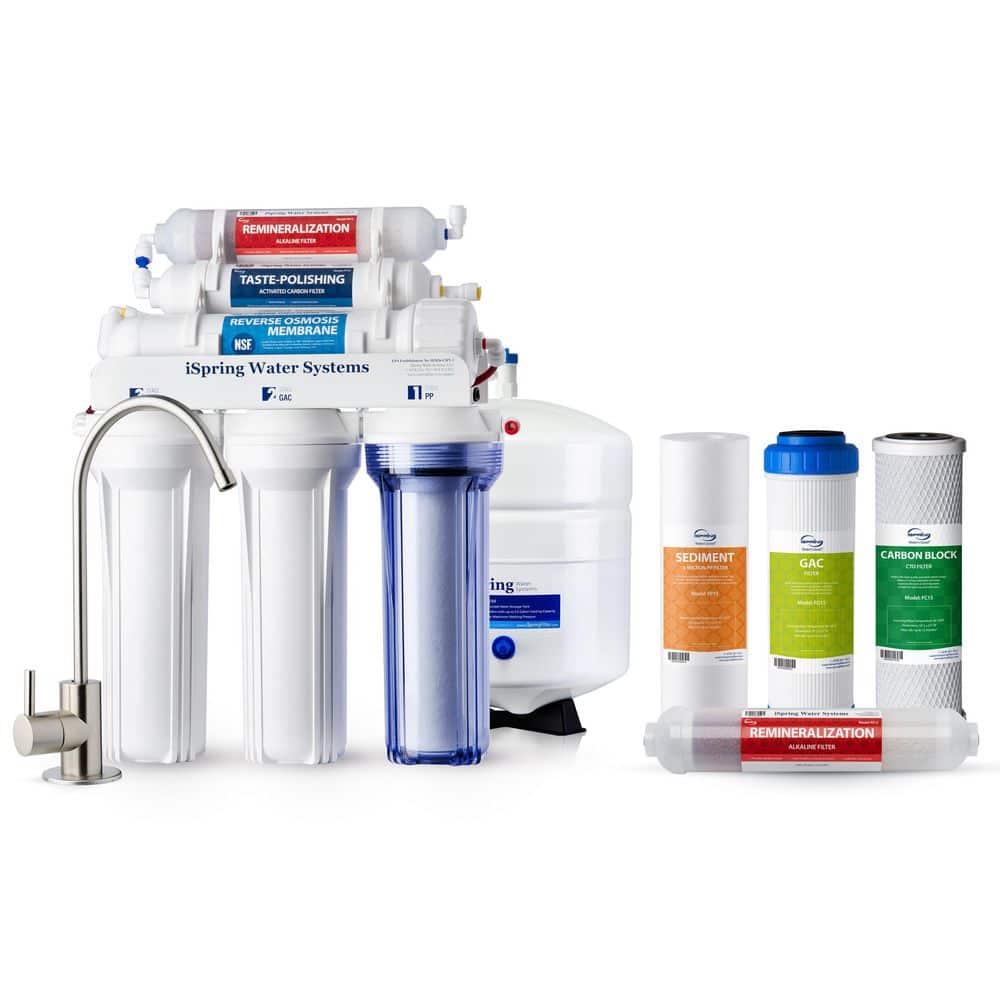
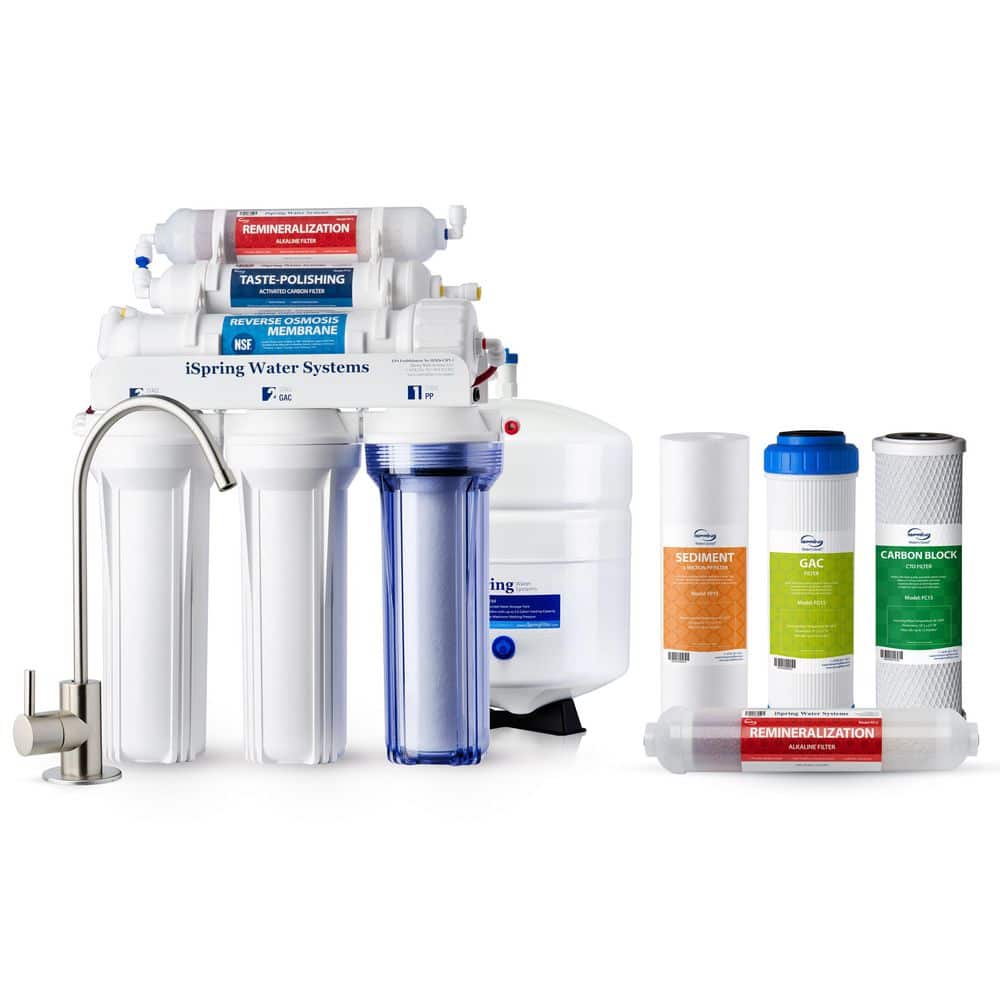
iSpring 6-Stage Under-Sink Reverse Osmosis System with Alkaline Remineralization
Score: 8.4/10 — The iSpring RCC7AK is a well-rounded six-stage under-sink reverse osmosis system that adds an alkaline remineralization stage most competitors skip, delivering genuinely great-tasting, balanced water at a price that makes professional-grade filtration accessible for most households.
This review contains affiliate links. We may earn a commission if you make a purchase through these links, at no additional cost to you.
Overview
Reverse osmosis (RO) filtration is widely considered the gold standard for removing contaminants from tap water, often paired with whole-house filtration for complete home protection. However, many entry-level systems strip out essential minerals, leaving water that tastes flat. iSpring 6-Stage Under-Sink Reverse Osmosis System with Alkaline Remineralization solves this by adding a dedicated alkaline remineralization stage to the standard RO process, ensuring your drinking water is both pure and pH-balanced.
Related parts & accessories
Related parts & accessories
This system targets homeowners and renters (with landlord permission) who want bottled-water quality on tap without the ongoing plastic waste and expense. It fits comfortably under most standard kitchen sinks, connects to existing cold-water supply lines, and drains through the existing drain pipe.
iSpring markets the iSpring 6-Stage Under-Sink Reverse Osmosis System toward households with moderately to heavily contaminated municipal or well water (those with severe hardness may also consider an Aquasana Salt-Free Whole-Home Water Softener and Conditioner for whole-home protection, or explore other whole-house filtration options)—though those seeking an even more intensive point-of-use solution may prefer the Express Water 10-Stage Alkaline Reverse Osmosis Under-Sink Water Filter System, or a GE High Flow Whole House Water Filtration System—including water with elevated levels of chlorine, lead, arsenic, fluoride, and sediment — and the filtration spec sheet backs that claim up convincingly.Installation sits squarely in the capable-DIY category. The system ships with color-coded tubing, a dedicated faucet, a storage tank, and a hardware kit that covers most common sink configurations. Budget two to three hours for a first-time installer, and expect to do filter changes every six to twelve months depending on water quality and usage. With replacement filters widely available and reasonably priced, ongoing costs are modest compared with buying bottled water or relying on a basic Brita Standard 10-Cup Pitcher with 1 Filter.
Key Features
Five dedicated RO stages remove up to 99% of over 1,000 contaminants, followed by an alkaline remineralization filter that restores healthy minerals and raises pH above neutral.
The standout AK (Alkaline) stage uses calcium, magnesium, and potassium mineral balls to bring pH into the 7.5–8.0 range, eliminating the flat, acidic taste common to standard RO water.
At 75 gallons per day, the RCC7AK produces enough filtered water to comfortably supply a family of four for drinking, cooking, and ice-making without extended tank-wait times.
The pressurized tank stores a usable reserve of roughly 2 gallons of filtered water, so you rarely wait at the tap — even after back-to-back large draws.
Filters are tested and certified to NSF/ANSI standards, covering structural integrity, material safety, and contaminant reduction claims for added peace of mind.
Color-coded, twist-and-lock filter housings require no special tools for routine maintenance, keeping annual upkeep straightforward and mess-free.
| Feature | Value |
|---|---|
| Model | iSpring RCC7AK |
| Filtration stages | 6 (5-stage RO + alkaline remineralization) |
| Production rate | 75 gallons per day (GPD) |
| Storage tank capacity | 3.2 gallons (approx. 2 gal usable) |
| Output pH range | 7.5 – 8.0 (alkaline stage) |
| Contaminant reduction | Up to 99% of 1,000+ contaminants |
| Stage 1 filter | 5-micron polypropylene sediment |
| Stage 2 filter | Granular activated carbon (GAC) |
| Stage 3 filter | Carbon block (CTO) |
| Stage 4 filter | RO membrane (TFC) |
| Stage 5 filter | Post carbon (GAC inline polishing) |
| Stage 6 filter | Alkaline remineralization |
| Pre-filter service life | 6–12 months |
| RO membrane service life | 2–3 years |
| Required water pressure | 45–80 psi (booster pump available separately) |
| Water temperature range | 40–100 °F (4–38 °C) |
| Drain ratio (waste:filtered) | Approx. 3:1 |
| Dedicated faucet included | Yes (brushed nickel finish) |
| Certifications | NSF/ANSI 58, WQA tested |
| Warranty | 1 year (manufacturer), US-based support |
| Approximate footprint | 16" W × 5.5" D × 17.5" H |
Pros & Cons
Pros
- Alkaline stage produces noticeably better-tasting water than standard RO
- Competitive six-stage filtration at a mid-range price point
- Comprehensive installation kit covers most sink configurations
- Color-coded tubing and clear manual make DIY install manageable
- NSF-certified filter components back up contaminant reduction claims
- Replacement filters are widely available and affordable
- US-based customer support with a responsive reputation
Cons
- Waste-water ratio (~3:1) is higher than some newer efficient RO systems
- Requires minimum 45 psi — low-pressure homes need a separate booster pump
- 3.2-gallon tank may feel limiting for larger households; those with heavy usage may prefer a Waterdrop Tankless Under-Sink Reverse Osmosis System
- Alkaline filter depletes faster than other stages, adding a replacement variable
- No built-in TDS meter or smart monitoring — tracking performance is manual
- Brushed nickel faucet style may not suit all kitchen aesthetics
Performance
In day-to-day use, the RCC7AK delivers on its core promise: water that tastes clean, smooth, and genuinely refreshing. Where a typical five-stage RO unit can produce water with a slightly hollow, flat character — owing to stripped minerals and a pH that dips below 7 — the alkaline stage here makes a perceptible difference. The water has a subtle roundness that's easier to describe as "mineral water from the tap" than as "filtered water." That distinction sounds minor until you're actually drinking a glass of it daily.
Filtration performance matches advertised claims for households on municipal supply. Running a TDS (Total Dissolved Solids) meter before and after confirms dramatic reductions — typical input readings in the 200–400 ppm range drop to single digits after the RO membrane, then creep back up slightly (often into the 20–50 ppm range) after the alkaline stage adds minerals back. That's exactly the intended behavior. For contaminants like chlorine, the difference is immediately apparent: water that previously carried a faint bleach smell is completely neutral from the dedicated faucet.
Flow rate from the dedicated faucet is steady at normal household pressures. Filling a 32-ounce water bottle takes roughly 30–45 seconds, which is on par with most under-sink RO systems in this class. Tank recovery after a large draw is acceptably quick — a full drain-down recovers to usable levels within a couple of hours. Households with water pressure below 45 psi will find performance degrades noticeably and should budget for the optional iSpring booster pump, which adds meaningful cost but restores full function.
Detailed Filtration Analysis: How It Works
To understand why the iSpring RCC7AK is superior to a basic filter, one must look at the specific sequence of its six stages. Reverse Osmosis is not a single filter, but a process of progressively smaller screens and chemical reactions designed to isolate pure H2O from everything else.
The Pre-Filtration Phase (Stages 1-3)
The first three stages protect the expensive RO membrane from premature clogging and chemical damage. This is where the "heavy lifting" of particle removal happens. Stage 1 is a 5-micron sediment filter made of polypropylene. It acts as a mechanical screen, stopping rust, sand, silt, and larger debris from entering the system. Without this, the subsequent carbon filters would clog almost instantly.
Stage 2 (GAC - Granular Activated Carbon) and Stage 3 (CTO - Carbon Block) are the chemical defense layers. They use high-surface-area activated carbon to neutralize chlorine and chloramine. This is critical because chlorine is an oxidant that can chemically "burn" holes in the delicate TFC RO membrane, rendering the entire system useless. The combination of GAC and CTO ensures that the water entering the membrane is virtually free of volatile organic compounds (VOCs) and chemical disinfectants.
The Purification Phase (Stage 4)
This is the heart of the system. The Thin Film Composite (TFC) membrane uses high pressure to force water through microscopic pores (typically around 0.0001 microns). This process removes lead, fluoride, arsenic, nitrate, and dissolved salts. However, because the membrane is so efficient, it also removes the calcium and magnesium that give water its "body" and flavor. This results in "pure" water, which is chemically lean and often slightly acidic (pH 5.5 to 6.5).
The Polishing & Remineralization Phase (Stages 5-6)
Water leaving the storage tank passes through a final carbon polish (Stage 5) to remove any lingering taste or odor that may have developed while the water sat in the pressurized tank. Finally, it enters the Alkaline Remineralization filter (Stage 6). Here, the water flows over crushed mineral balls consisting of calcium, magnesium, and potassium. This doesn't just add flavor; it chemically shifts the pH level back toward an alkaline state. This ensures the water isn't "aggressive" (acidic), which can sometimes lead to a metallic taste or an unpleasant mouthfeel, providing a crisp, alkaline finish.
Installation and Setup Guide
The iSpring RCC7AK is designed for the DIY homeowner, but "DIY" in this context involves some basic plumbing (see our SharkBite coupling guide for tips on leak-free connections). If you are uncomfortable drilling into a countertop or tapping into a cold water line (similar to the precision needed when installing a Wayne ESP25 Battery Backup Sump Pump Buying Guide or upgrading your MOEN Chateau 7430 kitchen faucet), a professional plumber is recommended (see our Pfister Stellen faucet buying guide for budget hardware or our Kohler Artifacts review for premium options). However, for most, the process is straightforward with the provided tools.
Step-by-Step Setup Process
First, the system requires the installation of the dedicated faucet. This involves drilling a small hole in the sink or countertop (if one doesn't already exist) and securing the brushed nickel tap (if you're upgrading your main sink as well, our MOEN Chateau 7430 kitchen faucet review offers a great high-end alternative). Ensure the faucet is tightened firmly to prevent leaks from the top down.
Second is the "T-Adapter" installation. You must shut off the cold water valve under the sink and insert a T-adapter into the line. This diverts a small stream of water into the iSpring system while allowing the rest of your faucet to function normally. The color-coded tubing (typically blue for pure water, red for waste, and yellow for feed) makes identifying the flow paths simple.
Third is the mounting of the filter manifold and the storage tank. We recommend mounting the manifold to the side wall of the cabinet rather than the back to allow for easier filter swaps. The storage tank should be placed in a location where it doesn't obstruct the cabinet door or other cleaning supplies. Finally, the waste line must be connected to the sink drain using the provided saddle clamp or drain port adapter.
Comprehensive Maintenance Schedule
A reverse osmosis system is only as good as its maintenance. Because the RCC7AK is a multi-stage system, different components have different lifespans. Neglecting a pre-filter can lead to a premature failure of the RO membrane, which is the most expensive part of the system to replace.
Quarterly Check-ups (Every 3 Months)
Every quarter, users should perform a basic system health check. This involves checking the pressure gauge (if installed) and using a handheld TDS meter to verify that the membrane is still rejecting contaminants effectively. If you notice a significant drop in flow rate at the faucet, it is usually a sign that the sediment filter (Stage 1) is heavily loaded and needs immediate replacement.
Semi-Annual Filter Swaps (Every 6-12 Months)
The first three stages (Sediment, GAC, and CTO) generally need replacing every 6 to 12 months. In areas with high sediment or heavy chlorine, the 6-month mark is recommended.
For routine maintenance, we recommend using the i