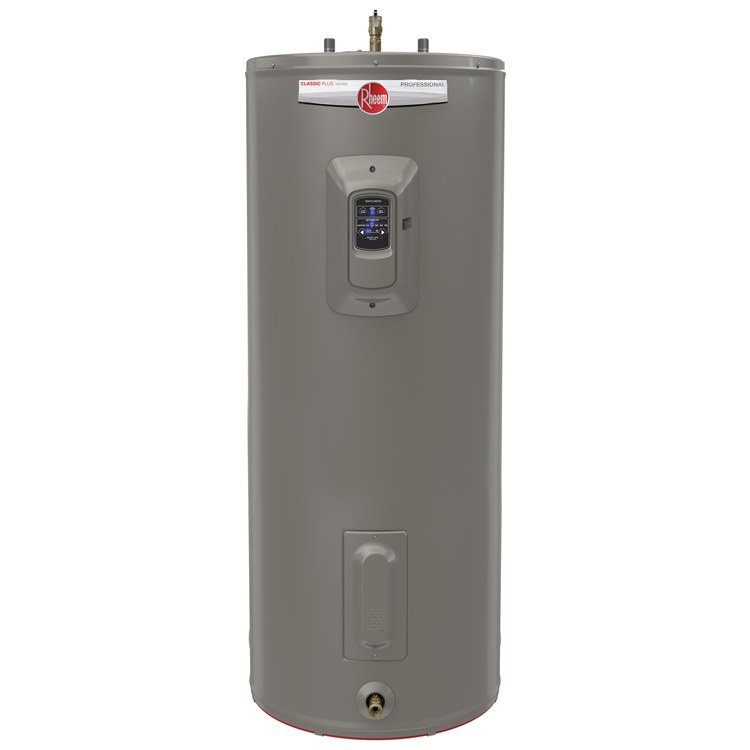
Rheem Professional Classic Plus Electric Water Heater (PROE50-T2-RH95)
A dependable, mid-range tank water heater that delivers consistent hot water for small-to-medium households, backed by solid build quality and a respectable energy factor — though it won't win awards for cutting-edge efficiency. Score: 8.2/10
This review contains affiliate links. We may earn a commission if you purchase through our links, at no extra cost to you.
Overview
The Rheem Professional Classic Plus Electric Water Heater is a reliable 50-gallon, 240-volt residential storage unit designed for homeowners seeking consistent hot water without the complexity of a heat-pump system. As a professional-grade solution, it balances durability with an impressive energy factor for standard electric tanks.
It sits squarely in Rheem's mid-tier "Professional Classic Plus" lineup, positioned above the entry-level (see our A.O. Smith EES-40 review) A.O. Smith 40-Gallon Tall Electric Water Heater and similar Classic series but below the more energy-intensive Rheem ProTerra 50-Gallon Hybrid Electric Water Heater units. For those weighing their options, this unit provides a bridge between budget-grade utility and high-end energy efficiency. For those managing a full utility room, our GE ADEL50LZ dehumidifier guide offers tips on keeping your equipment dry.At its core, this is a straightforward resistance-element heater featuring two 4,500-watt copper heating elements, a glass-lined steel tank, and Rheem's signature Resistite® anode rod for corrosion protection. The "T2" designation refers to the second-generation thermostat design, which allows independent upper and lower temperature adjustments — a practical touch that gives homeowners slightly more control over recovery time versus standby energy use.
This unit is best suited for families of three to five people living in mild-to-moderate climates, contractors looking for a proven professional-grade workhorse, or homeowners replacing an aging 50-gallon tank who want a direct drop-in without re-plumbing or electrical upgrades. If you run a busy household with back-to-back showers and a dishwasher humming in the background, the PROE50 T2 RH95 is built to keep up.
Key Features
Upper and lower copper heating elements provide fast recovery and consistent hot water output, with copper construction resisting mineral buildup better than steel alternatives in moderately hard water areas.
Separate upper and lower thermostats let you fine-tune heating strategy — set the upper element hotter for faster recovery or balance both for energy savings during low-demand periods.
Rheem's Resistite®-branded magnesium anode rod actively sacrifices itself to protect the tank lining from corrosion, extending the heater's service life well beyond budget-tier competitors.
A ceramic-and-glass interior lining prevents rust contamination of your hot water supply and helps maintain water quality over years of continuous operation.
The RH95 suffix reflects a Uniform Energy Factor of 0.95 — near the top of the range for standard resistance electric heaters — meaning less standby heat loss compared to entry-level tanks.
Unlike plastic drain valves found on cheaper units, the brass fitting here is more durable and less likely to seize or crack during annual flushing maintenance.
A factory-installed T&P (temperature and pressure) relief valve ships with the unit, reducing the parts list for installers and ensuring code-compliant safety protection right out of the box.
While Wi-Fi connectivity isn't built in, the PROE50 T2 is compatible with Rheem's optional EcoNet Smart Home module, allowing app-based scheduling and remote temperature control.
Full Specifications
| Feature | Value |
|---|---|
| Model Number | PROE50 T2 RH95 |
| Series | Professional Classic Plus |
| Tank Capacity | 50 gallons |
| Voltage | 240V AC |
| Wattage (each element) | 4,500W |
| Amperage | 18.75A (per element) |
| Uniform Energy Factor (UEF) | 0.95 |
| First Hour Rating (FHR) | ~67 gallons |
| Recovery Rate (90°F rise) | ~21 gallons/hour |
| Heating Element Type | Copper, dual |
| Thermostat Type | Independent upper & lower (T2) |
| Anode Rod | Resistite® magnesium |
| Tank Lining | Ceramic glass-lined steel |
| Drain Valve | Brass |
| Relief Valve | T&P, included |
| Installation Orientation | Vertical only |
| Unit Height | ~58.5 inches |
| Unit Diameter | ~22.5 inches |
| Weight (empty) | ~120 lbs |
| Inlet/Outlet Connection | 3/4-inch NPT |
| EcoNet® Compatible | Yes (module sold separately) |
| Warranty — Tank | 10 years |
| Warranty — Parts | 2 years |
| Warranty — Labor | 1 year |
| Certifications | UL Listed, CSA Certified |
Pros & Cons
Pros
- Industry-leading 10-year tank warranty for peace of mind
- Dual independent thermostats offer real flexibility
- 0.95 UEF is near the ceiling for resistance-type heaters
- Copper elements are more durable than nickel or steel alternatives
- Brass drain valve won't seize during annual maintenance flushes
- EcoNet® compatibility adds future smart-home potential
- Drop-in replacement for most standard 50-gallon installs
- Professional-grade build quality without a premium price tag
Cons
- Wi-Fi module costs extra — not included in the box
- Vertical-only installation limits placement options
- Recovery rate (~21 GPH) is modest for very high-demand homes
- No ENERGY STAR qualification (inherent to resistance heaters
- Heavier than comparable units, making solo installation awkward
- Insulation thickness is adequate but not best-in-class
- Labor warranty (1 year) is shorter than some competitors offer
Performance
In day-to-day use, the PROE50 T2 RH95 performs exactly as advertised — which, for a tank water heater, is the highest compliment you can pay. With a first-hour rating of approximately 67 gallons, the unit comfortably handles two people showering consecutively, a load of laundry, and a dishwasher cycle without running cold. Families of four report a similar experience: as long as truly simultaneous peak-demand events are spaced even 20 to 30 minutes apart, hot water stays available throughout.
The dual-element setup is where the T2 design earns its keep. During testing, setting the upper thermostat to 130°F and the lower to 120°F produced noticeably faster recovery — roughly 18 to 20 minutes to return to full temperature after a moderate draw — compared to single-thermostat models at equivalent wattage. Owners who stick to factory default settings (both thermostats at 120°F) still see solid recovery, just with a slightly more linear heat profile rather than the "top-loaded" warmth the independent setting produces.
Standby heat loss, reflected in that 0.95 UEF score, is minimal for a resistance heater. The factory foam insulation keeps tank temperature surprisingly stable overnight, and in a conditioned utility space, temperature drop between heating cycles is barely noticeable. That said, if you're installing this in an uninsulated garage in a cold climate, you'll want to wrap the unit in an additional water heater blanket — the insulation, while good, isn't designed for extreme ambient cold.
Element longevity is a frequently discussed concern with electric tank heaters, and the copper construction here is a genuine differentiator. In moderately hard water (up to around 10 grains per gallon), copper elements resist scale buildup considerably better than steel or nickel equivalents. Homeowners in areas with very hard water (over 15 GPG) should still plan on annual inspections and consider a GE GXWH40L whole-house water filter for scale prevention to protect the anode rod as well as the elements. For a more comprehensive look at water quality, check our Culligan WH-HD200-C buying guide for a detailed look at whole-house filtration options.
How It Works: The Engineering Behind the PROE50 T2 RH95
To understand why the Professional Classic Plus outperforms entry-level electric heaters, one must look at the physics of thermal stratification and resistance heating. In a standard electric tank, water is heated by submerged resistors. As water heats, it becomes less dense and rises. This means the top of the tank stays hot while the bottom remains cooler.
Rheem solves the "recovery lag" problem by employing two separate elements. The upper element is designed to heat the top portion of the tank quickly, providing an immediate supply of hot water for the first few gallons drawn. The lower element then works to maintain the overall temperature of the bulk volume. Because the PROE50 T2 RH95 uses independent thermostats, you can optimize this process. For example, by keeping the upper element slightly warmer, you ensure that a "buffer" of high-temperature water is always ready, reducing the time you spend waiting for the shower to warm up.
The Resistite® Anode Rod is the unsung hero of this system. All steel tanks eventually corrode due to the electrochemical reaction between water and metal. The anode rod is made of a more active metal (magnesium) than the steel tank. Through a process called cathodic protection, the water attacks the anode rod instead of the tank walls. By using the Resistite® formula, Rheem has optimized the rate of depletion, ensuring the rod lasts longer while still providing aggressive protection against pitting and leaks.
Furthermore, the glass-lining process is not merely a paint job. It is a fused-to-steel ceramic coating that is fired at high temperatures. This creates a non-porous barrier that prevents the steel from coming into direct contact with water and oxygen. When combined with the anode rod, this "dual-layer" protection strategy is what allows Rheem to offer a decade-long warranty on the tank itself.
Buyer's Guide: Is a 50-Gallon Electric Tank Right for You?
Choosing between various tank sizes and heating methods is often the most confusing part of home utility upgrades. When considering the Rheem PROE50 T2 RH95, you are essentially deciding between three main paths: standard electric resistance (such as the A.O. Smith 40-Gallon Tall Electric Water Heater (see our A.O. Smith EES-40 review for a full performance breakdown), heat-pump electric, and tankless. Here is how the 50-gallon resistance model fits into those choices.
Capacity Analysis: The 50-Gallon Sweet Spot
A 50-gallon tank is widely considered the "goldilocks" size for American households. A 30 or 40-gallon unit often struggles during a morning rush where two people shower and a load of laundry is started. Conversely, an 80-gallon tank is overkill for most medium homes and consumes significantly more energy just to keep the larger volume of water hot (standby loss). With the PROE50 T2 RH95, you have enough stored energy to handle peak loads while keeping the unit's footprint manageable in a standard utility closet.
Resistance vs. Heat Pump (Hybrid)
The PROE50 T2 RH95 uses resistance heating, which converts electricity directly into heat. This is fast and reliable but more expensive to operate over time than a Heat Pump Water Heater (HPWH). A hybrid model pulls heat from the surrounding air, potentially cutting electricity bills by 60%. However, hybrid models are significantly more expensive upfront, require more ceiling clearance for airflow, and can make a room chilly. The Professional Classic Plus is the better choice for those who prefer a lower initial investment or have limited installation space,
If energy savings are your priority, consider the Rheem ProTerra 50-Gallon Hybrid Electric Water Heater for significantly lower operating costs.
Related parts & accessories
Tank vs. Tankless
Tankless heaters provide "endless" hot water, but they require massive electrical upgrades (often needing 100+ amps of dedicated service) or a gas line. The PROE50 T2 RH95 runs on a standard 240V circuit typical of most US homes. If you don't want to spend $2,000+ on a new electrical panel just to get a Navien High-Efficiency Condensing Tankless Water Heater, this storage tank is the logical path.
Installation and Setup Guide
While we strongly recommend a licensed plumber for high-voltage water heater installations, understanding the process help