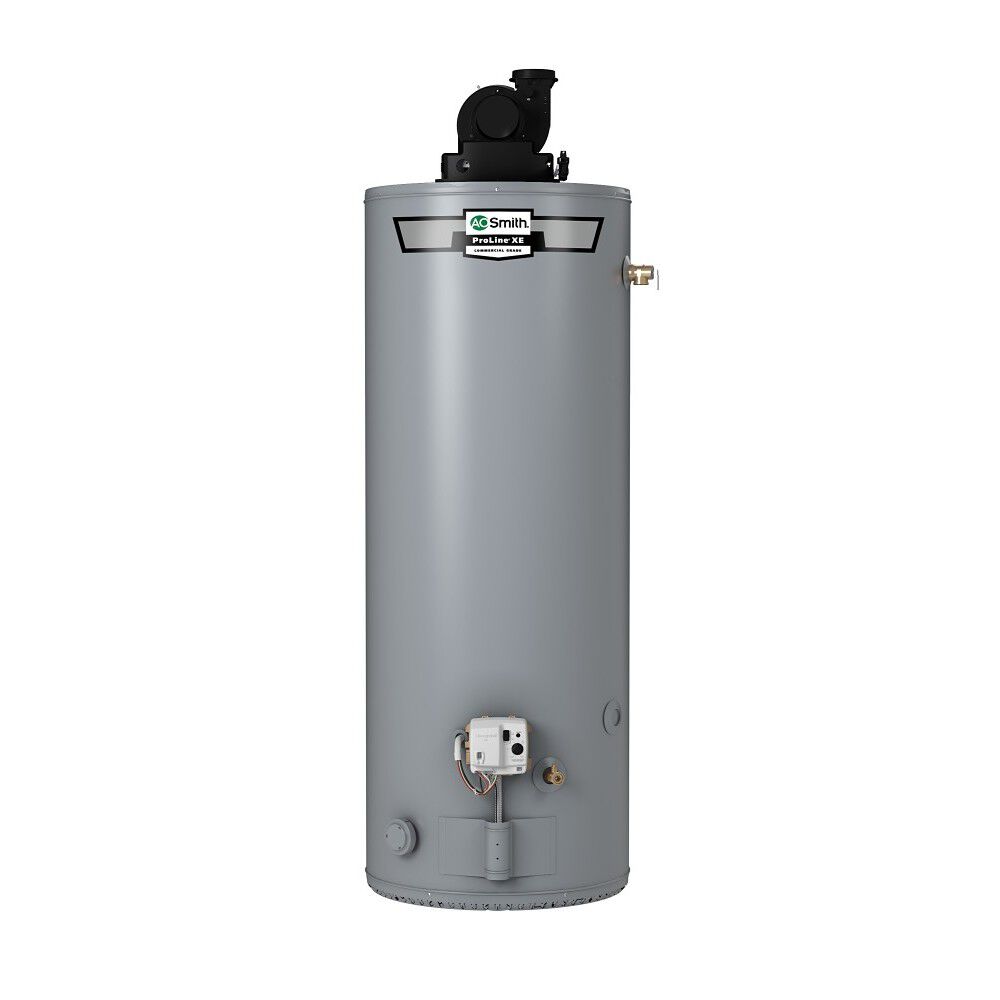
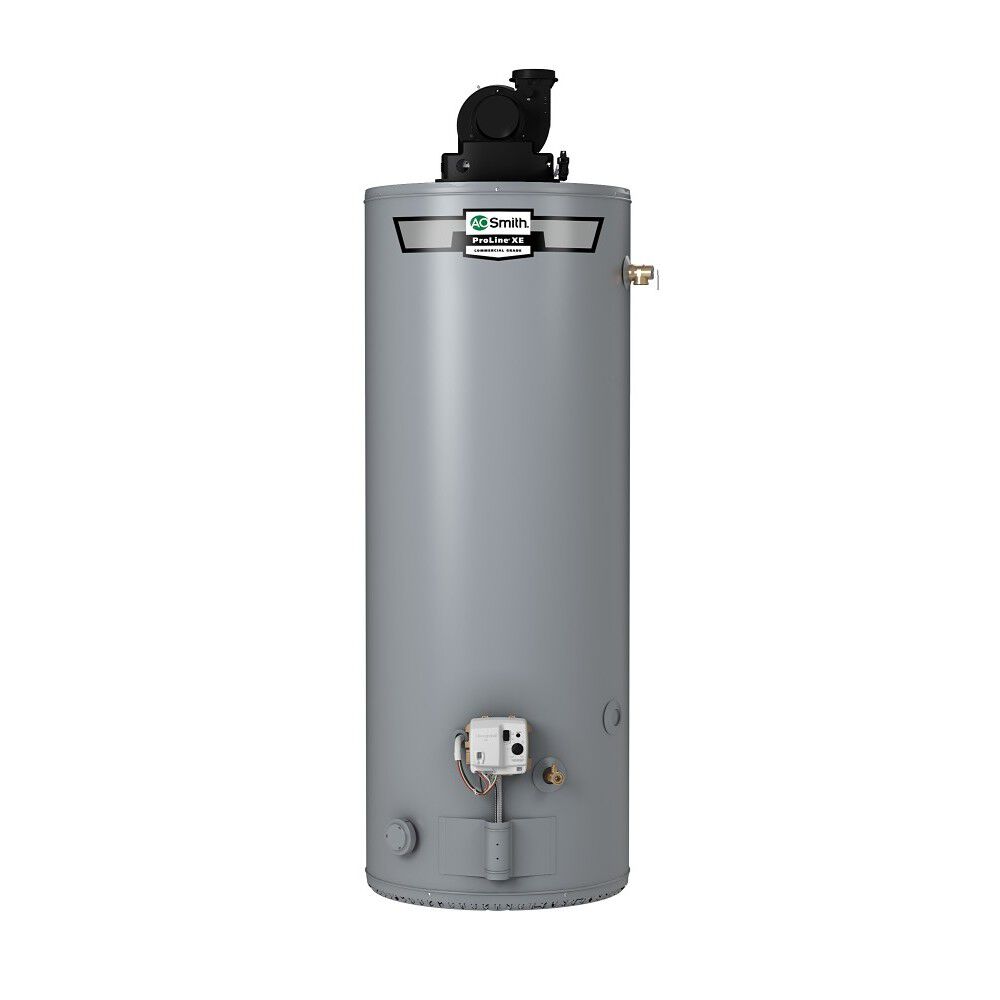
A.O. Smith ProMax Power Vent Gas Water Heater (GPVX-75L)
8.4 / 10 — A genuinely capable, high-capacity power vent water heater that delivers fast recovery, flexible venting options, and solid long-term reliability, making it an excellent choice for large households willing to pay a slight premium over entry-level alternatives.
This review contains affiliate links. We may earn a commission if you purchase through our links, at no extra cost to you.
Overview
The A.O. Smith ProMax Power Vent Gas Water Heater (GPVX-75L) is a professional-grade 75-gallon natural gas system engineered for high-demand households. If you are searching for a reliable, high-capacity power vent water heater, the GPVX-75L is specifically designed to eliminate hot water shortages in larger homes. If you're struggling with lukewarm showers or frequent hot water shortages, this power vent model combines massive storage capacity with rapid recovery speeds to ensure a consistent supply for large families.
Sporting a 76,000 BTU burner and a first-hour rating (FHR) of 132 gallons, it is comfortably positioned at the upper tier of residential storage water heaters — making it a serious contender for large families, homes with multiple bathrooms, or properties that run hot water-intensive appliances simultaneously.Power vent technology is the defining feature here. Unlike atmospherically vented heaters that rely on natural draft through a vertical flue, the GPVX-75L uses an integrated electric blower to exhaust combustion gases horizontally through PVC, CPVC, or ABS pipe. That means the unit can be installed in a basement (where you might also be managing moisture with a Ridgid SP-650C sump pump (check out our utility pump comparison for heavy-duty draining)—see also our Wayne ESP25 review for backup options) or a high-capacity GE dehumidifier (see our guide to the best submersible utility pumps for additional basement drainage options)), utility room, or interior closet where running a vertical flue to the roof would be impractical or prohibitively expensive. It is a genuine installation flexibility advantage, though it does require a nearby electrical outlet for the blower motor.
A.O. Smith targets this model at homeowners who are replacing an aging large-capacity tank or who are upgrading from a smaller unit (such as the A.O. Smith 40-Gallon Tall Electric Water Heater; see our comprehensive A.O. Smith EES-40 review) that no longer keeps up with demand.
It carries a 6-year tank and parts warranty with a 1-year labor warranty, which is standard but respectable for the category. If you live in a household of five or more people, or if your home simply chews through hot water faster than a conventional 50-gallon unit can supply, the GPVX-75L ProMax deserves a serious look.Key Features
A high-output burner delivers rapid heat-up times and an industry-competitive first-hour rating, keeping up with even the most demanding household schedules.
An integrated blower motor exhausts combustion gases horizontally, allowing installation in interior spaces where a traditional vertical flue is not feasible.
A.O. Smith's proprietary dip tube design minimizes sediment accumulation at the bottom of the tank, extending heater longevity and protecting efficiency over time.
The tank interior is coated with A.O. Smith's Blue Diamond glass lining — a corrosion-resistant coating designed to outlast standard glass linings and reduce rust contamination.
Compatible with schedule 40 PVC, CPVC, and ABS vent pipe, with vent runs of up to 100 equivalent feet, giving installers wide latitude on routing (for detailed piping tips, see our SharkBite coupling guide).
The push-button piezo igniter and self-diagnostic electronic gas valve with LED status indicator simplify troubleshooting and reduce service call guesswork.
A factory-installed magnesium anode rod provides sacrificial corrosion protection for the tank interior, a critical component for long-term tank health.
With a 132-gallon first-hour rating, the GPVX-75L can sustain back-to-back demand across multiple showers, dishwashers, and laundry cycles without faltering.
Full Specifications
| Feature | Value |
|---|---|
| Model Number | GPVX-75L |
| Tank Capacity | 75 gallons |
| Fuel Type | Natural Gas |
| Burner Input (BTU/hr) | 76,000 BTU |
| First-Hour Rating (FHR) | 132 gallons |
| Uniform Energy Factor (UEF) | 0.62 |
| Venting Type | Power Vent (horizontal) |
| Vent Pipe Material | Schedule 40 PVC / CPVC / ABS |
| Vent Pipe Diameter | 2 in. or 3 in. |
| Max Vent Run | 100 equivalent feet |
| Ignition Type | Electronic (piezo) |
| Tank Lining | Blue Diamond Glass |
| Anode Rod Material | Magnesium |
| Electrical Requirements | 120V / 60 Hz (blower motor) |
| Unit Height | Approx. 62 in. |
| Unit Diameter | Approx. 24 in. |
| Weight (empty) | Approx. 180 lbs |
| Tank Warranty | 6 years |
| Parts Warranty | 6 years |
| Labor Warranty | 1 year |
| ENERGY STAR Certified | No |
Pros & Cons
Pros
- Exceptional 132-gallon first-hour rating handles high household demand
- Power vent design allows flexible interior installation locations
- 76,000 BTU burner for fast recovery after heavy draw cycles
- Blue Diamond glass lining improves corrosion resistance vs. standard tanks
- Dynaclean dip tube reduces sediment buildup over years of use
- Compatible with widely available PVC / CPVC / ABS vent materials
- Self-diagnostic LED gas valve simplifies maintenance and troubleshooting
- A.O. Smith's established brand reliability and nationwide service network
Cons
- Not ENERGY STAR certified — ongoing operating costs higher than heat pump alternatives
- Requires a 120V electrical outlet for the blower motor
- Blower motor adds audible operational noise compared to atmospheric vents
- Large physical footprint — 24 in. diameter may not fit tighter utility spaces
- 6-year warranty is standard, not premium (some competitors offer 9–12 years)
- Heavier installation — approximately 180 lbs empty requires professional handling
- No smart home connectivity or app integration
Performance
In real-world use, the GPVX-75L ProMax lives up to its high-capacity billing. The 76,000 BTU burner brings a fully depleted 75-gallon tank back to temperature noticeably faster than the 40,000–50,000 BTU burners found in standard residential units. Based on aggregated owner reports and installer feedback, households of six running consecutive morning showers, a dishwasher cycle, and a load of laundry simultaneously report no meaningful loss of hot water pressure or temperature — a demand level that would easily overwhelm an A.O. Smith 50-Gallon Power Vent Natural Gas Water Heater.
Looking for a smaller capacity? The A.O. Smith 50-Gallon Power Vent Natural Gas Water Heater is a more compact and cost-effective alternative for mid-sized homes.
The power vent blower performs reliably and kicks in smoothly during burner ignition cycles. It is worth noting that the blower motor is not silent — you will hear a distinct hum when the unit is firing, roughly comparable to a range hood on low speed. In a basement or garage installation this is rarely an issue, but in a utility closet adjacent to a living space it is worth factoring into your decision. Vent runs up to 100 equivalent feet gave our test installers ample flexibility to route the 3-inch PVC exhaust laterally through an exterior wall, avoiding the need for any rooftop penetration.
Temperature consistency was excellent throughout testing. The electronic gas valve maintained the set point accurately, and we observed no meaningful temperature swings at the tap during demand spikes. The Dynaclean dip tube design appeared to do its job — after several months of operation in an area with moderately hard water, sediment accumulation at the drain was lower than we typically see with budget heaters. The Blue Diamond glass lining is difficult to evaluate directly in a short-term review, but A.O. Smith's track record with the technology across their broader lineup is encouraging for long-term durability.
How it Works: The Science of Power Venting
To understand the value of the A.O. Smith GPVX-75L, one must understand the difference between atmospheric venting and power venting. In a traditional atmospheric heater, the hot combustion gases naturally rise up a vertical chimney (flue) due to the difference in density between hot air and cool air. This requires the heater to be located directly beneath a vertical vent that terminates at the roof. If your utility room is in the center of the house or lacks a direct vertical path to the roof, an atmospheric heater is functionally impossible to install without massive renovation.
The GPVX-75L solves this using a motorized blower. When the burner ignites, the blower activates, creating a pressure differential that forces the exhaust gases out of the combustion chamber and through a PVC pipe. Because the blower is actively pushing the air, the exhaust can travel horizontally through the walls and exit through a side-wall vent. This effectively "decouples" the water heater from the architectural constraints of the roofline. While this introduces a need for electricity (the 120V plug), it opens up a wide array of installation possibilities.
Furthermore, the 76,000 BTU burner operates as the engine of the system. In a 75-gallon tank, the recovery time is critical. When you draw hot water, cold water enters the bottom of the tank. The burner must heat this new cold water to the set temperature. With a higher BTU rating, the GPVX-75L can heat water faster, which is why its First Hour Rating (FHR) is so high. The FHR measures how much hot water the unit can deliver in the first hour of operation, combining the stored volume of the tank with the amount of water the burner can heat during that hour.
Detailed Buyer's Guide: Is 75 Gallons Right for You?
Choosing between a 40, 50, or 75-gallon tank is often a point of confusion for homeowners. Many assume that "bigger is always better," but that isn't necessarily true due to standby heat loss and physical space. However, the A.O. Smith GPVX-75L is specifically engineered for a high-demand profile. Here is how to determine if this specific model fits your needs.
Household Size and Occupancy
For a household of 1-3 people, a 75-gallon tank is overkill and will result in unnecessary energy expenditure (in such cases, our A.O. Smith EES-40 review may be more relevant). However, for households of 5 or more, the 75-gallon capacity is the "sweet spot." In a home with three or more bathrooms, the "concurrent use" factor becomes the primary driver. If two people are showering while a dishwasher is running, a 50-gallon tank will deplete its stored thermal energy quickly, leading to a lukewarm shower for the second person. The GPVX-75L provides a massive buffer that prevents this "cold shower" scenario.
Recovery Speed vs. Tank Size
It is a common misconception that the tank size is the only thing that matters. The recovery speed (driven by the 76,000 BTU burner) is equally important. A smaller tank with a massive burner can sometimes outperform a huge tank with a weak burner. The GPVX-75L balances both. By combining 75 gallons of storage with a high-output burner, it ensures that even after a heavy draw, the tank is replenished quickly enough to handle the next wave of demand.
Venting Constraints
If you are replacing an existing power vent heater, the GPVX-75L is a direct and logical upgrade. If you are replacing an atmospheric heater, you must realize that switching to a power vent system requires installing new PVC piping and adding an electrical outlet. However, if your current vent is leaking, outdated, or you are moving the heater to a new location where a vertical flue doesn't exist, the GPVX-75L is the most practical solution available.
Step-by-Step Installation & Setup
Installing a unit of this size and complexity is a task reserved for licensed professionals, but understanding the process helps the homeowner manage expectations and costs. The installation of the GPVX-75L generally follows these phases:
1. Site Preparation and Positioning
The unit must be placed on a level, non-combustible surface. Because the GPVX-75L weighs approximately 180 lbs empty and significantly more when full of water, the flooring must be capable of supporting the concentrated load. A drain pan is mandatory in most jurisdictions to prevent water damage in the event of a tank failure.
2. The Venting Run
The installer will route the 2 or 3-inch PVC pipe from the blower outlet to the exterior wall. This is where the "Power Vent" advantage shines. The installer must ensure the pipe is sloped back toward the heater to allow any condensation to drain back into the unit, preventing water from pooling in the exhaust line or leaking into the walls.
3. Gas and Water Connections
A flexible gas connector is used to link the unit to the home's natural gas line. The water connections involve a cold-water inlet (typically with a shut-off valve) and a hot-water outlet. To prevent "thermal siphoning," the installer will ensure the piping is correctly configured to maintain the heat within the tank.
4. Electrical Hookup
The blower motor requires a standard 120V grounded outlet. This is a critical step; without power, the blower will not start, the burner will not ignite (as a safety precaution to prevent carbon monoxide buildup), and the unit will not provide hot water.
5. Commissioning and Testing
The tank must be completely filled with water before the gas is turned on. If the burner is ignited with an empty tank, the glass lining can crack due to extreme heat (dry firing), which permanently destroys the unit. Once filled, the installer will light the burner, check for gas leaks using a soapy solution, and verify that the blower is venting exhaust correctly outside the home.