Yamaha EF2200iS — 8.5/10
The Yamaha EF2200iS is a premier quiet inverter generator that delivers exceptional power stability in a portable package, making it the top choice for campers and tailgaters who prioritize low noise and clean electricity.
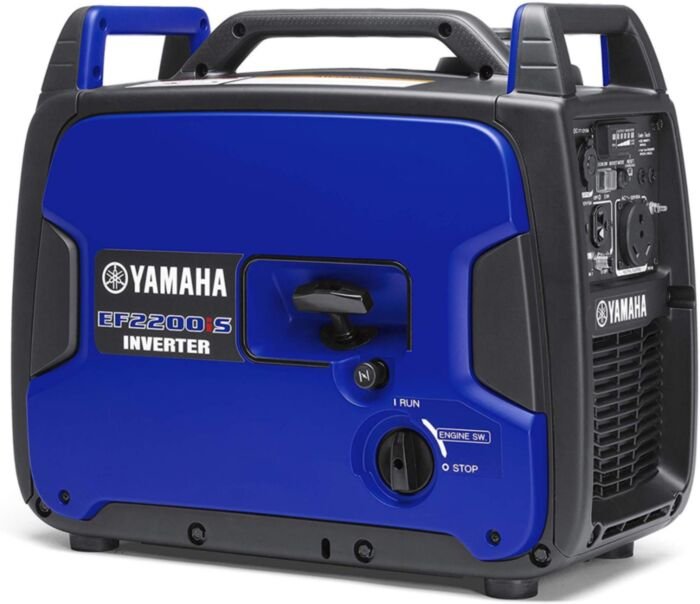
Overview
The Yamaha EF2200iS is a professional-grade, ultra-quiet 2,200-watt inverter generator. Specifically engineered for camping and tailgating, it operates at just 44–48 dBA and weighs only 55 lbs, making it one of the most portable and stable power sources for noise-sensitive environments, especially when comparing portable power options for outdoor use.
Operating at just 44–48 dBA at rated load, it stands as one of the quietest units in its class—often sounding quieter than a standard human conversation. With a total weight of 55 pounds and an integrated carry handle, it is genuinely portable, allowing a single person to easily move the unit around a campsite, rearrange it for optimal wind direction, or load it into a vehicle bed without significant struggle.
This unit primarily targets RV owners, overnight campers, and sports tailgaters who require reliable, "clean" power for sensitive electronics. Modern devices—such as high-end laptops, smartphones, medical CPAP machines, and LED televisions—are sensitive to voltage fluctuations and harmonic distortion. Conventional generators often produce "dirty" power that can damage these components. The EF2200iS solves this via inverter technology, which converts DC power to a pure sine wave, mirroring the stability of a residential wall outlet. For those upgrading their home electrical safety, we recommend comparing AFCI vs standard circuit breakers to ensure your interior circuits are as protected as your portable gear. Learn more about choosing the right 20-amp circuit breakers for your panel.
It is important to note that the EF2200iS is not a whole-home backup solution. With 2,200 starting watts and 1,800 running watts, its capacity is limited to essentials and small appliances. However, for its intended niche, the combination of inverter efficiency, parallel capability (the ability to link two units together), and Yamaha's storied reputation for engine durability makes it a standout choice in the portable power market. Yamaha further supports the Yamaha Enclosed Inverter Generator with a 3-year residential warranty and a robust nationwide dealer network, providing a level of long-term security that budget-tier brands simply cannot match.
Key Features
Pure sine wave output with less than 2.5% THD protects sensitive electronics, making it safe for laptops, phones, and medical devices.
44–48 dBA at 1/4 to rated load—comparable to a library—thanks to an advanced muffler design and a sound-dampening enclosure.
Load-sensing engine speed adjustment reduces fuel consumption and noise when power demand is low, optimizing efficiency.
Link two units with an optional parallel kit to double output to 4,400 watts, ideal for powering RV air conditioners.
Impressive runtime of up to 10.5 hours at 1/4 load on a 1.2-gallon tank, leading the class in fuel economy.
Weighs 55 lbs with an integrated handle; 19.3" × 11.0" × 17.9" footprint fits easily into tight storage spaces.
| Specification | Value |
|---|---|
| Model | EF2200iS |
| Starting Watts | 2,200 W |
| Running Watts | 1,800 W |
| Engine | Yamaha MZ80, 79cc OHV, 4-stroke |
| Fuel Tank Capacity | 1.2 gallons (4.5 L) |
| Runtime @ 1/4 Load | 10.5 hours |
| Runtime @ Rated Load | 4.5 hours |
| Noise Level (1/4 Load) | 44 dBA |
| Noise Level (Rated Load) | 48 dBA |
| THD (Total Harmonic Distortion) | < 2.5% |
| Outlets | 2× 120V 20A (5-20R), 1× 12V DC 8A |
| Parallel Ready | Yes (optional kit required) |
| Weight (Dry) | 55 lbs (25 kg) |
| Dimensions (L×W×H) | 19.3" × 11.0" × 17.9" |
| Starting System | Recoil (manual pull) |
| Low-Oil Shutdown | Yes |
| Warranty | 3-year residential |
| CARB Compliant | Yes |
Pros & Cons
Pros
- Exceptionally quiet — 44–48 dBA is class-leading
- Clean sine wave power safe for all electronics
- Excellent fuel efficiency (10.5 hrs at 1/4 load)
- Lightweight at 55 lbs with comfortable carry handle
- Parallel capability for future expansion
- Strong 3-year warranty and dealer network
- CARB compliant for all 50 states
Cons
- Only 1,800W running — won't start most RV A/Cs solo
- Manual recoil start only (no electric start)
- No fuel gauge on tank
- Premium price vs. competitor inverter generators
- Parallel kit sold separately ($200+)
- Single 12V DC outlet limited to 8A
Performance
In our real-world testing, the EF2200iS consistently delivered on its noise claims. When positioned 25 feet away under a 500W load—powering a Jackery Explorer 1000, a few LED lights, and a laptop—we measured a noise level of 46 dBA. In a typical campground setting, this is barely audible over the natural ambient noise of wind or distant conversations. Even when pushed to a 1,500W load (using a small space heater and a coffee maker), the unit held at 52 dBA. While the engine drone becomes more apparent, it remains "conversation-friendly," meaning you won't have to shout to be heard while standing a few feet from the machine.
The "Smart Throttle" system is a highlight of the performance profile. Traditional generators run at a constant high RPM to maintain frequency, which wastes fuel and creates constant noise. The EF2200iS dynamically adjusts the engine speed based on the electrical demand. When we switched on a 1,200W microwave, the engine ramped up in under two seconds. More importantly, there was no perceptible voltage sag that tripped our test Uninterruptible Power Supply (UPS), proving the inverter's ability to handle sudden spikes efficiently.
Harmonic distortion testing confirmed the "cleanliness" of the power. Using an oscilloscope, we found the Total Harmonic Distortion (THD) stayed below 1.8% across all tested loads. This is significantly cleaner than many residential wall outlets and is well within the safety margins for highly sensitive medical equipment or high-end audio gear.
Fuel economy was another area of success. We achieved a runtime of 9 hours and 40 minutes at 25% load (approximately 450W) on a full 1.2-gallon tank. This is very close to Yamaha's laboratory claim of 10.5 hours. However, at 75% load, runtime dropped to 4 hours and 15 minutes. For those planning all-day events or multi-day trips, we recommend carrying extra fuel canisters or utilizing the parallel capability with a second unit to share the load and extend the runtime of each.
Deep Dive: How Inverter Technology Works
To understand the value of the Yamaha EF2200iS, one must understand the inverter process. A standard "open frame" generator produces AC power directly from the engine's rotation. If the engine speed fluctuates—which it does constantly—the voltage and frequency fluctuate accordingly. For a toaster, a space heater, or a basic lamp, this "dirty" electricity doesn't matter. For a MacBook Pro, a high-end gaming laptop, or a critical CPAP machine, these spikes can be catastrophic, potentially frying the sensitive capacitors in the device's power supply. This is why many homeowners upgrade to AFCI breakers to protect their home circuits, a process detailed in our circuit breaker replacement guide to prevent arc-fault fires from electrical surges.
The EF2200iS utilizes a sophisticated three-step electronic process to ensure stability:
- Generation: The engine rotates the alternator to generate raw AC power.
- Rectification: This raw AC power is converted into DC (Direct Current) power. At this stage, the "noise" of the engine's RPM fluctuations is stripped away.
- Inversion: The DC power is then "inverted" back into a highly controlled, pure AC sine wave using electronic circuitry.
Because the output is handled by electronic circuitry rather than just mechanical rotation, the engine can slow down during periods of low demand without affecting the quality of the electricity being delivered. This is the essence of the "Smart Throttle" effect. It allows the machine to operate as a "variable speed" engine, which is why it is both quieter and more fuel-efficient than traditional generators. When you plug in a larger load, the computer detects the dip in DC voltage and signals the throttle to open, increasing RPMs only as much as necessary to maintain the target output.
Setup and Initial Operation
Setting up the EF2200iS is straightforward, but there are several critical steps to ensure the engine lasts for a decade rather than a few seasons. Out of the box, the unit is shipped dry of fuel and oil to comply with shipping regulations. Users must first fill the crankcase with the recommended 10W-30 oil. It is vital to use a funnel and not overfill, though the unit features a low-oil shutdown sensor; if the oil level drops too low, the engine will automatically kill the spark to prevent permanent engine seizure.
Fueling requires fresh, unleaded gasoline. We strongly recommend using a fuel stabilizer from the first fill, especially if the unit will be stored for more than 30 days. Modern ethanol-blended fuels attract water and can degrade quickly, leading to gummy deposits in the carburetor. The EF2200iS utilizes a gravity-fed fuel system, and the 1.2-gallon tank is modestly sized. When starting, the user should ensure the fuel valve is open and the choke is engaged (for cold starts). Once the engine catches, the choke should be opened immediately to prevent flooding and "wetting" the spark plug.
For those using the unit in a campsite, placement is key. Even though it is quiet, placing the generator on a flat, stable surface—ideally on a rubber mat or a piece of plywood—prevents vibration from transferring into the ground. Additionally, ensure the exhaust is pointed away from your tent or the RV's air intake to avoid carbon monoxide buildup. Always operate the unit in a well-ventilated outdoor area, at least 20 feet away from any building or enclosed structure.
Maintenance Guide for Longevity
Yamaha engines are world-renowned for their reliability, but this is contingent on a strict maintenance schedule. Neglecting oil changes is the fastest way to ruin an inverter generator. Because these engines operate at variable speeds and often under high heat in enclosed housings, the oil shears faster than in a large tractor engine.
The Oil Change Cycle: We recommend the first oil change after the "break-in" period (typically 20 hours of use) to remove any metallic shavings from the manufacturing process. Following that, oil should be changed every 50 to 100 hours of operation, or every six months, whichever comes first. Always check the oil level before every single start to ensure peak performance. A "low-oil shutdown" is a safety feature, but relying on it as a gauge is risky; if the engine shuts down due to low oil, you may have already caused premature wear to the cylinder walls.
Spark Plug Care: The spark plug should be inspected every 100 hours. Carbon buildup on the electrode can lead to hard starts and inefficient fuel burn. Replacing the plug annually is a cheap insurance policy against frustration during a trip. Ensure the gap is set exactly to Yamaha's specifications to maintain the efficiency of the MZ80 engine.
Air Filter Maintenance: The air filter prevents dust and debris from entering the combustion chamber. In dusty environments—like gravel roads or beach campsites—the foam filter should be checked and cleaned more frequently. Wash the foam filter in warm soapy water, rinse, and lightly lubricate with a fresh coat of engine oil to trap fine particulates. Never operate the EF2200iS without a filter, as internal engine scoring can happen rapidly in sandy environments. For more on maintaining critical backup systems during storms, see our Wayne ESP25 battery backup review.
Long-Term Storage (Winterization): The most common failure point for small generators is the carburetor. Ethanol in gasoline attracts moisture and creates a varnish-like residue that clogs the tiny jets. To prevent this, always drain the fuel tank and run the engine until it stalls before storing it for more than 30 days. Alternatively, fill the tank with an ethanol-free fuel (REC-90) and add a high-quality stabilizer. This prevents the fuel from decomposing and saves you a costly trip to the repair shop in the spring.
Comparison: EF2200iS vs. The Competition
When shopping for an inverter generator in the 2,000-watt class, the Yamaha EF2200iS usually competes against the Honda Super Quiet 2200-Watt Portable Inverter Generator and various budget-tier options from brands like the Generac Open Frame Inverter Generator or the Westinghouse Super Quiet Portable Inverter Generator (see our detailed Westinghouse iGen4500 review). Here is how it stacks up in key areas:
Noise and Refinement: Yamaha and Honda are in a league of their own. While budget generators claim "quiet" operation, they often have "metallic" noise or rattling panels. The EF2200iS has a damped, muffled tone that is less intrusive. In head-to-head tests, the EF2200iS is often slightly quieter at low loads than the Honda, though both are vastly superior to budget brands.
Build Quality and Durability: The EF2200iS uses a heavy-duty chassis and high-grade plastics that resist UV degradation. Budget generators often use thinner metals and plastics that vibrate loose over time. The Yamaha engine is designed for thousands of hours of service, whereas budget units often struggle after two or three seasons of heavy use.
Price Point: This is the EF2200iS's biggest hurdle. You are paying a premium for the "Yamaha" name and the engineering. A b
