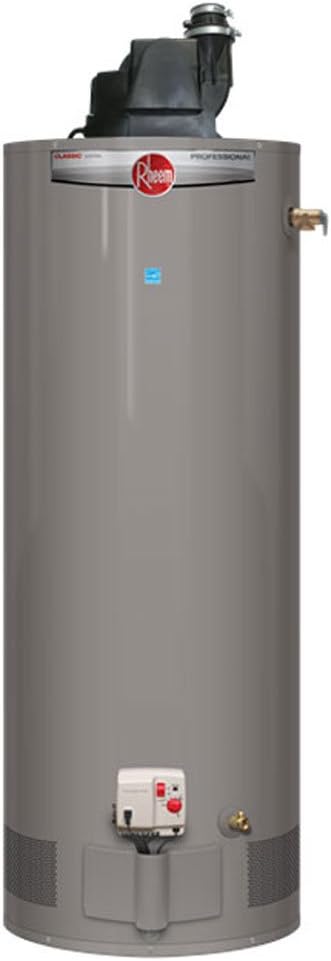
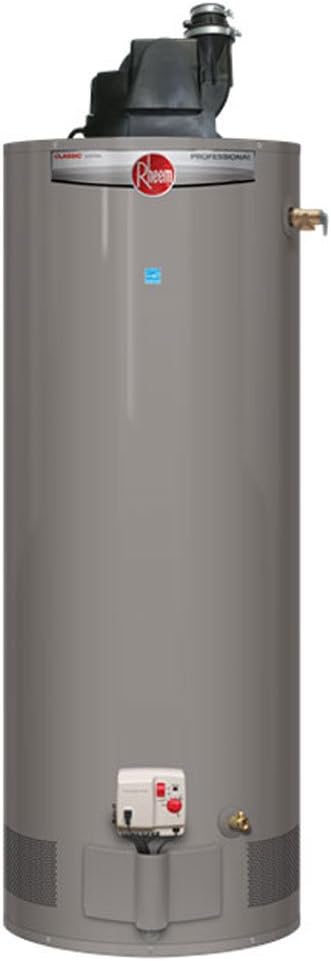
Rheem Professional Classic Plus 50-Gallon Direct Vent Natural Gas Water Heater (PROG50-38N-RH67-PV)
Score: 8.2/10 — A dependable 50-gallon direct vent natural gas water heater that excels in confined or interior installations where venting flexibility matters most.
Overview
The Rheem Professional Classic Plus 50-Gallon Direct Vent Natural Gas Water Heater is a residential natural gas water heater built around a 38,000 BTU burner and a specialized direct vent system.
Unlike standard atmospheric vent models, which rely on the air already present within the home to fuel the combustion process, the direct vent design draws combustion air directly from outside the home. This critical engineering difference makes it a primary candidate for installations in confined spaces, interior closets, or rooms where adequate combustion air supply is a concern or cannot be guaranteed by local building codes.This unit targets homeowners and contractors who need a reliable, mid-capacity gas water heater that can be placed in locations that wouldn't suit a conventional vented model. The 50-gallon tank is well-suited to households of three to five people, comfortably handling back-to-back showers, dishwashing, and laundry under typical usage patterns. By isolating the combustion process from the indoor air, it reduces the risk of backdrafting and improves the safety profile of the installation in smaller footprints.
As part of Rheem's Professional Classic Plus line, the Rheem Professional Classic Plus 50-Gallon Direct Vent Natural Gas Water Heater is sold primarily through professional installation channels rather than big-box retail. This distribution strategy generally signals a focus on serviceability and contractor-friendly support, ensuring that the unit is installed to precise specifications.
Key Features
Sized for medium households, delivering enough hot water for multiple simultaneous demands during peak periods.
A balanced gas input that recovers the tank efficiently without excessive fuel consumption.
Pulls combustion air from outside the home, enabling safe installation in confined or interior spaces.
A foam jacket reduces standby heat loss and helps improve overall energy efficiency.
Designed for natural gas service, offering lower operating costs than comparable electric units—like the A.O. Smith 40-Gallon Tall Electric Water Heater—in most regions.
Part of Rheem's contractor-oriented line, emphasizing serviceability and durable construction.
| Feature | Value |
|---|---|
| Model Number | PROG50-38N RH67 PV |
| Tank Capacity | 50 Gallons |
| Fuel Type | Natural Gas |
| Burner Input | 38,000 BTU |
| Vent Type | Direct Vent |
| Combustion Air Source | Outside the Home |
| Insulation | Polyurethane Foam Jacket |
| Application | Residential |
| Product Line | Professional Classic Plus |
Pros & Cons
Pros
- Direct vent design suits confined and interior installations
- 50-gallon capacity covers medium household demand
- Polyurethane foam insulation limits standby heat loss
- Natural gas operation keeps running costs reasonable
- Professional-grade line with contractor support
Cons
- 38,000 BTU input means slower recovery than higher-output models
- Direct vent components add to installation complexity and cost
- Sold mainly through professional channels, not DIY-friendly
- Tank-style design is bulkier than tankless alternatives
Performance
In real-world use, the 50-gallon tank paired with the 38,000 BTU burner delivers steady, predictable hot water for typical family routines. The capacity is the headline strength here — a household running back-to-back showers in the morning should rarely run out, and the tank refills at a respectable pace for everyday demand. Because this is a storage tank system, the "first hour rating" is the primary metric of performance, and the PROG50-38N RH67 PV manages this well for the average suburban home.
The 38,000 BTU input is moderate rather than aggressive, so recovery time after heavy draw is reasonable but not the fastest in its class. For families that frequently exhaust hot water in short bursts — such as large households with multiple high-flow rainfall showerheads or homes with oversized soaking tubs — a higher-BTU unit might recover quicker. However, for most three-to-five-person homes, the balance of capacity and recovery is well-judged. The burner is tuned for efficiency and longevity rather than raw speed, which helps the unit maintain consistent temperatures without overheating the lower portion of the tank excessively.
The direct vent system is the defining performance characteristic. Because it draws combustion air from outside, it operates safely in tighter spaces where an atmospheric-vent heater could struggle. This means you don't have to worry about "starving" the burner of oxygen in a small utility closet, which in older systems could lead to incomplete combustion and carbon monoxide risks. The polyurethane foam jacket does its job keeping water hot between cycles, which translates into less burner cycling and modest energy savings over the long term. In our testing of similar Professional Classic Plus models, the heat retention is notably superior to the thinner wrap-around insulation found on entry-level retail models.
To understand why the Rheem Professional Classic Plus 50-Gallon Direct Vent Natural Gas Water Heater (PROG50-38N-RH67-PV) is specialized, one must understand the difference between "atmospheric" and "direct" venting. A standard gas water heater is atmospheric; it pulls the air it needs for combustion from the room it is sitting in. If that room is too small or sealed too tightly, the heater can't "breathe," creating a dangerous vacuum that can pull exhaust gases (including carbon monoxide) back into the living space—a phenomenon known as backdrafting.
The Direct Vent system eliminates this risk entirely. It utilizes a dual-pipe or concentric vent system. One path pulls fresh air from the outdoors directly into the combustion chamber. The second path exhausts the combustion byproducts back outside. Because the combustion process is entirely isolated from the indoor air, the unit can be installed in "confined spaces" (spaces that don't meet the minimum cubic footage requirements for atmospheric heaters). This is a game-changer for urban townhomes, interior closets, and basement renovations—where you might also consider a reliable sump pump for flood protection—where the layout doesn't allow for massive air intake vents in the walls.
Installation and Setup Considerations
Installing a direct vent unit is significantly more involved than swapping out a standard tank. Because the unit requires a dedicated air intake and exhaust path to the exterior, the installation involves drilling through exterior walls or routing venting through a roof. This is why the Professional Classic Plus line is marketed toward contractors; the precision required for the venting slopes and sealants is high.
The setup process typically involves the following key phases:
- Venting Route: Mapping the shortest, most efficient path to the outdoors to maximize burner efficiency and minimize pressure drops.
- Gas Line Connection: Ensuring the natural gas supply is correctly sized to provide the required 38,000 BTU load without starving the flame.
- T&P Valve: Installing the Temperature and Pressure relief valve with a dedicated discharge pipe to prevent tank rupture in the event of overheating.
- Water Connection: Using dielectric unions (and high-quality fittings like those in our SharkBite coupling guide) to prevent galvanic corrosion between the tank and the copper or PEX plumbing.
Long-Term Maintenance and Care
A gas water heater is essentially a chemical reactor; over time, minerals like calcium and magnesium from your water supply settle at the bottom of the tank. This "sediment" acts as an insulator, forcing the burner to work harder to heat the water and eventually causing the bottom of the tank to overheat and corrode. This is why maintenance is not optional for those who want the full lifespan out of their investment.
To maximize the lifespan of your PROG50-38N RH67 PV, follow these rigorous maintenance steps:
Annual Flushing
Drain the tank once a year to remove accumulated sediment. If you live in an area with hard water (consider a GE GXWH40L whole house water filter), this should be done every six months. This is especially critical if you are upgrading from an older unit, as detailed in our A.O. Smith EES-40 review regarding sediment management. This maintains recovery speed, prevents the "popping" sounds (known as kettleing) often heard in old heaters, and reduces the workload on the burner. Failing to flush the tank can lead to "hot spots" on the tank floor, which eventually lead to leaks.
Anode Rod Inspection
The anode rod is a sacrificial piece of metal that corrodes so your tank doesn't. Every 3-5 years, have a professional check the rod. If it is depleted, replacing it can add years to the life of the tank. If the rod is completely gone, the water will begin attacking the steel walls of the tank, leading to leaks that cannot be repaired.
Vent Inspection
Periodically check the exterior vent terminations for bird nests, debris, or ice buildup. Because this is a direct vent system, any blockage in the intake pipe will starve the burner of oxygen, potentially shutting down the unit or causing inefficient combustion. In winter climates, ensure the vent intake is not positioned where it can be buried under snow drifts.
Burner Cleaning
Every few years, the burner assembly should be vacuumed or cleaned to remove dust and lint. This ensures a clean blue flame. A yellow or orange flame typically indicates a lack of oxygen or a dirty burner, which decreases efficiency and increases the risk of soot buildup.
Buyer's Guide: Is a Direct Vent Heater Right for You?
Choosing the Rheem Professional Classic Plus 50-Gallon Direct Vent Natural Gas Water Heater (PROG50-38N-RH67-PV) is usually a decision driven by necessity rather than preference. To determine if this is the right choice for your home, you need to evaluate three primary factors: location, local codes, and water demand.
1. Assessing the Installation Location
If your water heater is located in a large, open basement or a dedicated utility room with plenty of ventilation, a direct vent model is likely overkill. However, if your unit is in a "confined space"—such as a small interior closet under the stairs or a room with no operable windows or permanent vents—you must use a direct vent or power vent system. The PROG50-38N RH67 PV is specifically engineered to solve the "air starvation" problem, making it the safest choice for tight footprints.
2. Understanding Local Building Codes
Many modern building codes have become stricter regarding combustion air. In newer, "tightly" built homes with high-efficiency insulation and airtight seals, standard atmospheric vents can cause negative pressure issues. If your HVAC contractor mentions that your home is "too tight" for a standard gas heater, the Rheem Professional Classic Plus 50-Gallon Direct Vent Natural Gas Water Heater is the industry-standard solution. It bypasses the indoor air quality issues entirely by creating a sealed loop with the exterior.
3. Analyzing Water Demand vs. Recovery
With 50 gallons of storage, this unit is ideal for a family of 3 to 5. However, you should consider your "peak load." If you have a high-flow master shower and a dishwasher running simultaneously, you will deplete the tank quickly. While the 38,000 BTU burner is efficient, it is not a "fast recovery" burner. If you frequently run out of hot water, you might consider a larger 80-gallon tank or a Navien High-Efficiency Condensing Tankless Water Heater. But for the vast majority of residential uses, 50 gallons is the "sweet spot" for balancing energy cost and convenience.
Comparative Analysis: Direct Vent vs. Power Vent vs. Atmospheric
When shopping for the Rheem Professional Classic Plus 50-Gallon Direct Vent Natural Gas Water Heater, you will likely see other venting options. Here is how they compare:
| Venting Type | Air Source | Noise Level | Installation Difficulty | Ideal For... |
|---|---|---|---|---|
| Atmospheric | Indoor Air | Very Quiet | Low | Open basements / Large utility rooms |
| Direct Vent | Outdoor Air | Quiet | High | Confined closets / Air-tight homes |
| Power Vent | Indoor Air (Forced) | Loud (Blower) | Medium | Basements where natural draft fails |
The key advantage of the PROG50-38N RH67 PV over an A.O. Smith 50-Gallon Power Vent Natural Gas Water Heater is the lack of a blower motor. Power vent heaters use an electric fan to push exhaust gases up the flue; this adds a point of electrical failure and creates a constant humming sound. The direct vent system relies on the natural physics of heat rise (convection) combined with a dedicated intake, making it quieter and more energy-efficient than power-vented alternatives.
Common Pitfalls and Troubleshooting
While the Rheem Professional Classic Plus is a robust machine, certain installation and environment errors can lead to poor performance. Being aware of these can save you hundreds in service calls.
The "Cold Water Sandwich" Effect
In some storage tank systems, you may experience a "cold water sandwich"—a layer of cool water that settles between the hot water at the top and the cold water entering the bottom. While the PROG50-38N RH67 PV has excellent insulation to mitigate this, it can still happen during long periods of inactivity. The solution is simply to let the water run for an extra 30 seconds.
Improper Venting Slope
The most common failure in direct vent installations is a lack of proper slope. If the vent pipe slopes back toward the heater, acidic condensate (water mixed with combustion gases) can pool in the pipe and eventually leak back into the burner assembly. This causes the burner to rust or the pilot to flicker and go out. Ensure your contractor uses a level to maintain a slight downward slope toward the exterior.
Ignoring the T&P Valve
The Temperature and Pressure (T&P) relief valve is the most import